Bode Sound Company
established 1958
BornHamburg, Germany
Biographyby Sarah Davachi
Along with the Hammond Novachord of 1939, the Warbo Formant Organ, which was released in 1937, is effectively one of the first polyphonic synthesizers. True polyphony eluded the complex modular systems of the 1960s and did not remerge until the late 1970s with instruments such as the Sequential Circuits Prophet 5. In a similar manner to the Novachord, the Warbo Formant Organ also employs a series of filters and envelope shaping controls. ‘Warbo’ derives from a combination of the surnames Warnke and Bode, the former referring to Christian Warnke, the instrument’s financial backer.
Throughout the Second World War, Bode was tasked with conducting research on military submarine acoustics and wireless communication, settling shortly after the war’s conclusion in Neubeuern in southern Germany. In the late 1940s, he designed another electronic instrument, the Melochord, with a specially commissioned unit constructed in 1953 for the famed Nordwestdeutscher Rundfunk (NWDR) electronic music studio in Cologne, Germany. This studio served throughout the 1950s as ground zero for the development of the Elektronische Musik technique, which was spearheaded by composers such as Karlheinz Stockhausen (German, 1928 – 2007), who is widely recognized as one of the most influential figures in modern electronic music, Herbert Eimert (1897 – 1972), one of the founders of the studio, and Werner Meyer-Eppler (Belgian-German, 1913 – 1960) who, in 1949, was the first to formally theorize the basic tenet of Elektronische Musik, this being a compositional practice that employs exclusive use of electronic means.
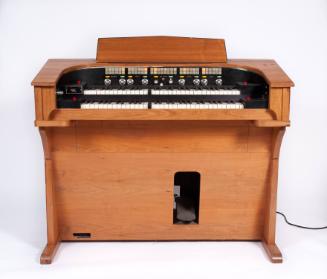
Notable compositions to have featured the NWDR Melochord include Eppler’s Klangmodelle of 1951 and renowned Hungarian composer Gyorgy Ligeti’s Glissandi of 1957. Ligeti worked only briefly at the studio in the late 1950s, soon abandoning the electronic medium in favour of acoustic sound-mass composition, of which his well-known Atmosphères of 1961 is an example. Throughout the 1950s, Bode worked as a contractor for the German Apparatewerk Bayern (AWB) company and the American Estey Organ Company, producing instruments such as the Polychord and Bode Organ. In 1954, thanks to the commercial success of the Bode Organ, he immigrated to the United States to take on the position of chief engineer, and later vice president, for Estey in Brattleboro, Vermont.
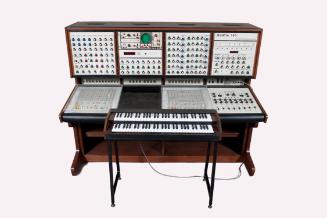
Bode’s main contribution came in the late 1950s, when he began to theorize the concept of a modular, voltage-controlled instrument that employs the newly emerging devices of solid-state technology, such as transistors. He developed prototype synthesizer and processor units, and, in 1961, compiled a paper outlining the concept. He began disseminating the idea at the Audio Engineering Society (AES) conventions of 1962 and 1964, which proved largely influential to two budding instrument designers, Robert Moog and Donald Buchla.
From 1960, Bode briefly relocated to Buffalo, New York, to work with the Wurlitzer Organ Company on their first transistorized electromechanical pianos. Throughout his later life, Bode worked for Moog Music, Bell Aerospace as a researcher on early micro-circuitry, and as a commercial composer for television advertising. Under the direction of his own company, the Bode Electronics Company (later the Bode Sound Company), which was established in 1958, and in collaboration with composer Vladimir Ussachevsky at the Columbia-Princeton Center for Electronic Music in New York, the highly influential Bode Frequency Shifter and Bode Ring Modulator, both of 1964, were produced and later licensed to Moog Music.
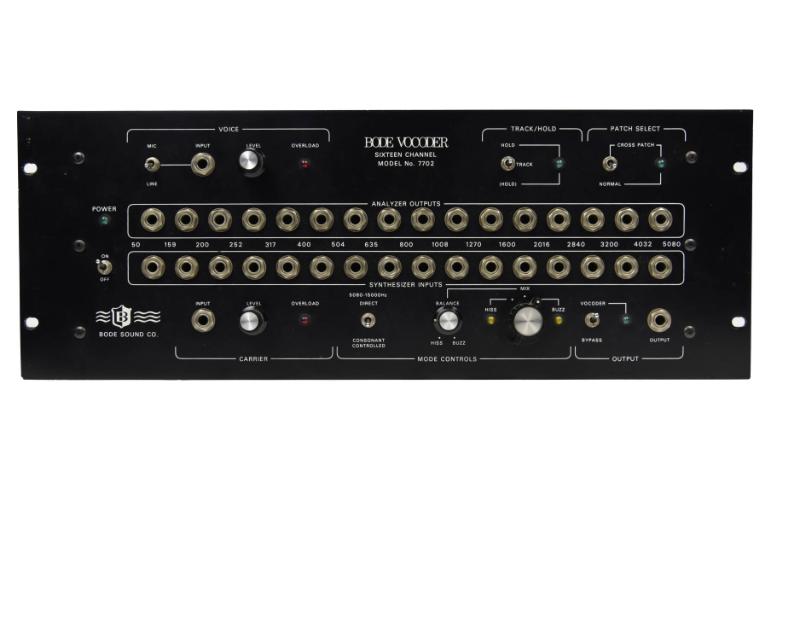
Although Bode retired in 1974, he continued to design new devices such as the Bode Vocoder of 1977 and the Bode Barberpole Phaser of 1981, the latter of which is based on the psychoacoustic principle of the Shepard tone and its perceived infinite frequency ascent.
Along with the Hammond Novachord of 1939, the Warbo Formant Organ, which was released in 1937, is effectively one of the first polyphonic synthesizers. True polyphony eluded the complex modular systems of the 1960s and did not remerge until the late 1970s with instruments such as the Sequential Circuits Prophet 5. In a similar manner to the Novachord, the Warbo Formant Organ also employs a series of filters and envelope shaping controls. ‘Warbo’ derives from a combination of the surnames Warnke and Bode, the former referring to Christian Warnke, the instrument’s financial backer.
Throughout the Second World War, Bode was tasked with conducting research on military submarine acoustics and wireless communication, settling shortly after the war’s conclusion in Neubeuern in southern Germany. In the late 1940s, he designed another electronic instrument, the Melochord, with a specially commissioned unit constructed in 1953 for the famed Nordwestdeutscher Rundfunk (NWDR) electronic music studio in Cologne, Germany. This studio served throughout the 1950s as ground zero for the development of the Elektronische Musik technique, which was spearheaded by composers such as Karlheinz Stockhausen (German, 1928 – 2007), who is widely recognized as one of the most influential figures in modern electronic music, Herbert Eimert (1897 – 1972), one of the founders of the studio, and Werner Meyer-Eppler (Belgian-German, 1913 – 1960) who, in 1949, was the first to formally theorize the basic tenet of Elektronische Musik, this being a compositional practice that employs exclusive use of electronic means.
Notable compositions to have featured the NWDR Melochord include Eppler’s Klangmodelle of 1951 and renowned Hungarian composer Gyorgy Ligeti’s Glissandi of 1957. Ligeti worked only briefly at the studio in the late 1950s, soon abandoning the electronic medium in favour of acoustic sound-mass composition, of which his well-known Atmosphères of 1961 is an example. Throughout the 1950s, Bode worked as a contractor for the German Apparatewerk Bayern (AWB) company and the American Estey Organ Company, producing instruments such as the Polychord and Bode Organ. In 1954, thanks to the commercial success of the Bode Organ, he immigrated to the United States to take on the position of chief engineer, and later vice president, for Estey in Brattleboro, Vermont.
Bode’s main contribution came in the late 1950s, when he began to theorize the concept of a modular, voltage-controlled instrument that employs the newly emerging devices of solid-state technology, such as transistors. He developed prototype synthesizer and processor units, and, in 1961, compiled a paper outlining the concept. He began disseminating the idea at the Audio Engineering Society (AES) conventions of 1962 and 1964, which proved largely influential to two budding instrument designers, Robert Moog and Donald Buchla.
From 1960, Bode briefly relocated to Buffalo, New York, to work with the Wurlitzer Organ Company on their first transistorized electromechanical pianos. Throughout his later life, Bode worked for Moog Music, Bell Aerospace as a researcher on early micro-circuitry, and as a commercial composer for television advertising. Under the direction of his own company, the Bode Electronics Company (later the Bode Sound Company), which was established in 1958, and in collaboration with composer Vladimir Ussachevsky at the Columbia-Princeton Center for Electronic Music in New York, the highly influential Bode Frequency Shifter and Bode Ring Modulator, both of 1964, were produced and later licensed to Moog Music.
Although Bode retired in 1974, he continued to design new devices such as the Bode Vocoder of 1977 and the Bode Barberpole Phaser of 1981, the latter of which is based on the psychoacoustic principle of the Shepard tone and its perceived infinite frequency ascent.
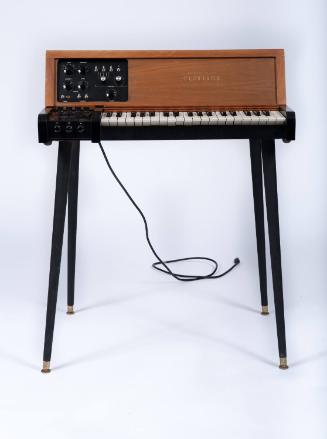

(division of Norlin Music Instruments, Ltd.)