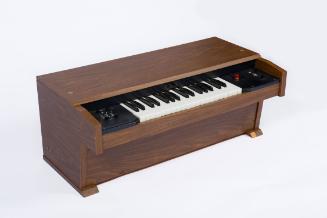
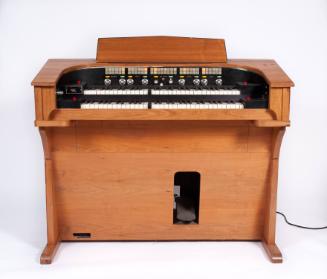
Chamberlin Instruments Company, Inc.
The story of the tape sampler originates with the California-based inventor, Harry Chamberlin (born Iowa, Wisconsin). While playing his home organ, Chamberlin conceived of an instrument that could play back pre-recorded samples of sound from a keyboard and, throughout the mid 1940s, began to develop the first of such instruments, including the Rhythmate and the MusicMaster, the former of which played back drum samples. Patented in 1949, the MusicMaster employed a design in which each pitch corresponded to an open loop strip of magnetic tape that, when pushed down by the depression of a key, contacted a tape head that enabled the sound recorded on the tape to be played back through the instrument’s internal amplification system. Original Chamberlin samples were recorded in the late 1940s and early 1950s by Chamberlin himself and were performed by members of the Lawrence Welk Orchestra in Chamberlin’s California home studio; he had had the acoustics modified in his home to accommodate the recording process. The MusicMaster was also the first instrument to employ two keyboards placed side by side, with the right hand side used for melodic phrases and the left hand side used to produce accompanying chords. Chamberlin’s innovation garnered the interest of Bill Fransen, a California-based window cleaner and former uranium prospector, who eventually began managing the sales and marketing of these instruments. The MusicMaster suffered certain technical obstacles, including producing an insuperable hum and containing a highly unreliable mechanism, however Chamberlin’s instruments remained the only ones of their kind throughout the entirety of the 1950s. This changed in 1962, however, when Fransen sought to obtain a matched set of 70 tape heads – one of the foremost problems with the Chamberlin machines was that they did not employ matching tape heads, thus producing inconsistencies in the sound – from the Bradmatics, Ltd. company of Birmingham, England. Founded in 1932 by Leslie C. Bradley, the company originally manufactured machine tools for the Second World War. Following the war, Bradley’s sons, Frank, Norman, and Leslie, all mechanical engineers, rebranded the company as Bradmatics and focused on the production of amplifiers, tape recorders, and tape replay heads. Without notifying Chamberlin, Fransen had traveled to the United Kingdom with two MusicMaster instruments, and, upon contacting the Bradley brothers, demonstrated the need for his somewhat unorthodox order by introducing them to the innovative mechanism. Fransen was acutely aware of the fact that Chamberlin was not capable of taking the technology to the level of production he believed it deserved, and the Bradleys were keen to accept Fransen’s further proposition to be involved in the development of the instrument. And, so, also unbeknownst to Chamberlin, the two came into a business arrangement wherein Bradmatics would refine the instrument, so as to make it more reliable and stable, as well as produce it on a mass scale. At the time, the Bradley brothers were not aware that Fransen was not the owner of the technology, with the knowledge that they had infringed on someone else’s intellectual property not emerging until one year later. Chamberlin also became aware of this agreement in 1963 and, in 1966, settled the dispute by selling the technology to Bradmatics for $30,000. The Mellotronics Manufacturing subsidiary (from which the more common term ‘Mellotron’ was derived) of the Eric Robinson Organization was established in London as a sales office to market the instrument. In keeping with the terms of their agreement, Chamberlin continued to manufacture his own instruments independently. Among Chamberlin’s products were the Model 10, introduced in 1948, and the Model 200, which was manufactured throughout the 1950s. Subsequent instruments, including the Models 300, 400, 500, 600, and Rhythmate were produced throughout the 1960s in a satellite factory in Ontario, California. The Riviera and M1 were both introduced in 1970, with the latter manufactured until 1981. Chamberlin instruments were never distributed or sold outside of North America. Unfortunately, Harry Chamberlin passed away in the 1980s, having never had the opportunity to witness his instrument’s renaissance.