Linn Electronics, Inc.
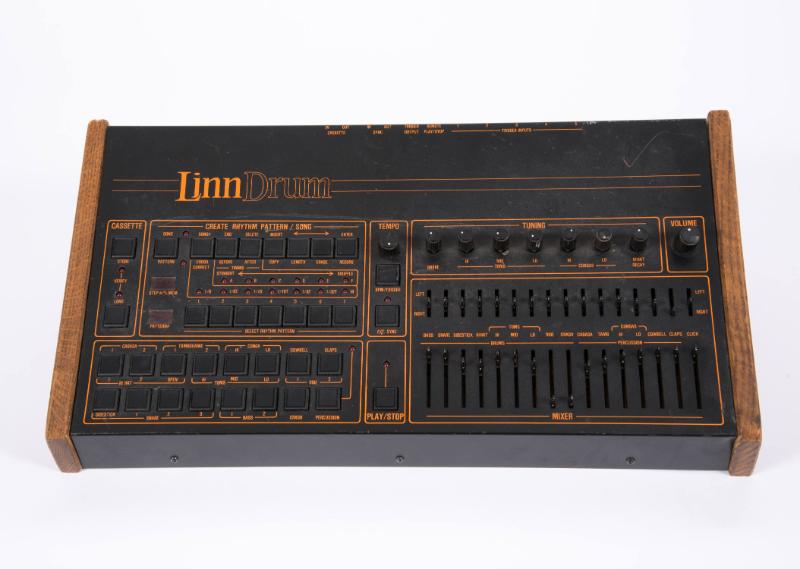
BiographyThere is little documented information about American industrial designer Roger Linn (born 1955), founder of Linn Electronics, Inc., however it is known that he spent the majority of his early career in the Los Angeles area, first entering the music industry as a guitarist and songwriter. In 1976, he worked for folk musician Leon Russell as a touring guitarist and recording engineer, and in 1979 he co-wrote Eric Clapton’s hit, “Promises”. His father, the late Robert Linn, was also an accomplished composer and professor of music at the University of Southern California. Linn’s first product, the LM-1, was seen as revolutionary when it entered the market in 1980, following a prototyping phase in 1979 that consisted in a series of electronic circuits housed within what was essentially a cardboard box. It was the first drum machine to employ digital samples of an acoustic drum kit, and was also among the first programmable drum machines. He followed the LM-1 with the LinnDrum in 1982, which incorporated expanded sounds including those of the crash and ride cymbals, as well as longer sampling lengths. In 1984, the LinnDrum was replaced by the Linn 9000, which employed the same sampling structure as in the previous instruments along with a multi-track, integrated MIDI sequencer. A fourth instrument, the LinnDrum Midistudio, was designed but not put into production before the company ceased operations in 1986. All of the company’s remaining assets were purchased by Forat Electronics. During its seven-year history, Linn Electronics seems to have had several different manufacturing facilities. Addresses listed on advertisements for the company’s instruments include 18720 Oxnard Street in Tarzana, California, 3249 Tareco Drive in Hollywood, California, and 4000 West Magnolia in Burbank, California. Following the dissolution of his company, Linn was contracted by the Akai Corporation of Japan to help design their hugely successful MPC line of drum machines and samplers, starting with the MPC60 MIDI Production Center, which was released in 1988. The updated MPC60-II followed in 1991 along with Linn’s final instrument for Akai, the MPC3000 MIDI Production Center of 1994, which featured stereo sampling in 16 bits and a 44.1 kHz sampling rate. During this time, Linn also consulted with a number of other manufacturers, including the Japan-based Roland Corporation, designers of the TR-808 and TR-909 line of drum machines. In 1997, Akai released the MPC2000, based largely on the design of the 3000. In 2001, Linn relocated to Berkeley, California and formed his current company, Roger Linn Design, which focuses primarily on guitar effects pedals and alternate performance controllers. Their most popular product is the AdrenaLinn Guitar Effects Processor series, including the AdrenaLinn II and the Black Box, a collaborative effort with M Audio, which was released in 2005. The AdrenaLinn series employs digital modeling of numerous guitar effects, and features an onboard drum machine and amplifier modeler as well. These units have been employed by a number of contemporary popular musicians, including bands Green Day and Red Hot Chili Peppers. Among Roger Linn Design’s performance controllers is the LinnStrument MIDI controller of 2014. In 2007, Linn combined forces with musical instrument manufacturer Dave Smith, co-developer of MIDI and designer of the legendary Sequential Circuits Prophet 5 synthesizer, to produce a new drum machine. Originally referred to as the LinnDrum II, the instrument was renamed the Tempest and co-released by Roger Linn Design and Dave Smith Instruments in 2011. Also in that year, Linn was the recipient of a Grammy award for Lifetime Technical Achievement, an honour previously bestowed upon the likes of Thomas Edison and Leo Fender. Linn is also a member of the Berkeley-based ‘Dead President’s Society’, which also includes the late Max Mathews who is regarded as the father of computer music and namesake to the max/MSP programming environment, Tom Oberheim of Oberheim Electronics, Donald Buchla of Buchla & Associates, Keith McMillen of Keith McMillen Instruments, Perrin Meyer of the Meyer Sound pro-audio company, Dave Smith of Dave Smith Instruments and Sequential Circuits, John Chowning who is regarded as the inventor of the FM synthesis algorithm Yamaha employed in their hugely successful DX7 digital synthesizer, and the late David Wessel who was the director and co-founder of the University of California at Berkeley’s Center for New Music and Audio Technologies (CNMAT).





(division of Norlin Music Instruments, Ltd.)