EN / FR
Skip to main content

Moog Liberation

Not available for use in Recording Studios
On exhibit
On exhibit
Artifact TypeSynthesizer
Manufacturer Moog Music, Inc. (division of Norlin Music Instruments, Ltd.)
Manufacturer LocationUSA
Date1980
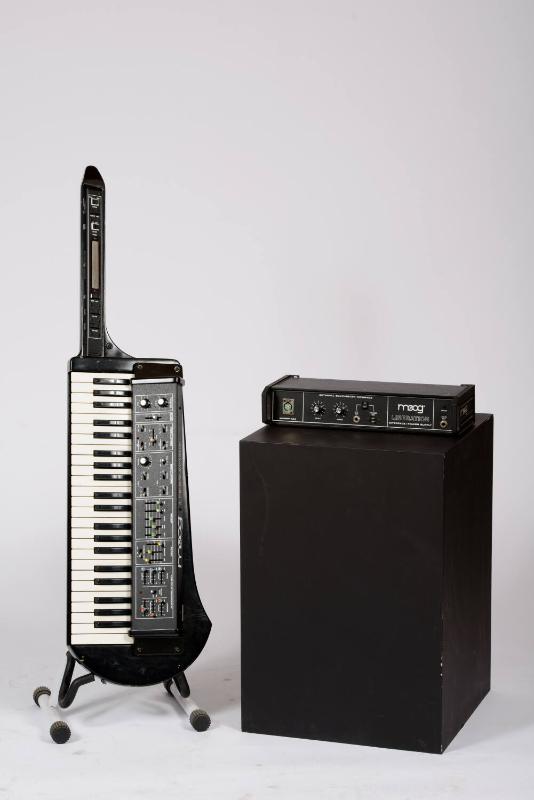
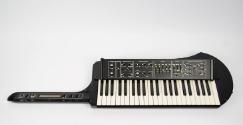
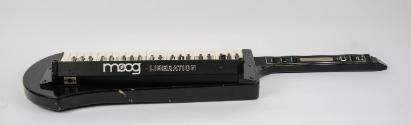
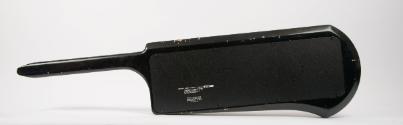
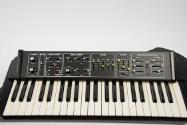
A synth in the shape of a guitar, the Liberation was known affectionately as a “keytar” and was designed as an alternative way to hold the standard keyboard. Used for the most part during live performances, the keytar was popularized by early-’80s New Wave and synth-pop bands like Devo and The Human League. Forever associated with the era, the instrument was also used by Herbie Hancock and Miami Vice theme composer Jan Hammer. 
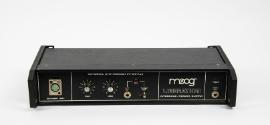
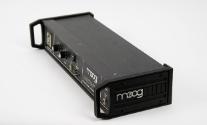
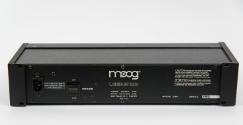
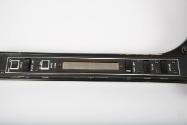
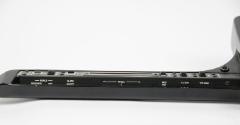
Operation/FunctionThis particular artifact is a combination monophonic lead synthesizer and ten-voice polyphonic fixed organ section, with a 44-note (three octaves plus eight notes) compass keyboard. The filter and envelope controls of the instrument are paraphonic. The lead synthesizer contains two voltage-controlled oscillators per voice: oscillator A ranges between 32’, 16’, and 8’ (labeled as -2, -1, and 0, respectively) with sawtooth, triangle, and square waveforms; oscillator B ranges between 16’, 8’, and 4’ (labeled -1, 0, and +1, respectively) also with sawtooth, triangle, and square waveforms. The instrument also contains one 24 dB/octave low-pass voltage-controlled filter (VCF) with cutoff, emphasis, and enveloped amount, and two voltage-controlled amplifiers (VCA, labeled ‘contour generator’) with attack, decay/release, and sustain for both the filter and the overall instrument output. Also on board are master tune knobs for both the synthesizer and poly sections, a glide/portamento function, a ring modulator, and a five-stage mixer for balancing oscillator 1, oscillator 2, noise, ring modulation, and poly section inputs. The extended “neck” component of the instrument contains a ribbon controller and several wheels for pitch bend and modulation. The instrument also accepts external CV/gate control through its external, rackmount power supply. The instrument is connected to the power supply via a cable.Cultural SignificanceAlthough the modern keytar was developed with functional intentions in mind, its legacy remains primarily as a novelty. Moog Music is perhaps the most well known synthesizer manufacturer, with the term ‘Moog’ often assigned in layman vernacular to any synthesizer, regardless of the actual manufacturer.Technological SignificanceThe concept of the keytar could arguably be traced back to the development of the Orphica, an acoustic piano designed by the Viennese instrument builder, Carl Leopold Röllig in the late eighteenth and early nineteenth centuries. The Orphica employs strings, a frame, and an early piano action, however, unlike most stringed keyboard instruments, its frame and strings extend slightly beyond the instrument’s wooden soundboard. In this way, it could be viewed as being similar to the design of the guitar, which also extends its strings beyond the sounding body of the instrument. Although the instrument was designed to be small and portable, it was not, however, meant to be held in the same manner as a guitar; doing so would render its action ineffective. As with other portable acoustic keyboard instruments such as the virginal, it was to be sat on a tabletop. Moreover, the extended strings of the instrument were not placed as such so as to be operated directly by one of the player’s hands; again, as with all other keyboard instruments of the time, the player’s hands were, for the most part, positioned exclusively on the keyboard. Rather, the shape of the Orphica was inspired by that of the lyre, the instrument performed by the mythological character, Orpheus, to charm gods, humans, and animals. That being said, the first real instantiation of the keytar is often considered to be the Weltmeister Basset. The Basset, which was often also referred to as the “Combo Bass”, was in production between 1963 and 1969 and was designed to be an electromechanical bass instrument, similar in concept to the Fender Rhodes Piano Bass of 1959 – 1964. Like the Piano Bass, the Basset employed a pickup assembly and mechanical action based on its predecessor, the Weltmeister Claviset. It was designed to be more portable than either the Claviset or Piano Bass, however, and could be placed across the player’s lap, held in place by a guitar strap while standing. As with the Orphica, the instrument’s strings did extend beyond its body, producing a shape that followed that of the harp (term used to refer to an instrument’s series of tone generators, typically strings, which emulate the curve of a harp in their varying lengths), not unlike the bent side of a piano or harpsichord. As such, the “neck” of later keytars could be seen to have emulated the external design of this feature. The Liberation was accompanied throughout the 1970s and 1980s by instruments such as the Hillwood RockeyBoard of 1977, the PMS Syntar of 1979, the Davis Clavitar of 1980, and the Royalex Probe of the early 1980s, the keytar of choice for film composer Jan Hammer. Another notable keytar is the Yamaha SHS-10 of 1987, which was referred to by its manufacturer not as a keytar but as a “sholkey”, short for “shoulder keyboard”.Users/PerformersThere is no documented usage of this instrument on recordings from the era, however numerous groups have used it in live performance since its initial release. Notable players of the Liberation include Tom Coster of Santana, Devo, multi-instrumentalist Herbie Hancock, The Moog Cookbook, Saga, Stereolab, The Human League, contemporary Canadian electronic musician Bryce Kushnier of Winnipeg, and famed French electronic musician and synthesist Jean Michel Jarre.
Object number2010.02.03.1-2
Photo credit: Don Kennedy
Moog Music, Inc.
1973
Available for use in Recording Studios
On View: Not currently on exhibit
isVirtual:
Photo credit: Meghan MacKrous, courtesy of the National Music Centre
R.A. Moog, Inc.
1970
Available for use in Recording Studios
On View: Not currently on exhibit
isVirtual:
Photo credit: Don Kennedy
Moog Music, Inc.
c. 1978
Not available for use in Recording Studios
On View: On exhibit
isVirtual:
Photo credit: Don Kennedy
Maurice Louis Eugène Martenot
1975
Available for use in Recording Studios
On View: Not currently on exhibit
isVirtual:
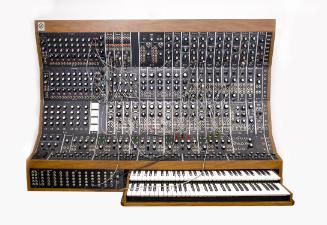
Photo credit: Don Kennedy
R.A. Moog Inc./ Moog Music Inc. (division of Norlin Music Instruments, Ltd.)
c. 1973
Available for use in Recording Studios
On View: Not currently on exhibit
isVirtual:
Photo credit: Meghan MacKrous, courtesy of the National Music Centre
Kurzweil Music Systems
1985
Available for use in Recording Studios
On View: Not currently on exhibit
isVirtual:
Photo credit: Meghan MacKrous, courtesy of the National Music Centre
Moog Music, Inc.
1976
Available for use in Recording Studios
On View: Not currently on exhibit
isVirtual:
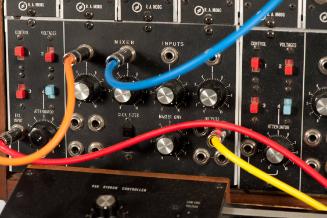
Photo credit: Don Kennedy
Moog Music, Inc.
1969
Not available for use in Recording Studios
On View: On exhibit
isVirtual:
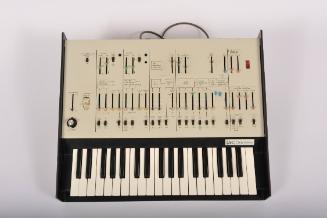
Photo credit: Don Kennedy
ARP Instruments, Inc.
1972
Available for use in Recording Studios
On View: Not currently on exhibit
isVirtual:
Photo credit: Don Kennedy
Linn Electronics, Inc.
1982
Not available for use in Recording Studios
On View: On exhibit
isVirtual:
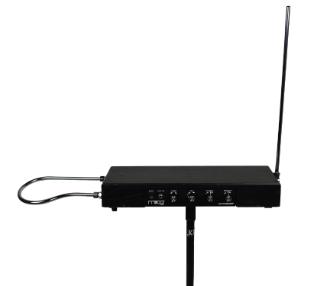
Photo credit: Meghan MacKrous, courtesy of the National Music Centre
Moog Music, Inc.
2001
Available for use in Recording Studios
On View: Not currently on exhibit
isVirtual:
Photo credit: Don Kennedy
Ken Freeman
c. 1975
Available for use in Recording Studios
On View: Not currently on exhibit
isVirtual:
Back