EN / FR
Skip to main content

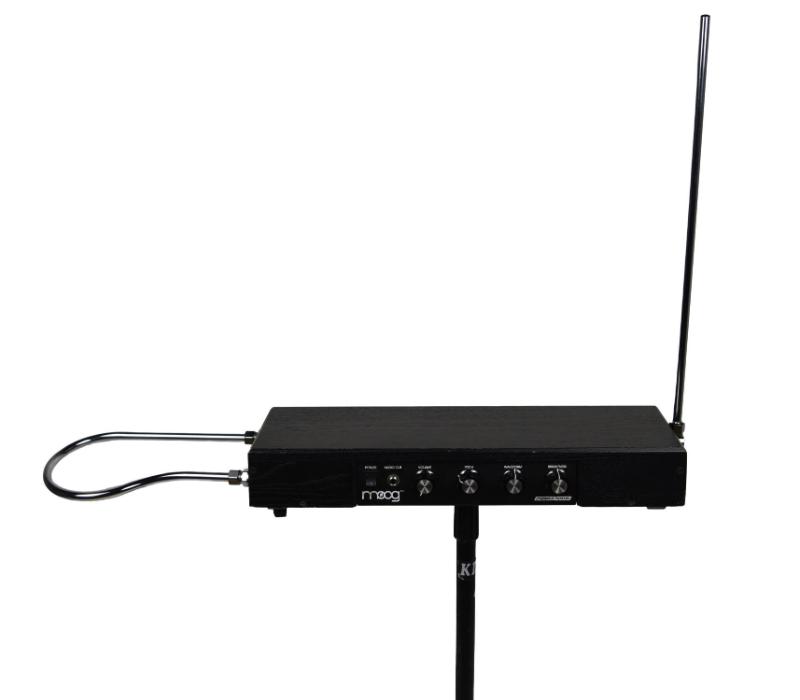
Moog Etherwave Theremin

Available for use in Recording Studios
Not currently on exhibit
Artifact TypeTheremin
Manufacturer Moog Music, Inc. (division of Norlin Music Instruments, Ltd.)
Manufacturer LocationAsheville, North Carolina, USA
Date2001

Moog Music began producing their Etherwave Theremin to honour the instrument’s importance to their company’s namesake, Dr. Robert Moog. Moog’s pioneering work in electronic music could be traced to a childhood fascination with the Theremin. It is the first and only instrument of its kind to be played without any physical contact from the performer, instead, it is controlled by hovering one’s hands over radio antennae. Although perhaps not as experimental as his contemporaries, Robert Moog was one of the most significant contributors to synthesizer design; he set the standards that were used by nearly every other manufacturer that would follow.

Operation/FunctionThis instrument consists of a black wooden enclosure, two nickel-plated 3/8” brass tube antennae (referred to as the pitch control rod and the volume control loop), single-sweep variable control knobs for ‘Volume’, ‘Pitch’, ‘Waveform’, and ‘Brightness’, a 1/4" audio output for connection to an external amplification system, and a power rocker switch. Frequency range spans approximately five octaves. The front of the instrument is also fitted with an adapter for mounting onto a standard microphone stand.Cultural SignificanceAlthough the Theremin remains a relatively obscure electronic instrument, its cultural impact cannot be understated. That being said, it never became a highly commercial success despite attaining an initial flurry of interest among the general public. It was initially marketed as an instrument for the “everyman”, so to speak, in that simply standing and moving one’s arms around haphazardly could produce new and unusual tones. This claim of ease, of course, did not prove to be the case, as the majority of aspiring players who lacked any formal musical training – as well as a number of those who did have extensive training in an acoustic instrument – found the instrument exceedingly difficult to work with on account of its non-physical performance technique. That being said, the Theremin has always held a very important place in the history of contemporary Classical music in that it came exactly at a time when avant-garde and early experimental composers, such as Edgar Varèse and Olivier Messiaen, had felt the acoustic realm to be nearly exhausted, and were yearning for new timbres and articulations. The Theremin remains one of the most critically regarded musical instruments, precisely due to its unique method of playing. Still, to this day, it stands as the first and only musical instrument that requires zero physical contact from the player in order to generate tones. It has been referenced numerous times in popular culture, including its somewhat niche usage in popular music. Although it remains the case that only a handful of performers have ever truly mastered the instrument throughout its nearly century-old history, it still stands as a sort of cult addition to the musical landscape, with a number of amateur Theremin orchestras emerging within the last few decades. It is regarded as one of the most groundbreaking instruments in the history of musical instrument design, and is still lauded for its unparalleled and unmistakable interface.Technological SignificanceThe Theremin stands, still today, as one of the most important instruments in the history of electronic music. It is unsurpassed in its technological innovation, providing the groundwork for a series of electronic musical instruments that would emerge throughout the twentieth century employing new and alternative methods of interaction. Although its internal electronic mechanisms are, in fact, somewhat simplistic, the brilliance and uniqueness of its exterior operation are what have continued to render the instrument such an iconic musical object for nearly a century. Technologically, it also attests to the geist, so to speak, of an aesthetic era – this being the modernist decades of the early twentieth century – where the general attitude was bent towards new and progressive ideas. The first Theremins, which were produced by the Radio Corporation of America (RCA) predated the advent of the transistor and employed vacuum tube technology. A vacuum tube is a device that directs the flow of electric current through a vacuum within a sealed container. They were used as a fundamental component of electronic technology throughout the first half of the twentieth century, until they were replaced by solid-state transistors and related devices in the 1950s and 1960s. Solid-state technology was far smaller, lighter, more reliable, more durable, and less expensive than vacuum tube technology. It has been said that Theremin first conceived of the idea for the instrument while experimenting with radio frequency oscillating circuits at the Technical Institute in St. Petersburg, where he was employed throughout the mid 1920s. He became fascinated by the notion that the body moving within an electromagnetic field could affect the frequency of the circuit without requiring any physical interaction, likening the experience of control to that of an orchestral conductor. It is important to note that, despite popular belief, the Theremin was not by any means the first electronic musical instrument. It was, indeed, certainly among the first commercially-minded electronic instruments, however a number of other experiments in the electronic generation and amplification of sound preceded it. Most notable among these is Thaddeus Cahill’s Telharmonium, which was developed in 1897 and is often considered to be the first precursor to the electronic organ given its use of tonewheels and additive synthesis. That being said, the Theremin does remain alone in its unique design, with no other instrument created either before or after replicating the extent to which the instrument is performed without the physical contact of the player, and with few other instruments employing the body’s natural capacitance (its ability to hold an electrical charge) as an element of intended design. That being said, a number of instruments emerged in the decades that followed that explored alternatives to the conventional keyboard interface, which quickly became (and has remained) the standard in electronic instrument design. Notable among these are the Ondes Martenot, which was invented by French cellist and radio telegrapher Maurice Martenot in 1928, and employs a continuous ring controller that also relies on the player’s capacitance in order to generate tones; and, the Trautonium, which was co-developed by Friedrich Trautwein and Oskar Sala between 1929 and 1931, and employs the contact between resistance wires and a metal plate in order to generate tones. More recent designs include several innovations by American synthesizer builder, Donald Buchla (born 1937 in South Gate, California), including the iconic touch-plates that adorn many of his modular systems, in which each “key” is individually tunable. In the 1990s, Buchla also designed several controllers, including the Thunder and Lightning, which employ interfaces that are more gesture variable. It is interesting to note that most of these instruments and controllers, which provide gradual movement between pitches, are, as a result of their flexible interfaces, microtonal, meaning that they can easily isolate frequencies in between those defined within the equal-tempered twelve-tone octaves of the piano. Microtonality was a particularly gripping concept during the twentieth century, with experimentalist pioneers such as the American composers and instrument builders Harry Partch (1901 – 1974, born in Oakland, California) and Lou Harrison (1917 – 2003, born in Portland, Oregon) designing complete musical systems and orchestras based on an expanded approach to frequency, often inspired by non-Western tuning systems. A number of more modern instruments have been designed with similar controls, including sensors and continuous ribbons, so as to produce more fluid articulations than those offered by the traditional chromatic keyboard. In the early 1950s, famed American musician and inventor, Raymond Scott, designed the Clavivox, which is essentially a keyboard-controlled Theremin that incorporated a Theremin module built by Robert Moog, then just a budding engineer.Users/PerformersThe most notable user of the Theremin is, arguably, Clara Rockmore (Lithuanian, 1911 – 1998). Although Leon Theremin himself also performed quite frequently on the instrument, Rockmore’s performances and recordings have remained the most widely recognized and referenced historical examples. Other notable performers of the Theremin include Samuel Hoffman (American, 1903 – 1967), who performed the instrument on the soundtracks to the films It Came From Outer Space (1953) and The Day the Earth Stood Still (1951), in addition to performances on recordings by musicians such as Sun Ra and Captain Beefheart and his Magic Band; famed British conductor Leopold Stokowski (1882 – 1977), who worked with the Cincinnati Symphony Orchestra, the Philadelphia Orchestra, the NBC Symphony Orchestra, and the Hollywood Bowl Orchestra, in addition to founding the New York City Symphony Orchestra and arranging the music for the Disney classic, Fantasia; and, the highly prolific performer, Pamelia Kurstin (American, born 1976), who has recorded with the likes of David Byrne, Yoko Ono, and Béla Fleck, released solo recordings on John Zorn’s Tzadik label, and become well known for her “walking bass” performance technique, inspired by her previous training on upright bass. Perhaps the most recognizable performer of the Etherwave Theremin is Dorit Chrysler, an Austrian-born and New York-based musician who co-founded the New York Theremin Society and currently heads the Kid Cool Theremin School.
Object number2004.04.01
Photo credit: Don Kennedy
ARP Instruments, Inc.
1972
Available for use in Recording Studios
On View: Not currently on exhibit
isVirtual:
Photo credit: Don Kennedy
Radio-Victor Corporation of America (RCA)
1929
Not available for use in Recording Studios
On View: On exhibit
isVirtual:
Photo credit: Don Kennedy
Moog Music, Inc.
1973
Available for use in Recording Studios
On View: Not currently on exhibit
isVirtual:
Photo credit: Meghan MacKrous, courtesy of the National Music Centre
R.A. Moog, Inc.
1970
Available for use in Recording Studios
On View: Not currently on exhibit
isVirtual:
Photo credit: Don Kennedy
Electronic Music Studios (London) Limited
1971
Available for use in Recording Studios
On View: Not currently on exhibit
isVirtual:
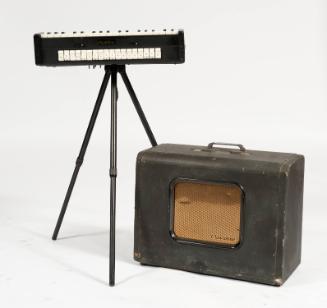
Photo credit: Don Kennedy
Selmer (UK)
1957
Available for use in Recording Studios
On View: Not currently on exhibit
isVirtual:
Photo credit: Don Kennedy
Hammond Organ Company
1957
Not available for use in Recording Studios
On View: Not currently on exhibit
isVirtual:
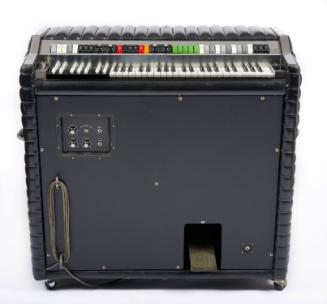
Photo credit: Don Kennedy
Kustom
1969
Available for use in Recording Studios
On View: Not currently on exhibit
isVirtual:
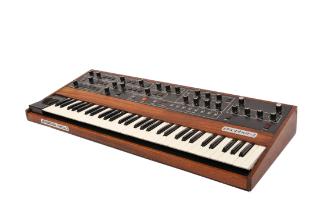
Photo credit: Don Kennedy
Sequential Circuits Inc.
c. 1978
Available for use in Recording Studios
On View: Not currently on exhibit
isVirtual:
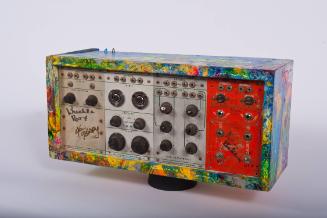
Photo credit: Don Kennedy
Donald Buchla
c. 1966
Not available for use in Recording Studios
On View: On exhibit
isVirtual:
Photo credit: Don Kennedy
Linn Electronics, Inc.
c. 1982
Available for use in Recording Studios
On View: Not currently on exhibit
isVirtual:
Photo credit: Don Kennedy
Sequential Circuits Inc.
c. 1981
Available for use in Recording Studios
On View: Not currently on exhibit
isVirtual:
Back