EN / FR
Skip to main content

Polymoog Synthesizer

Available for use in Recording Studios
Not currently on exhibit
Artifact TypeSynthesizer
Manufacturer Moog Music, Inc. (division of Norlin Music Instruments, Ltd.)
Manufacturer LocationWilliamsville/Buffalo, New York, USA, North America
Date1976

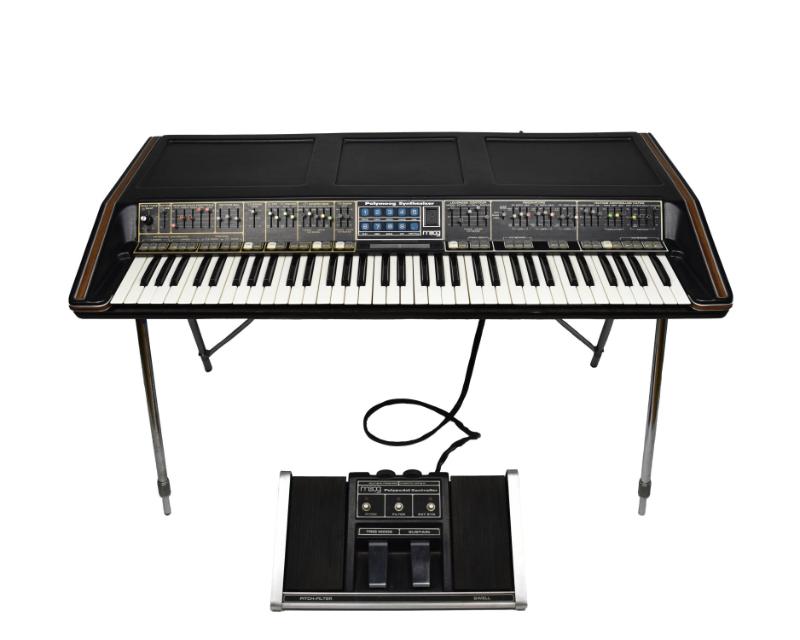
The Polymoog is an analog, polyphonic synthesizer which began as a component of the Moog Constellation. The Moog Constellation was envisioned as a large integrated ensemble system consisting of a polyphonic synthesizer (Apollo), a monophonic synthesizer (Lyra), and a foot operated bass synthesizer (Taurus). The Taurus and Lyra went on to become standalone units, and the Apollo was reconfigured and released as the Polymoog keyboard model 203a. The Polymoog had full polyphony, which was not fully incorporated into synthesizers until well into the 1980s. Additionally, it had a unique ribbon controller, replacing the pitch wheels of earlier instruments, a weighted keyboard with velocity sensitivity, and built-in pre-sets. It also came with a set of polypedals, allowing for foot control of filter and volume. Primarily designed by David Luce, Moog’s Director of Engineering, the Polymoog had very little commercial success; it came with a hefty price tag and had stability and reliability issues, requiring regular servicing. Moog ceased its production in 1980 but despite its commercial disappointment a number of well-known artists are known to have used the Polymoog, including Rick Wakeman, Patrick Moraz, Kraftwerk, Devo, Prince, Herbie Hancock, Gary Newman, Yes, and Rush.
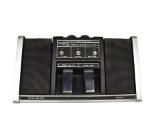
Operation/FunctionThis particular artifact is an analog, polyphonic synthesizer that contains two sets of twelve voltage-controlled oscillators capable of sawtooth and pulse/square waveforms, pulse-width modulation, both low-pass and high-pass filters, a three-band equalizer (EQ), sample-and-hold functions, an external CV/gate input, multiple LFO controls, and a 71-note (six octaves) chromatic, weighted plastic keyboard. The Pratt & Read keyboard is capable of velocity sensitivity and is fully polyphonic in all of the preset modes. The instrument features eight preset modes (Strings, Piano, Organ, Harpsichord, Funk, Clavi, Vibes, and Brass) as well as a ninth Var (Variation) mode that allows for a number of parameters to be altered on any of the preset sounds. It is accompanied by a set of Polypedals, which allows for foot control of filter and volume parameters.Cultural SignificanceAlthough the Polymoog is not typically regarded as being among the more successful polyphonic instruments of the era – this title is usually given to products such as the Yamaha CS80 and Sequential Circuits Prophet 5 – it holds an important place historically in that it was one of the first to offer such unique and innovative features at a time when the majority of synthesizers were monophonic. Historically, Robert Moog is perhaps the most notable synthesizer manufacturer referenced in popular culture; so much so that the name ‘Moog’ is often used in layman vernacular to describe the term ‘synthesizer’, regardless of the actual manufacturer, not unlike brand names ‘Kleenex’ and ‘Q-Tip’. Although Moog instruments were not the choice of all musicians – with many experimentally-minded composers opting for the more flexible Buchla systems and most European composers relying on the readily-available EMS systems emerging out of London – they were by far the most commercially successful, permeating popular music in a manner that few other manufacturers experienced throughout the 1970s.Technological SignificanceThe synthesizer is arguably one of, if not the most technologically significant contributions to the course of electronic music. Although earlier electronic instruments such as the Theremin and Ondes Martenot offered new and unique ways of articulating sound, their sonic template was, for the most part, quite limited, capable of producing only a few distinct timbres. The modern synthesizer, on the other hand, was viewed as an integrated electronic orchestra, as it were, allowing the user to sculpt a wide and varied array of tones and gestures. What’s more, it allowed the user to modify their sounds in real time, seemingly without the sorts of physical limitations imposed on acoustic instruments. Of course, each instrument did come with its own characteristic tonal qualities and control limitations, however the wealth of opportunity inherent in the ability to manipulate and define nearly every parameter of sound structure solidified the synthesizer’s place as one of the most powerful musical innovations of the twentieth century. The concept of modular design was initially quite desirable to professional and studio musicians in that it allowed one to more or less completely customize their instrument and modify its functions as desired. The modular nature of early synthesizers also meant that an array of patches, or defined sounds that could be altered in real time, were possible, offering the musician a high degree of flexibility and the opportunity to develop their own performance technique and signature tone. Analog modular synthesis was quite prevalent as a music-making practice in academic institutions and private studios throughout the late 1960s and into the early 1980s, both in Europe and throughout North America. Electronic instruments of this era were entirely transistor-based, with solid-state devices such as the transistor representing the next generation in technology following the vacuum tube, which was used extensively throughout the first half of the twentieth century. Solid-state technology was far smaller, lighter, more reliable, more durable, and less expensive than vacuum tube technology. This technology developed even further in around 1970 into the form of integrated circuits (ICs), which house the many discrete components of transistor-based circuits within a single silicon chip, as they are often called. Integrated circuits were significantly smaller and less expensive to manufacture than the circuits from which they derived. Although not all analog synthesizers designed in the very early 1970s employed integrated circuitry, their use was mostly standardized by the late 1970s with the inclusion of the first affordable eight-bit microprocessors, such as the Zilog Z80, that emerged mid-decade. As a result, integrated circuits adapted to incorporate more sophisticated digital components. With the advent of integrated circuits, synthesizers increasingly began to adopt the smaller, more compact aesthetic exhibited in the performance-oriented instruments of the early 1970s, especially that of the revered Minimoog. The once popular modular approach gave way to more streamlined designs that, while still offering users the ability to control numerous aspects of the instrument’s tone and gesture, limited the way in which the instrument could be operated. Although the modular synthesizer was highly regarded for its flexibility, it was also criticized for being largely unintuitive and cumbersome in its patching schemes. Despite its lack of commercial success, the Polymoog offered the promise of many new and sophisticated innovations for the time, including full polyphony, a unique ribbon controller to replace the pitch bend wheels of earlier instruments, a weighted keyboard with velocity sensitivity, and built-in presets. It also incorporated a ladder-style filter that had come to be associated with Moog products. The instrument suffered many technical drawbacks, however, including instability and reliability issues, resulting in regular service requirements. Although its divide-down circuitry allowed users access to a full polyphonic keyboard – a feat which was not incorporated into synthesizers until well into the 1980s – it resulted in a paraphonic structure among its filters and amplifiers, meaning that when the instrument was in its variable mode, the addition of subsequent voice was not accompanied by independent shape and articulation. As such, the Polymoog is not always regarded as being fully polyphonic in the traditional sense of the term, which requires such independent control between each of the instrument’s available voices. Visually, the Polymoog was also unique, with a flat top allowing users to place other instruments, such as a Minimoog, on top, and a sleek, futuristic aesthetic. Ultimately, timing plagued any future success of the instrument, with Yamaha releasing the far more powerful GX1 in 1975 and CS80 in 1976, with the latter incorporating two self-contained synthesizers for each of its eight voices, as well as polyphonic aftertouch, polyphonic ring modulation, chorus and vibrato functions, twin envelopes and resonant filters, and a wooden keyboard. In 1978, Sequential Circuits effectively obliterated the polyphonic market with the introduction of the groundbreaking Prophet 5 digital-analog hybrid. Moog was not able to reenter the competition until 1981 with the production of the Memorymoog, ceasing production on the Polymoog in 1980.Users/PerformersA number of notable musicians used this instrument throughout the mid 1970s, prior to the release of competitors such as the Yamaha CS80 and Sequential Circuits Prophet 5, including prog rock legends Rick Wakeman and Patrick Moraz, Kraftwerk, Devo, Prince, and Herbie Hancock. Perhaps the most active user of the Polymoog, however, was English new wave musician Gary Numan, who was particularly fond of the Vox Humana preset on the later Polymoog Keyboard.
Object number2002.05.33
Photo credit: Don Kennedy
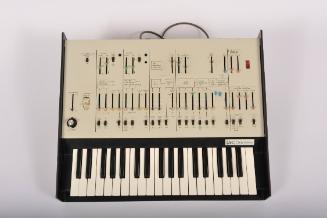
ARP Instruments, Inc.
1972
Available for use in Recording Studios
On View: Not currently on exhibit
isVirtual:
Photo credit: Don Kennedy
Sequential Circuits Inc.
c. 1981
Available for use in Recording Studios
On View: Not currently on exhibit
isVirtual:
Photo credit: Meghan MacKrous, courtesy of the National Music Centre
CBS Musical Instruments
c. 1980
Available for use in Recording Studios
On View: Not currently on exhibit
isVirtual:
Photo credit: Don Kennedy
Hohner Musikinstrumente GmbH & Co. KG
c. 1966
Available for use in Recording Studios
On View: Not currently on exhibit
isVirtual:
Photo credit: Don Kennedy
Raymond Scott Enterprises/Manhattan Research
1957
Not available for use in Recording Studios
On View: Not currently on exhibit
isVirtual:
Photo credit: Don Kennedy
Electronic Music Studios (London) Limited
1972
Available for use in Recording Studios
On View: Not currently on exhibit
isVirtual:
Photo credit: Don Kennedy
Optigan Corporation (of Mattel) / Opsonar (of Miner Industries)
c. 1973
Available for use in Recording Studios
On View: Not currently on exhibit
isVirtual:
Photo credit: Don Kennedy
Maurice Louis Eugène Martenot
1975
Available for use in Recording Studios
On View: Not currently on exhibit
isVirtual:
Photo credit: Don Kennedy
Buchla & Associates
1999
Not available for use in Recording Studios
On View: On exhibit
isVirtual:
Photo credit: Don Kennedy
Hammond Organ Company
1957
Not available for use in Recording Studios
On View: Not currently on exhibit
isVirtual:
Photo credit: Don Kennedy
1969
Available for use in Recording Studios
On View: On exhibit
isVirtual:
Photo credit: Don Kennedy
CBS Musical Instruments
1966
Available for use in Recording Studios
On View: Not currently on exhibit
isVirtual:
Back