EN / FR
Skip to main content

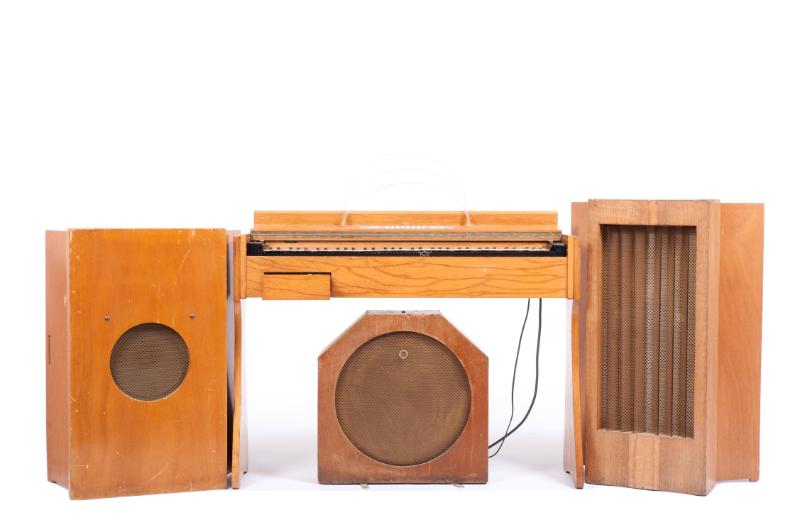
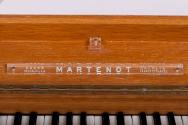
ondes Martenot Synthesizer

Available for use in Recording Studios
Not currently on exhibit
Artifact TypeSynthesizer
Manufacturer Maurice Louis Eugène Martenot French, 1898 - 1980
Manufacturer LocationFrance
Date1975
Kissing cousin to the more famous Theremin, the ondes Martenot was immensely popular upon its release in 1928. Far easier to play than the Theremin, but producing a very similar sound, it was immediately incorporated into the Western art music of the time by composers such as Olivier Messiaen and Edgar Varèse.  More recently, it’s been used by Radiohead guitarist Jonny Greenwood, who has featured the instrument on each of the group’s albums since 2000’s Kid A.
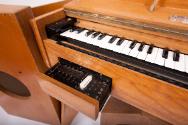
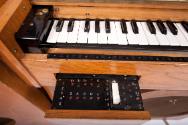
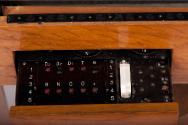
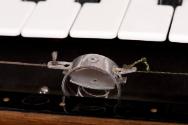
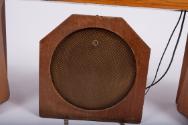
Operation/FunctionThis particular artifact contains a six-octave, chromatic mechanical keyboard and associated ribbon controller with “dummy” keyboard underneath. A control box located on the left side of the instrument contains seven filters for varying the overall timbre, as well as two sliders for varying the intensity of the ‘8’ and ‘g’ filter effects. A white glass bar is depressed to vary both the volume and articulation of the tones produced by either the keyboard or ribbon controller. A built-in pink noise generator is also included, as well as an associated switch for altering between the keyboard and ribbon controller. Unlike the earlier valve-based models upon which this artifact is based, this instrument is entirely transistor-based.Cultural SignificanceThe ondes Martenot remains a relatively obscure electronic instrument, with its technological impact certainly having more far-reaching effects than its cultural contributions. In the history of electronic musical instruments, it is typically the Theremin that is viewed as having helped initiate electronic instruments into popular musical repertoire, with its use on numerous film and television scores. Although the ondes Martenot has certainly permeated both the Classical and popular realms, it is often mistaken for other instruments, including the Theremin. Throughout the mid twentieth century, the instrument was highly influential in modernist and avant-garde Classical music, offering composers a unique and new timbre that was markedly easier to perform with than the Theremin. More recently, the ondes Martenot has held its place in the recordings of groups such as Radiohead, and in the performance works of ondist Thomas Bloch. Unlike most other early electronic instruments, the ondes Martenot has the ability to sound both otherworldly and familiar, making it particularly appealing for those desiring the flexibility of an electronic instrument along with the expressivity of an acoustic instrument.Technological SignificanceThe ondes Martenot stands as among the most unique electronic musical instruments, primarily with respect to the innovative character of its ribbon controller interface. Although its internal electronic mechanisms are, in fact, somewhat simplistic, the brilliance and uniqueness of its exterior operation are what have continued to render the instrument such a curious musical object for nearly a century. Technologically, the ondes Martenot does generally attest to the geist, so to speak, of an aesthetic era – this being the modernist decades of the early twentieth century – where the general attitude was bent towards new and progressive ideas. That being said, the ondes Martenot is unique among its contemporaries in that its design concerns the integration of human interaction and technological capability, rather than focusing squarely on the latter. By combining a newly emerging application – namely, vacuum tube heterodyning – within the still largely foreign realm of electronic music and the familiarity of an acoustic-inspired interface and approach to articulation, the ondes Martenot was able to differentiate itself from the decidedly mechanistic tenets prescribed in the era’s defining aesthetic and theoretical works such as Luigi Rossolo’s seminal The Art of Noises (1913). The instrument was particularly lauded for its ability to take on acoustic timbres, such as that of the human voice or orchestral stringed instrument, while still offering a quality of “otherness”, so to speak, in its character. For his part, Martenot was exceedingly interested in connecting technology and physiology, allowing for humans to feel a closer connection to the machines with which they interact. The ondes Martenot’s ability to produce incredibly subtle variations in dynamics, vibrato, portamento, and intonation is truly unparalleled among even modern electronic instruments, with most relying far more heavily on the keyboard interface or more complex approaches, as in the touch-less antennae of the Theremin, that require a level of musicianship somewhat beyond that of the average musician. Of course, the ondes Martenot was only one among several different instruments that make up the earliest contributions to electronic music. Most notable among its contemporaries are Thaddeus Cahill’s Telharmonium, which was developed in 1897 and is often considered to be the first precursor to the electronic organ given its use of tonewheels and additive synthesis; the Theremin, which was invented by Russian physicist Leon Theremin in 1919, and employs a highly unique though relatively unintuitive interface that does not require physical interaction between the player and the instrument’s two capacitance-sensitive antennae; and, the Trautonium, which was co-developed by Friedrich Trautwein and Oskar Sala between 1929 and 1931, and employs the contact between resistance wires and a metal plate in order to generate tones. The latter two instruments as well as the ondes Martenot are representative of the earliest electronic musical instruments to explore alternatives to the now-standardized keyboard. More recent designs that have followed in this trend include several innovations by American synthesizer builder, Donald Buchla (born 1937 in South Gate, California), including the iconic touch-plates that adorn many of his modular systems, in which each “key” is individually tunable. In the 1990s, Buchla also designed several controllers, including the Thunder and Lightning, which employ interfaces that are more gesture variable. As with Martenot, Buchla was also interested in merging interactivity between emerging technologies and physiological concerns. It is interesting to note that most of these instruments and controllers, including the ondes Martenot, which provide gradual movement between pitches, are, as a result of their flexible interfaces, mictrotonal, meaning that they can easily isolate frequencies in between those defined within the equal-tempered twelve-tone octaves of the piano. Microtonality was a particularly gripping concept during the twentieth century, with experimentalist pioneers such as the American composers and instrument builders Harry Partch (1901 – 1974, born in Oakland, California) and Lou Harrison (1917 – 2003, born in Portland, Oregon) designing complete musical systems and orchestras based on an expanded approach to frequency, often inspired by non-Western tuning systems. The ribbon controller featured in the ondes Martenot has also served as the inspiration for more modern ribbon controllers seen in the synthesizers of the 1970s, such as those in the Moog modular and the Yamaha CS80. In these cases, a piece of felt or vinyl is used as the “ribbon”, and, instead of sweeping pitch across the entire range of the keyboard, as in the ondes Martenot, the ribbon is only capable of slightly bending the pitch on either side of a selected key. Moreover, the ondes Martenot was among the first early electronic instruments to offer multiple waveforms, which became standard on the first modular synthesizers of the late 1960s. Although the ondes Martenot shares a nearly identical method of sound generation as the Theremin, the two are distinguished in that the former allows for the user to interact with the instrument physically, enabling ease of expression and control. The instrument’s interface can also be likened to that of the orchestral stringed instrument, with one hand determining pitches and the other inducing vibration and controlling dynamics and articulation. Of course, the roles are reversed with respect to the ondes Martenot, with the right hand controlling pitch selection – fretting the instrument, so to speak, along its continuous string – and the left hand controlling dynamics and articulation. In addition to its unique interface, the ondes Martenot was perhaps most innovative in its use of multiple loudspeakers, each filtering or modifying the output sound in a particular way. The practice of using non-speaker objects, such as springs, sympathetic strings, and plates of metal, in order to vary the acoustic and resonant qualities of a sound was not seriously practiced until the experimental era of the late 1960s and early 1970s with American composers such as David Tudor (1926 – 1996) and Alvin Lucier (born 1931).Users/PerformersWithin the Classical realm, the most well known compositions to incorporate the ondes Martenot include: Olivier Messiaen’s Turangalîla Symphony (1946 – 1948), Oraison (1937), the Saint-François d’Assise opera (1983), Trois petites liturgies de la présence divine (1943 – 1944), and Fete des Belles Eaux (1937); André Jolivet’s Concerto pour ondes Martenot et orchestre (1947); Giacinto Scelci’s Uaxuctum (1969); Tristan Murail’s Mach 2,5 (1971) and La Conquête de l’Antarctique (1982); Edgar Varèse’s Ecuatorial (1932 – 1934); and Gilles Gobeil’s Voix blanche (1988 – 1989). In film, the instrument has been used to accompany numerous scores, including Lawrence of Arabia (1962), Billion Dollar Brain (1967), Secret Ceremony (1968), Ghostbusters (1984), My Left Foot (1989), Amélie (2001), and Bodysong (2003). Perhaps the most famous usage of the instrument in television is in Gerry Anderson’s Thunderbirds series of the 1960s. In popular music, the instrument has been featured in works emerging from primarily more alternative and electronic-inspired genres, including: Radiohead’s Kid A (2000), Amnesiac (2001), Hail to the Thief (2003), In Rainbows (2007), and The King of Limbs (2011) albums; Québecois groups Harmonium and Beau Dommage on their Si on avait besoin d’une cinquieme saison and Où est passée la noce? of 1975; and, former Roxy Music lead singer Bryan Ferry’s As Time Goes By of 1999. Thomas Bloch has performed with the instrument on recordings by Tom Waits, Gorillaz, and, most recently, Daft Punk on the track “Touch” from their Random Access Memories of 2013.
Object number2008.02.01.1-4
Photo credit: Don Kennedy
Thomas Alva Edison
1904
Not available for use in Recording Studios
On View: On exhibit
isVirtual:
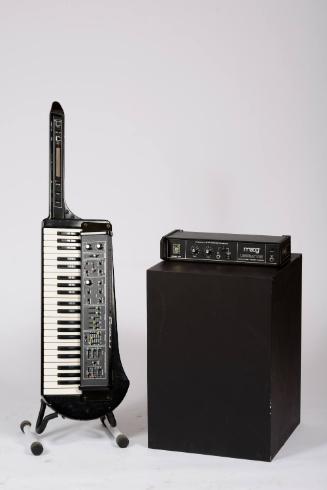
Photo credit: Don Kennedy
Moog Music, Inc.
1980
Not available for use in Recording Studios
On View: On exhibit
isVirtual:
Photo credit: Don Kennedy
Obelisk
Unknown
Available for use in Recording Studios
On View: Not currently on exhibit
isVirtual:
Photo credit: Don Kennedy
CBS Musical Instruments
1966
Available for use in Recording Studios
On View: Not currently on exhibit
isVirtual:
Photo credit: Don Kennedy
Optigan Corporation (of Mattel) / Opsonar (of Miner Industries)
c. 1973
Available for use in Recording Studios
On View: Not currently on exhibit
isVirtual:
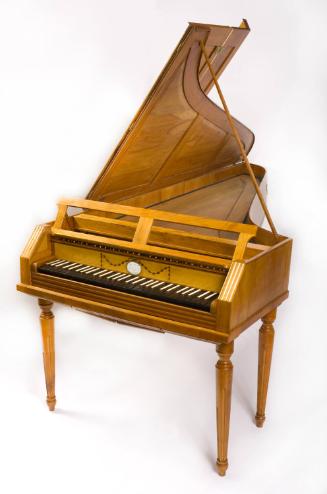
Photo credit: Don Kennedy
Louis Dulcken II
1791
Available for use in Recording Studios
On View: Not currently on exhibit
isVirtual:
Photo credit: Don Kennedy
Hammond Organ Company
1957
Not available for use in Recording Studios
On View: Not currently on exhibit
isVirtual:
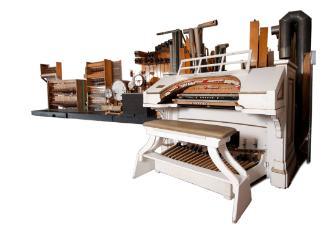
Photo credit: Don Kennedy
Kimball Piano and Organ Company
1924
Not available for use in Recording Studios
On View: On exhibit
isVirtual:
Photo credit: Don Kennedy
Streetly Electronics/ Mellotronics/ Mellotron
1971
Not available for use in Recording Studios
On View: On exhibit
isVirtual:
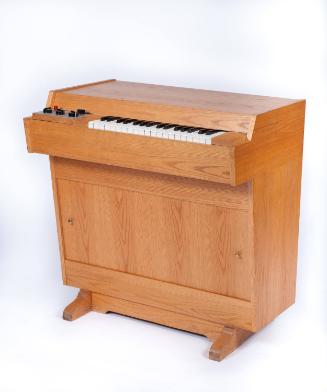
Photo credit: Don Kennedy
Mellotron (Mellotronics Manufacturing)
1973
Not available for use in Recording Studios
On View: Not currently on exhibit
isVirtual:
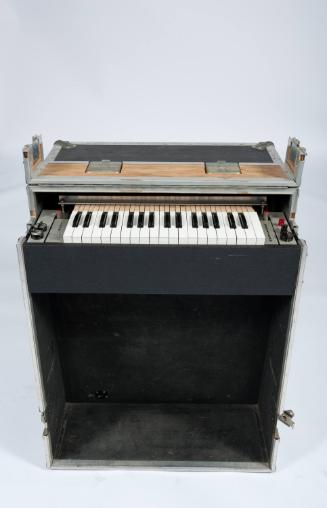
Photo credit: Don Kennedy
Novatron
c. 1981
Available for use in Recording Studios
On View: Not currently on exhibit
isVirtual:
Photo credit: Don Kennedy
Electro Music / Donald Leslie
c.1972
Available for use in Recording Studios
On View: Not currently on exhibit
isVirtual:
Back