
EN / FR
Skip to main content

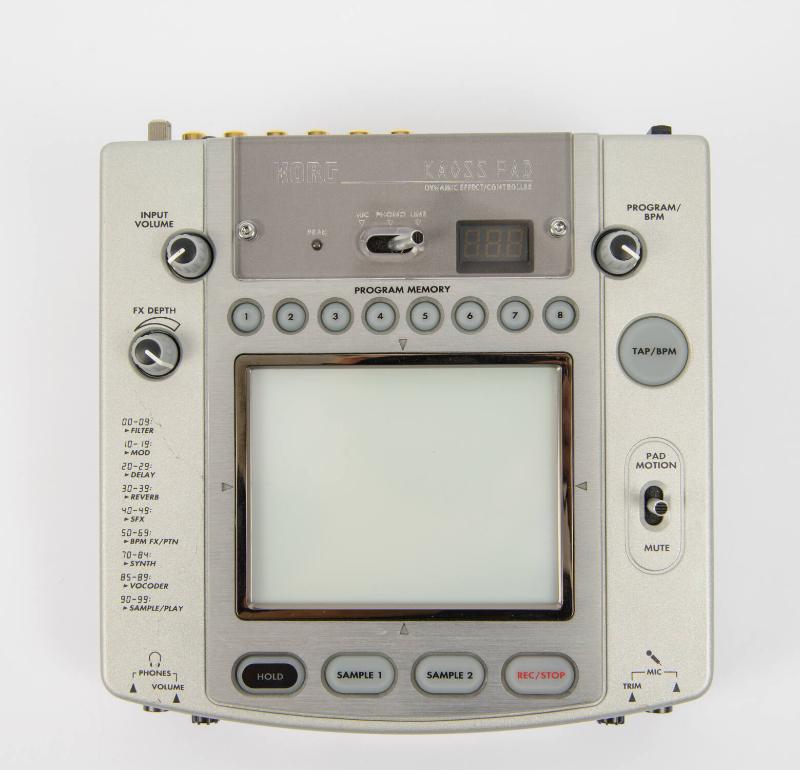
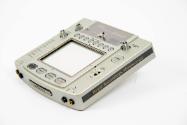
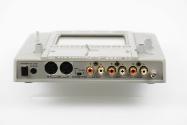
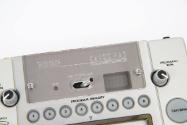
Oscar Peterson Kaoss Pad

Available for use in Recording Studios
Not currently on exhibit
Artifact TypeSynthesizer, Controller
Manufacturer Korg, Inc.
Manufacturer LocationJapan
DateAbout 1999

Oscar Peterson is known as the greatest jazz pianist Canada has ever produced. But he also collected keyboard instruments of all kinds—from the Bösendorfer grand piano that he often played to this unusual synthesizer controller. Upon its release in 1999, the Kaoss Pad found early enthusiasts in the international DJ community who were drawn to its intuitive touchpad design. Other musicians, from Brian Eno to Radiohead’s Jonny Greenwood, have also been fans.


Donated by the Peterson family

Operation/FunctionThis artifact contains a series of program buttons and knobs as well as an LCD display for selecting preset effects and navigating mapping directions for MIDI control. The interface of the device consists in the touchpad, which is sensitive to multi-directional finger movements from the user. Connections include MIDI in and out and a direct line input.Cultural SignificanceWhile most alternative controllers were popular in the commercial/domestic and professional markets for use in recording and performance, the Kaoss Pad was hugely influential within the DJ scene. It remains a popular tool within that genre today.Technological SignificanceAlthough a number of synthesizer designers have experimented over the years with alternate methods of interacting with their instruments, the keyboard interface has remained the dominant tool, having first emerged in early electronic instruments such as the Ondes Martenot and Ondioline, and being retained throughout the progression of early electric organs and sampling instruments on account of its relatively intuitive and “fool proof” nature. The advent of the alternate controller is one of the most important in the development of synthesizer technology in that it helped to expand both the range of the instrument, allowing players to articulate sounds in ways that are not afforded by the physical limitations of the keyboard, and the demographic of users, giving access to those who are trained in non-keyboard instruments. MIDI was first posited by Sequential Circuits, Inc.’s Dave Smith in late 1981, when he presented a paper at the Audio Engineering Society’s annual meeting theorizing the creation of a standard protocol that would allow various electronic instruments to communicate with one another. With the help of synthesizer designers Tom Oberheim of Oberheim Electronics, Ikutaro Kakehashi of Roland, and representatives from Korg and Kawai, the Musical Instrument Digital Interface – which was in fact coined by Smith – was consecrated at NAMM in 1983 with a Roland Jupiter 6 and a Sequential Circuits Prophet 600 making the first successful connection. Although appearing much later in the course of alternative controllers, the Kaoss Pad is highly unique in its use of a flat, multi-directional touchpad, allowing those with no familiarity in any musical instrument to access the device.Users/PerformersOver the past few decades, the Kaoss Pad has been employed by numerous notable artists, including Brian Eno and Jonny Greenwood of Radiohead, who have featured the device both on recordings and in live contexts. This particular artifact was formerly owned by Canadian jazz pianist, composer, and instrument collector, Oscar Peterson (1925 – 2007), who has earned the popular title of “Maharaja” of the keyboard. Peterson was born 15 August 1925 in Montréal, and was raised into a musical culture early on, taking up trumpet and piano by the age of five. His formative musical education borrowed both from classical and jazz traditions. In 1940, he was the recipient of a prestigious music competition hosted by the Canadian Broadcasting Corporation (CBC), which allowed him to focus full-time on developing a career in piano performance. In 1949, Peterson was invited to join Norman Granz’s renowned Verve recording label and his Jazz at the Philharmonic performance project; he made his Carnegie Hall debut that year, and Granz remained Peterson’s manager throughout his career. His performance style is characterized by a keen virtuosity and technical skill, while his compositional aesthetic favours melodic development within a jazz structure. Peterson continued to work as an active performer and recording artist throughout the 1950s, 1960s, and 1970s, having appeared with a number of duets, trios, and small ensembles. His Oscar Peterson at the Stratford Shakespearean Festival recording is often considered a seminal work in the repertoire of jazz trios. As a composer, he completed works for various ensembles and big bands, as well as solo pieces for piano and songs, some of which he performed himself. He maintained a home base in Toronto for the majority of his later life, having taught at York University for several years during the 1990s. This period in his life was plagued by health problems, including arthritis, limited mobility from hip surgery, and a stroke, which he suffered in 1993. Following a short string of performances and recordings into the new millennium, Peterson passed away on 23 December 2007 from kidney failure. He is the recipient of numerous awards and honours, including eight Grammy awards, one of which came in the form of a Lifetime Achievement Award for his catalogue of more than 200 recordings, induction into the Canadian Music Hall of Fame in 1978, induction into the Juno Awards Hall of Fame, induction into the Canadian Jazz and Blues Hall of Fame, and induction into Canada’s Walk of Fame. He has been awarded many prestigious national awards, including the Roy Thomson Award in 1987, the Governor General’s Performing Arts Award in 1992, and the Glenn Gould Prize in 1993; international recognitions include the UNESCO Music Prize in 2000 and the BBC-Radio Lifetime Achievement Award. He was made an Officer of the Order of Canada in 1972, a Companion to the Order of Canada in 1984, a member of the Order of Ontario, a Chevalier of the National Order of Quebec, and an officer of the Ordre des Arts et des Lettres of France. He has also received numerous honorary doctorates from institutions including Carleton University, Queen’s University, Concordia University, McMaster University, York University, the University of Toronto, the University of British Columbia, and the University of Western Ontario. Peterson was also a prolific collector of musical instruments, with his most well known items including a Bösendorfer grand piano upon which he performed extensively, various Steinway, Baldwin, and Bechstein grand pianos, electronic instruments such as electric pianos, electric organs, and synthesizers, and a clavichord.
Object numberT.2016.02.01
Photo credit: Don Kennedy
Korg, Inc.
c. 1988
Not available for use in Recording Studios
On View: Not currently on exhibit
isVirtual:
Photo credit: Don Kennedy
Buchla & Associates
c. 1990
Not available for use in Recording Studios
On View: Not currently on exhibit
isVirtual:
Photo credit: Don Kennedy
Buchla & Associates
1982
Not available for use in Recording Studios
On View: Not currently on exhibit
isVirtual:
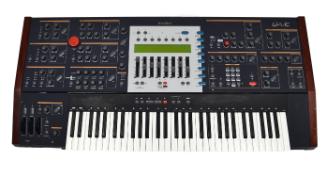
Photo credit: Meghan MacKrous, courtesy of the National Music Centre
Waldorf Electronics GmbH
1993
Available for use in Recording Studios
On View: Not currently on exhibit
isVirtual:
Photo credit: Meghan MacKrous, courtesy of the National Music Centre
Moog Music, Inc.
1976
Available for use in Recording Studios
On View: Not currently on exhibit
isVirtual:
Photo credit: Don Kennedy
Yamaha Corporation/Nippon Gakki Company Limited
1987
Not available for use in Recording Studios
On View: On exhibit
isVirtual:
Photo credit: Don Kennedy
Buchla & Associates
1999
Not available for use in Recording Studios
On View: On exhibit
isVirtual:
Photo credit: Don Kennedy
E-mu Systems, Inc.
1979
Not available for use in Recording Studios
On View: Not currently on exhibit
isVirtual:
Photo credit: Meghan MacKrous, courtesy of the National Music Centre
Bode Sound Company
1977
Available for use in Recording Studios
On View: Not currently on exhibit
isVirtual:
Photo credit: Don Kennedy
Linn Electronics, Inc.
1982
Not available for use in Recording Studios
On View: On exhibit
isVirtual:
Photo credit: Don Kennedy
Moog Music, Inc.
c. 1978
Not available for use in Recording Studios
On View: On exhibit
isVirtual:
Photo credit: Don Kennedy
Sequential Circuits Inc.
c. 1981
Available for use in Recording Studios
On View: Not currently on exhibit
isVirtual:
Back