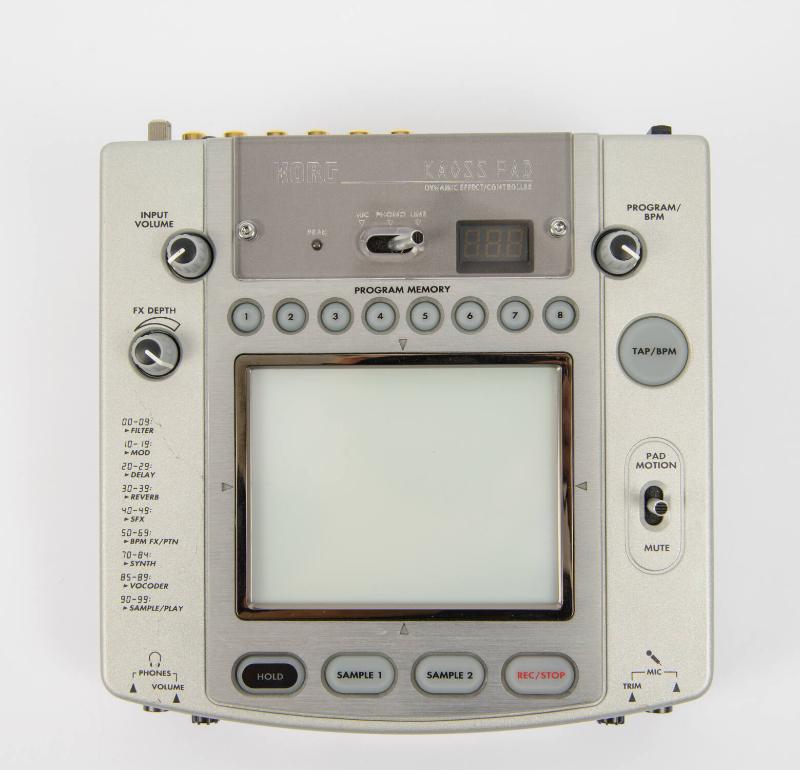
Korg, Inc.
ActiveInagi, Tokyo, Japan
BiographyKorg, Inc. was founded in Tokyo, Japan in 1962 by Tsutomu Katoh and Tadashi Osanai, and was originally branded as Keio Electronic Laboratories. Katoh and Osanai first came into business together when Osanai, while performing on a Wurlitzer Sideman drum machine in the nightclub Katoh owned, approached the latter about financing a project wherein he would improve the instrument’s design. Their first collaborative venture emerged in 1963 as an electromechanical drum machine called the ‘Donca’, followed by a transistorized version in 1966. The following year, the duo was joined by electrical engineer Fumio Mieda, who produced the firm’s first programmable electric organ. This instrument was branded under the Korg moniker, which derives from the first letters in Katoh and Osanai’s names, as well as the ‘org’ of organ. In the early 1970s, Korg expanded into the synthesizer market with well-known instruments such as the MS20 and Polysix. Throughout the decade, the company continued to produce two streams of instruments, namely those designed for the amateur market, and those intended for professional users, such as the sophisticated PS series. A string of digital workstations emerged throughout the 1980s and 1990s, including the hugely successful M1 synthesizer of 1988. In 1989, the former design team of the defunct Sequential Circuits, Inc. was acquired by Korg from Yamaha, with whom they maintained a fruitful partnership until 1993. Korg released the Wavestation synthesizer in the early 1990s, based on the vector synthesis technology employed in Sequential’s Prophet VS synthesizer. In 1992, Korg acquired Vox, a guitar and electric organ manufacturer formerly based in England and Italy. The company continues to produce electronic musical instruments, guitar pedals and effects units, and recording equipment.




electronic instruments manufacturer | founded 1969


(division of Norlin Music Instruments, Ltd.)