EN / FR
Skip to main content

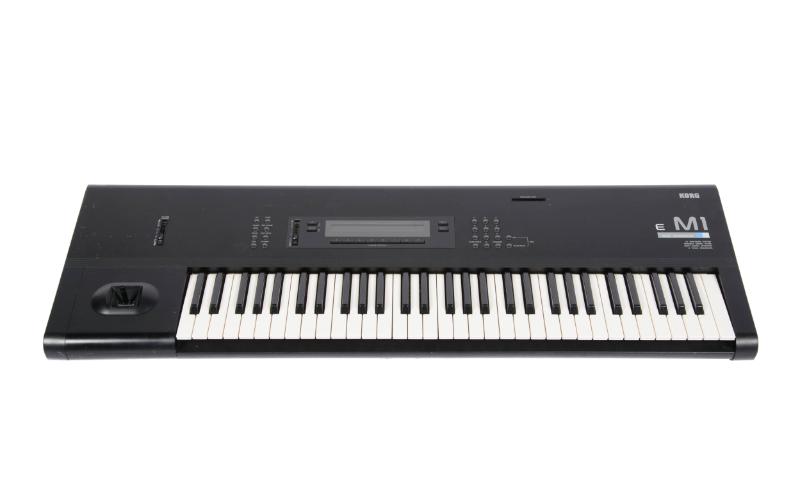
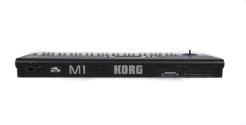
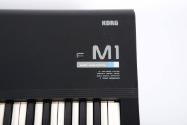
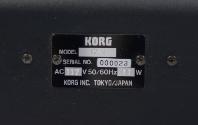
Korg M1

Not available for use in Recording Studios
Not currently on exhibit
Artifact TypeSynthesizer
Manufacturer Korg, Inc.
OriginInagi, Tokyo, Japan
Manufacturer LocationUSA
Datec. 1988
A key instrument in the definitive late-80s and early-90s sound—the Korg M1 was the first “music workstation”, laying the groundwork for synths that followed. Distinguished by its superior sound quality and capabilities, the M1 offered sounds that were previously unavailable in sample-playback synthesizers, such as drums, percussion hits, and exotic instruments. This—combined with a built-in eight track MIDI sequencer and immediate memory expansion via card slots—made the M1 the most popular synth of all time, selling an estimated 250,000 units during its 6-year production period.
Operation/FunctionThe Korg M1 generates its sound via AI (Advanced Integrated) synthesis for digital processing of 4 MB of PCM sampled and synthesized waveforms (144 total), and is capable of producing up to sixteen-voice polyphony across its five-octave (61 notes, C-C) compass. Its interface contains a backlit LCD display screen and accompanying sliders (for master volume and value) and push button switches for selecting modes and their sources, as well as a joystick for pitch bend and modulation. Also onboard are an eight-track sequencer, a digital multi-effects processor (with reverb, delay, overdrive, equalization, chorus, and rotary speaker), a variable digital low-pass filter (VDF), a variable digital amplifier (VDA) with three independent four-pole (ADSR) envelope generators, patch memory of up to 100 patterns, full MIDI implementation, inputs for two assignable footswitches and a sustain pedal, and velocity, aftertouch, and multi/layer/split modes across the keyboard.Cultural SignificanceThe Yamaha DX7 stood as perhaps the most influential synthesizer of the early 1980s, eclipsed only by the emergence of the far more sophisticated and intuitive Korg M1 of 1988, which remained the best-selling synthesizer of its time until the release of the Korg Triton workstation in 1999. Together, the DX7 and M1 spelled the near end of the complex and relatively unreliable analog and hybrid systems of the 1970s. Their use was widespread throughout the 1980s and 1990s, appearing on literally countless popular recordings.Technological SignificanceThe synthesizer is arguably one of, if not the most technologically significant contributions to the course of electronic music. Although earlier electronic instruments such as the Theremin, Clavivox, and Ondes Martenot offered new and unique ways of articulating sound, their sonic template was, for the most part, quite limited, capable of producing only a few distinct timbres. The modern synthesizer, on the other hand, was viewed as an integrated electronic orchestra, as it were, allowing the user to sculpt a wide and varied array of tones and gestures. What’s more, it allowed the user to modify their sounds in real time, seemingly without the sorts of physical limitations imposed on acoustic instruments. Of course, each instrument did come with its own characteristic tonal qualities and control limitations, however the wealth of opportunity inherent in the ability to manipulate and define nearly every parameter of sound structure solidified the synthesizer’s place as one of the most powerful musical innovations of the twentieth century. The concept of modular design was initially quite desirable to professional and studio musicians in that it allowed one to more or less completely customize their instrument and modify its functions as desired. Although modular-type systems are still in production today, the advent of affordable eight-bit microprocessor-based integrated circuitry in the mid 1970s and the rise of programmable polyphonic instruments in the late 1970s resulted in the relative obsolescence of the discrete transistor-based systems of the early 1970s. Synthesizers increasingly began to adopt the smaller, more compact aesthetic exhibited in these performance-oriented instruments, especially that of the revered Minimoog. The once popular modular approach gave way to more streamlined designs that, while still offering users the ability to control numerous aspects of the instrument’s tone and gesture, limited the way in which the instrument could be operated. In the early 1970s, integrated circuits emerged in synthesizers, housing the many discrete components of transistor-based circuits within a single silicon chip, as they are often called. Integrated circuits were significantly smaller and less expensive to manufacture than the circuits from which they derived. With the introduction of the first affordable eight-bit microprocessors in the mid 1970s, such as the Zilog Z80, integrated circuits adapted to incorporate more sophisticated digital components. The M1 of 1988 – as well as its predecessors, the Yamaha DX7 of 1983 and the Roland D50 of 1987 – was among the first in a generation of synthesizers that were entirely digital, replacing voltage-controlled and digitally controlled analog oscillators with computer-generated waveforms. Although computers had existed for decades prior in the form of both analog and digital iterations, it was not until the early 1980s that the latter became increasingly mass-produced and, thus, more affordable for and accessible to the consumer market, with the relatively compact home and personal computers becoming a reality by the mid 1980s. These fully digital instruments had several advantages over their analog counterparts: they were far more flexible, allowing for greater programming and memory capabilities, far more stable with the ability to remain in tune, significantly less expensive, and generally smaller and even more streamlined. As such, control of the commercial synthesizer market shifted in the 1980s from the United States to Japan, with many of the original manufacturers of the 1970s, such as Sequential Circuits and ARP Instruments, folding due to the inability to compete. As digital sampling continued to improve in fidelity, the market once again shifted away from digital synthesizers, favouring sampling instruments that could provide high quality versions of the real thing, so to speak, rather than digital simulations. The workstation synthesizer-sampler, of which the Korg M1 was the pioneering unit, became the new product of the early 1990s, allowing the user to merge both worlds, offering samples and editing and modifying capabilities in addition to more studio-inspired sequencing and multi-track features for composition. Modern digital synthesizers such as the Waldorf Q still incorporate something of a hybrid approach, offering high quality samples that can be modified as well as a series of sophisticated digital synthesis and signal processing techniques, including those that perform a sort of “analog modeling”, imitating the revered icons of the 1970s. In addition to hardware digital synthesizers, software synthesis – that is, the implementation of computer applications and programs that enable highly flexible synthesis and sampling environments – is also among the most practiced forms of computer music, gaining particular notoriety within the past few decades thanks to sophisticated programs such as max/MSP and SuperCollider. Although it was in direct competition with the Yamaha DX7, the Korg M1 offered a far more sophisticated approach. In addition to pioneering the concept of the workstation synthesizer, it also presented the first usage of a complex AI (Advanced Integrated) PCM-based synthesis approach, which is capable of producing a vast range of combination timbres.Users/PerformersExamples of the M1’s usage are countless throughout the late 1980s and 1990s, with most occurring in pop and related genres, such as new wave and techno. Notable examples to incorporate the M1 include Madonna’s “Vogue” from I’m Breathless of 1990, Quincy Jones’ Back on the Block of 1989, Queen’s “The Show Must Go On” from Innuendo of 1991, and Babylon Zoo’s “Spaceman” from The Boy with the X-Ray Eyes of 1996. Perhaps the most famous but often overlooked example of the M1 came at the hands of American television composer Jonathan Wolff, who employed the instrument’s slap bass preset for the introductory theme to the massively successful Seinfeld series, which ran on NBC from 1989 until 1998.
Object number2011.02.01
Photo credit: Meghan MacKrous, courtesy of the National Music Centre
Waldorf Electronics GmbH
1993
Available for use in Recording Studios
On View: Not currently on exhibit
isVirtual:
Photo credit: Don Kennedy
Korg, Inc.
About 1999
Available for use in Recording Studios
On View: Not currently on exhibit
isVirtual:
Photo credit: Meghan MacKrous, courtesy of the National Music Centre
Kurzweil Music Systems
1985
Available for use in Recording Studios
On View: Not currently on exhibit
isVirtual:
Photo credit: Don Kennedy
Raymond Scott Enterprises/Manhattan Research
1957
Not available for use in Recording Studios
On View: Not currently on exhibit
isVirtual:
Photo credit: Don Kennedy
Ken Freeman
c. 1975
Available for use in Recording Studios
On View: Not currently on exhibit
isVirtual:
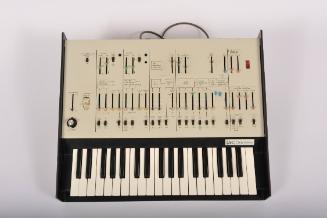
Photo credit: Don Kennedy
ARP Instruments, Inc.
1972
Available for use in Recording Studios
On View: Not currently on exhibit
isVirtual:
Photo credit: Meghan MacKrous, courtesy of the National Music Centre
Moog Music, Inc.
1976
Available for use in Recording Studios
On View: Not currently on exhibit
isVirtual:
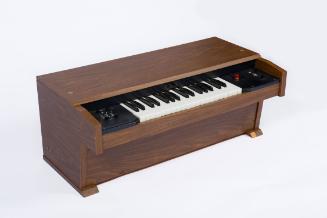
Photo credit: Don Kennedy
Chamberlin Instruments Company, Inc.
1979
Available for use in Recording Studios
On View: Not currently on exhibit
isVirtual:
Photo credit: Don Kennedy
Sequential Circuits Inc.
c. 1981
Available for use in Recording Studios
On View: Not currently on exhibit
isVirtual:
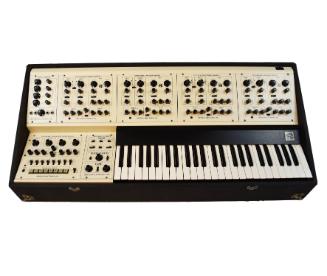
Photo credit: Meghan MacKrous, courtesy of the National Music Centre
Oberheim Electronics, Inc.
1976
Available for use in Recording Studios
On View: Not currently on exhibit
isVirtual:
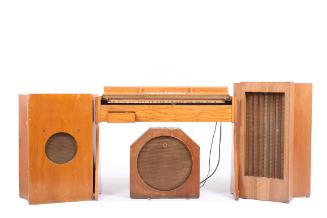
Photo credit: Don Kennedy
Maurice Louis Eugène Martenot
1975
Available for use in Recording Studios
On View: Not currently on exhibit
isVirtual:
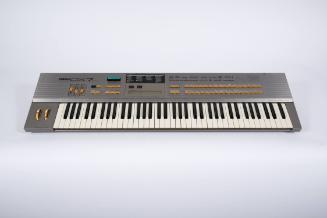
Photo credit: Don Kennedy
Yamaha Corporation/Nippon Gakki Company Limited
1987
Not available for use in Recording Studios
On View: On exhibit
isVirtual:
Back