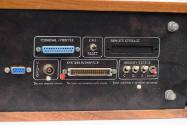
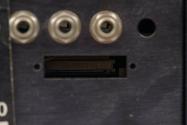
Buchla 400
Not available for use in Recording Studios
Not currently on exhibit
Not currently on exhibit
Artifact TypeSynthesizer
Manufacturer
Buchla & Associates
Date1982
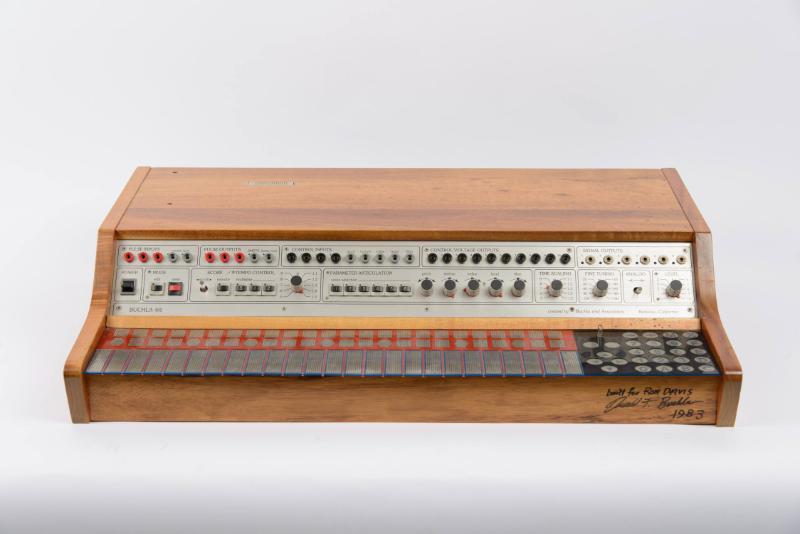
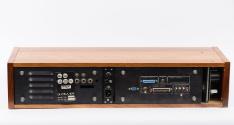
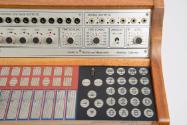
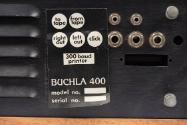
Operation/FunctionThe Buchla 400 is a digital-analog hybrid synthesizer that features six-voice polyphony across a pressure-sensitive touch plate. The instrument employs a customized programming language called MIDAS, which, in conjunction with an external computer monitor allows for real-time editing and sequencing of up to 64 acoustic parameters. The instrument contains nine control voltage inputs, five pulse inputs, ten control voltage outputs, and five pulse outputs, all with standard banana jacks, as well as eight audio outputs, including a two-channel stereo bus, and a 1/4” headphone connector.Cultural SignificanceTypically, Robert Moog is more popularly associated with the introduction of the first synthesizers. However, in the mid 1960s, both Don Buchla and Robert Moog – who was, at the time, based in New York – independently developed the first voltage-controlled synthesizers, both employing a modular structure and offering similar functions. Although their instruments catered to different demographics, both designers were highly influential to the next generation of synthesizer manufacturers, though perhaps in varying ways. Buchla stood primarily as an inspiration to designers looking to implement ideas that were less conventional and more aesthetically minded. The emergence of Buchla’s first instrument at a time when the counterculture of the 1960s was near its apex, as well as his involvement in related concerts and events such as the infamous Altamont Free Concert in 1969, certainly helped establish the designer as something of a figurehead for the movement. Moreover, being situated in the San Francisco Bay Area, which has been historically recognized as a national haven for innovation and less-than-conventional attitudes for several decades, allowed for Buchla’s instruments to enjoy a heightened reception that may not have been as prevalent elsewhere in the country.Technological SignificanceThe synthesizer is arguably one of, if not the most technologically significant contributions to the course of electronic music. Although earlier electronic instruments such as the Theremin, Clavivox, and Ondes Martenot offered new and unique ways of articulating sound, their sonic template was, for the most part, quite limited, capable of producing only a few distinct timbres. The modern synthesizer, on the other hand, was viewed as an integrated electronic orchestra, as it were, allowing the user to sculpt a wide and varied array of tones and gestures. What’s more, it allowed the user to modify their sounds in real time, seemingly without the sorts of physical limitations imposed on acoustic instruments. Of course, each instrument did come with its own characteristic tonal qualities and control limitations, however the wealth of opportunity inherent in the ability to manipulate and define nearly every parameter of sound structure solidified the synthesizer’s place as one of the most powerful musical innovations of the twentieth century. The concept of modular design was initially quite desirable to professional and studio musicians in that it allowed one to more or less completely customize their instrument and modify its functions as desired. Although modular-type systems are still in production today, the advent of affordable eight-bit microprocessor-based integrated circuitry in the mid 1970s and the rise of programmable polyphonic instruments in the late 1970s resulted in the relative obsolescence of the discrete transistor-based systems of the early 1970s. Synthesizers increasingly began to adopt the smaller, more compact aesthetic exhibited in these performance-oriented instruments, especially that of the revered Minimoog. The once popular modular approach gave way to more streamlined designs that, while still offering users the ability to control numerous aspects of the instrument’s tone and gesture, limited the way in which the instrument could be operated. Although the modular synthesizer was highly regarded for its flexibility, it was also criticized for being largely unintuitive and cumbersome in its patching schemes; the smaller, integrated digital-analog hybrids of the late 1970s, though still not relatively inexpensive, responded more readily to the technological demands of an increasingly burgeoning consumer market. In the early 1970s, integrated circuits emerged in synthesizers, housing the many discrete components of transistor-based circuits within a single silicon chip, as they are often called. Integrated circuits were significantly smaller and less expensive to manufacture than the circuits from which they derived. With the introduction of the first affordable eight-bit microprocessors in the mid 1970s, such as the Zilog Z80, integrated circuits adapted to incorporate more sophisticated digital components. The Buchla 400 belongs to the era of synthesizers that incorporate microprocessor-based integrated circuits. In addition to being more reliable and less expensive to manufacture, the synthesizers of the microprocessor era were, to varying extents, also programmable, meaning that various parameters could be stored either within the instrument’s internal memory or onto an external device. Synthesizers that emerged from the era of digital-analog hybrids are often considered to represent the height of synthesizer design, combining analog sound production with reliable and flexible digital control. Throughout the 1980s and 1990s, synthesizers continued to develop following the compact, user-friendly model established in the mid 1970s. These instruments, however, generally moved away from the hybrid internal architecture to incorporate full digital control, computer-based tone generation, and digital signal processing, such as in the iconic Yamaha DX7 of 1983.
Although it was never a commercial success, the Buchla 400 stands as among the most sophisticated digital-analog hybrid synthesizers of the time. Its programming capabilities, which were facilitated by a language developed specifically for the instrument, dubbed MIDAS, allowed for real-time editing and sequencing of numerous parameters, along with graphic displays corresponding to an external computer monitor. Another unique feature of the 400 was its ability to connect to Buchla’s earlier modular systems via a series of input and output banana jacks on the instrument’s front panel; this was particularly significant given that the instrument emerged in the pre-MIDI era. The internal architecture of the instrument was also quite sophisticated, with three dedicated computers and specialized circuitry to provide unparalleled depth in the output stereo field. Most paramount to the design aesthetic adopted by Buchla & Associates was the ability to offer the user direct and immediate control of all musical parameters. Perhaps on account of his background in physiology, Buchla seemed to be particularly preoccupied in eliminating the distance between the user and the machine; of course, this is especially clear in the design of his controllers, including the touch plates of the early systems and the MIDI controllers of the 1990s. To the extent that Buchla instruments were revered by the experimental composers of the 1960s, they were also met with hesitance by the more commercially-minded musicians of the early 1970s, who opted for similar products manufactured by Moog and ARP, which were, by and large, more straightforward in their functions and certainly more stable. Although Buchla & Associates remained more or less on the fringe of the mainstream from the 1970s onward, their instruments were still regarded as among the most innovative, unique, and sophisticated. Buchla & Associates were also regarded as never having fully bowed to commercial pressures, instead continuing to expand their idiomatic design aesthetic throughout the 1970s and 1980s despite a lack of popular usage. As a designer, Buchla was also unique in that he approached his instruments both as an engineer and as a musician. Just as Alan R. Pearlman, a former test engineer with NASA, used his background to produce components that were extremely stable, Buchla made certain decisions for the user in his designs that could be seen as helpful from a performance standpoint. For instance, most singular functions on his modules each contain two identical outputs, allowing the same signal to be directed to two different locations. In addition to being credited as one of the inventors of the voltage-controlled synthesizer, along with Robert Moog, Donald Buchla is recognized as one of the most innovative synthesizer designers.Users/PerformersThere is no documented usage of the 400 in recorded music or live contexts. Notable users of early Buchla systems, including the 100 and 200 modular series, are Americans Pauline Oliveros, Morton Subotnick, and Suzanne Ciani.Collection
Object number2001.03.02
Buchla & Associates
1999
Available for use in Recording Studios
On View: Not currently on exhibit
isVirtual:

Buchla & Associates
c. 1990
Not available for use in Recording Studios
On View: Not currently on exhibit
isVirtual:

Buchla & Associates
c. 1968
Available for use in Recording Studios
On View: Not currently on exhibit
isVirtual:

Buchla & Associates
2006
Available for use in Recording Studios
On View: Not currently on exhibit
isVirtual:
Buchla & Associates
1999
Not available for use in Recording Studios
On View: On exhibit
isVirtual:
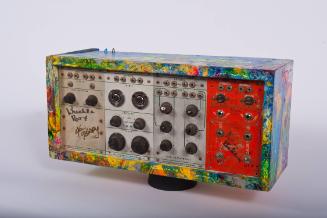
Donald Buchla
c. 1966
Not available for use in Recording Studios
On View: On exhibit
isVirtual:

Korg, Inc.
About 1999
Available for use in Recording Studios
On View: Not currently on exhibit
isVirtual:

Sébastien Érard
1820
Not available for use in Recording Studios
On View: On exhibit
isVirtual:

Hohner Musikinstrumente GmbH & Co. KG
c. 1950
Not available for use in Recording Studios
On View: Not currently on exhibit
isVirtual:
The Wurlitzer Company
c. 1959
Not available for use in Recording Studios
On View: On exhibit
isVirtual:
Chamberlin Instruments Company, Inc.
1970
Not available for use in Recording Studios
On View: On exhibit
isVirtual:
Garnet "Gar" Gillies
Available for use in Recording Studios
On View: Not currently on exhibit
isVirtual: