EN / FR
Skip to main content

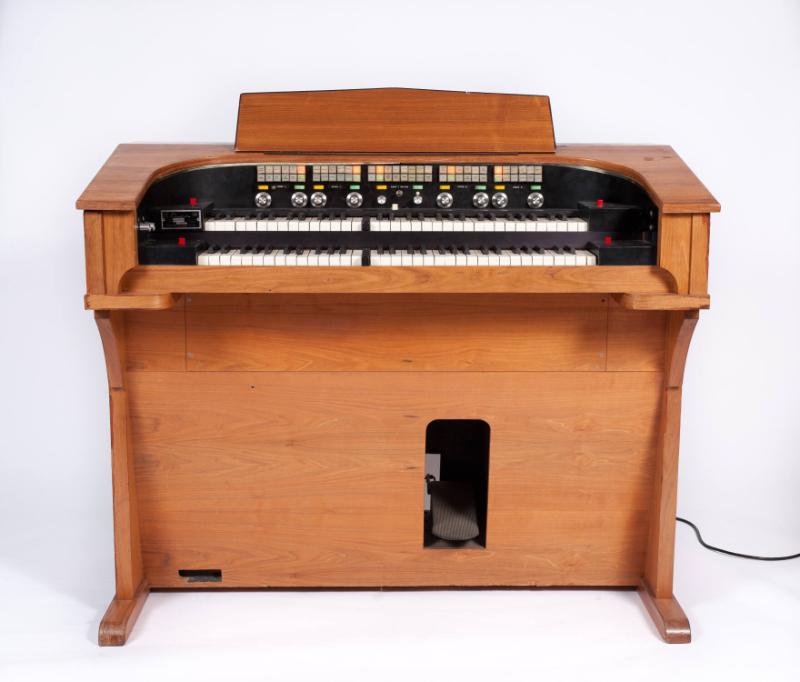
Chamberlin Riviera

Not available for use in Recording Studios
On exhibit
On exhibit
Artifact TypeSample Playback, Tape Replay
Manufacturer LocationUSA, North America
Date1970
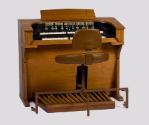
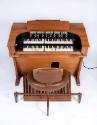
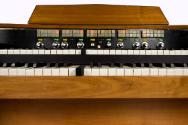
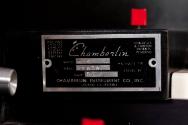
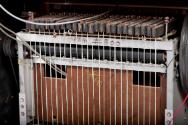
Paving the way for everything from hip-hop to Steve Reich, the Chamberlin Riviera is an early analog sampler—that is, an instrument that plays back sounds that have been recorded, or “sampled,” in the real world. Its inventor, Harry Chamberlin, pioneered the concept of sampling. Using four piano-style keyboards and pre-recorded magnetic tape samples of dozens of instruments and special effects—Chamberlin players essentially had an orchestra at their fingertips. While this particular model was intended for home use, the more compact M1 model has been used by musicians including Three Dog Night, Stevie Wonder and Tom Waits.
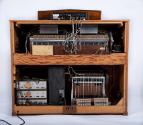
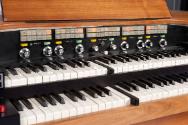
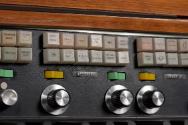
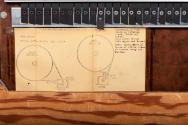
Operation/FunctionThis instrument employs a series of ten 1/2" eight-track tapes, summed from five subassemblies to a single stereo output. Each tape contains six to eight different samples, with the ten different sections spread across four keyboard portions (upper left, lower left, upper right, and lower right) and a portion for rhythm and bass. Each of the keyboard portions and the bass & rhythm portion correspond with two individual tapes, designated with either a green or yellow lamp when selected. The following samples are included in this instrument: Sound Effects, Dixie, Organ, Harp Roll, Harp Solo, Slur Guitar (lower left yellow) and Organ, Harp Roll, Harp Solo, Slur Guitar, French Horn, Slur Tromb. (lower left green); Bassoon, Banjo, Do-Wa Tromb., Harp 7th, Marimba, Tenor Sax (upper left yellow) and Do-Wa Tromb., Harp Emb., Marimba, Tenor Sax, Female Voice, Accu. Guitar (upper left green); V. Waltz, 4/4 144, Fox Trot 112, March, Tango, Rhumba, Standard Waltz, Tempo 216 (rhythm & bass) and Tuba, Dixie, Fox Trot 96, Organ Bass, Samba, Bolero, Cha-cha, Organ Bass (rhythm & bass); Male Voice, Harps., Vibs, Alto Sax, Tibia, Bass Clarinet (upper right yellow) and Vibs, Alto Sax, Tibia, Bass Clarinet, Kinura Organ, Violin (upper right green); Flute, Mando., Open Trumpet, Open Tromb., Guitar, Organ (lower right yellow) and Tenor Sax, Cello, Flute, Mandolin, Open Trumpet, Guitar (lower right green). Each keyboard portion spans 25 notes (approximately two octaves), and is arranged along two manuals. An additional set of foot pedals is also featured.Cultural SignificanceWhen it comes to differentiating between Chamberlin and Mellotron instruments, the technological import of the former is clearly superior in its essentially defining the mechanism that would be employed in nearly every model of tape sampler. In terms of cultural impact, however, Chamberlin’s instruments are often forgotten and overlooked, especially within the context of popular music, as they were never marketed with the expressed aim of commercial appeal. The Mellotron did, however, make an indelible mark on the course of popular music. With its extensive usage in the 1960s and 1970s by bands such as Led Zeppelin, King Crimson, and The Beatles, its distinctive, lo-fidelity quality helped shape the sound that defined not only a certain genre of music, but an entire era. As being essentially the first sampling instrument, Chamberlin’s designs did help pave a way forward for the concept of the sampler, which has in itself revolutionized the way people make, define, and think about music. With the advent of magnetic tape and its associated recording technology, composers could for the first time begin to incorporate sounds from the outside world into their music. This post-war compositional aesthetic, known as musique concrète, came to form one of the first fully established genres of electronic music, and influenced nearly every other electronic composer in the decades that followed. The manipulation and flexibility of the tape medium allowed composers to not only feature real sounds into their works, which could also have been easily done in the acoustic realm, but also to manipulate these sounds so as to produce timbres and gestures that were fresh and curious to the listener’s ear. Tape replay instruments helped expand this path of experimentalism, and offered musicians simulations of acoustic sounds that were at once familiar, yet unusual as a result of the instabilities of the mechanism employed in the instruments.Technological SignificanceThe technology developed by Harry Chamberlin was extremely innovative and groundbreaking for its time, and effectively pioneered the concept of the sampler. Throughout the 1940s, Chamberlin conceived of an instrument that could play back sound pre-recorded onto magnetic tape via a keyboard. The instruments he produced in the late 1940s and throughout the 1950s were the first to employ such a mechanism. They were, however, fairly unreliable, partly on account of the fact that components crucial to sound production, such as the tape heads used, were not standardized. After a somewhat awkward exchange of technological ownership (see ‘Manufacturer Background’), a British company called Streetly Electronics began producing Chamberlin’s designs under the Mellotron name. The Mellotron was revered for its accessibility, allowing musicians to obtain any number of sounds, typically derived from orchestral instruments, at the touch of a button, so to speak. Prior to the instruments produced by both Chamberlin and Mellotron, no such technology had existed. The concept of the sampler – that is, an instrument that produces sounds that were recorded in the real world, usually from its keyboard – was born of Chamberlin’s designs and, through the Mellotron, the technology became widespread and highly popular. Of course, sampling would not have been as feasible without the advent of magnetic tape and its associated recording technology. Magnetic tape revolutionized the recording industry in several ways. It had the advantage of being relatively small and easy to work with, and was also malleable in ways that preceding recording technologies such as the wax cylinder were not: magnetic tape could be cut, or spliced, into pieces that could be rearranged and reattached to another portion of tape. Moreover, tape could also be manipulated by the tape playing machine in compositionally meaningful ways: the tapes could be played backwards, or the speed at which they are played back could be sped up or slowed down, thereby altering the pitch of the recorded sound. Another well-used tape music technique consisted in removing the pick up tape reel and attaching the end of a piece of tape back to the beginning of the tape, thus producing an infinite tape loop. Early experimental practices with tape helped foster the development of musique concrète, which was one of the first established genres of electronic music. Composers working in this field, who were primarily based in France throughout the 1940s and 1950s, exploited the ability they now had to bring real world sounds into their music, and to manipulate the sounds in ways that were simply not possible before. Composers of this genre include Pierre Schaeffer (1910 – 1995) and Pierre Henry (born 1927), who worked at the Office de Radiodiffusion-Télévision Française (ORTF) studio in Paris. Tape technology continued to fascinate composers into the 1960s and 1970s, with American minimalist innovators Terry Riley (born 1935) and Steve Reich (born 1936) making heavy use of splicing techniques and tape loops in their electronic music. Moreover, the advent of magnetic tape also brought with it the advent of multi-track recording. There are many variations of tape that accommodate this style of recording, including some tapes that only contain two tracks and others that can store up to 24 independent tracks, however in each case a single strip of tape is evenly divided into a number of individual tracks. As such, instead of recording an entire band, for instance, in one take with every player sounding at the same time, individual instruments could be allocated to the various tracks of the tape and recorded in turn. Most band recording sessions begin by recording the drums, which is itself often split such that individual drums and cymbals have their own tracks, and then by overlaying other instruments on top of the drum tracks. This process if known as overdubbing, and is still the central function of modern recording. That being said, not all recording sessions employ overdubbing. For instance, orchestral studio recordings do not typically record individual instruments on their own. The multi-tracking process is still maintained though, as certain instruments or groups of instruments will each have their own microphone, which will capture that information on an independent track. Although tape is still often used in many professional recording studios, the digital audio workstation, or DAW, including software such as ProTools and Logic, is the primary recording medium. These programs are modeled from analog recording techniques, however, with the recording engineer still creating independent tracks that correspond to a single microphone, and using the process of overdubbing. Whereas tape is limited to the number of tracks that can fit onto a single strip without compromising the amount of physical space used to store audio, usually no smaller than 1/8”, digital media is far more flexible, with most programs capable of maintaining nearly 100 independent tracks before running into issues. Despite the fact that the Chamberlin’s design was highly innovative for its time, the technology did not come without its drawbacks. Although the associated instruments that employ this technology are revered for the quirks of their distinctive tone and for the charm of their limitations, it was precisely these characteristics that led to the instrument’s eventual demise in the 1980s. One of the main difficulties with the technology is the infamous eight-second lifespan of the recorded sound. The mechanism featured in the instrument would not be capable of operating if the tapes were looped to provide a continuous tone, and thus a definitive length of time that the samples could sound had to be enforced. Although somewhat authentic acoustic attacks can be imitated on the instrument, the abrupt manner with which the sound ceases once the tape has run its course was not generally considered to be a desirable side effect of the mechanism. And, although some units, such as the Chamberlin M1, were designed to be portable, they were not necessarily built for excessive movement. The instruments were highly temperamental and required regular servicing. Changes in temperature and humidity could warp the tapes or cause them to become sticky, and movement of the entire unit could cause the many internal components to shift or misalign. One advantage the tape samplers retained throughout the 1970s, however, with the advent of commercial synthesizers was their polyphony. The majority of the earliest synthesizers were monophonic, meaning only one note could be played at a time. Theoretically, any number of keys could be played simultaneously on a tape sampler as each key corresponds with an individual tape head, however when too many notes were played at one time, the over tonal quality of the sound became noticeably diminished. Chamberlin and Mellotron are among two of the most well known manufacturers of early sampling instruments, both employing the same tape replay technology Chamberlin had designed. Chamberlin’s first instruments included the model 100 Rythmate, which contained drum samples and effectively served as the first drum machine, the model 200 Rhythmate, which incorporated a keyboard, and the MusicMaster 600, which the first Mellotron model, the Mark I, was based on. Chamberlin employed 3/8” tape in the MusicMaster instead of the far more common 1/4" format. Chamberlin’s M series, which includes the portable M1 unit, employed eight-track 1/2” tape, and his final instrument, the Riviera Model 800, featured what was essentially equivalent to four M1 units. The Mark I and Mark II Mellotrons of 1963 and 1964, respectively, were based on Chamberlin’s MusicMaster, but improved upon the design by incorporating a sturdier internal frame, as well as built in speakers and reverb devices. In general, the Mellotron instruments were more reliable and more stable than the Chamberlin instruments, employing standardized components, and were produced at much faster rates. That being said, however, many believed the sound of the Chamberlin instruments to be of higher quality, containing less compression and clearer articulations. Both manufacturers succumbed to the advent of digital samplers in the 1980s, which featured a much greater clarity of tone, more flexibility and portability, and a relatively smaller build. That being said, however, tape samplers were still able to retain something of an advantage over the earliest digital samplers in that the amount of memory those instruments would have required to store the same amount of samples, at the same definition of quality, was initially unattainable. Other notable early samplers include the Birotron, which was designed by American Dave Biro, and employs a technology similar to that used by the eight-track tape player. Although these instruments were also plagued with technical inconsistencies, the Birotron had the advantage of being able to produce continuous loops of sound. The Band Box Chordarama is an accompanying instrument that also employed eight track tapes, typically of chordal progressions or drum loops, and was operated by the user’s foot, similar to a stomp box. The Opsonar Optigan and Vako Orchestron were introduced in the 1970s, and both employ a similar method of optical sampling. A laser inside the instrument detects changes in light density on a circular, transparent disc that rotates as the instrument is active. The Orchestron is often considered to be the more professionally-minded of the two, though of all the analog sampling instruments, it is also generally agreed to have the worst fidelity in its recordings. The Optigan was originally designed by the toy company, Mattel, and was intended for the home market. Its orientation is similar to that of the accordion: on the left hand side of the instrument are chord buttons, including major, minor, and dominant seventh chords, and on the right hand side of the instrument is a small keyboard that can be used to produce melodic accompaniment. The instrument also includes several switches that produce looped percussive accompaniment. Throughout his early career, Chamberlin received numerous US patents for his designs, including ones for Magnetic Tape Sound Reproducing Musical Instrument (1960), Sound Reproducing System (1959), Musical Instrument with Record Type Tone Generator (1966), Electrical Musical Instrument Having Pre-recorded Tape for Tone Generation (1966), Multi-tape Reproducer with Single Pickup Head (1966), and Tape Drive Mechanism for Electrical Musical Instruments (1971).Users/PerformersExamples of Chamberlin use are not as widespread as that of the Mellotron, especially for larger, more sophisticated units such as the Riviera, however the sound of the M1 can be heard on David Bowie’s Low of 1977 and Scary Monsters of 1980, Edgar Winter’s Jasmine Nightdreams of 1975, Leon Russell’s Carney of 1972, The Moody Blues’ Seventh Sojourn of 1972, and later recordings by Tom Waits, including Black Rider of 1993. The instrument has also been featured in several film scores, including Boogie Nights of 1997 and I Heart Huckabees of 2004.
Object number2000.05.06
Photo credit: Don Kennedy
Electronic Music Studios (London) Limited
1972
Available for use in Recording Studios
On View: Not currently on exhibit
isVirtual:
Photo credit: Don Kennedy
Chamberlin Instruments Company, Inc.
1979
Available for use in Recording Studios
On View: Not currently on exhibit
isVirtual:
Photo credit: Don Kennedy
Hammond Organ Company
1957
Not available for use in Recording Studios
On View: Not currently on exhibit
isVirtual:
Photo credit: Don Kennedy
Moog Music, Inc.
c. 1978
Not available for use in Recording Studios
On View: On exhibit
isVirtual:
Photo credit: Don Kennedy
CBS Musical Instruments
1966
Available for use in Recording Studios
On View: Not currently on exhibit
isVirtual:
Photo credit: Don Kennedy
Buchla & Associates
2006
Available for use in Recording Studios
On View: Not currently on exhibit
isVirtual:
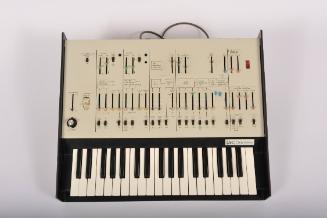
Photo credit: Don Kennedy
ARP Instruments, Inc.
1972
Available for use in Recording Studios
On View: Not currently on exhibit
isVirtual:
Photo credit: Don Kennedy
Bösendorfer Klavierfabrik GmbH
1938
Not available for use in Recording Studios
On View: Not currently on exhibit
isVirtual:
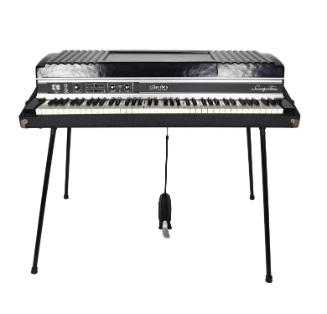
Photo credit: Meghan MacKrous, courtesy of the National Music Centre
CBS Musical Instruments
c. 1980
Available for use in Recording Studios
On View: Not currently on exhibit
isVirtual:
Photo credit: Don Kennedy
Vox Sound, Ltd.
c. 1967
Not available for use in Recording Studios
On View: Not currently on exhibit
isVirtual:
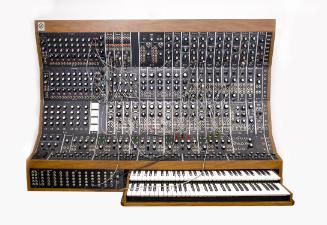
Photo credit: Don Kennedy
R.A. Moog Inc./ Moog Music Inc. (division of Norlin Music Instruments, Ltd.)
c. 1973
Available for use in Recording Studios
On View: Not currently on exhibit
isVirtual:
Photo credit: Don Kennedy
Elettronica Musicale Europea (EME) / Vox
c. 1968
Available for use in Recording Studios
On View: Not currently on exhibit
isVirtual:
Back