EN / FR
Skip to main content

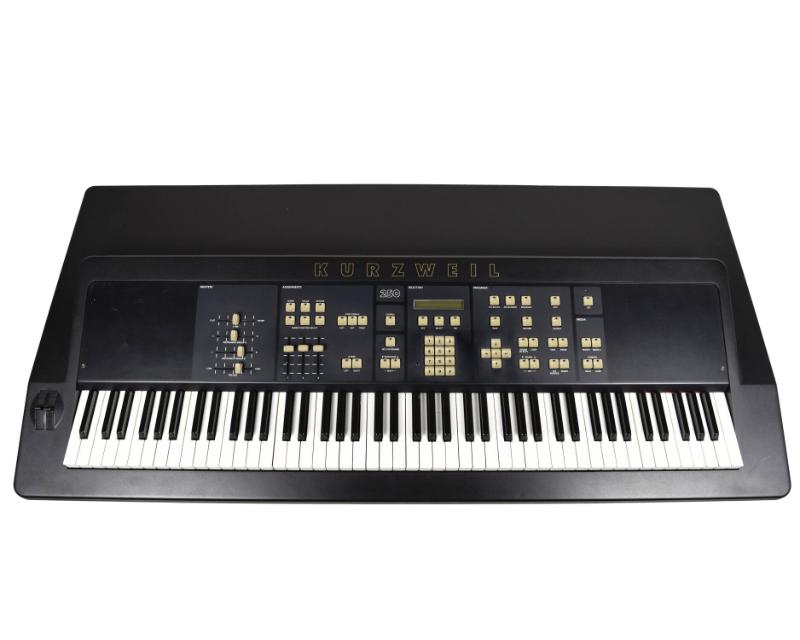
Kurzweil K250

Available for use in Recording Studios
Not currently on exhibit
Artifact TypeSynthesizer, Sampler
Date1985

The K250 was the first synthesizer produced by Kurzweil Music Systems and one of the first successful, mass-produced sampling keyboards. Founded in 1982 by Ray Kurzweil, Bruce Cichowlas and Stevie Wonder, the company got a major endorsement from the artist, who owned several versions including a prototype with Braille buttons. Among its features, the K250 had as much as 100 seconds of sampling time, 341 pre-sets and a full 88 key weighted keyboard. It was renowned for emulating the complex sound of a grand piano. This instrument was previously owned by Bob Derkach, a Canadian multi-instrumentalist, composer, arranger, producer and musical director who used it for soundtracks at the Vancouver World Expo ’86 and on several of his film and television scores.


Donated by Bob Derkach

Operation/FunctionThis instrument features a seven-octave (88 notes, A through C, as in the acoustic piano) compass and twelve-voice polyphony. Samples are stored onto internal ROM (read-only memory) circuits and recalled via five sound banks labeled A, B, C, D, and QLS.Cultural SignificanceThe K250 asserted itself as one of the foremost electronic instruments of the 1980s, offering a highly sophisticated sound and internal architecture that suited itself particularly well to studio professionals. Its association with keyboard aficionado Stevie Wonder is especially telling of its appeal. The workstation concept, which emerged from instruments such as the K250, revolutionized music production in the domestic market, allowing amateur users to control every aspect of the process, from the performance of various acoustic sources to the recording, sequencing, and editing of longer works. In effect, workstations helped minimize the gap between the professional and the amateur, eliminating the absolute necessity for multiple roles – composer, performers, engineer, producer, studio technician, arranger, etc. – and assigning full control of basic production to the user, often from the convenience of their own home. Of course, today, the personal computer serves this vital function in conjunction with an abundance of software.Technological SignificanceThe concept of the sampler – that is, an instrument that produces sounds that were recorded in the real world, usually from its keyboard – was born of the designs of California-based Harry Chamberlin and, through the iconic models of the Mellotron, which employed Chamberlin’s approach, the technology became widespread and highly popular throughout the 1960s and 1970s. Of course, sampling would not have been as feasible without the advent of magnetic tape and its associated recording technology. Magnetic tape revolutionized the recording industry in several ways. It had the advantage of being relatively small and easy to work with, and was also malleable in ways that preceding recording technologies such as the wax cylinder were not: magnetic tape could be cut, or spliced, into pieces that could be rearranged and reattached to another portion of tape. Moreover, tape could also be manipulated by the tape playing machine in compositionally meaningful ways: the tapes could be played backwards, or the speed at which they are played back could be sped up or slowed down, thereby altering the pitch of the recorded sound. Another well-used tape music technique consisted in removing the pick up tape reel and attaching the end of a piece of tape back to the beginning of the tape, thus producing an infinite tape loop. Despite the fact that the Mellotron was highly innovative for its time, the technology did not come without its drawbacks. One of the main difficulties with the technology employed in all models of the Mellotron, as well as those employed in Chamberlin instruments, is the infamous eight-second lifespan of the recorded sound. The mechanism featured in the instrument would not be capable of operating if the tapes were looped to provide a continuous tone, and thus a definitive length of time that the samples could sound had to be enforced. And, although a few Mellotron models, including the M400, were designed to be as portable as could be made possible, they were certainly not capable of withstanding excessive movement. With the introduction of the first affordable eight-bit microprocessors in the mid 1970s, such as the Zilog Z80, the transistorized analog circuitry of the early 1970s adapted to incorporate more sophisticated digital components. Many manufacturers experimented with these technologies throughout the latter half of the decade, with complex digital-analog hybrid synthesizers and sample-based drum machines emerging full force into the commercial market. Perhaps the most unique aspect of the K250 is that it did not develop as a commercial response to the presence of competitors such as the Fairlight CMI of 1979 or the E-mu Emulator I of 1981. Rather, the K250 was born of a collaboration between Raymond Kurzweil, inventor of the Reading Machine of 1976, which merged a flexible optical character recognition device with text-to-speech synthesis technology, and popular music mogul Stevie Wonder, who has suffered visual impairment since birth. It was Wonder who posited the idea of extending computer control over the sound of acoustic instruments; Kurzweil Music Systems was founded to aid in this project. Even among modern standards, the K250 boasts flexible features, including a variable sampling rate and extensive editing capabilities. It offered a much cleaner and more realistic sound than that of the digitally simulated Yamaha DX7 of 1983, which exhibited a decidedly harsher tone as a result of its use of frequency modulation synthesis. In effect, the K250 was the first main precursor to the workstation units of the 1990s, which allow the user to record, modify or synthesize, perform, and edit within a single system.Users/PerformersNotable users of the K250 throughout the 1980s include, of course, Stevie Wonder, Pink Floyd’s Richard Wright, former Yes and The Moody Blues keyboardist Patrick Moraz, Greek film and electronic composer Vangelis, and filmmaker and composer John Carpenter.
Object number2020.05.01.1-9
Photo credit: Don Kennedy
E-mu Systems, Inc.
1979
Not available for use in Recording Studios
On View: Not currently on exhibit
isVirtual:
Photo credit: Don Kennedy
Moog Music, Inc.
1973
Available for use in Recording Studios
On View: Not currently on exhibit
isVirtual:
Photo credit: Don Kennedy
ARP Instruments, Inc.
1972
Available for use in Recording Studios
On View: Not currently on exhibit
isVirtual:
Photo credit: Don Kennedy
Yamaha Corporation/Nippon Gakki Company Limited
1987
Not available for use in Recording Studios
On View: On exhibit
isVirtual:
Photo credit: Meghan MacKrous, courtesy of the National Music Centre
R.A. Moog, Inc.
1970
Available for use in Recording Studios
On View: Not currently on exhibit
isVirtual:
Photo credit: Don Kennedy
E-mu Systems, Inc.
About 1973
Available for use in Recording Studios
On View: Not currently on exhibit
isVirtual:
Photo credit: Don Kennedy
Moog Music, Inc.
1980
Not available for use in Recording Studios
On View: On exhibit
isVirtual:
Photo credit: Don Kennedy
Electronic Music Studios (London) Limited
1972
Available for use in Recording Studios
On View: Not currently on exhibit
isVirtual:
Photo credit: Meghan MacKrous, courtesy of the National Music Centre
Moog Music, Inc.
1976
Available for use in Recording Studios
On View: Not currently on exhibit
isVirtual:
Photo credit: Don Kennedy
Ken Freeman
c. 1975
Available for use in Recording Studios
On View: Not currently on exhibit
isVirtual:
Photo credit: Meghan MacKrous, courtesy of the National Music Centre
Oberheim Electronics, Inc.
1976
Available for use in Recording Studios
On View: Not currently on exhibit
isVirtual:
Photo credit: Meghan MacKrous, courtesy of the National Music Centre
Moog Music, Inc.
2001
Available for use in Recording Studios
On View: Not currently on exhibit
isVirtual:
Back