Kurzweil Music Systems
ActiveWaltham, Massachusetts, USA
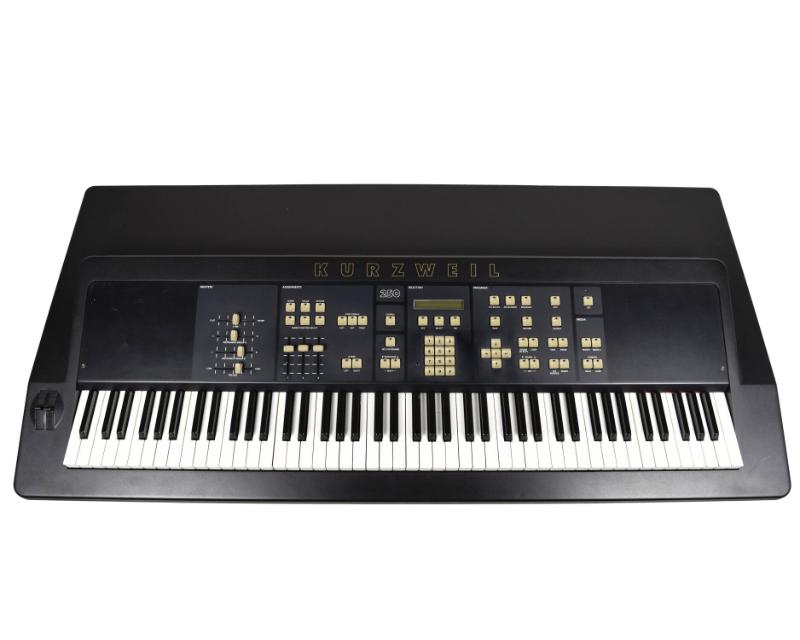
BiographyKurzweil Music Systems was founded by its namesake, Raymond Kurzweil, and popular music mogul, Stevie Wonder, in 1982. Wonder (born 1950 in Saginaw, Michigan), who has been visually impaired since birth, met Kurzweil (born 1948 in Queens, New York) through the latter’s specialized work in developing reading aids for the blind. Their initial efforts in transferring this technology into musical systems came in 1984 with the K250, a sophisticated digital sampler that was, at the time, lauded for producing the most realistic emulation of the grand piano. This was followed by the K150 rackmount additive synthesizer, the K1000 sampler, which was an extension of the K250 sound library, and the K2000 series of the early 1990s, a flexible line of integrated workstation instruments that were capable of both sampling and synthesis. In 1996, Kurzweil founded Kurzweil Education Systems, a firm that focuses specifically on aiding those with literacy and learning disabilities, especially those who are visually impaired or blind. In 1990, Kurzweil Music Systems was purchased by Young Chang, a South Korean musical instrument manufacturer, and later by Hyundai. Today, the original company manufactures under the Kurzweil Computer Products, Inc. moniker.
Kurzweil, a sort of Renaissance man who has worked in the fields of communications, electronic and computer systems development, health and nutrition, biotechnology, speech recognition, neuroscience, filmmaking, and artificial intelligence, earned his Bachelor of Science in computer science from the Massachusetts Institute of Technology in 1970, the result of a highly precocious youth. A series of independent business ventures between 1968 and 1982 allowed him to assert his prominence as an entrepreneur and inventor, especially in the field of electronic aids for the physically impaired. In 1974, Kurzweil developed and programmed an optical character recognition system that could perform text-to-speech functions; as such, any machine employing this technology could be used to read written text and speak it back to the user, naturally serving as an especially useful tool for those suffering from visual impairment and blindness. This developed into the Kurzweil Reading Machine, which served as the basis for many of his early musical instruments. Kurzweil is the author of The Age of Intelligent Machines (1990), The Age of Spiritual Machines (1999), Fantastic Voyage: Live Long Enough to Live Forever (2004), and The Singularity is Near (2006), and is the recipient of numerous prestigious awards, including the Grace Murray Hopper Award (1978) for his invention of the text-to-speech Reading Machine, the National Medal of Technology (1999), which is bestowed by the President of the United States, the Lemelson-MIT Prize for lifetime achievement (2001), the Arthur C. Clarke Lifetime Achievement Award (2009), and a Technical Grammy Award (2015); Kurzweil is also an inductee in the National Inventors Hall of Fame and holds 21 honorary Doctorates. He currently consults with Google on machine intelligence and natural language understanding.
Kurzweil, a sort of Renaissance man who has worked in the fields of communications, electronic and computer systems development, health and nutrition, biotechnology, speech recognition, neuroscience, filmmaking, and artificial intelligence, earned his Bachelor of Science in computer science from the Massachusetts Institute of Technology in 1970, the result of a highly precocious youth. A series of independent business ventures between 1968 and 1982 allowed him to assert his prominence as an entrepreneur and inventor, especially in the field of electronic aids for the physically impaired. In 1974, Kurzweil developed and programmed an optical character recognition system that could perform text-to-speech functions; as such, any machine employing this technology could be used to read written text and speak it back to the user, naturally serving as an especially useful tool for those suffering from visual impairment and blindness. This developed into the Kurzweil Reading Machine, which served as the basis for many of his early musical instruments. Kurzweil is the author of The Age of Intelligent Machines (1990), The Age of Spiritual Machines (1999), Fantastic Voyage: Live Long Enough to Live Forever (2004), and The Singularity is Near (2006), and is the recipient of numerous prestigious awards, including the Grace Murray Hopper Award (1978) for his invention of the text-to-speech Reading Machine, the National Medal of Technology (1999), which is bestowed by the President of the United States, the Lemelson-MIT Prize for lifetime achievement (2001), the Arthur C. Clarke Lifetime Achievement Award (2009), and a Technical Grammy Award (2015); Kurzweil is also an inductee in the National Inventors Hall of Fame and holds 21 honorary Doctorates. He currently consults with Google on machine intelligence and natural language understanding.

(division of Norlin Music Instruments, Ltd.)