Joseph Johannes Couchet
ActiveAntwerp, Belgium
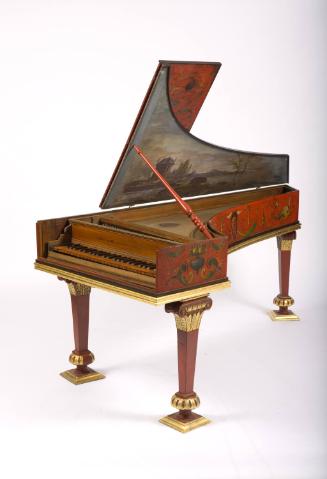
BiographyJoseph Johannes (dates of birth and death unknown) was a member of the Flemish Couchet family of harpsichord and virginal builders, who were based in Antwerp, Belgium. The Couchet family harpsichord building tradition was founded by Joseph Johannes’ father, Johannes Couchet (1615 – 1655), who was the grandson of Hans Ruckers (about 1540 – 1598), and is occasionally referred to as Jan the Elder. Johannes began his career in instrument building through an apprenticeship he undertook with his uncle, the famed Johannes Ruckers (1578 – 1642), son of Hans Ruckers, in 1626. Following Ruckers’ death in 1642, Couchet continued the tradition of harpsichord building that the Ruckers family had established, producing nearly identical instruments. Seven children, three of whom continued in harpsichord building, survived Couchet: Petrus Johannes Couchet, Joseph Johannes Couchet, and Maria Abraham Couchet. Although the Ruckers designs proved to be the most innovative and significant in the history of the instrument, the Couchet family also contributed a few modifications, including extending the range of the keyboard, and introducing different string registrations beyond the standard 8’ and 4’, including 8’ and 8’, and 8’, 8’, and 4’. Joseph Johannes even produced a harpsichord that employed two sets of jacks for a single set of 8’ strings.
The Flemish Ruckers family, which includes the descendant Couchet family, dominated the keyboard industry throughout the sixteenth and seventeenth centuries, having significantly improved upon the structure, technical design, and quality of earlier Italian harpsichords, and established the standard that most harpsichords throughout the seventeenth and eighteenth centuries were modeled upon. The French builders in particular were heavily influenced by the Ruckers’ design, with a number of French harpsichords, including several of those produced by the famed French builder Pascal Taskin (1723 – 1793), being modifications of earlier Ruckers instruments. This process was referred to as ravalement, and consisted in alterations that renewed the case and soundboard, and extended the range of the keyboard. Moreover, their instruments have remained highly influential in the instrument building methodologies of the twentieth century early music revival. As such, they often garner comparisons to the Italian Stradivari family, led by Antonio Stradivari (1644 – 1737), who produced some of the highest quality stringed instruments – primarily violins and cellos – throughout the seventeenth and eighteenth centuries. Although based in Antwerp, Belgium, the Ruckers family is believed to have originated in Germany, with the eldest member of the family, Hans Ruckers, believed to have been born in Weissenburg, Germany and raised in Mechelen, Belgium. Hans Ruckers (about 1540 – 1598) was survived by eleven children, two of whom became harpsichord builders: Johannes Ruckers (1578 – 1642) and Andreas Ruckers I (1579 – 1645). One of Hans’ daughters, Catharina, was married into the Couchet family of instrument builders, and birthed Johannes Couchet, who, as aforementioned, apprenticed under Johannes Ruckers in 1626. Upon Hans’ death in 1598, Johannes and Andreas I merged to carry on the family business, however Johannes remained the sole builder of the firm in 1608. Following Johannes’ death in 1642, Johannes Couchet took over production of the family’s instruments. Andreas Ruckers also had several children, one of whom, Andreas Ruckers II (1607 – 1667) also became a harpsichord builder. Andreas Ruckers II was the last member of the family to use the Ruckers name, with remaining descendants of Hans Ruckers working under the Couchet name.
The Ruckers and Couchet families kept excellent records with their instruments, always incorporating serial numbers, as it were, on the case, numbers on the various sound-producing components, and dates on the soundboard. The designs Ruckers instruments incorporated were somewhat unique from other manufacturers. Renaissance patterns were often used, and were placed on both the key well and along the inside of the case. The family employed well-known Flemish painters such as Peter Paul Rubens and Brueghel to decorate their lids and cases. The rosettes of the soundboard were often surrounded by a painted wreath of flowers, occasionally also featuring other flora and fauna. Every member of the Ruckers and Couchet families also placed an angel playing a harp on the rosette, with the maker’s signature next to it. Based on dating of historical instruments, it is believed that the Ruckers family produced approximately only 40 instruments per year.
The Flemish Ruckers family, which includes the descendant Couchet family, dominated the keyboard industry throughout the sixteenth and seventeenth centuries, having significantly improved upon the structure, technical design, and quality of earlier Italian harpsichords, and established the standard that most harpsichords throughout the seventeenth and eighteenth centuries were modeled upon. The French builders in particular were heavily influenced by the Ruckers’ design, with a number of French harpsichords, including several of those produced by the famed French builder Pascal Taskin (1723 – 1793), being modifications of earlier Ruckers instruments. This process was referred to as ravalement, and consisted in alterations that renewed the case and soundboard, and extended the range of the keyboard. Moreover, their instruments have remained highly influential in the instrument building methodologies of the twentieth century early music revival. As such, they often garner comparisons to the Italian Stradivari family, led by Antonio Stradivari (1644 – 1737), who produced some of the highest quality stringed instruments – primarily violins and cellos – throughout the seventeenth and eighteenth centuries. Although based in Antwerp, Belgium, the Ruckers family is believed to have originated in Germany, with the eldest member of the family, Hans Ruckers, believed to have been born in Weissenburg, Germany and raised in Mechelen, Belgium. Hans Ruckers (about 1540 – 1598) was survived by eleven children, two of whom became harpsichord builders: Johannes Ruckers (1578 – 1642) and Andreas Ruckers I (1579 – 1645). One of Hans’ daughters, Catharina, was married into the Couchet family of instrument builders, and birthed Johannes Couchet, who, as aforementioned, apprenticed under Johannes Ruckers in 1626. Upon Hans’ death in 1598, Johannes and Andreas I merged to carry on the family business, however Johannes remained the sole builder of the firm in 1608. Following Johannes’ death in 1642, Johannes Couchet took over production of the family’s instruments. Andreas Ruckers also had several children, one of whom, Andreas Ruckers II (1607 – 1667) also became a harpsichord builder. Andreas Ruckers II was the last member of the family to use the Ruckers name, with remaining descendants of Hans Ruckers working under the Couchet name.
The Ruckers and Couchet families kept excellent records with their instruments, always incorporating serial numbers, as it were, on the case, numbers on the various sound-producing components, and dates on the soundboard. The designs Ruckers instruments incorporated were somewhat unique from other manufacturers. Renaissance patterns were often used, and were placed on both the key well and along the inside of the case. The family employed well-known Flemish painters such as Peter Paul Rubens and Brueghel to decorate their lids and cases. The rosettes of the soundboard were often surrounded by a painted wreath of flowers, occasionally also featuring other flora and fauna. Every member of the Ruckers and Couchet families also placed an angel playing a harp on the rosette, with the maker’s signature next to it. Based on dating of historical instruments, it is believed that the Ruckers family produced approximately only 40 instruments per year.




piano manufacturer | founded 1857