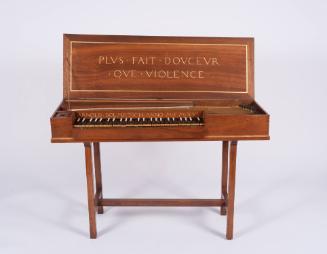
Arnold Dolmetsch
Arnold Dolmetsch is regarded as having been one of the eminent figures in the revival of early music that occurred throughout the twentieth century, steadfast in producing objects that were historically informed and authentic in their delivery, yet reconsidered to reflect modern improvements. Dolmetsch was born Eugène Arnold Dolmetsch in Le Mans, France on 24 February 1858 to Swiss parents. Dolmetsch’s father was an esteemed piano and organ builder and it was in his Le Mans workshop, Maison Dolmetsch-Guillouard, where Arnold first developed his craft. He would go on to study violin, piano, and composition at the Conservatoire royal de Bruxelles, and, between 1883 and 1889, at the Royal College of Music, where he earned his Bachelor of Music degree. As the story goes, it was upon viewing the musical instrument collection at the Brussels conservatory that Dolmetsch was first inspired to build historical objects. He produced his first instrument, a lute, in 1893 before turning his attention toward keyboard instruments, apprenticing with Chickering in Boston, Massachusetts between 1905 and 1910 and Gaveau in Paris, France between 1911 and 1914. Dolmetsch returned to England in 1914 and established a workshop in Haslemere, Surrey, working exclusively with instruments produced throughout the Renaissance and Baroque (approximately the early 1400s through to the end of the 1700s), including viols, lutes, recorders, harps, and keyboard instruments. In 1915, he released the seminal The Interpretation of the Music of the Seventeenth and Eighteenth Centuries, which served as a standard resource in the burgeoning reemergence of early music performance and scholarship. Throughout the 1920s and 1930s, Dolmetsch continued to manufacture an array of instruments, and ensured that his wives (Marie Morel from 1878 – 1889, Elodie Désirée from 1899 – 1903, and Mabel Johnston (from 1903, a scholar in early dance) and four children (Rudolph, Nathalie, Carl, and Cecile) were instructed both in instrument building and in authentic performance. Carl Dolmetsch would continue his father’s workshop following his passing, and the family would perform together for groups such as the Elizabethan Stage Society. Dolmetsch kept a colourful circle of friends in nearby London, which included prominent cultural figures such as Ezra Pound (1885 – 1972, mentions Dolmetsch in Canto LXXXI), W.B. Yeats (1865 – 1939), Selwyn Image (1849 – 1930), Percy Grainger (1882 – 1961), and Roger Fry (1866 – 1934). Many of his instruments featured original Arts and Crafts designs; as such, ownership of a Dolmetsch instrument carried with it a certain status symbol. Dolmetsch passed away on 28 February 1940 in Haslemere. Although today his name is not widely known outside the instrument building community, his cultural legacy remains strongly felt: thanks to his revival of the recorder – a forgotten instrument that was little used beyond the medieval and Renaissance eras – and his advocacy of its potential function as a teaching aid for amateur performers, it has become among the most widely used in educational music programs and one of the most mass produced for the entry-level market. An annual summer festival of early chamber music, founded by Dolmetsch in 1925, is still held in Haslemere. Since 1940, his collection of instruments has been held by The Horniman Museum in south London.