EN / FR
Skip to main content

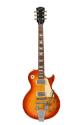
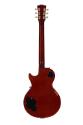
Randy Bachman American Woman Guitar

Not available for use in Recording Studios
Not currently on exhibit
Artifact TypeGuitar, Electric
Manufacturer LocationUSA
Date1959

Arguably one of the most famous guitars in Canadian rock’n’roll history, Bachman acquired his signature instrument on a whim during his early days with The Guess Who. While playing a gig in a church basement in Nanaimo B.C., a young fan offered to trade his 1959 Gibson Les Paul for Bachman’s own guitar – and the $72 he had in his pocket. It wasn’t long before it became the Canadian rocker’s favourite playing guitar – shaping the distinctive buttery sound behind famous tracks such as “These Eyes”, “No Time”, and the band’s gigantic hit, “American Woman”. 


On loan from Randy Bachman

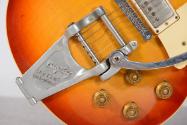
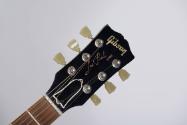
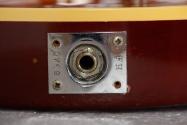
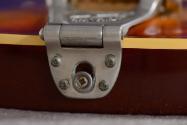
Operation/FunctionThis artifact consists of a solid wooden body (mahogany on the back, two-piece carved maple on top), six steel strings, a wooden (mahogany) neck, a wooden and metal headstock with accompanying machine heads, and wooden (rosewood) fingerboard with metal frets. The instrument’s maple top is stained with a light brown and orange “sunburst” design and coated with a lacquer finish. It employs standard tuning, with open string pitches beginning at the bottom with the highest pitch, the E a major third above middle C, and moving downwards in pitch by a fourth to B, downwards by a major third to G, downwards by a fourth to D, downwards by a fourth to A, and downwards by a fourth to E, spanning two octaves in total. The instrument’s front features a toggle power switch and plastic pick guard, as well as four volume and tone controls (potentiometer knobs). This guitar employs two standard PAF humbucker pickups with nickel covers, a Bigsby B7 vibrato unit, Kluson-style machine heads, and a nickel-plated “Nashville”-style Tune-o-matic bridge with accompanying aluminum stopbar. The instrument is referred to as being ‘standard-handed’, meaning it is to be strummed with the right hand while the left hand controls the frets.Cultural SignificanceThe cultural significance of both the acoustic and electric guitar cannot be overstated. Gibson remains at the forefront of guitar manufacturing as one of the leading companies, with the Les Paul model recognized as perhaps the most iconic of all electric guitar models. The firm’s primary competition throughout the late 1950s and into the 1960s was the California-based Fender Electric Instrument Manufacturing Company, who produced the equally influential Telecaster, Stratocaster, Jazzmaster, and Mustang models. Although the acoustic guitar is perhaps not used quite as commonly as the electric guitar, both have remained throughout the course of the twentieth century one of, if not the most, exploited instruments in popular music. This particular unit was purchased as one of three 1959 Standard units, with the other two being acquired by Jimmy Page of Led Zeppelin and Keith Richards of The Rolling Stones. Together, these three guitars have produced some of the most revered sounds in popular music.Technological SignificanceBoth acoustic and electric guitars have undergone a number of technological advances that have improved their tone and construction quality, however it is the mere advent of the latter that has had the most lasting technological impact. Les Paul (1915 – 2009) helped pioneer both the design and popularity of the electric guitar, and is considered one of the founders of solid-body technology, having produced a prototype called “The Log” while working at Epiphone’s New York factory in 1940. Additionally, Paul also conducted a number of experiments in guitar design and recording technology, essentially establishing the revolutionary practices of multi-track recording and overdubbing, as well as delay and phasing effects. Fender, based in California, was the first company to produce a commercial solid-body electric guitar in 1950 with the release of the Telecaster, and Gibson responded in 1952 with the Les Paul, named in recognition of the fact that Paul helped design the instrument with Gibson’s president of the time, Ted McCarty. Gibson also contributed several other innovations throughout its history, including McCarty’s Tune-o-matic bridge and stopbar, which first featured on a Les Paul Custom in 1953 and remains the standard bridge of Gibson electric guitars, as well as the first semi-hollow-body electric guitar in 1958. The Tune-o-matic consists in two adjustable posts connected by a metal bar with six openings for holding the instrument’s strings. These openings, referred to as ‘saddles’ can each be independently shifted backwards or forward with a screw to set an optimal tension and intonation for maximizing amplification of the string’s vibrations. The main alternative to this design throughout the late 1950s and 1960s was Fender’s Jazzmaster-style bridge. Gibson also produced the first commercial humbucker pickup, designed in 1955 and patented in 1959, which eliminated the hum of single-coil pickups without compromising the tone quality. In the late 1950s and early 1960s, Gibson also premiered several series of electric guitars that featured futuristic body shapes, including the Flying V, Explorer, and Firebird. The Bigsby vibrato unit featured on the Les Paul was also quite innovative, offering players the ability to perform slight pitch bends, as is commonly practiced on orchestral string instruments. Bigsby’s basic design was later incorporated into many electric guitar models, having been colloquially dubbed the ‘whammy bar’. The Bigsby approach is regarded for its depth of control across a wide range of motion, typically suited to slow, subtle, and extended pitch bends. These units were featured either directly or in retrofit on many units from manufacturers such as Gibson, Epiphone, and Gretsh, with competing styles such as the Floyd Rose and Fender ‘trembar’ offering more immediate and pronounced control. The first Les Paul model emerged between 1951 and 1952, with two P-90 single-coil pickups. This was succeeded in 1953 by the Les Paul Custom and Goldtop models, which incorporated the Tune-o-matic bridge. In 1957, the P-90 pickups were replaced by humbucker units and, in 1958, the Standard model emerged with a new “sunburst” design. In 1961, a lighter redesign came in the form of the SG, not technically a part of the Les Paul family, which was once again replaced by the Les Paul Standard in 1963. The Les Paul Special and Junior models also appeared in the mid 1960s. Changes in ownership in 1969 resulted in a decline in quality of subsequent units. Although the acoustic guitar is not recognized as having made as significant a contribution in instrument technology, it has also seen many important changes throughout its history. The instrument finds it origins in the lute, which featured a varying number of gut strings and was most popular throughout the Renaissance, and the Baroque guitar, which featured five sets or courses of gut strings and eclipsed the popularity of the lute in the early eighteenth century. The majority of usage of such instruments took place in Europe, however a number of variants of these instruments, such as the Middle Eastern oud, were equally as prevalent. The modern guitar shares the same basic construction approach as its predecessors, consisting of a curved wooden sound box and soundboard, designed to optimize amplification and tone quality, as well as a neck and fretboard across which a series of tuned strings are strung. Although performance techniques and tuning systems have been considerably adapted over the years, the same basic approach of plucking or strumming with one hand and coordinating frets with the other has also been maintained. The modern acoustic guitar was pioneered by the American C.F. Martin & Company, which was founded in 1833 by the German craftsman Christian Frederick Martin. Martin established the body shape and size still used in modern acoustic guitars, which employed a larger lower bout, smaller upper bout, and deeper box than its Classical predecessors so as to produce a louder volume and accentuate bass frequencies. Martin’s design was known as the “dreadnought”, and quickly became the most common body style on account of its ability to project the guitar above other instruments in an ensemble. Martin was also pivotal in introducing steel strings to replace the nylon strings used in Classical guitars. Steel strings significantly altered the structural requirements of the instrument and, along with Martin’s inclusion of a series of bracing pieces in the box and the truss rod in the headstock, further enhanced the tone quality and volume. Most modern pickups come in the form of the humbucker pickup, which employs two coils in inverse phase so as to reduce the amount of extraneous noise or AC hum included in the signal. The first dedicated pickup was designed by Hawaiian steel-guitar player, George Beauchamp, in collaboration with Adolph Rickenbacker in the early 1930s. The use of pickups rendered any need for a hollow wooden soundboard or resonating structure obsolete in associated instruments. Of course, the use of pickups also meant that the conventional tone of the acoustic instruments to which they were applied, such as guitars, pianos, and harpsichords, could be modified through the use of external effects pedals and amplification systems.Users/PerformersRandy Bachman (born 1943 in Winnipeg, Manitoba), guitarist, songwriter, and radio host, best known as the lead guitarist and one of the founding members of The Guess Who and Bachman-Turner Overdrive. Bachman began his musical career as a child, studying violin in the Royal Conservatory of Toronto system; he would later cite his affection for the sustain of string instruments as informative of his desired sound in the Garnet Herzog distortion unit, which he helped design with tube amp repairman, Gar Gillies. In 1960, Bachman co-founded the group Al and The Silvertones with Chad Allan, changing the name in 1962 to Chad Allan and the Expressions, and again to The Guess Who. In 1966, Burton Cummings replaced Chad Allan as front man of the band. Bachman co-wrote many of the songs on the first three albums, all of which also feature the Garnet Herzog and amplifiers: Wheatfield Soul (1968), Canned Wheat (1969), and American Woman (1970). The single “American Woman” reached number 1 on the U.S. charts in 1970, the first time this achievement had been earned by a Canadian group. Bachman left the group following the release of American Woman, citing irreconcilable differences in lifestyle. Bachman also recorded a solo album at this time, Axe, which was released in March 1970 on RCA Records. In 1971, he and Chad Allan formed the band Brave Belt, later changing the name to Bachman-Turner Overdrive, in reference to another Garnet amplifier, the Big Time Operator, or BTO. The group released their first album, Bachman-Turner Overdrive in 1973. Bachman eventually left BTO in 1977 to pursue a series of solo recordings and collaborations. Bachman was the recipient of an honorary doctorate from Brandon University (Brandon, Manitoba) in 2001, in 2005 he was awarded the Order of Manitoba, and in 2008 he was made an Officer of the Order of Canada. The Guess Who received The Governor General’s Performing Arts Award in 2002.
Object numberL.2015.01.01.1-2
Photo credit: Don Kennedy
Vladimir Bosnar
1979
Not available for use in Recording Studios
On View: On exhibit
isVirtual:
Photo credit: Don Kennedy
Gibson Guitar Corporation
Not available for use in Recording Studios
On View: Not currently on exhibit
isVirtual:
Photo credit: Don Kennedy
Oscar Schmidt Company
Unknown
Not available for use in Recording Studios
On View: Not currently on exhibit
isVirtual:
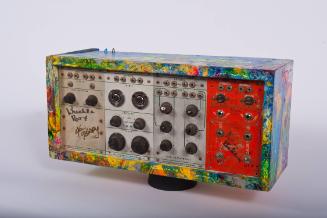
Photo credit: Don Kennedy
Donald Buchla
c. 1966
Not available for use in Recording Studios
On View: On exhibit
isVirtual:
Photo credit: Don Kennedy
On View: On exhibit
isVirtual:
Photo credit: Don Kennedy
Hohner Musikinstrumente GmbH & Co. KG
c. 1950
Not available for use in Recording Studios
On View: Not currently on exhibit
isVirtual:
Photo credit: Don Kennedy
Joseph Johannes Couchet
1679
Not available for use in Recording Studios
On View: On exhibit
isVirtual:
Photo credit: Don Kennedy
Buchla & Associates
1999
Available for use in Recording Studios
On View: Not currently on exhibit
isVirtual:
Photo credit: Don Kennedy
Raymond Scott Enterprises/Manhattan Research
1957
Not available for use in Recording Studios
On View: Not currently on exhibit
isVirtual:
Photo credit: Don Kennedy
The Wurlitzer Company
c. 1959
Not available for use in Recording Studios
On View: On exhibit
isVirtual:
Photo credit: Don Kennedy
Sébastien Érard
1820
Not available for use in Recording Studios
On View: On exhibit
isVirtual:
Photo credit: Don Kennedy
Chamberlin Instruments Company, Inc.
1970
Not available for use in Recording Studios
On View: On exhibit
isVirtual:
Back