




EN / FR
Skip to main content

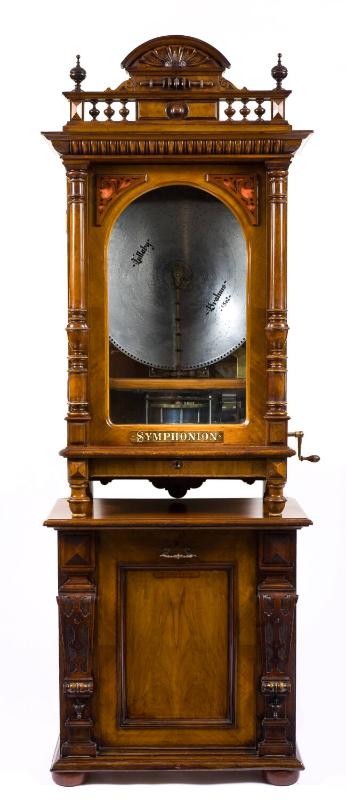
Symphonion Music Box

Not available for use in Recording Studios
On exhibit
On exhibit
Artifact TypeSound Equipment, Music Box
Manufacturer LocationGermany
Datec. 1890
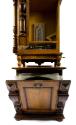
The Symphonion is basically a standalone music box. Much like changing albums on a modern-day DC or record player, it is equipped with metal discs that can be changed to play different pieces of music. The variety and ease of use offered by the Symphonion made it a popular 19th century instrument—even playing a significant role in disseminating popular music through the public sphere. As such, the Symphonion had a direct impact on the development of the player piano and barrel organ. This particular example is coin-operated—but you’ll need an era-specific British penny to make it sing.
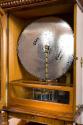
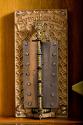
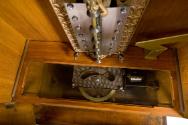
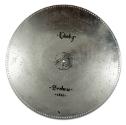
Operation/FunctionThis particular artifact consists of two portions: a music and the stand on which it rests. The exterior cabinets of both are constructed of wood, with brass handles and finishes. The stand contains a single drawer that opens from the top, used to store discs that may be interchanged within the player. The music box player features a glass door, allowing the user to view the rotation of the disc. The mechanism of the player consists of a series of gears and springs, both constructed of metal, used to control the rotation of the disc. The disc itself is constructed of likely either steel or zinc, and is secured to the player by a brass holder and metal shaft. The tines of the comb are constructed of steel, and number at approximately 50. The diameter of each disc is approximately 20”.Cultural SignificanceDuring the nineteenth and early twentieth centuries, the music box, especially larger ones such as the Symphonion, would have been associated with affluence, and, in addition to being used as entertainment devices in public venues, were typically featured in the homes of the wealthy. This could be viewed as a primary distinction between the music box and the similarly designed barrel organ: the barrel organ was portable and intended for public use, while the music box varied in size and orientation, and could be used both in public and private contexts. As such, the music box is effectively the first mechanical musical instrument to achieve a significant level of domestic popularity, and is generally considered a predecessor to the player piano and the phonograph. In much the same way as the player piano and the phonograph, the music box served an important entertainment function in the locations in which it was installed, and was significant in proliferating music to populations that may not have ordinarily been capable of or interested in engaging in the culture of live musical performance. In a way, the music box can be seen as a predecessor for all modern machines whose purpose is one of musical dissemination: it employed interchangeable objects that contained coded musical information that was to be played back through the instrument, and usually only consisted of the popular musical pieces of the era. When the user became tired of the music, he or she needed only switch the playing object for another.Technological SignificanceThe music box remains one of the first fully mechanical musical instruments, and is also one of the first to be capable of automation, predating both the player piano and the phonograph, and influencing the development of similar mechanical instruments such as the barrel organ. Although the cylinder-playing music box predates the disc-playing music box, the latter garnered greater popularity during the late nineteenth and early twentieth centuries on account of its flexibility; the great advantage of disc-playing music boxes is that they were more often interchangeable, allowing the user to replace the music produced by the instrument. Moreover, while the pins of cylinders had to be inserted manually, the perforations in discs could be produced by a machine, making the latter format far easier to manufacture and reproduce. Interestingly, many manufacturers of disc-playing music boxes varied the dimensions used in their instruments, including those of the metal tines and shafts for holding the discs, so as to prevent the use of their discs in a different manufacturer’s machine. Throughout the late nineteenth century and early twentieth centuries, Symphonion, its sister company Polyphon, and the New Jersey-based Regina dominated the music box manufacturing industry with their stand-alone disc-playing instruments, helping to popularize the machines through mass production. The player pianos that succeeded music boxes employed a similar method of programming musical information into the machine: in player pianos, the pitch and duration of notes is transcribed as perforations onto a paper roll. Although these paper rolls may look similar to the perforated metal discs of music boxes, the player piano still functions as a piano, employing a striking mechanism to activate vibrations in strings instead of the plucked action found in music boxes. The player piano was even more flexible than the disc-playing music box, and it was standard for paper rolls to contain a number of different musical pieces that could be selected by moving through the scroll. Player pianos could also be operated as a “regular” piano, and thus served a dual function in the household, both for those who could play the instrument and those who could not. The music box flourished in an era in which technological developments in clockwork mechanisms were at their apex. That being said, more primitive versions of mechanical musical instruments have been in existence since approximately the ninth century, while devices employing some sort of automatic mechanism, not necessarily for musical purposes, can be said to date back to Greece in approximately the fifth century BCE. The earliest examples resembling the music box emerged in the Middle East and, later, in Western Europe, and consisted of a mechanism that employs the rotation of a barrel outfitted with a series of pins; this design largely remained standard until the advent of the disc-playing music box in the nineteenth century. The primary predecessor to the music box is often considered to be the carillon; though an instrument that employs a struck instead of plucked action, the carillon was one of the first musical instruments to employ the occasional use of an automatic mechanism that would ring the bells of the instrument based on a musical program. Throughout the fifteenth century, the carillon continued to be developed into much smaller forms, and eventually found equal usage in both outdoor and indoor settings. The development of mechanical musical devices continued to grow throughout the sixteenth and seventeenth centuries in Europe, and throughout the seventeenth, eighteenth, and early nineteenth centuries, cylindrical mechanisms similar to those found in music boxes were incorporated into large clocks, often employing the same system of gears, and consisted of an assortment of percussive instruments, including drums and, more commonly, bells, instead of metal tines. The use of a steel comb edged with metal tines instead of bells as the sound producing material is believed to have originated in Geneva, Switzerland in 1796, attributed to the Swiss watchmaker Antoine Favre, with the first fully developed music boxes appearing in around 1811. With the advent of the steel comb, the miniaturization of the instrument began, and small music boxes began to become incorporated into small mechanical devices such as pocket watches. The first disc-playing music boxes emerged in Germany in around 1870, and by 1895 they had eclipsed the cylinder music boxes in popularity. The earliest music boxes were generally smaller and individually crafted, however as production increased throughout the mid nineteenth century, the instruments grew in size, and became more complex in their construction and design, typically appearing as stand-alone items. The period between 1870 and 1890 is regarded as the most technologically advanced era for the cylinder music box, while the period between 1895 and 1905 is regarded as the technological golden age for disc-playing music boxes, with their usage spreading throughout both public and domestic spheres. Symphonion was chief among the disc music box manufacturers, and in 1889 the company patented the “star wheel” mechanism that became standard in machines employing this medium. Several other manufacturers also contributed a number of standard features to the instrument: the brass barrel was developed in Belgium, while the inclusion of a “singing” bird, typical of many traditional Alpine clocks, was established in Switzerland in the late eighteenth century. Other innovations included the sectional comb, which consolidated the teeth that would previously have been allocated among several different combs, each producing varying timbral qualities, into a single comb. Music boxes were also often ornately decorated, and were occasionally paired with mechanically moveable figurines, such as ballerinas or animals. The closest relative of the music box is the orchestrion, which refers more generally to mechanical instruments that employ a similar cylinder or disc mechanism, but that also incorporate a variety of instruments beyond the steel comb or bells of earlier music boxes. The panharmonicon was one such instrument: produced by Johann Nepomuk Maelzel (1772 – 1838), the German designer who is also credited with the invention of the metronome, the panharmonicon was effectively a large music box that extended the timbral range to include a number of orchestral instruments as well as a bellows system that were both powered by the automatic mechanism. Beethoven, a great admirer of mechanical music devices, composed his Wellington’s Victory for the panharmonicon. In addition to Symphonion, Polyphon, and Regina, other well-known produces of music boxes included Olympia, New Century, Mira, Lockmann, Kalliope, Empress, and Adler.Users/PerformersGiven that the music box is not a musical instrument in the traditional sense, there is no documentation of associated “performers”, so to speak. That being said, a number of composers have incorporated the music box into their work, and in a variety of ways, either through sampling or through custom-built devices. Popular recording musicians to have incorporated the music box into a work include English electronic composer Aphex Twin, and Icelandic electronic composer Björk, the latter of whom employed custom-built discs. A number of composers following in the “classical” tradition have also employed music boxes into their works, with some even composing specifically for boxes that were later custom built to perform the pieces. Most notable among these is Tierkreis (1745-75), by the famed German composer and electronic music pioneer Karlheinz Stockhausen (1928 – 2007). Tierkreis, which translates from the German for “zodiac”, consists of a series of twelve separate melodies, each corresponding to a particular sign of the zodiac calendar. These melodies were originally composed for music box, but have been featured in countless interpretations and variations, scored for a wide range of ensembles and arrangements. In the Classical era, all three composers of the First Viennese School – Haydn, Mozart, and Beethoven – composed works specifically for mechanical music boxes and similar devices.
Object number2004.04.04.1-2
Photo credit: Don Kennedy
Harvey Krantz
20th Century
On View: Not currently on exhibit
isVirtual:
Photo credit: Don Kennedy
Joseph Johannes Couchet
1679
Not available for use in Recording Studios
On View: On exhibit
isVirtual:
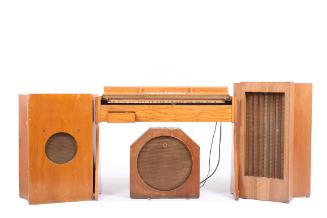
Photo credit: Don Kennedy
Maurice Louis Eugène Martenot
1975
Available for use in Recording Studios
On View: Not currently on exhibit
isVirtual:
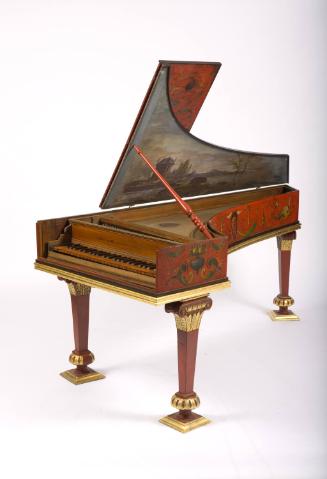
Photo credit: Don Kennedy
Vido Trasuntino
1591
Available for use in Recording Studios
On View: Not currently on exhibit
isVirtual:

Photo credit: Don Kennedy
c. 2010
On View: Not currently on exhibit
isVirtual:
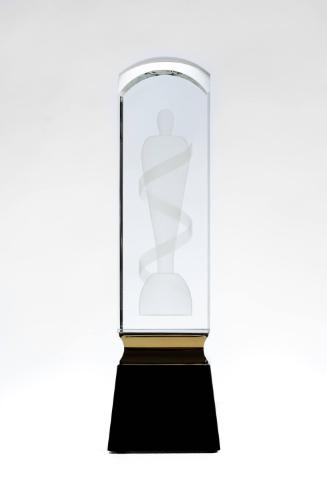
Photo credit: Don Kennedy
2011
On View: Not currently on exhibit
isVirtual:
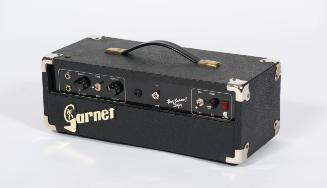
Photo credit: Don Kennedy
Garnet "Gar" Gillies
c. 1960
Not available for use in Recording Studios
On View: On exhibit
isVirtual:
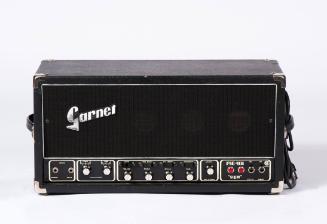
Photo credit: Don Kennedy
Garnet "Gar" Gillies
Available for use in Recording Studios
On View: Not currently on exhibit
isVirtual:
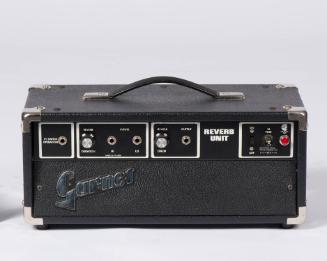
Photo credit: Don Kennedy
Garnet "Gar" Gillies
Available for use in Recording Studios
On View: Not currently on exhibit
isVirtual:
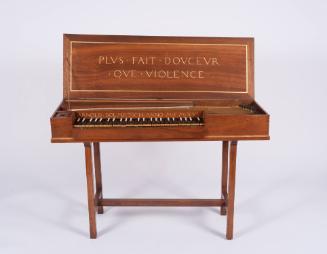
Photo credit: Don Kennedy
Arnold Dolmetsch
1926
Not available for use in Recording Studios
On View: On exhibit
isVirtual:
Photo credit: Don Kennedy
Sébastien Érard
1820
Not available for use in Recording Studios
On View: On exhibit
isVirtual:
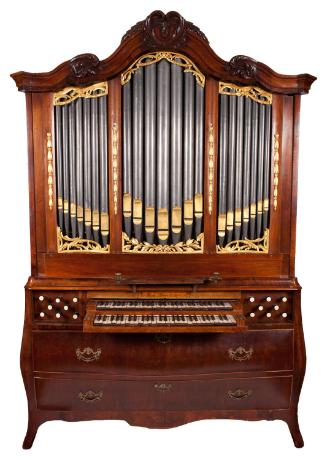
Photo credit: Don Kennedy
Hendrik Anthonie Meijer
1785
Not available for use in Recording Studios
On View: Not currently on exhibit
isVirtual:
Back