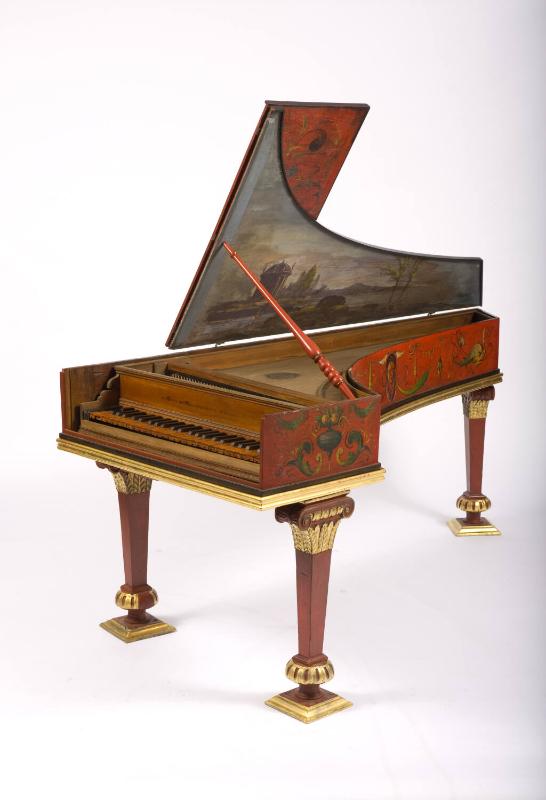
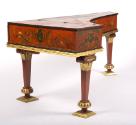
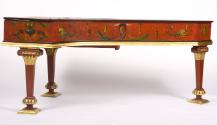
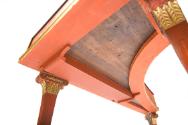
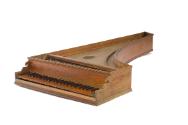
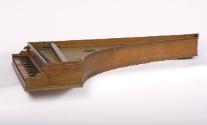
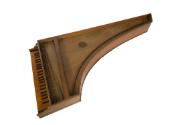
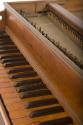
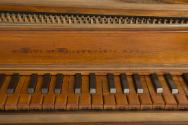
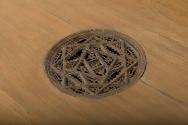
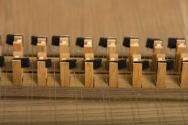
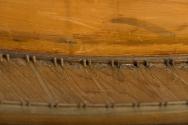
Trasuntino Harpsichord
Available for use in Recording Studios
Not currently on exhibit
Not currently on exhibit
Artifact TypeHarpsichord
Manufacturer
Vido Trasuntino
1522 - 1606
Date1591
Operation/FunctionThis particular instrument is a single manual Italian harpsichord, employing an E – E (four octaves) compass, brass and steel strings, wooden jacks, leather plectra, a wooden soundboard, keyboard, case, and bridge, metal hitch pins and tuning pins, and a decorative rose.Cultural SignificanceThe harpsichord is historically recognized as the most well known of the plucked string keyboard instruments, with the more compact virginal and spinet holding a similar reputation to the vertical piano in their being a more practical alternative to the larger and more complex grand piano. It stood as the dominant keyboard instrument of the Renaissance and Baroque eras, and its designer’s penchant for complexity and intricate design has resulted in the instrument’s association with luxury, opulence, and innovation. Unlike the clavichord, the harpsichord was capable of projecting its tone to a far more substantial level and was thus more suitable for public usage. The harpsichord remained popular in the context of chamber and orchestral performance, as it was loud enough to hold its place among a group of instruments, while the virginal and spinet, along with other small keyboard instruments such as the clavichord, were more common in domestic settings and among travelling musicians. Although most composers of keyboard music throughout the Renaissance and Baroque did not write for a specific instrument, the harpsichord was typically the most popular among early keyboard instruments, and remained so until its decline in the eighteenth century with the rise of the piano. A number of prominent composers, including J.S. Bach, Franz Haydn, and W.A. Mozart composed for the harpsichord. Although the instrument remained relatively obscure throughout the nineteenth century, its resurgence in the twentieth century – both in the form of the revival movement of the early twentieth century and the historical revival in the mid twentieth century – once again returned the instrument into popular usage. Along with its modern usage in early music revival, repertoire for the harpsichord has considerably expanded throughout the century, including appearances in popular and experimental music. The design of the instrument has continued to develop throughout the century, as well, with electric versions of the instrument emerging in the mid twentieth century.Technological SignificanceAlthough succumbing to the piano late in the eighteenth century, instruments belonging to the harpsichord family are still today regarded as tonally and structurally intriguing on account of their unique plucking mechanism. The harpsichord, in its ability to alter its tone, split its voicing over the two manuals of double-manual instruments, and maintain a relatively loud volume, remained the dominant keyboard instrument of the Baroque era. When the piano emerged in 1700, however, it brought with it a more sophisticated clavichord mechanism that enabled the instrument to project its tone. Unlike the harpsichord, the clavichord employs a striking mechanism that attaches small pieces of metal called tangents to the back end of the keys: when a key is depressed, the back end is lifted and the tangent hits the string, causing it to vibrate. Since there is no other mechanism separating the key from the tangent, however, the difficulty with the clavichord lies in the fact that the tangent remains in contact with the string for as long as the player holds down the key. As a result, the tangent dampens the vibrations in the strings, preventing them from projecting. That being said, since the touch of the key is directly correspondent with the movement of the tangent, it is possible for the player of the clavichord to produce tones that vary in dynamic expression; by hitting the key with minimal force, a quieter sound is produced, and by hitting the key with a greater force, louder tones are achieved. Thus, although the clavichord was more expressive than the harpsichord, its tone was, overall, too quiet in comparison and the instrument was largely rendered inappropriate for public performance. The inventor of the piano, Italian builder Bartolomeo Cristofori, is crediting with the design of the single escapement action, which improved upon the key lever system of the clavichord by physically detaching the key from the tangent, or hammer as they are called in pianos. When a key is depressed on Cristofori’s piano, the hammer is similarly pushed upward to strike the string, but then falls back to its resting position immediately afterward under its own weight, regardless of whether the key remains held down. Cristofori’s piano was also capable of producing the same types of expressive and dynamic variations as the clavichord. For the most part, the harpsichord was not capable of varying its dynamics – an unfortunate feature that is attributed to the plucking mechanism. A number of innovations were introduced into the instrument to attempt to overcome this difficulty, including: incorporating coupling mechanisms into double-manual instruments, which would enable the player to split the manuals into 8’ and 4’ sections, thereby producing tones of slightly varying amplitude as well as frequency; replacing the quill or bone plectra with ones made of leather – a practice first established by the French builder Pascal Taskin in 1768, which produced a slightly softer tone; introducing materials such as silk and silver into the instrument’s steel and brass strings, again, so as to produce somewhat softer tones; and, retrofitting the lid of the instrument with moveable slats that would allow the player to make active changes to the projected amplitude. In the end, these innovations proved ineffectual, and the hammering system of the piano, capable of natural subtleties and variations that are a direct result of the player’s touch, emerged as the more flexible mechanism at the end of the eighteenth century. The organ, though also considered an early keyboard instrument, is often placed into its own category of instruments, and has been continuously refined over the centuries to allow the player a great many number of variations in tone, timbre, and amplitude. The harpsichord also suffered further practical issues, one of which stems from the manner in which the jacks mute the strings after the key is released. When the key is released, the jack falls back into its resting position and a piece of felt placed at the top of the jack serves to dampen the vibrations of the strings. Unless a key is held down for a sufficient amount of time, which is not generally feasible in common performance practice, the jack mutes the string somewhat prematurely, resulting in a tone that feels roughly cut.
On account of its size and complexity, the harpsichord was usually considered the central figure of the harpsichord family. The virginal, which is believed to have predated the harpsichord, is generally recognized as a smaller, more compacted version of the harpsichord; in this sense, it is not unlike the square or vertical piano in its relation to the larger and more complex grand piano. The virginal itself is characterized as having one of two keyboard orientations, making it either in the form of a spinet virginal, or in the form of a muselar virginal. Each orientation serves to alter the sound of the virginal in slight and subtle ways. The ‘spinet’ virginal is considered the standard orientation, with the keyboard positioned closer to the left side of the instrument. In this position, the strings are plucked at one end just before the bridge, in much the same manner as the harpsichord and most other acoustic instruments that employ a bridge. A greater harmonic variance in the tone is produced in these instruments on account of the end of the string producing upper harmonics when activated. The ‘muselar’ virginal, however, positions the keyboard closer to the middle or right side of the instrument, away from the bridge. In this arrangement, an area closer to the center of the strings (at approximately one-third the sounding length of the string) is plucked, resulting in a warm, resonant tone that isolates more of the fundamental frequency, and less of any associated upper harmonics. Placing the keyboard farther from the bridge, as the muselar does, results in greater amplification by the sound box (essentially, the hollow wooden case in which the instrument sits), producing a deeper tone than would occur in the spinet virginal. Moreover, with the plucking mechanism placed nearer to the centre of the soundboard, the muselar virginal also amplifies the sounds of the mechanism itself, which is regarded as the major drawback of the orientation. The orientation of the keyboard is the primary factor in determining the sound produced by any particular virginal, as it affects both the location of the jacks in relation to the soundboard, and the position at which the strings are plucked, the latter of which will produce varying amounts of harmonics in addition to the fundamental. Unlike the harpsichord, in which one end of the strings are attached directly to tuning pins, both ends of the virginal’s strings are attached directly to the soundboard, giving it a more unique tone.
In addition to the virginal, several other smaller variations of the harpsichord were designed. The next most common variation is the spinet, which is not to be confused with the spinet virginal. The spinet is an instrument that lies somewhere in between the harpsichord and the virginal: it features one bent side, as in the manner of the harpsichord, but its keyboard is also placed along the longest side of the body, typically closer to the left side. The strings of the spinet run at approximately a 30-degree angle to the keys, and are grouped in pairs, with two jacks placed in the space in between, facing either side. This is done because, being strung at an angle, the strings are too close together for an individual jack to fit in the space in between. Thus, by placing two strings closer together, a large space is made in between each pair, and the two jacks may be placed side by side, facing opposite directions. The spinet is regarded as having a feel more akin to the harpsichord, however due to the orthogonal stringing, the spinet loses much of its bass tones. The double virginal, or virginals, as it was more commonly called, is another variation of the virginal that consists of two separate instruments merged within one case. The “mother” virginal, consisting of an 8’ set of strings, was oriented as a muselar, with the keyboard positioned on the player’s right hand side. On the left hand side of the instrument was a small drawer for a second virginal containing a 4’ set of strings. This virginal, often referred to as the “child”, could either be played on its own, or it could be removed from its drawer and sat on top of the “mother”, thus producing a double-manual virginal in which both the 8’ and 4’ sets of strings could be activated from the “mother” manual. The 8’ arrangement of strings was standard in most virginals, however an independent series of instruments that employed only a 4’ set of strings were also produced. These instruments, which were otherwise identical to the rectangular spinet virginal, were referred to as ottavino (pl. ottavini), which derives from the Italian for ‘octave’ and is named in recognition of the fact that the 4’ ottavino is pitched at exactly one octave higher than the 8’ virginal. Unlike most virginals, in which the keyboard is recessed into the case, the keyboard of the ottavino emerges from the case. The ottavino also lacks a protective lid, and, like most early virginals, was not built with legs. Due to its small size, the ottavino remained a popular domestic instrument, well suited for composing and practicing in one’s home. Another variation of the harpsichord came in the form of the clavicytherium, which, not unlike the vertical piano, orients its strings and soundboard vertically instead of laterally. As in the vertical piano, the clavicytherium was designed so as to provide a space-saving alternative. Since both instruments are unable to incorporate gravity into their action, their mechanism tends to be more complex than that of their laterally oriented counterparts. Yet another variation came in the form of the archicembalo, which was first constructed in the sixteenth century with a unique keyboard design that was capable of accommodating different tuning systems. A very small number of pedal harpsichords were also built prior to the eighteenth century, and included another set of strings underneath the primary disposition that were controlled with the player’s feet via a series of pedals. No known examples of this instrument currently exist. An instrument known as the tangent piano also emerged briefly, incorporated the shape of the harpsichord with the mechanism of the clavichord. This instrument was not produced in large numbers, and was also eclipsed by the piano, which substantially modified the clavichord mechanism. In the late nineteenth century, a number of piano builders, most notably the French firms of Érard and Pleyel began reproducing harpsichords, incorporated techniques and materials borrowed from piano building. These instruments came to be known as “revival” harpsichords and, along with the historically informed instruments that arose in the mid twentieth century, which based their designs on historical models and documents, were in popular use throughout the twentieth century. Some modern harpsichords are built with a transposition mechanism that allows the player to shift the keyboard so as to alter the A pitch (i.e. 440 Hz versus 415 Hz, etc.).
The harpsichord finds its origins in the psaltery, a medieval plucked stringed instrument that was modified at some point during the mid fifteenth century to incorporate a keyboard for controlling the plucking action. The psaltery also employed tuning pins similar to those found in the harpsichord, as well as a bridge and soundboard for amplifying the vibration of the strings. The foremost producers of harpsichords, virginals, and spinets during the late Renaissance and Baroque periods were based primarily in the regions of Italy, England, France, Germany, and Flanders, an area that encompasses modern day Belgium and the Netherlands. The spinet and the virginal are understood to have first appeared in Italy in the early sixteenth century, followed by the first Flemish spinets and virginals. Earlier harpsichords, primarily constructed by Italian builders, were distinguished from later ones of other nations in that the former were somewhat smaller, typically featuring a shorter compass and only a single set of strings, being similar in size to the hand-held psaltery. Italian instruments employed cypress wood as the primary construction material, while the instruments of Northern Europe typically employed heavier woods such as poplar. Moreover, Italian instruments were generally known for being relatively lighter in weight, also maintaining a relatively lower string tension. The spinet virginal was used all throughout Europe, however the muselar was featured only in Northern Europe, with its design was attributed to the famed Flemish builder, Johannes Ruckers (1578 – 1642). The Ruckers family of builders is also credited as the foremost producer of the mother and child virginals, and is considered the pioneer of the double-manual harpsichord. In around 1580, they revolutionized harpsichord design by introducing a heavier construction into the instrument, so as to produce a more resonant and balanced tone. In addition, they employed iron strings in the treble register with greater tension throughout, as well as multiple sets of strings. The Ruckers family is historically recognized as one of the most esteemed manufacturers of harpsichords and virginals, and was based in Antwerp, which stood as the centre of harpsichord production during the sixteenth and seventeenth centuries. Their instruments are unique in their designs, and are lauded for their innovative construction and high standard of quality; effectively, their instruments set the standard throughout Europe. The first instrument builders who settled in Antwerp were believed to have arrived from Germany in the early sixteenth century. While the Flemish harpsichords, and primarily those of Ruckers, served as the model for most other builders throughout Europe throughout the seventeenth and eighteenth centuries, each region introduced its own variations in proportion, design, construction, and tone. Italian harpsichords, for instance, were unique in their use of cypress wood for the case, soundboard, and bridge, and did not typically feature two manuals. While the Flemish employed a double manual for the purpose of transposition, the French builders were the first to adapt its usage in the mid seventeenth century to the control of different choirs of strings, allowing the player to alter the tone of the instrument. The French builders also extended the range of the Flemish instruments from four octaves to approximately five octaves. Interestingly, the French builders were also keen to work on reconstructions of older Ruckers instruments in processes referred to as grand ravalement and petit ravalement: the former consisted in a complete overhaul of the instrument, while the latter simply modified the keyboard and strings, occasionally increasing the range of the instrument. In both cases, the soundboard was generally preserved so as to maintain the original sound quality. As such, a number of French harpsichords were in fact modified Flemish harpsichords. The virginals constructed by the Ruckers family were not standardized in size or tuning, with the largest instruments tuned to A=415 Hz, and smaller instruments often tuned a whole tone, fourth, fifth, octave, or even a ninth higher. In addition to their mother and child virginals, the Ruckers also occasionally built “double harpsichords”, so to speak, that featured a virginal fitted into the bentside of the harpsichord. Ruckers employed a standard disposition of one 8’ and one 4’ choir of strings, each corresponding to one of the two manuals of the instrument. As the manuals of the Flemish instruments were intended to aid in transposition, the lower manual was typically tuned a fourth below the upper. When the French builders repurposed the double-manual mechanism for controlling registration, the two keyboards were aligned such that the upper manual was tuned exactly one octave above the lower. The ravalement process undertaken by French builders on Flemish harpsichords often also included realigning the manuals. German builders extended the instrument’s disposition to include a 16’ and 2’ set of strings; this was not a common feature in historical harpsichords, but resurfaced in the construction of revival harpsichords in the twentieth century. German builders, who were primarily trained as organ builders, likely incorporated these additions in order to extend the tonal range of the instrument, with some even employing three manuals. French harpsichords and English harpsichords were distinguished primarily in terms of their sound: in much the same manner as each nation’s pianos were distinguished, English harpsichords were known for their robust and full tone, while French instruments were characterized as having a more subtle and refined tone. The shapes of the instruments also varied: Italian harpsichords featured a wide angle at the case’s end, with a strongly concave bentside; German harpsichords did not feature a pointed end, but rather continued the bentside all along the instrument; while Flemish, French, and English harpsichords featured a narrow angle at the case’s end, with a weakly concave bentside. Notable harpsichords builders include the Blanchet family and Pascal Taskin (1723 – 1793) of France, whose instruments often serve as the model for modern harpsichords, the Dulcken family of the Netherlands, Jacob Kirkman (1710 – 1792) of England, and Vido Trasuntino (1522 – 1606) of Italy. Most harpsichords employed a range of somewhere in between four and five octaves. Occasionally, smaller instruments were given a “short” octave in the bass notes, replacing a few of the lowest notes with more common ones of a lower range. Historically, harpsichords were tuned to A=415 Hz, which is approximately one semitone lower than the modern practice of A=440 Hz. Certain exceptions are practiced in the repertoire of French Baroque music, in which the acceptable tuning is A=392 Hz, approximately another semitone lower than A=415 Hz. In the modern era, tuning of instruments is based on A, however historically it would have been referenced from either a C or F pitch.
In the late nineteenth and early twentieth centuries, several piano manufacturers, most notably the Paris-based Érard and Pleyel, began producing new examples of the harpsichord. Given their initial production in piano factories, these “revival” harpsichords employed certain elements and components of early twentieth-century piano building, such as a heavier metal frame and a 16’ rank of strings to bolster the sound, resulting in them being more durable and offering a range of new timbres. Builders who followed in this practice continued to experiment with the design, applying significant additions and modifications to the historical design. Although revival harpsichords are not considered historically accurate, they do share the same basic plucking mechanism for sound production. One particularly notable distinction between revival and historical harpsichords is the inclusion of a series of pedals in the former. Unlike piano pedals, which control certain aspects of the amplitude and sustain of the piano’s tone, the pedals of a revival harpsichord actually serve as stops, varying the registration of the instrument. An instrument’s registration refers to the combination of timbres present at any one time, which, in the case of harpsichords, is primarily in relation to the lengths of strings. Most harpsichords, including both revival and historical examples, feature several sets of strings of various lengths – this particular harpsichord contains five sets of strings: a 16’ set, three separate 8’ sets, and a 4’ set. By activating certain pedals, specific combinations of strings are engaged, producing a unique tone. In the mid twentieth century, the early music revival produced a number of builders who supported a return to the creation of historically accurate instruments, basing their design principles and materials of construction on those historical models and writings still in existence. Revival harpsichords were lauded for their durability and depth of tone, which is often regarded as being richer than in historical instruments, though the majority of well-built historical harpsichords are capable of producing a very lush tone quality. Revival harpsichords remained in development until the end of the twentieth century, and by mid century, manufacture of these instruments had become focused in Germany, with the majority of factories and workshops dedicated to the construction of revival harpsichords founded by either German-born or German-based builders.
Basic differences between revival and historic harpsichords include, among many others: solid construction and larger proportions in the former, and thinner proportions in the latter; plywood or chipboard panels and veneered exterior in the former, and hand-painted solid wood throughout with highly decorative designs or images in the latter; heavy cases with rigid internal bracing and occasionally featuring metal frames in the former, and thinner cases that never feature metal frames and have a relatively lighter bracing for string tension in the latter; thicker soundboard that is often laminated in the former, and a thinner wooden soundboard that is often decorated in the latter; coupling and registration via pedals in the former, and via levers attached to the name board in the latter; bone, quill, or leather plectra in the former, and typically Delrin plectra in the latter; yellow brass strings or overspun strings in the bass and hard steel strings in the treble in the former, and red and yellow brass strings in the bass and soft iron wire strings in the treble in the latter; and, less even stringing, bulkier music stands and lid sticks, more secure fallboard, larger compass, more complicated jacks and larger dampers, more varied disposition that often includes a 16’ rank of strings, larger hitch pins and nut pins, and slightly wider and heavier keys, similar to those of a piano, in the former. Moreover, revival harpsichords were typically mass produced in factories and contained serial numbers, whereas historical harpsichords were made in low production, often just as individual examples of a particular design. Revival harpsichords were also extended into the realm of electricity, with several builders producing electric versions that replaced the soundboard with a set of magnetic pickups. Although revival harpsichords are no longer in production and the so-called “authentic” harpsichords built in the historical tradition are more commonly seen, revival harpsichords enjoyed a period of time in which the instrument was capable of offering new timbral possibilities and approaches to modern performance.
As a harpsichord builder, Trasuntino, along with his contemporary, Domenico da Pesaro (ca. 1500 – 1548), was particularly respected for his expertise in the design and construction of enharmonic harpsichords or the aforementioned archicembalo, which employ microtonal principles to divide the keyboard beyond the twelve-tone strictures of equal temperament. Prior to the standardization of equal temperament during the late Baroque era, most composers and builders were preoccupied with the flexibility of just intoned tuning systems, such as the commonly used meantone temperament, which did not subscribe notes of enharmonic equivalence (such as G-sharp and A-flat, for instance) to the same frequency. In order to make such tuning systems feasible, builders such as Trasuntino experimented with the implementation of split sharps, allowing the performer to strike either the top or bottom portion of the accidental key independently to produce differing tones. The concepts of microtonality and just intonation were rendered near obsolete throughout much of the late Baroque, Classical, and early Romantic eras (effectively 1700 through to 1850), with the tenets of Western diatonic harmony strongly overriding compositional frameworks. Increasing use of chromaticism in the late nineteenth century evolved into a complete abandonment of tonality in the early twentieth century, spearheaded primarily by the composers of the Second Viennese School, including Arnold Schoenberg (1874 – 1951). Microtonality returned as an especially gripping concept during the mid twentieth century, as well, with experimentalist pioneers such as the American composers and instrument builders Harry Partch (1901 – 1974, born in Oakland, California) and Lou Harrison (1917 – 2003, born in Portland, Oregon) designing complete musical systems and orchestras based on an expanded approach to frequency, often inspired by non-Western tuning systems. With the advent of electronic musical instruments that exhibit flexible, non-keyboard-based interfaces, such as the Theremin and ondes Martenot, interest in alternate tuning systems continued to proliferate into the burgeoning world of electronic music. Several synthesizer designers of the late 1960s and 1970s especially sought to incorporate such possibilities into their interface design, as well, including the California-based engineer, Donald Buchla (born 1937), who produced a series of touch-plates with keys that are individually tunable across a broad frequency spectrum.Users/PerformersEspecially throughout England, the term ‘virginal’ was actually used to describe an array of stringed keyboard instruments including harpsichords, virginals, spinets, and even clavichords. In fact, most composers of early keyboard music did not specify a particular instrument for which the music was optimal, except, perhaps, occasionally in the case of organs. As such, written keyboard music could be performed on virtually any keyboard instrument of the time, with the player making practical decisions about how to execute the piece based on the features offered by the instrument in use. The majority of these early instruments had a similar keyboard compass range that was capable of accommodating much of the standard keyboard music of the time. Similarly, those who were historically regarded as composers or performers of music for the harpsichord could be considered more generally as composers of early keyboard instruments. Although a number of harpsichordists would have existed at the time, there is very little documented information about historical players. There is, however, a great deal of information regarding composers of early keyboard music, with the most well known group of composers belonging to the virginal school, which was based in England in the late Renaissance and included the famed composer William Byrd (about 1540 – 1623). Other composers of early keyboard music who lived on the European continent include François Couperin (France, 1668 – 1733), Jean-Philippe Rameau (France, 1683 – 1764), Domenico Scarlatti (born in Italy, lived in Spain, 1685 – 1757), Girolamo Frescobaldi (Italy, 1583 – 1643), Giovanni Picchi (Italy, 1571 – 1643), Samuel Scheidt (Germany, 1587 – 1684), Jan Pieterszoon Sweelinck (The Netherlands, 1562 – 1621) and, of course, Johann Sebastian Bach (Germany, 1685 – 1750).
The English virginal school produced a number of “virginal books”, as they were called, which were simply collections of the popular keyboard music of the time, and were not necessarily intended for the virginal. These included The Mulliner Book, The Dublin Virginal Manuscript, Elizabeth Roger’s Virginal Book, The Fitzwilliam Virginal Book, My Ladye Nevells Booke, Clement Matchett’s Virginal Book, Parthenia, Priscilla Bunbury’s Virginal Book, Will Forster’s Virginal Book, and Anne Cromwell’s Virginal Book. The most famous of these is The Fitzwilliam Virginal Book, which served as the seminal source of keyboard music throughout the late Renaissance and early Baroque eras. Its name is derived from the Viscount Fitzwilliam, who bequeathed the manuscript to Cambridge University in 1816; the book is still housed within Cambridge’s Fitzwilliam Museum collection. As was the case with most collections of musical scores at the time, The Fitzwilliam Virginal Book is not attributed to any particular author, and contains in excess of 300 works from composers such as William Byrd, Peter Philips, Giles Farnaby, John Bull, and Jan Sweelinck. Parthenia, which was printed in 1612, was essentially the first published collection of music in England; prior to this, most collections of musical scores were simply manuscripts that circulated directly between performers. The majority of works composed for solo harpsichord consist of suites, fugues, and fantasias.
With the advent of the revival harpsichord in the late nineteenth and early twentieth centuries, and the emergence of the historically-informed early music revival in the mid twentieth century, however, a modern performance practice that was tailored specifically to the instrument began to flourish. The revival harpsichord was popularized by the Polish-French harpsichordist Wanda Landowska (1879 – 1959), who regularly performed on an instrument manufactured by Pleyel in the 1920s. A number of early twentieth century composers produced works for revival harpsichords, the most notable being the French composer Francis Poulenc (1899 – 1963), who had established a working relationship with Landowska. Another well-known harpsichordist of the revival era was the Austrian-Canadian performer Greta Kraus (1907 – 1998) who worked with instruments that were customized to her specifications, and taught historical performance at The Royal College of Music and the University of Toronto. Revival harpsichords were also the choice of the famed Toronto-based pianist Glenn Gould (1932 – 1982). Gould, who was known for his unique interpretations of Baroque music on modern pianos, completed one commercial recording on a harpsichord during his career: a series of four harpsichord suites by Handel for CBS. Gould chose a revival harpsichord built by the German revival harpsichord builder Kurt Wittmayer for this recording in favour of its tactile similarity to the piano – particularly in relation to its keys, which are characterized by their featuring piano-size dimensions, a heavier feel, and felt bushings. Along with Poulenc, other contemporary composers to have written for harpsichord include Dmitri Shostakovich (1906 – 1975, Russian), Alfred Schnittke (1934 – 1998, Russian), Béla Bartók (1881 – 1945, Hungarian), Michael Nyman (born 1944, London, United Kingdom), Philip Glass (born 1937, Baltimore, USA), Elliott Carter (1908 – 2012, American; in his Double Concerto of 1961 for harpsichord, piano, and two chamber orchestras and his Sonata for Flute, Oboe, Cello, and Harpsichord of 1952), György Ligeti (1923 – 2006, Hungarian; in his Continuum of 1968), Josef Tal (1910 – 2008, Israeli; with his Concerto for harpsichord & electronic music of 1964), John Cage (1912 – 1992, American; with his HPSCHD of 1969 for harpsichord and tape), and John Zorn (born 1953 in New York, USA). A number of contemporary composers have also composed works for the instrument in reference to historical models and styles, including Grant Colburn (born 1966 in Wisconsin, USA), Hendrik Bouman (born 1951 in the Netherlands), and Fernando De Luca (born 1961 in Rome, Italy).Object number2006.15.01
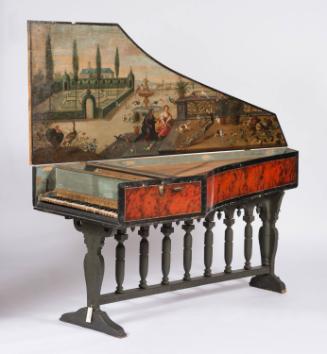
Joseph Johannes Couchet
1679
Not available for use in Recording Studios
On View: On exhibit
isVirtual:

Oscar Schmidt Company
Unknown
Not available for use in Recording Studios
On View: Not currently on exhibit
isVirtual:

Baldwin Piano and Organ Company
1966
Available for use in Recording Studios
On View: Not currently on exhibit
isVirtual:
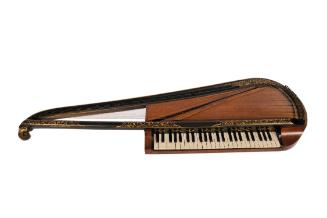
Carl (Karl) Leopold Röllig
c. 1800
Not available for use in Recording Studios
On View: Not currently on exhibit
isVirtual:

Sébastien Érard
1820
Not available for use in Recording Studios
On View: On exhibit
isVirtual:
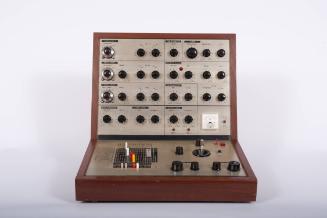
Electronic Music Studios (London) Limited
1969
Not available for use in Recording Studios
On View: Not currently on exhibit
isVirtual:
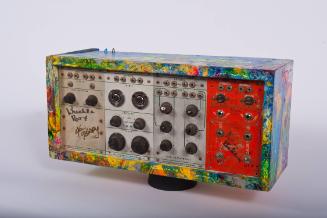
Donald Buchla
c. 1966
Not available for use in Recording Studios
On View: On exhibit
isVirtual:
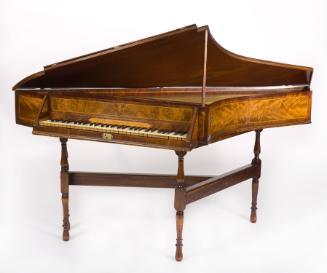
Neil Stewart
1777
Not available for use in Recording Studios
On View: Not currently on exhibit
isVirtual:
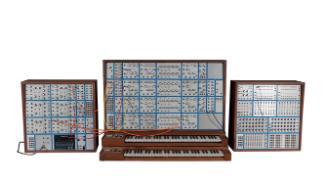
E-mu Systems, Inc.
About 1973
Available for use in Recording Studios
On View: Not currently on exhibit
isVirtual:

Buchla & Associates
1982
Not available for use in Recording Studios
On View: Not currently on exhibit
isVirtual:
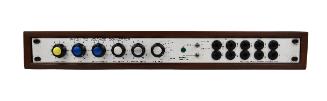
Electronic Music Studios (London) Limited
1971
Available for use in Recording Studios
On View: Not currently on exhibit
isVirtual:
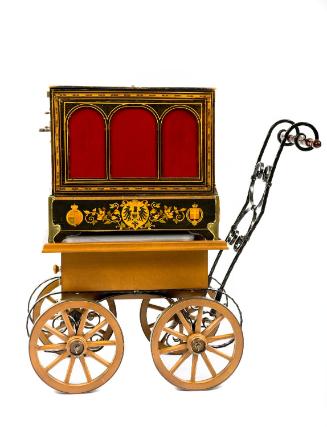
Bacigalupo-Söhne, Orgelfabrik
c. 1880
Not available for use in Recording Studios
On View: Not currently on exhibit
isVirtual: