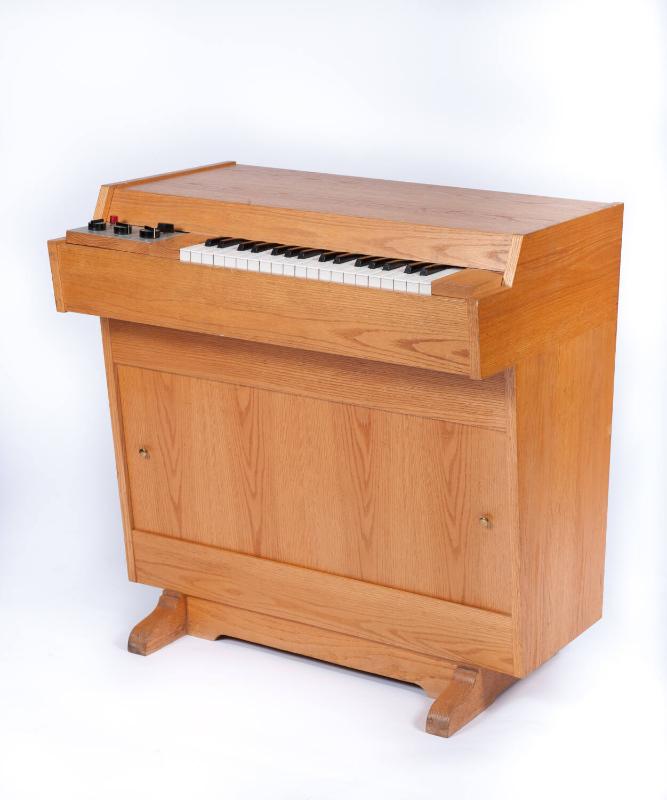

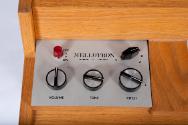

Mellotron M400
Not available for use in Recording Studios
Not currently on exhibit
Not currently on exhibit
Artifact TypeSample Playback, Tape Replay
Manufacturer
Mellotron (Mellotronics Manufacturing)
Date1973
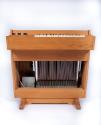
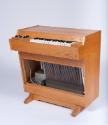
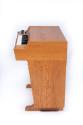
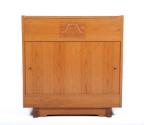
Operation/FunctionThis cabinet of this particular artifact is constructed of oak wood, containing a rotary switch for sample selection, and three knobs for adjusting volume, tone, and pitch. The keys of the instrument are made of wood, with a keyboard compass of three octaves, or 35 notes. The instrument is polyphonic. The interior of the instrument contains a removable tape frame onto which 35 sets of magnetic tapes are connected. The tapes are three-track 3/8”, with a different sound recorded onto each track. The tape replay mechanism consists of an electric motor and belt that turns a metal capstan, a rubber pinch roller and felt pressure pad connected via screws to the keys, and a spring that attaches to the front end of the magnetic tape.Cultural SignificanceThe Mellotron has made an indelible mark on the course of popular music, especially within the psychedelic and progressive rock scenes with which it is most closely associated. With its extensive usage in the 1960s and 1970s by bands such as Led Zeppelin, King Crimson, and The Beatles, its distinctive, lo-fidelity quality helped shape the sound that defined not only a certain genre of music, but an entire era. As essentially the first commercial sampling instrument, the Mellotron also helped pave a way forward for the concept of the sampler, which has in itself revolutionized the way people make, define, and think about music. With the advent of magnetic tape and its associated recording technology, composers could for the first time begin to incorporate sounds from the outside world into their music. This post-war compositional aesthetic, known as musique concrète, came to form one of the first fully established genres of electronic music, and influenced nearly every other electronic composer in the decades that followed. The manipulation and flexibility of the tape medium allowed composers to not only feature real sounds into their works, which could also have been easily done in the acoustic realm, but also to manipulate these sounds so as to produce timbres and gestures that were fresh and curious to the listener’s ear. Tape replay instruments such as the Mellotron helped expand this path of experimentalism, and offered musicians simulations of acoustic sounds that were at once familiar, yet unusual as a result of the instabilities of the mechanism employed in the instruments.
The Mellotron catered to an era in which musicians and bands were keen to expand the forms and timbres they were using in their music. Instead of hiring orchestras or session players, bands could produce any number of orchestral timbres from a single machine. Moreover, the tones produced by these instruments were distorted by the machine’s mechanism and provided a unique tone that helped characterize many of the qualities such composers desired in their music. The progressive rock genre that emerged in the United Kingdom in the 1960s certainly saw the most extensive usage of the instrument, though the instrument was in popular use among the most popular British bands of the time. The Mellotron also changed the possibilities of live performance: although most models were not expressly designed for portability and movement on account of the fragility of the tape replay mechanism alignment, models such as the Mark II and M400 were nevertheless extensively used in live contexts, again allowing bands to employ a single person to produce a multitude of different sounds. The Mellotron’s popularity decreased significantly throughout the 1980s, with the rise of digital samplers that were more reliable, more tonally stable, much smaller, and far less expensive. That being said, however, the Mellotron remerged in the 1990s with users desiring it specifically because of its idiosyncratic tone and behaviour. Still today, the sound of the Mellotron conjures a very specific aesthetic that was associated with the music it transformed throughout the 1960s and 1970s.Technological SignificanceThe Mellotron was an extremely innovative and groundbreaking instrument for its time, and effectively pioneered the concept of the sampler. Interestingly, although instruments produced under the Mellotron brand are the most well known of the analog samplers, the invention of the instrument is accredited to American designer Harry Chamberlin. Throughout the 1940s, Chamberlin conceived of an instrument that could play back sound pre-recorded onto magnetic tape via a keyboard. The instruments he produced in the late 1940s and throughout the 1950s were the first to employ such a mechanism. They were, however, fairly unreliable, partly on account of the fact that components crucial to sound production, such as the tape heads used, were not standardized. After a somewhat awkward exchange of technological ownership (see ‘Manufacturer Background’), a British company called Streetly Electronics began producing Chamberlin’s designs under the Mellotron name. The Mellotron was revered for its accessibility, allowing musicians to obtain any number of sounds, typically derived from orchestral instruments, at the touch of a button, so to speak. Prior to the instruments produced by both Chamberlin and Mellotron, no such technology had existed. The concept of the sampler – that is, an instrument that produces sounds that were recorded in the real world, usually from its keyboard – was born of Chamberlin’s designs and, through the Mellotron, the technology became widespread and highly popular. Of course, sampling would not have been as feasible without the advent of magnetic tape and its associated recording technology. Magnetic tape revolutionized the recording industry in several ways. It had the advantage of being relatively small and easy to work with, and was also malleable in ways that preceding recording technologies such as the wax cylinder were not: magnetic tape could be cut, or spliced, into pieces that could be rearranged and reattached to another portion of tape. Moreover, tape could also be manipulated by the tape playing machine in compositionally meaningful ways: the tapes could be played backwards, or the speed at which they are played back could be sped up or slowed down, thereby altering the pitch of the recorded sound. Another well-used tape music technique consisted in removing the pick up tape reel and attaching the end of a piece of tape back to the beginning of the tape, thus producing an infinite tape loop. Early experimental practices with tape helped foster the development of musique concrète, which was one of the first established genres of electronic music. Composers working in this field, who were primarily based in France throughout the 1940s and 1950s, exploited the ability they now had to bring real world sounds into their music, and to manipulate the sounds in ways that were simply not possible before. Composers of this genre include Pierre Schaeffer (1910 – 1995) and Pierre Henry (born 1927), who worked at the Office de Radiodiffusion-Télévision Française (ORTF) studio in Paris. Tape technology continued to fascinate composers into the 1960s and 1970s, with American minimalist innovators Terry Riley (born 1935) and Steve Reich (born 1936) making heavy use of splicing techniques and tape loops in their electronic music. Moreover, the advent of magnetic tape also brought with it the advent of multi-track recording. There are many variations of tape that accommodate this style of recording, including some tapes that only contain two tracks and others that can store up to 24 independent tracks, however in each case a single strip of tape is evenly divided into a number of individual tracks. As such, instead of recording an entire band, for instance, in one take with every player sounding at the same time, individual instruments could be allocated to the various tracks of the tape and recorded in turn. Most band recording sessions begin by recording the drums, which is itself often split such that individual drums and cymbals have their own tracks, and then by overlaying other instruments on top of the drum tracks. This process if known as overdubbing, and is still the central function of modern recording. That being said, not all recording sessions employ overdubbing. For instance, orchestral studio recordings do not typically record individual instruments on their own. The multi-tracking process is still maintained though, as certain instruments or groups of instruments will each have their own microphone, which will capture that information on an independent track. Although tape is still often used in many professional recording studios, the digital audio workstation, or DAW, including software such as ProTools and Logic, is the primary recording medium. These programs are modeled from analog recording techniques, however, with the recording engineer still creating independent tracks that correspond to either to a single microphone or to a stereo pair, and using the process of overdubbing. Whereas tape is limited to the number of tracks that can fit onto a single strip without compromising the amount of physical space used to store audio, usually no smaller than 1/8”, digital media is far more flexible, with most programs capable of maintaining nearly 100 independent tracks before running into CPU issues.
Despite the fact that the Mellotron was highly innovative for its time, the technology did not come without its drawbacks. Although the instrument is revered for the quirks of its distinctive tone and for the charm of its limitations, it was precisely these characteristics that led to the instrument’s eventual demise in the 1980s. One of the main difficulties with the technology employed in all models of the Mellotron, as well as those employed in Chamberlin instruments, is the infamous eight-second lifespan of the recorded sound. The mechanism featured in the instrument would not be capable of operating if the tapes were looped to provide a continuous tone, and thus a definitive length of time that the samples could sound had to be enforced. Although somewhat authentic acoustic attacks can be imitated on the instrument, the abrupt manner with which the sound ceases once the tape has run its course was not generally considered to be a desirable side effect of the mechanism. And, although a few Mellotron models, including the M400, were designed to be as portable as could be made possible, they were certainly not capable of withstanding excessive movement. On account of each key on the keyboard essentially containing its own tape player mechanism, the instrument was highly temperamental and required regular servicing. Changes in temperature and humidity could warp the tapes or cause them to become sticky, and movement of the entire unit could cause the many internal components to shift or misalign. One advantage the Mellotron retained throughout the 1970s with the advent of commercial synthesizers was its polyphony. The majority of the earliest synthesizers were monophonic, meaning only one note could be played at a time; this remained until the late 1970s with the advent of polyphonic synthesizers such as the Sequential Circuits Prophet 5 in 1978. Theoretically, any number of keys could be played simultaneously on the Mellotron, however when too many notes were played at one time, the over tonal quality of the sound became noticeably diminished.
Chamberlin and Mellotron are among two of the most well known manufacturers of early sampling instruments, both employing the same tape replay technology Chamberlin had designed. Chamberlin’s first instruments included the model 100 Rythmate, which contained drum samples and effectively served as the first drum machine, the model 200 Rhythmate, which incorporated a keyboard, and the MusicMaster 600, which the first Mellotron model, the Mark I, was based on. Chamberlin employed 3/8” tape in the MusicMaster instead of the far more common 1/4" format, and this somewhat unusual practice was maintained in all but one of the Mellotron models. Logistically, using 3/8” tape made the process of recording sample banks somewhat more complicated, however the use of an uncommon format made it difficult for users to record their own sample banks instead of using those sold by the manufacturer. Chamberlin’s M series, which includes the portable M1 unit, employed eight-track 1/2” tape, and his final instrument, the Riviera model 800, featured what was essentially equivalent to four M1 units. The Mark I and Mark II Mellotrons of 1963 and 1964, respectively, were based on Chamberlin’s MusicMaster, but improved upon the design by incorporating a sturdier internal frame, as well as built in speakers and reverb devices. The Mark II also featured two manuals, with one intended for use in producing melodies and the other used to provide accompanying chords. The model 300 Mellotron was the only instrument produced by the manufacturer to use 1/4" tape instead of 3/8” tape. This instrument also featured an entirely new sample bank from those used in previous instruments such as the Mark I and Mark II. The M400, the most well known and widely produced of their instruments, improved upon the design of the 300 by returning to 3/8” and incorporating a removable frame for interchanging tapes. By this time, the Mellotron had also greatly improved the function of components such as the capstan, and had significantly decreased the signal to noise ratio of earlier models. The M400 also came with the option of incorporating a mixer device that provided a three-band equalizer and greater volume control. One version of the M400 was also designed such that users could record their own samples onto 1/4" tape and insert them into the frame. In general, the Mellotron instruments were more reliable and more stable than the Chamberlin instruments, employing standardized components, and were produced at much faster rates. Both manufacturers succumbed to the advent of digital samplers in the 1980s, which featured a much greater clarity of tone, more flexibility and portability, and a relatively smaller build. That being said, however, Mellotrons were still able to retain something of an advantage over the earliest samplers in that the amount of memory those instruments would have required to store the same amount of samples, at the same definition of quality, was initially unattainable. Other notable early samplers include the Birotron, which was designed by American Dave Biro, and employs a technology similar to that used by the eight-track tape player. Although these instruments were also plagued with technical inconsistencies, the Birotron had the advantage of being able to produce continuous loops of sound. The Band Box Chordarama is an accompanying instrument that also employed eight track tapes, typically of chordal progressions or drum loops, and was operated by the user’s foot, similar to a stomp box. The Opsonar Optigan and Vako Orchestron were introduced in the 1970s, and both employ a similar method of optical sampling. A photoreceptor inside the instrument detects changes in light density on a circular, transparent disc that rotates as the instrument is active. The Orchestron is often considered to be the more professionally-minded of the two, though of all the analog sampling instruments, it is also generally agreed to have the worst fidelity in its recordings. The Optigan was originally designed by the toy company, Mattel, and was intended for the home market. Its orientation is similar to that of the accordion, as well as the earliest double manual Mellotrons, such as the Mark II: on the left hand side of the instrument are chord buttons, including major, minor, and diminished chords, and on the right hand side of the instrument is a small keyboard that can be used to produce melodic accompaniment. The instrument also includes several switches that produce looped percussive accompaniment.Users/PerformersThe Mellotron, and particularly the single manual model M400 and preceding double manual Mark II, was one of the most extensively used instruments throughout the 1960s and 1970s, and examples are countless. Although it employs samples of actual acoustic sources, the instability of its mechanism causes distinct warbles in the quality of the sound, resulting in a low fidelity tonal imperfection that is unmistakable in recordings. The earliest users of the Mellotron were professional musicians who had been hired by the manufacturing company to promote the instrument in public venues and broadcast media. The British Broadcasting Corporation (BBC) Radiophonic Workshop, responsible for the audio production of radio and television, became interested in the technology relatively early on, and assisted with the development of the FX Console, a Mellotron that featured only sound effects. The BBC used two customized units of the FX Console in the mid 1960s before the studio turned its attention to the more reliable synthesizers and related electronic equipment of the time. One of the earliest proponents of the Mellotron was musician Mike Pinder, who was employed by the manufacturer to test instruments for faults, and worked with them for eighteen months before forming The Moody Blues. Pinder, who developed a strong fascination with the Mellotron sound through his work, is also credited with introducing the instrument to The Beatles, who were among the most extensive users throughout the 1960s. The band’s inclusion of the instrument certainly complimented and informed their transition into a more experimental and psychedelic-inspired aesthetic, reflected in albums such as 1966’s Revolver. Perhaps the most iconic track of theirs to feature the Mellotron is “Strawberry Fields Forever”, which was recorded in November and December of 1966 at EMI Studios in London, and later released in the United States on the Magical Mystery Tour album. Another notable track is “The Continuing Story of Bungalow Bill”, from The White Album of 1968, which features a backing melodic phrase played on a sample bank of Spanish guitar recordings.
The Mellotron featured prominently in much of the popular music of the 1960s and 1970s, and was in especially heavy use by the British progressive rock bands of the era, including Pink Floyd, The Moody Blues, King Crimson, Genesis, Barclay James Harvest, and Yes, to name just a few. The progressive rock genre sought to expand both the forms and timbres featured in popular music, and the Mellotron was poised to provide the most convenient method for achieving orchestral sounds. That being said, a number of players did not attempt to imitate orchestral gestures, and exploited the various articulations the instrument could produce. One of the most well known users of the Mellotron outside of the United Kingdom were the German electronic pioneers Tangerine Dream, who employed several units of the instrument live, as well as on the albums Phaedra (1974), Rubycon (1975), and Stratosfear (1976). The most notable users and examples of the Mellotron throughout the 1960s, 1970s and early 1980s include: The Moody Blues on 1967’s Days of Future Passed (“Nights in White Satin”, in particular); Led Zeppelin, who featured the instrument on 1973’s Houses of the Holy (“The Rain Song”, in particular) and 1975’s Physical Graffiti (“Kashmir”, in particular), as well as taking a unit on tour; Brian Eno in his Apollo: Atmospheres & Soundtracks of 1983; King Crimson on 1969’s In the Court of the Crimson King; Genesis on the albums Foxtrot of 1972, Selling England by the Pound of 1973 and A Trick of the Tail of 1976; Alice Cooper on 1973’s Billion Dollar Babies; the Québécois band Harmonium on their Si on avait besoin d’une cinquième saison album of 1975; The Rolling Stones on their Their Satanic Majesties Request album of 1967; and, Jean Michel Jarre on his Oxygène album of 1976. By the mid 1980s, the Mellotron had faded into relative obscurity with the increasing popularity of synthesizers and more reliable digital samplers. That being said, one notable user of the instrument in the 1980s was the English new wave group Orchestral Manoeuvres in the Dark (OMD), who employed the instrument on the album Architecture & Morality of 1981. In the 1990s, the Mellotron experienced something of a second wave in the Britpop genre, with its use by Oasis on their (What’s the Story) Morning Glory? album of 1995 and by Radiohead on 1997’s critically-acclaimed OK Computer. The Mellotron is still today a highly sought after instrument and can be heard on numerous popular and experimental recordings.Collection
Object number2000.05.28

Streetly Electronics/ Mellotronics/ Mellotron
1971
Not available for use in Recording Studios
On View: On exhibit
isVirtual:
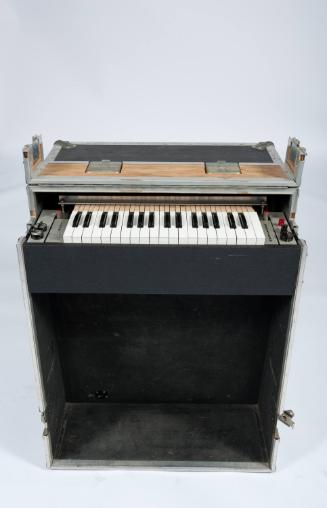
Novatron
c. 1981
Available for use in Recording Studios
On View: Not currently on exhibit
isVirtual:
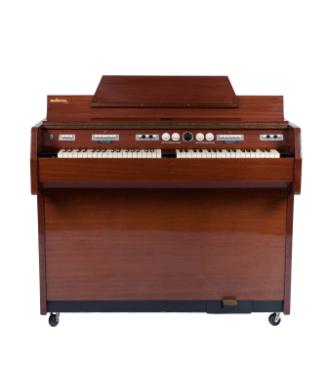
Mellotron (Mellotronics Manufacturing)
1964
Available for use in Recording Studios
On View: Not currently on exhibit
isVirtual:
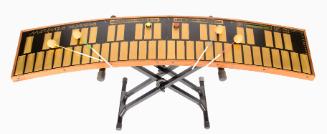
Buchla & Associates
1999
Available for use in Recording Studios
On View: Not currently on exhibit
isVirtual:

Oscar Schmidt Company
Unknown
Not available for use in Recording Studios
On View: Not currently on exhibit
isVirtual:
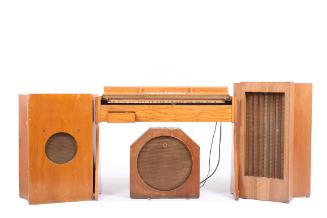
Maurice Louis Eugène Martenot
1975
Available for use in Recording Studios
On View: Not currently on exhibit
isVirtual:

Hendrik Anthonie Meijer
1785
Not available for use in Recording Studios
On View: Not currently on exhibit
isVirtual:

Joseph Johannes Couchet
1679
Not available for use in Recording Studios
On View: On exhibit
isVirtual:
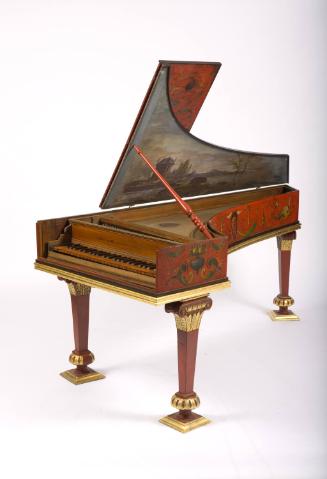
Vido Trasuntino
1591
Available for use in Recording Studios
On View: Not currently on exhibit
isVirtual:

Buchla & Associates
1982
Not available for use in Recording Studios
On View: Not currently on exhibit
isVirtual:
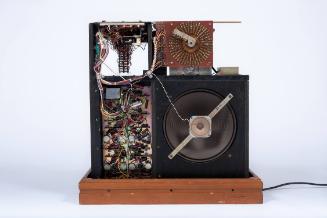
The Wurlitzer Company
c. 1959
Not available for use in Recording Studios
On View: On exhibit
isVirtual:
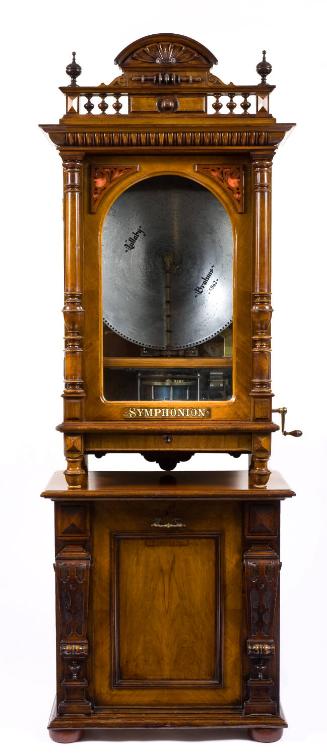
Symphonion Company
c. 1890
Not available for use in Recording Studios
On View: On exhibit
isVirtual: