EN / FR
Skip to main content

Buchla Lightning

Not available for use in Recording Studios
On exhibit
On exhibit
Artifact TypeSynthesizer, Controller
Manufacturer LocationUSA, North America
Date1999
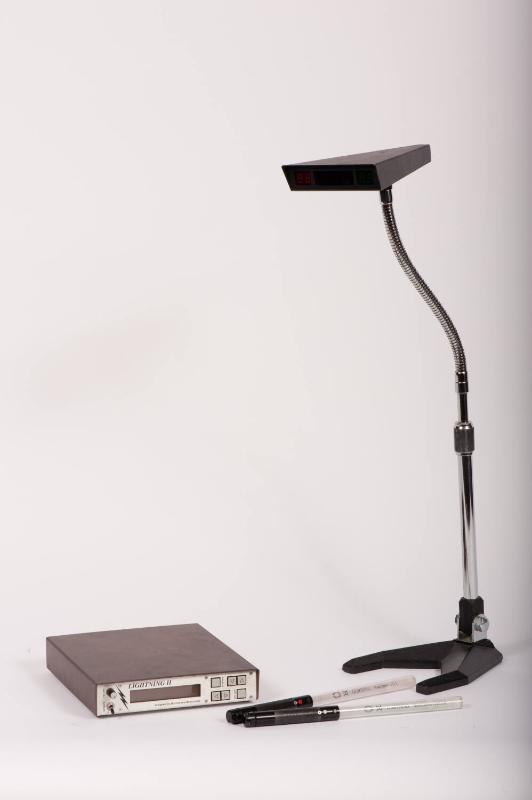
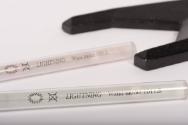
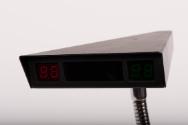
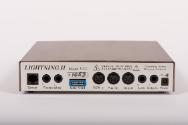
If you’ve ever conducted an imaginary orchestra alone in your room with pencils or a hairbrush—chances are you’d be able to operate the Buchla Lightning. The principle behind the controller is simple and intuitive; a player moves the infrared wands in various directions and speeds, those gestures are transmitted to a synthesizer via photo-sensors, and then translated into pre-programmed sounds. Much like the two “wands” used by drummers, the Lightning is unencumbered by wires—allowing complete freedom of movement and expression by the musician. 
Operation/FunctionThis instrument consists in a half-rack cabinet with a self-contained 32-voice synthesizer, two handheld wands, a remote head for wand control, and an input for a memory card to store additional voices. The handheld wands are battery-powered.Cultural SignificanceTypically, Robert Moog is more popularly associated with the introduction of the first synthesizers. However, in the mid 1960s, both Don Buchla and Robert Moog – who was, at the time, based in New York – independently developed the first voltage-controlled synthesizers, both employing a modular structure and offering similar functions. Although their instruments catered to different demographics, both designers were highly influential to the next generation of synthesizer manufacturers, though perhaps in varying ways. Buchla stood primarily as an inspiration to designers looking to implement ideas that were less conventional and more aesthetically minded. The emergence of Buchla’s first instrument at a time when the counterculture of the 1960s was near its apex, as well as his involvement in related concerts and events such as the infamous Altamont Free Concert in 1969, certainly helped establish the designer as something of a figurehead for the movement. Moreover, being situated in the San Francisco Bay Area, which has been historically recognized as a national haven for innovation and less-than-conventional attitudes for several decades, allowed for Buchla’s instruments to enjoy a heightened reception that may not have been as prevalent elsewhere in the country.Technological SignificanceAlthough a number of synthesizer designers have experimented over the years with alternate methods of interacting with their instruments, the keyboard interface has remained the dominant tool, having first emerged in early electronic instruments such as the Ondes Martenot and Ondioline, and being retained throughout the progression of early electric organs and sampling instruments on account of its relatively intuitive and “fool proof” nature. The advent of the alternate controller is one of the most important in the development of synthesizer technology in that it helped to expand both the range of the instrument, allowing players to articulate sounds in ways that are not afforded by the physical limitations of the keyboard, and the demographic of users, giving access to those who are trained in non-keyboard instruments. MIDI was first posited by Sequential Circuits, Inc.’s Dave Smith in late 1981, when he presented a paper at the Audio Engineering Society’s annual meeting theorizing the creation of a standard protocol that would allow various electronic instruments to communicate with one another. With the help of synthesizer designers Tom Oberheim of Oberheim Electronics, Ikutaro Kakehashi of Roland, and representatives from Korg and Kawai, the Musical Instrument Digital Interface – which was in fact coined by Smith – was consecrated at NAMM in 1983 with a Roland Jupiter 6 and a Sequential Circuits Prophet 600 making the first successful connection. Perhaps on account of his background in physiology, Buchla seemed to be particularly preoccupied in eliminating the distance between the user and the machine. This is certainly no more evident than in the design of his alternate controllers, including the touch plates of the early modular systems and the MIDI controllers of the 1990s such as the Lightning, Thunder, and Marimba Lumina. Although appearing much later in the course of alternative controllers, the Lightning is a highly unique device in its use of interactive mapping that expands the possible range of parameters into the spatial field of the player’s surroundings, uninhibited by wires or other connecting cables thanks to innovate use of infrared technology. While most alternate controllers still borrow from other non-keyboard musical instruments, the Lightning is distinguished in that it is completely gestural, allowing those with no musical training or background to perform with it in meaningful ways.Users/PerformersThere does not exist a great deal of documented usage of this instrument. Notable works that incorporate the Lightning have been produced by composers such as George Lewis and by the instrument’s designer, Donald Buchla. Perhaps the most well known user of the Lightning is the Oakland-based performer and part-time Buchla & Associates collaborator, Joel Davel (b. 31 July 1966, Milwaukee, Wisconsin). Joel has previously been employed as a hardware assistant with Buchla & Associates and holds degrees in percussion and electronic music from Northern Illinois University and Mills College.
Object number2000.02.04.1-4
Photo credit: Don Kennedy
Buchla & Associates
2006
Available for use in Recording Studios
On View: Not currently on exhibit
isVirtual:
Photo credit: Don Kennedy
Buchla & Associates
1999
Available for use in Recording Studios
On View: Not currently on exhibit
isVirtual:
Photo credit: Don Kennedy
Buchla & Associates
c. 1990
Not available for use in Recording Studios
On View: Not currently on exhibit
isVirtual:
Photo credit: Don Kennedy
Buchla & Associates
c. 1968
Available for use in Recording Studios
On View: Not currently on exhibit
isVirtual:
Photo credit: Don Kennedy
Buchla & Associates
1982
Not available for use in Recording Studios
On View: Not currently on exhibit
isVirtual:
Photo credit: Don Kennedy
E-mu Systems, Inc.
1979
Not available for use in Recording Studios
On View: Not currently on exhibit
isVirtual:
Photo credit: Meghan MacKrous, courtesy of the National Music Centre
Moog Music, Inc.
1976
Available for use in Recording Studios
On View: Not currently on exhibit
isVirtual:
Photo credit: Meghan MacKrous, courtesy of the National Music Centre
Kurzweil Music Systems
1985
Available for use in Recording Studios
On View: Not currently on exhibit
isVirtual:
Photo credit: Don Kennedy
Korg, Inc.
About 1999
Available for use in Recording Studios
On View: Not currently on exhibit
isVirtual:
Photo credit: Don Kennedy
Donald Buchla
c. 1966
Not available for use in Recording Studios
On View: On exhibit
isVirtual:
Photo credit: Don Kennedy
Paolo Guerrini
20th Century
Not available for use in Recording Studios
On View: On exhibit
isVirtual:
Photo credit: Don Kennedy
Electronic Music Studios (London) Limited
1969
Not available for use in Recording Studios
On View: Not currently on exhibit
isVirtual:
Back