
EN / FR
Skip to main content

Buchla Marimba Lumina

Available for use in Recording Studios
Not currently on exhibit
Artifact TypeSynthesizer, Controller
Manufacturer LocationUSA, North America
Date1999
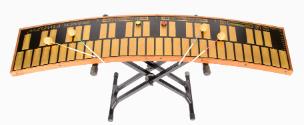
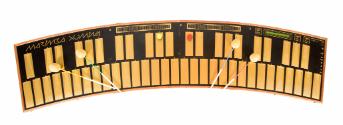
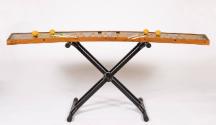
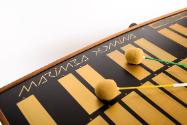
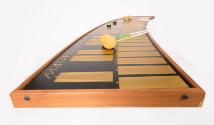
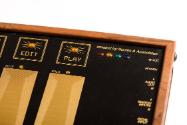
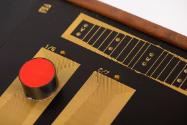
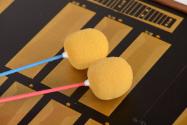
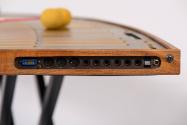
With its cartoonish curves and futuristic interface, the gold edition of the Marimba Lumina looks like something that might have been played on The Jetsons. In fact, it’s another product of the ever-imaginative studio of Don Buchla. As its namesake suggests, this synth controller was modelled on the bars of the acoustic marimba, though it takes that instrument to a whole new level. Using its four colour-coded mallets, each equipped with radio frequency technology, versatile players can simulate acoustic percussion instruments and create their own otherworldly music.
Operation/FunctionThis instrument contains a series of chromatic bars spanning 3.5 octaves as well as twelve additional pads. The primary function is as a MIDI controller, however a built-in synthesizer module with fifty preset voices allows the Marimba Lumina to function in isolation or in combination with another instrument. The four accompanying mallets are colour-coded (red, yellow, green, and blue) to perform varying functions. An additional 150 preset programs may be stored onto external memory cards.Cultural SignificanceTypically, Robert Moog is more popularly associated with the introduction of the first synthesizers. However, in the mid 1960s, both Don Buchla and Robert Moog – who was, at the time, based in New York – independently developed the first voltage-controlled synthesizers, both employing a modular structure and offering similar functions. Although their instruments catered to different demographics, both designers were highly influential to the next generation of synthesizer manufacturers, though perhaps in varying ways. Buchla stood primarily as an inspiration to designers looking to implement ideas that were less conventional and more aesthetically minded. The emergence of Buchla’s first instrument at a time when the counterculture of the 1960s was near its apex, as well as his involvement in related concerts and events such as the infamous Altamont Free Concert in 1969, certainly helped establish the designer as something of a figurehead for the movement. Moreover, being situated in the San Francisco Bay Area, which has been historically recognized as a national haven for innovation and less-than-conventional attitudes for several decades, allowed for Buchla’s instruments to enjoy a heightened reception that may not have been as prevalent elsewhere in the country.Technological SignificanceAlthough a number of synthesizer designers have experimented over the years with alternate methods of interacting with their instruments, the keyboard interface has remained the dominant tool, having first emerged in early electronic instruments such as the Ondes Martenot and Ondioline, and being retained throughout the progression of early electric organs and sampling instruments on account of its relatively intuitive and “fool proof” nature. The advent of the alternate controller is one of the most important in the development of synthesizer technology in that it helped to expand both the range of the instrument, allowing players to articulate sounds in ways that are not afforded by the physical limitations of the keyboard, and the demographic of users, giving access to those who are trained in non-keyboard instruments. MIDI was first posited by Sequential Circuits, Inc.’s Dave Smith in late 1981, when he presented a paper at the Audio Engineering Society’s annual meeting theorizing the creation of a standard protocol that would allow various electronic instruments to communicate with one another. With the help of synthesizer designers Tom Oberheim of Oberheim Electronics, Ikutaro Kakehashi of Roland, and representatives from Korg and Kawai, the Musical Instrument Digital Interface – which was in fact coined by Smith – was consecrated at NAMM in 1983 with a Roland Jupiter 6 and a Sequential Circuits Prophet 600 making the first successful connection. Perhaps on account of his background in physiology, Buchla seemed to be particularly preoccupied in eliminating the distance between the user and the machine. This is certainly no more evident than in the design of his alternate controllers, including the touch plates of the early modular systems and the MIDI controllers of the 1990s such as the Lightning, Thunder, and Marimba Lumina. Although appearing much later in the course of alternative controllers, the Marimba Lumina is a highly unique device in its use and expansion of the standard layout of the acoustic marimba. This instrument was designed in close conjunction with programmer Mark Goldstein and percussionist Joel Davel, and uses a unique iteration of radio frequency technology to control the distinct functions of each mallet.Users/PerformersThere does not exist a great deal of documented usage of this instrument. Perhaps the most well known user of the Marimba Lumina is the Oakland-based performer and part-time Buchla & Associates collaborator, Joel Davel (b. 31 July 1966, Milwaukee, Wisconsin). Joel has previously been employed as a hardware assistant with Buchla & Associates and holds degrees in percussion and electronic music from Northern Illinois University and Mills College.
Object number2002.05.09.1-5
Photo credit: Don Kennedy
Buchla & Associates
c. 1990
Not available for use in Recording Studios
On View: Not currently on exhibit
isVirtual:
Photo credit: Don Kennedy
Buchla & Associates
1982
Not available for use in Recording Studios
On View: Not currently on exhibit
isVirtual:
Photo credit: Don Kennedy
Buchla & Associates
1999
Not available for use in Recording Studios
On View: On exhibit
isVirtual:
Photo credit: Don Kennedy
Buchla & Associates
2006
Available for use in Recording Studios
On View: Not currently on exhibit
isVirtual:
Photo credit: Don Kennedy
Buchla & Associates
c. 1968
Available for use in Recording Studios
On View: Not currently on exhibit
isVirtual:
Photo credit: Don Kennedy
Oscar Schmidt Company
Unknown
Not available for use in Recording Studios
On View: Not currently on exhibit
isVirtual:
Photo credit: Don Kennedy
Maurice Louis Eugène Martenot
1975
Available for use in Recording Studios
On View: Not currently on exhibit
isVirtual:
Photo credit: Don Kennedy
Korg, Inc.
About 1999
Available for use in Recording Studios
On View: Not currently on exhibit
isVirtual:
Bösendorfer Klavierfabrik GmbH
1855
Not available for use in Recording Studios
On View: Not currently on exhibit
isVirtual:
Photo credit: Don Kennedy
Garnet "Gar" Gillies
Available for use in Recording Studios
On View: Not currently on exhibit
isVirtual:
Photo credit: Don Kennedy
Yamaha Corporation/Nippon Gakki Company Limited
1987
Not available for use in Recording Studios
On View: On exhibit
isVirtual:
Photo credit: Don Kennedy
E-mu Systems, Inc.
1979
Not available for use in Recording Studios
On View: Not currently on exhibit
isVirtual:
Back