
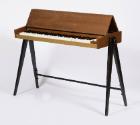
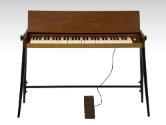
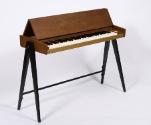
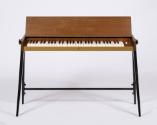
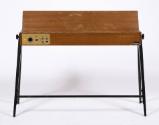
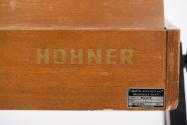
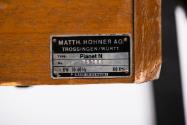
Hohner Pianet
Available for use in Recording Studios
Not currently on exhibit
Not currently on exhibit
Artifact TypePiano, Electromechanical
Manufacturer
Hohner Musikinstrumente GmbH & Co. KG
Datec. 1967
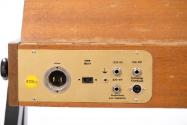
Operation/FunctionThis artifact features a 61-note (F through F) compass across a mechanical, chromatic keyboard as well as corresponding stainless steel metal reeds and wooden hammers for each note. The hammers are wooden levers, with keyed end fitted with injected molded plastic and the free end fitted with a metal rod and leather pad finished with urethane foam. The instrument also incorporates a basic vibrato circuit, transistorized (solid-state) pre-amplifier circuit, a socket for connecting to a volume pedal, and electromagnetic pickups of variable capacitance.Cultural SignificanceAlthough the electric piano and its variants, such as the Pianet, have perhaps not had as groundbreaking an impact on the development of music as the electric guitar did in the 1950s, their use has spanned multiple genres, with the most prevalent examples occurring in rock- and jazz-based compositions. Just as the electric guitar had been originally developed for use with jazz combos – amplification emerging as a technical rather than aesthetic necessity so that the instrument could be heard among a large group of instruments – the electric piano was first popularized in the jazz scene of the late 1950s, with musicians as varied as Ray Charles and Sun Ra featuring early instantiations of the instrument in recordings and performances. Although instruments such as the Pianet as well as the iconic Wurlitzer 200 and Fender Rhodes electric piano were unique in their use of metal reeds and metal tonebars instead of strings, the percussive, bell-like sound generated by these instruments had been present for nearly a century prior in instruments such as the dulcitone and celesta. The celesta in particular enjoyed extensive usage throughout the late nineteenth and early twentieth centuries, revered for its whimsical sonic properties and scored in a range of classical and jazz compositions, such as Tchaikovsky’s The Nutcracker of 1892.Technological SignificanceThe Pianet is a highly unique instrument within the context of classic electromechanical instruments from the 1960s and 1970s. Whereas most fell into a singular category – such as the Wurlitzer 200 and Fender Rhodes electric pianos, the Hohner Clavinet, which was an example of an electromechanical clavichord, or the Baldwin electric harpsichord – the Pianet merged aspects of several different designs to offer an unparalleled sonic quality and feel for the player. Significant variations were made between the two basic groups of Pianet in 1977, with earlier models implementing stainless steel reeds, a pick-up with variable capacitance, and leather adhesion pads finished with urethane foam, and later models implementing spring-steel reeds, basic electromagnetic pick-ups, and molded rubber adhesion pads finished with silicone oil. In addition to changing the tone from one that was much richer in the earlier instruments to one that was decidedly more mellow in later instruments, the latter were also rendered more stable and easier to maintain. The leather pads of the earlier models required regular replacement as the urethane foam degraded over the years; the silicone-finished molded rubber pads of the later instruments were much more reliable. The silicone pads also had the added benefit of not affecting the metal reeds, allowing them to better stay in tune throughout temperature changes. The Pianet developed from Hohner’s first electric keyboard instrument, which came in the form of the Cembalet, an electrically amplified harpsichord designed in the 1950s by Ernst Zacharias, who had a keen interest in modernizing early musical instruments. While still in the production phases of the Pianet, Zacharias developed the Clavinet, an electrically amplified clavichord, which stands as the company’s most successful electric keyboard instrument.
When solid body electric guitars such as the Fender Telecaster and Gibson Les Paul emerged in the early 1950s, they revolutionized use of the instrument in popular music. Although iconic electric pianos such as the Wurlitzer 200 and Fender Rhodes Mk I, which were produced in the late 1960s and early 1970s, were not quite as transformative, they certainly solidified a position as one of the most widely used keyboard instruments in popular music. The first electric pianos were designed in the 1920s, with one of the earliest examples emerging from the Berlin-based C. Bechstein piano manufacturers. Their Neo-Bechstein grand piano, which was developed in the late 1920s and produced into the early 1930s, removed the instrument’s soundboard and implemented a series of magnetic coils, essentially an early version of the pickup. Interestingly, the instrument also featured a built-in radio receiver and an external loudspeaker cabinet with an integrated record player; as such, the unit was meant to appeal to the commercial market as a sort of all-in-one home entertainment product. In the 1930s, inventor Benjamin Meissner developed an amplified vertical piano, patenting the pickup mechanism that was later used in most of the electric pianos of the 1960s and 1970s. Other early electric pianos include the Story & Clark Storytone of 1939, which weighed in at nearly half a ton. The most technologically innovative feature of electric pianos such as the Wurlitzer 200 and Pianet is with respect to their use of variously fashioned metal bars instead of the strings that characterize a conventional piano. On account of this, these instruments can be seen as a closer relative to acoustic instruments such as the dulcitone, celesta, and glockenspiel, all of which employ metal bars activated by hammers. The dulcitone was the first of these instruments, designed and manufactured by Thomas Machell & Sons of Glasgow, Scotland in the 1860s. The instrument featured felt-covered hammers and a keyboard as well as a series of metal tuning forks as the tone generators. Unlike the strings of a traditional piano, which require a specific amount of maintained tension in order to stay in tune, the dulcitone was far more stable in this regard. The celesta, effectively a keyboard-controlled glockenspiel, followed in 1886 from French organ builder, Auguste Mustel, and featured an improved resonating mechanism, allowing it to produce a much louder sound than the dulcitone. As such, the instrument has been regularly used in a number of orchestral and chamber settings, by composers ranging from Tchaikovsky to Morton Feldman. The Fender Rhodes electric pianos directly continued this tradition, implementing an assembly that employs a metal tine and tonebar oriented as a tuning fork, however Wurlitzer electric pianos featured a modified tone generator design consisting in singular flat, tapered pieces of metal; the Pianet employed a similar component. These pieces of metal are more commonly referred to as reeds on account of their similar shape to the wooden reeds used in many woodwind and brass instruments, as well as those used in reed organs. Of course, the primary distinction between electric pianos, and acoustic predecessors is that the former employ built-in electric amplification. As with most electromechanical instruments, this is achieved through the use of a set of pickups, which are types of transducers similar to microphones. A pickup consists in a permanent magnet (a single magnet that achieves the same effect of two polarized magnets) that maintains a constant electromagnetic field, and a coil of copper wire that is wrapped around the magnet. The tone-generating component of the electric musical instrument is placed near the magnet. When the tone generator vibrates, a disturbance is created in the electromagnetic field, which in turn induces a voltage in the coil. This electrical signal is then sent to an amplification system, generally consisting in a preamplifier, amplifier, and loudspeaker. Most modern pickups come in the form of the humbucker pickup, which employs two coils in inverse phase so as to reduce the amount of extraneous noise or AC hum included in the signal. The first dedicated pickup was designed by Hawaiian steel-guitar player, George Beauchamp, in collaboration with Adolph Rickenbacker in the early 1930s. The use of pickups rendered any need for a hollow wooden soundboard or resonating structure obsolete in associated instruments, as reflected in the design of the solid-body electric guitar. Of course, the use of pickups also meant that the conventional tone of the acoustic instruments to which they were applied, such as guitars, pianos, and harpsichords, could be modified through the use of external effects pedals and amplification systems.Users/PerformersAmong the most recognizable albums and compositions to feature the various early models of the Pianet include: Three Dog Night’s iconic “Joy to the World” from Naturally of 1970; The Zombies’ “She’s Not There” from The Zombies of 1965; several tracks from The Beatles, including “I Am the Walrus” from 1967’s Magical Mystery Tour, “Getting Better” from 1967’s Sgt. Pepper’s Lonely Hearts Club Band, and “You Like Me Too Much” from 1965’s Help!; and, Roxy Music’s “Editions of You” from For Your Pleasure of 1973. The Pianet was also popularly used among progressive rock musicians, such as King Crimson and Genesis, who frequently employed the instrument in live performances. Another notable user of the instrument was Fleetwood Mac’s Christine McVie, who preferred the N and Combo models.Collection
Object number2000.05.21

Hohner Musikinstrumente GmbH & Co. KG
c. 1950
Not available for use in Recording Studios
On View: Not currently on exhibit
isVirtual:

Hohner Musikinstrumente GmbH & Co. KG
c. 1966
Available for use in Recording Studios
On View: Not currently on exhibit
isVirtual:

Hohner Musikinstrumente GmbH & Co. KG
1971
Available for use in Recording Studios
On View: Not currently on exhibit
isVirtual:
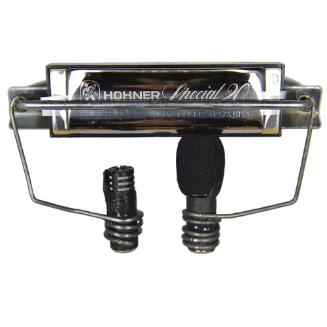
Hohner Musikinstrumente GmbH & Co. KG
Not available for use in Recording Studios
On View: Not currently on exhibit
isVirtual:

Hohner Musikinstrumente GmbH & Co. KG
Not available for use in Recording Studios
On View: On exhibit
isVirtual:

Hammond Organ Company
1957
Not available for use in Recording Studios
On View: Not currently on exhibit
isVirtual:

Höfner GmbH & Co. KG
20th Century
Not available for use in Recording Studios
On View: Not currently on exhibit
isVirtual:

Ken Freeman
c. 1975
Available for use in Recording Studios
On View: Not currently on exhibit
isVirtual:

Baldwin Piano and Organ Company
1966
Available for use in Recording Studios
On View: Not currently on exhibit
isVirtual:
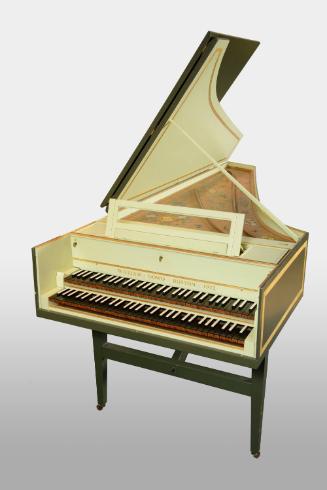
William Richmond Dowd
1972
Available for use in Recording Studios
On View: Not currently on exhibit
isVirtual:
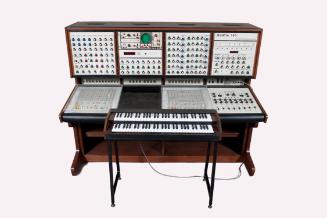
Electronic Music Studios (London) Limited
1972
Available for use in Recording Studios
On View: Not currently on exhibit
isVirtual:
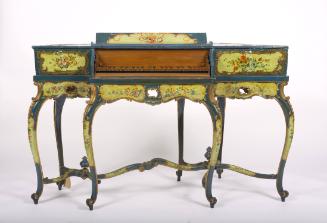
Francesco Bonafinis
c. 1560
Not available for use in Recording Studios
On View: On exhibit
isVirtual: