


EN / FR
Skip to main content

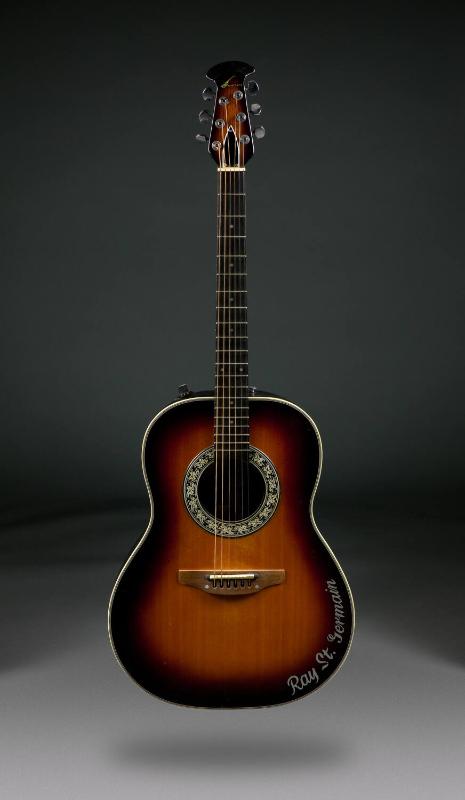
Ray St. Germain Guitar

Not available for use in Recording Studios
On exhibit
On exhibit
Artifact TypeGuitar, Acoustic
Manufacturer LocationUSA, North America
Date20th Century
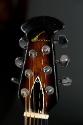
This steel-string, flat-top acoustic guitar was once owned by Métis country musician and TV host Ray St. Germain. Known in his youth as “Winnipeg’s Elvis,” St. Germain has recorded more than a dozen albums, hosted the nationally syndicated TV show Big Sky Country for 13 years and received countless awards. This instrument was built by the Ovation Guitar Company, which uniquely incorporated aircraft engineering techniques into its guitar design and production.
Operation/FunctionThis particular artifact is an example of a steel-string, flat-top acoustic guitar. It consists of a hollow wooden body, which is itself comprised of a soundboard, box, and sound hole for amplification, as well as six steel strings and accompanying machine heads and metal fingerboard. This instrument employs standard tuning, with open string pitches beginning at the bottom with the highest pitch, the E a major third above middle C, and moving downwards in pitch by a fourth to B, downwards by a major third to G, downwards by a fourth to D, downwards by a fourth to A, and downwards by a fourth to E, spanning two octaves in total. The instrument is referred to as being ‘standard-handed’, meaning it is to be strummed with the right hand while the left hand controls the frets.Cultural SignificanceThe cultural significance of both the acoustic and electric guitar cannot be overstated. Gibson remains at the forefront of guitar manufacture as one of the leading companies. Although the acoustic guitar is perhaps not used quite as commonly as the electric guitar, both have remained throughout the course of the twentieth century one of, if not the most, exploited instruments in popular music. The steel-stringed flat-top has served as the most popular form of acoustic guitar, with its usage spanning a multitude of genres.Technological SignificanceBoth acoustic and electric guitars have undergone a number of technological advances that have improved their tone and construction quality, however it is the mere advent of the latter that has had the most lasting technological impact. Les Paul (1915 – 2009) helped pioneer both the design and popularity of the electric guitar, and is considered one of the founders of solid-body technology, having produced a prototype called “The Log” in 1940. Additionally, Paul also conducted a number of experiments in guitar design and recording technology, essentially establishing the revolutionary practices of multi-track recording and overdubbing, as well as delay and phasing effects. Fender was the first company to produce a commercial solid-body electric guitar in 1950 with the release of the Telecaster, and Gibson responded in 1952 with the Les Paul, named in recognition of the fact that Paul helped design the instrument with Gibson’s president of the time, Ted McCarty. Gibson also produced the first commercial humbucker pickup, designed in 1955 and patented in 1959, which eliminated the hum of single-coil pickups without compromising the tone quality. Although the acoustic guitar is not recognized as having made as significant a contribution in instrument technology, it has seen many important changes throughout its history. The instrument finds it origins in the lute, which featured a varying number of gut strings and was most popular throughout the Renaissance, and the Baroque guitar, which featured five sets or courses of gut strings and eclipsed the popularity of the lute in the early eighteenth century. The majority of usage of such instruments took place in Europe, however a number of variants of these instruments, such as the Middle Eastern oud, were equally as prevalent. The modern guitar shares the same basic construction approach as its predecessors, consisting of a curved wooden sound box and soundboard, designed to optimize amplification and tone quality, as well as a neck and fretboard across which a series of tuned strings are strung. Although performance techniques and tuning systems have been considerably adapted over the years, the same basic approach of plucking or strumming with one hand and coordinating frets with the other has also been maintained. The modern acoustic guitar was pioneered by the American C.F. Martin & Company, which was founded in 1833 by the German craftsman Christian Frederick Martin. Martin established the body shape and size still used in modern acoustic guitars, which employed a larger lower bout, smaller upper bout, and deeper box than its Classical predecessors so as to produce a louder volume and accentuate bass frequencies. Martin’s design was known as the “dreadnought”, and quickly became the most common body style on account of its ability to project the guitar above other instruments in an ensemble. Martin was also pivotal in introducing steel strings to replace the nylon strings used in Classical guitars. Steel strings significantly altered the structural requirements of the instrument and, along with Martin’s inclusion of a series of bracing pieces in the box and the truss rod in the headstock, further enhanced the tone quality and volume. Ovation is regarded as having been one of the most unique and innovative guitar manufacturers. They are distinct in that they aimed to draw upon their collective expertise in aircraft design in order to alter and improve the construction and design of the acoustic guitar. To this end, they introduced several important improvements inspired by the design and construction of helicopters, including the use of synthetic and composite materials intended to lessen the instrument’s weight and control the amount of internal vibrations. Perhaps their greatest contribution was the implementation of a parabolic synthetic bowl in replacement of the Dreadnought-style flat back and sides. This shape greatly reduced feedback, allowing the user to perform at relatively louder volumes. The company patented their synthetic material, referred to as Lyrachord, and its unique combination of glass filament and bonding resin. In 1977, they released the Adamas model, designed by Charles McDonough, which featured the parabolic back, composite materials in the soundboard, and multiple offset holes placed toward the upper chamber of the instrument’s body instead of a single sound hole in the centre.Users/PerformersRay St. Germain was born in St. Vital, a suburb of Winnipeg, Manitoba, in 1940. Following a brief period playing accordion as a child, he began performing on guitar as a teenager, even garnering the opportunity to travel across the country as a supporting musician for larger acts; in so doing, he earned the nickname of “Winnipeg’s Elvis”. Germain spent the majority of his early adult life performing extensively, recording, and hosting a multitude of radio and television shows. He received his first public exposure on CKY radio, with his single “She’s so Square” becoming the first local rock recording to be aired on the station. He later wrote, hosted, and produced a number of television series for CBC, Global, and APTN, including Big Sky Country, Time For Living, and Rhythm of the Métis. Other broadcasts include Métis Hour on NCI-FM Network, and Ray St. Germain Country on CKND, which featured many artists from Canada and Nashville and won a gold medal at the Can-Pro awards for Best New Variety Series. He is the author of an autobiography, I Wanted To Be Elvis, So What Was I Doing in Moose Jaw?, and was the 2006 federal Liberal candidate for Winnipeg Centre. Among his notable albums are Ray St. Germain of 1968, Time for Livin’ of 1969, Thank God, I’m Métis of 1985, There’s No Love Like Our Love of 1990, and My Many Moods of 2003. Awards and accolades include the Aboriginal Order of Canada, the Order of Sash (Saskatoon and Prince Albert), a place on the Aboriginal Wall of Honour in the Winnipeg Friendship Centre, and an induction into the Canadian Country Music Hall of Fame in 2010. Germain continues to tour and record.
Object numberT.2016.15.01
Photo credit: Don Kennedy
On View: Not currently on exhibit
isVirtual:
Photo credit: Don Kennedy
Ovation Guitar Company
20th Century
Not available for use in Recording Studios
On View: Not currently on exhibit
isVirtual:
Photo Credit: Don Kennedy
Not available for use in Recording Studios
On View: On exhibit
isVirtual:
Photo credit: Don Kennedy
Garnet "Gar" Gillies
1965 through 1980
Not available for use in Recording Studios
On View: On exhibit
isVirtual:
Photo credit: Don Kennedy
Garnet "Gar" Gillies
Available for use in Recording Studios
On View: Not currently on exhibit
isVirtual:
Photo credit: Don Kennedy
Garnet "Gar" Gillies
Available for use in Recording Studios
On View: Not currently on exhibit
isVirtual:
Photo credit: Don Kennedy
Liberty
On View: On exhibit
isVirtual:
Photo credit: Don Kennedy
Western Electric Company, Inc.
c. 1920
Not available for use in Recording Studios
On View: On exhibit
isVirtual:
Photo credit: Don Kennedy
Henri Selmer Paris
c. 1930
Not available for use in Recording Studios
On View: On exhibit
isVirtual:
Photo credit: Don Kennedy
Gerri Schneider
20th Century
On View:
isVirtual:
Photo credit: Don Kennedy
Gibson Guitar Corporation
1959
Not available for use in Recording Studios
On View: Not currently on exhibit
isVirtual:
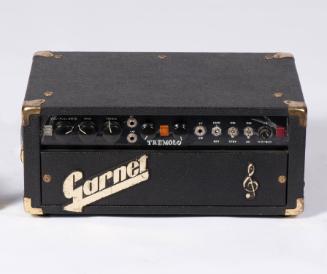
Photo credit: Meghan MacKrous, courtesy of the National Music Centre
Grammer Guitar Inc (Ampeg Corporation)
1971
Available for use in Recording Studios
On View: Not currently on exhibit
isVirtual:
Back