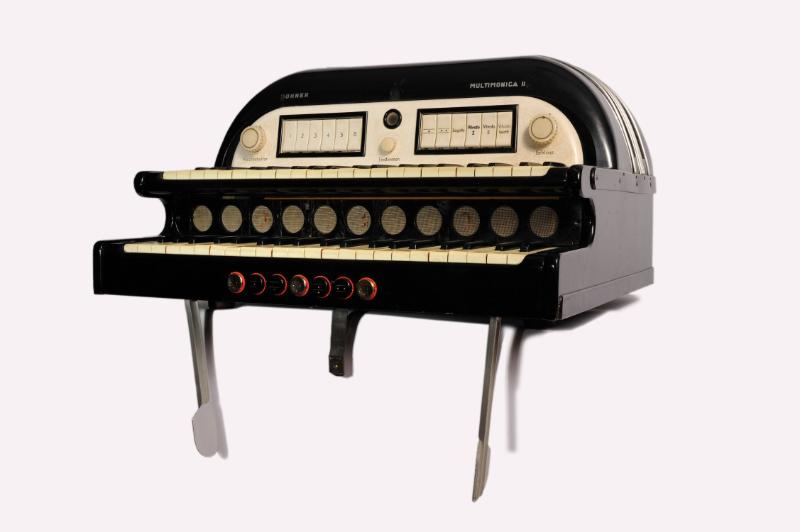

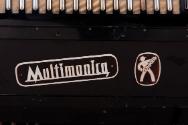

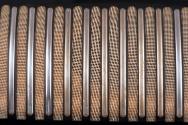
Hohner Multimonica
Not available for use in Recording Studios
Not currently on exhibit
Not currently on exhibit
Artifact TypeSynthesizer, Accordion
Manufacturer
Hohner Musikinstrumente GmbH & Co. KG
Datec. 1950
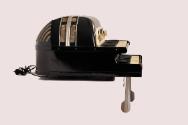
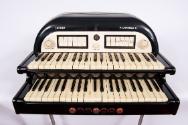
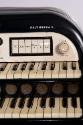
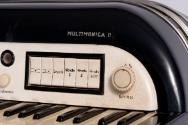
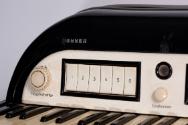
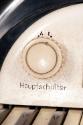
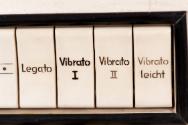
Operation/FunctionThis particular artifact combines a vacuum-tube monophonic synthesizer and a reed organ. Both instruments have their own dedicated chromatic keyboard, each with 41 keys (spanning three octaves plus five notes, from F through to A). The instrument’s front panel contains three knobs labeled from left to right as ‘Hauptschalter’ (master switch), ‘Einstimmen’ (tune), and ‘Gebläse’ (fan blower) as well as twelve rocker switches on either side of the Einstimmen knob. The left-side switches read ‘1’ through ‘6’ and the right-side switches read ‘.’, ‘. .’, ‘Legato’, ‘Vibrato I’, ‘Vibrato II’, and ‘Vibrato leicht’. The circuitry used in this instrument employs EL41, ECC40, and EF40 vacuum tubes. The exterior of the instrument is constructed of black and white Bakelite plastic.Cultural SignificanceThe Multimonica is unique not only in its hybrid electronic and acoustic design, but also in the fact that it was one of the first synthesizer-based instruments to be mass-produced for the consumer market. The instrument’s exterior design, with its streamlined shape and stylish black-and-white Bakelite enclosure, was perhaps its greatest selling point. The instrument was a commercial success within Germany and other parts of continental Europe throughout the 1950s.Technological SignificanceAlong with instruments such as the Ondes Martenot of the late 1920s, the Hammond Novachord of the late 1930s, and Raymond Scott’s Clavivox of the early 1950s, the Multimonica is an early instantiation of a basic analog synthesizer. As with these and most other electronic musical instruments of the era, the Multimonica employs vacuum tube technology, the precursor to the more widely used solid-state devices that emerged throughout the 1950s and 1960s. Conceptually, the Multimonica is similar to contemporaneous instruments such as the Hammond Solovox of 1940 and the Selmer Clavioline of 1947, which are small, monophonic electronic units that were meant to attach to an organ or piano such that the user could perform solos with their right hand, and accompanying chords and harmonic progressions on the organ or piano with their left hand. Although the modular synthesizers that would emerge nearly a decade later in the mid 1960s proved to be far more sonically flexible and physically interactive, the experimental and unique interfaces used in these early designs helped inform the aesthetic and technical concerns that continue to pervade electronic musical instrument technology today. Unlike many of its predecessors, which are entirely electronic, the Multimonica is highly unique in that it incorporates elements of both electronic and acoustic instrument design. That being said, it is not an electroacoustic instrument in the traditional sense of the term, which typically refers to acoustic instruments that have been made electric through the use of electromagnetic pickups, such as the electric guitars and electric pianos that also emerged in the 1950s. Rather, the Multimonica employs two different instruments, as it were, connected within the same enclosure. Unlike the Clavioline and Solovox, the Multimonica also precludes the player’s need to have an external organ in order to produce accompaniment. As such, it is a much more integrated design that aims to balance both functionality and convenience. Although the synthesizer component of the Multimonica effectively offers more preset settings rather than active controls for tone shaping – the latter being more in line with modern synthesizers and the former being more representative of early samplers – it is in line with the common synthesis practices of this era, which entailed taking a singular, complex waveform such as the sawtooth and a subtractive formula that employed a series of filtering techniques to extract new timbres, each with a distinctive harmonic spectrum. Before the advent of digital sampling in the early 1980s, most analog drum machines of the 1960s and 1970s used this technique, as well, so as to simulate the various instruments of the traditional drum kit. Unlike most later synthesizers, and even earlier units such as the Ondes Martenot and Clavivox, the synthesizer portion of the Multimonica does not, by and large, allow the user to vary the envelope or articulation of its overall sound. The reed organ component of the Multimonica is essentially a modified mechanism that does not employ many of the complexities found in the majority of reed and pipe organs. Although it does, however, share certain similarities with smaller reed organs such as the harmonium, there are still some notable differences, including the fact that most harmoniums are often still self-pumped via bellows, rather than through an electric blower mechanism. Unlike many other acoustic instruments, the reed organ does not require a separate resonator, such as a soundboard, to amplify the tone of the reed even though it is enclosed within the instrument. This works well for the Multimonica, which is externally constructed as an electric rather than acoustic instrument.
Historically, the Multimonica is signficiant in that its electronic components were designed by the German engineer Harald Bode, who is also credited with developing the theory and implementation methods behind transistorized modular voltage control in the 1950s, which revolutionized synthesizer design into the 1960s and 1970s. The concept of voltage control is based on the principle by which the function of electrical components relates to voltage, or the flow of electrical current. The most unique aspect of its implementation, which the modular synthesizers of the late 1960s and early 1970s took full advantage of, suggests that a voltage produced by one component of the instrument can be used to control some function, regular behaviour, or parameter of another component. Modular synthesizers were distinguished from their predecessors in that the former took the basic electronic units of classic studios, such as oscillators, filters, and noise generators, and housed them within a singular cabinet. Harald Bode (1909 – 1987, born in Hamburg, Germany) was one of the most influential thinkers and designers in the history of electronic musical instrument design, having pioneered many unique innovations that were adapted in numerous experiments by others. Following completion of his studies in mathematics, physics, and natural philosophy at the University of Hamburg in 1934, Bode relocated to Berlin to undertake postgraduate work at Berlin Technical University’s Heinrich Hertz Institute for Oscillation Research. It was during this time that he began designing his first instrument, the groundbreaking Warbo Formant Organ. Along with the Hammond Novachord of 1939, the Warbo Formant Organ, which was released in 1937, is effectively one of the first polyphonic synthesizers. True polyphony eluded the complex modular systems of the 1960s and did not remerge until the late 1970s with instruments such as the Sequential Circuits Prophet 5. In a similar manner to the Novachord, the Warbo Formant Organ also employs a series of filters and envelope shaping controls. ‘Warbo’ derives from a combination of the surnames Warnke and Bode, the former referring to Christian Warnke, the instrument’s financial backer. Throughout the Second World War, Bode was tasked with conducting research on military submarine acoustics and wireless communication, settling shortly after the war’s conclusion in Neubeuern in southern Germany. In the late 1940s, he designed another electronic instrument, the Melochord, with a specially commissioned unit constructed in 1953 for the famed Nordwestdeutscher Rundfunk (NWDR) electronic music studio in Cologne, Germany. This studio served throughout the 1950s as ground zero for the development of the Elektronische Musik technique, which was spearheaded by composers such as Karlheinz Stockhausen (German, 1928 – 2007), who is widely recognized as one of the most influential figures in modern electronic music, Herbert Eimert (1897 – 1972), one of the founders of the studio, and Werner Meyer-Eppler (Belgian-German, 1913 – 1960) who, in 1949, was the first to formally theorize the basic tenet of Elektronische Musik, this being a compositional practice that employs exclusive use of electronic means. Notable compositions to have featured the NWDR Melochord include Eppler’s Klangmodelle of 1951 and renowned Hungarian composer Gyorgy Ligeti’s Glissandi of 1957. Ligeti worked only briefly at the studio in the late 1950s, soon abandoning the electronic medium in favour of acoustic sound-mass composition, of which his well-known Atmosphères of 1961 is an example. Throughout the 1950s, Bode worked as a contractor for the German Apparatewerk Bayern (AWB) company and the American Estey Organ Company, producing instruments such as the Polychord and Bode Organ. In 1954, thanks to the commercial success of the Bode Organ, he immigrated to the United States to take on the position of chief engineer, and later vice president, for Estey in Brattleboro, Vermont. Bode’s main contribution came in the late 1950s, when he began to theorize the concept of a modular, voltage-controlled instrument that employs the newly emerging devices of solid-state technology, such as transistors. He developed prototype synthesizer and processor units, and, in 1961, compiled a paper outlining the concept. He began disseminating the idea at the Audio Engineering Society (AES) conventions of 1962 and 1964, which proved largely influential to two budding instrument designers, Robert Moog and Donald Buchla. From 1960, Bode briefly relocated to Buffalo, New York, to work with the Wurlitzer Organ Company on their first transistorized electromechanical pianos. Throughout his later life, Bode worked for Moog Music, Bell Aerospace as a researcher on early micro-circuitry, and as a commercial composer for television advertising. Under the direction of his own company, the Bode Electronics Company (later the Bode Sound Company), which was established in 1958, and in collaboration with composer Vladimir Ussachevsky at the Columbia-Princeton Center for Electronic Music in New York, the highly influential Bode Frequency Shifter and Bode Ring Modulator, both of 1964, were produced and later licensed to Moog Music. Although Bode retired in 1974, he continued to design new devices such as the Bode Vocoder of 1977 and the Bode Barberpole Phaser of 1981, the latter of which is based on the psychoacoustic principle of the Shepard tone and its perceived infinite frequency ascent.Users/PerformersThere is no documented use of the Multimonica in recordings or live performance, despite it being a relative commercial successful upon its release in the mid twentieth century.Collection
Object number2002.05.21

Hohner Musikinstrumente GmbH & Co. KG
c. 1966
Available for use in Recording Studios
On View: Not currently on exhibit
isVirtual:

Hohner Musikinstrumente GmbH & Co. KG
c. 1967
Available for use in Recording Studios
On View: Not currently on exhibit
isVirtual:

Hohner Musikinstrumente GmbH & Co. KG
1971
Available for use in Recording Studios
On View: Not currently on exhibit
isVirtual:

Paolo Guerrini
20th Century
Not available for use in Recording Studios
On View: On exhibit
isVirtual:
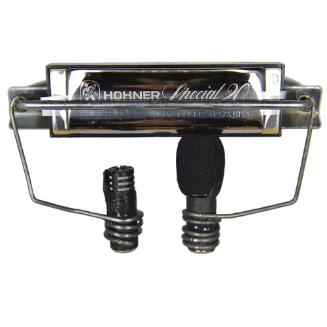
Hohner Musikinstrumente GmbH & Co. KG
Not available for use in Recording Studios
On View: Not currently on exhibit
isVirtual:

Hohner Musikinstrumente GmbH & Co. KG
Not available for use in Recording Studios
On View: On exhibit
isVirtual:

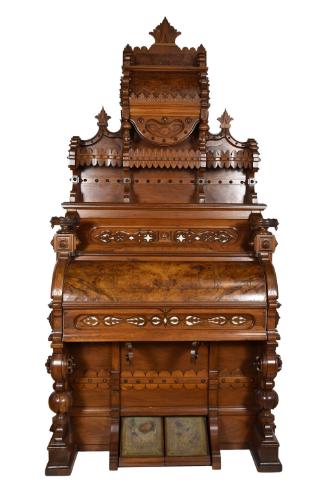
1887
Not available for use in Recording Studios
On View: Not currently on exhibit
isVirtual:
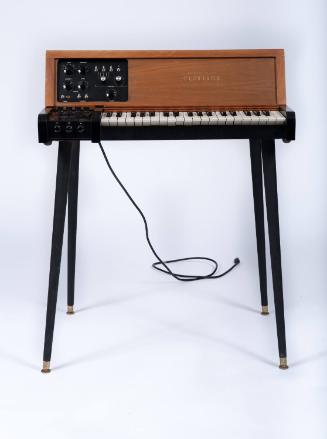
Raymond Scott Enterprises/Manhattan Research
1957
Not available for use in Recording Studios
On View: Not currently on exhibit
isVirtual:
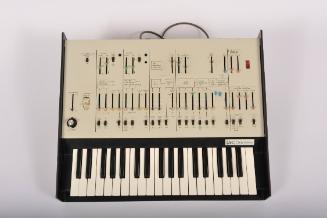
ARP Instruments, Inc.
1972
Available for use in Recording Studios
On View: Not currently on exhibit
isVirtual:
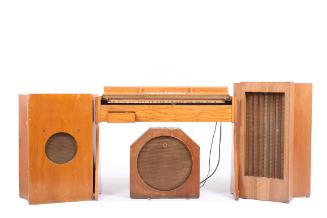
Maurice Louis Eugène Martenot
1975
Available for use in Recording Studios
On View: Not currently on exhibit
isVirtual:
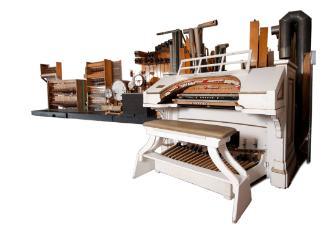
Kimball Piano and Organ Company
1924
Not available for use in Recording Studios
On View: On exhibit
isVirtual: