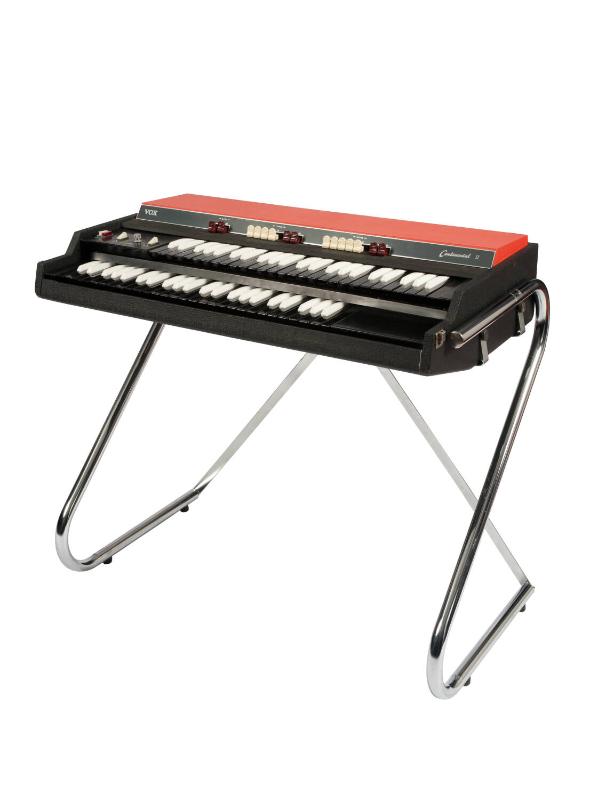
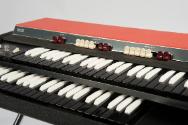
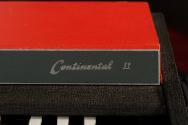
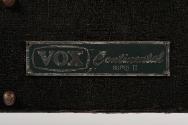
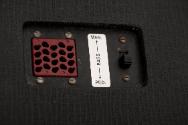
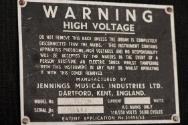
Vox Continental II
Not available for use in Recording Studios
Not currently on exhibit
Not currently on exhibit
Artifact TypeOrgan, Electronic
Manufacturer
Vox Sound, Ltd.
Datec. 1967
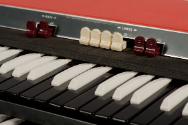
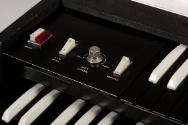
Operation/FunctionThe Continental II contains twelve oscillators per each of its two four-octave manuals as its primary tone generating component as well as three sets of octave dividers per manual. The instrument is transistor based, with the corresponding model number TC/2M indicating that the unit is a ‘Transistor Continental, Two Manual’. Each manual corresponds with a series of drawbars, allowing the user to select between two different timbres per manual and to select the octave ranges in which each is heard. This particular artifact also comes equipped with a set of bass pedals.Cultural SignificanceWith its introduction in the early 1960s, the combo organ – and those produced by Vox especially – quickly asserted itself as one of the most iconic instruments of the decade, used extensively by many of the psychedelic bands of the era. Its highly stylish design, often featuring brightly colored Vynide coverings, polished chrome legs, and reverse-coloured keyboards that harken back to the instruments of the Renaissance and Baroque, featured prominently in the visual identity of various rock-inspired genres. Although its popularity has waned considerably since the early 1970s, these instruments remain revered for their clean aesthetic and characteristic tone.Technological SignificanceCombo organs hold a unique place within the development of electronic musical instruments. Although often classified as a type of organ, they share little with their electromechanical predecessors – instruments such as the tone-wheel-based Hammond B3 – in that they generate their tones entirely by solid-state (i.e. transistor-based) electronic means, as with the earliest voltage-controlled synthesizers of the late 1960s. Unlike synthesizers, however, which are capable of producing a large and varied range of timbres and articulations, combo organs are relatively limited in their scope and idiom, capable of producing only a select few sounds, typically in imitation of popular orchestral instruments. Also unlike most early synthesizers, combo organs were usually fully polyphonic, employing a similar form of divide-down architecture seen in earlier electronic organs such as the Hammond Novachord of 1939. Nonetheless, the combo organ was designed as a response to the popularity of the electromechanical organ in the domestic market throughout the 1950s and early 1960s. Although professional musicians regularly used instruments such as the Hammond B3, their large size and commanding weight rendered them largely inconvenient for continued live use. Thus, the combo organ emerged as a smaller, cheaper, more lightweight alternative geared specifically for the stage. As with electromechanical organs, both single and double manual versions of combo organs were developed, with the latter typically allowing the performer to produce two different timbres between their hands. The Continental II and the Super Continental were virtually identical functionally and electronically, with the former being manufactured in the JMI factory in Erith, England and the latter being manufactured in the EME factory in Portofino, Italy. Later variations of the first Vox combo organs incorporated integrated circuitry and additional presets and effects such as reverb. The majority of combo organs that were produced by various manufacturers – primarily in Italy, the United Kingdom, Japan, and the United States – throughout the 1960s and 1970s followed a similar format, incorporating a portable design and exhibiting a thin, bright, reedy sound. Most employed transistorized circuitry, with those emerging in the early 1970s also transitioning to integrated circuitry. Although the combo organ became ubiquitous throughout the 1960s especially, it did not by any means replace usage of its larger electromechanical counterparts. With the introduction of the first portable voltage-controlled synthesizers, which were far more flexible and powerful in their design, in the early 1970s, combo organs fell considerably out of favour, experiencing only a brief resurgence toward the late 1970s and into the early 1980s.Users/PerformersThere are numerous examples of the original Continental model in both recorded and live contexts, spanning from the early 1960s until the present, with more sophisticated models such as the Continental II and Continental Baroque emerging toward the end of the 1960s. The 1960s remain the combo organ’s most active period, with usage tapering off in the mid 1970s and increasing once again in the late 1970s. Among the most recognizable albums and compositions to feature either the Continental or one of its double-manual derivatives include: The Animals’ “House of the Rising Sun” from ¬The Animals of 1964; The Doors’ “Light My Fire” from The Doors of 1966 and “Love Her Madly” from L.A. Woman of 1971; The Dave Clark Five’s “Because” of American Tour of 1964; The Zombies’ “Woman” single of 1964; The Monkees’ “I’m a Believer” from More of the Monkees of 1967; Iron Butterfly’s “In A Gadda Da Vida” from In-A-Gadda-Da-Vida of 1968; Elvis Costello’s “Watching the Detectives” from My Aim is True of 1978; Bob Dylan’s “Absolutely Sweet Marie” from Blonde on Blonde of 1966; The Velvet Underground’s “Sister Ray” from White Light/White Heat of 1968; The Beatles’ “I’m Down” B-side of 1964; and, Strawberry Alarm Clock’s “Incense and Peppermints” from Incense and Peppermints of 1967.Collection
Object number2002.05.60

Elettronica Musicale Europea (EME) / Vox
c. 1968
Available for use in Recording Studios
On View: Not currently on exhibit
isVirtual:

Hammond Organ Company
1957
Not available for use in Recording Studios
On View: Not currently on exhibit
isVirtual:
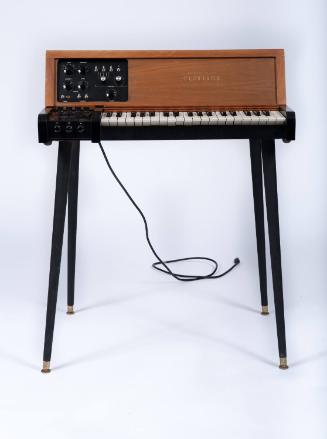
Raymond Scott Enterprises/Manhattan Research
1957
Not available for use in Recording Studios
On View: Not currently on exhibit
isVirtual:
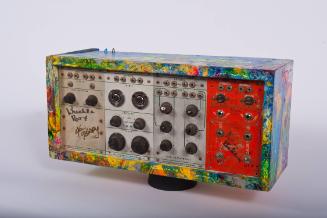
Donald Buchla
c. 1966
Not available for use in Recording Studios
On View: On exhibit
isVirtual:
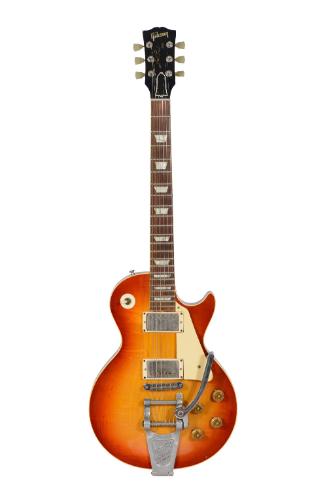
Gibson Guitar Corporation
1959
Not available for use in Recording Studios
On View: Not currently on exhibit
isVirtual:
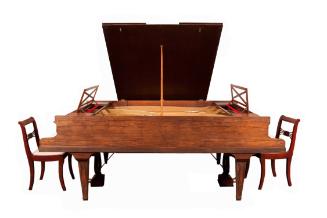
Pleyel et Cie
1913
Not available for use in Recording Studios
On View: Not currently on exhibit
isVirtual:

Kurzweil Music Systems
1985
Available for use in Recording Studios
On View: Not currently on exhibit
isVirtual:
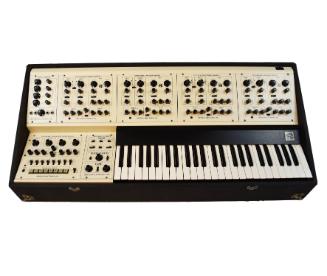
Oberheim Electronics, Inc.
1976
Available for use in Recording Studios
On View: Not currently on exhibit
isVirtual:
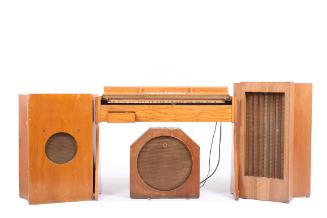
Maurice Louis Eugène Martenot
1975
Available for use in Recording Studios
On View: Not currently on exhibit
isVirtual:
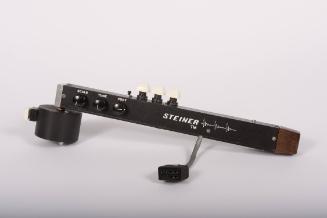
Nyle Steiner
c. 1975
Not available for use in Recording Studios
On View: Not currently on exhibit
isVirtual:
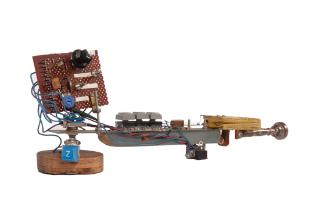
Nyle Steiner
1972
Not available for use in Recording Studios
On View: On exhibit
isVirtual: