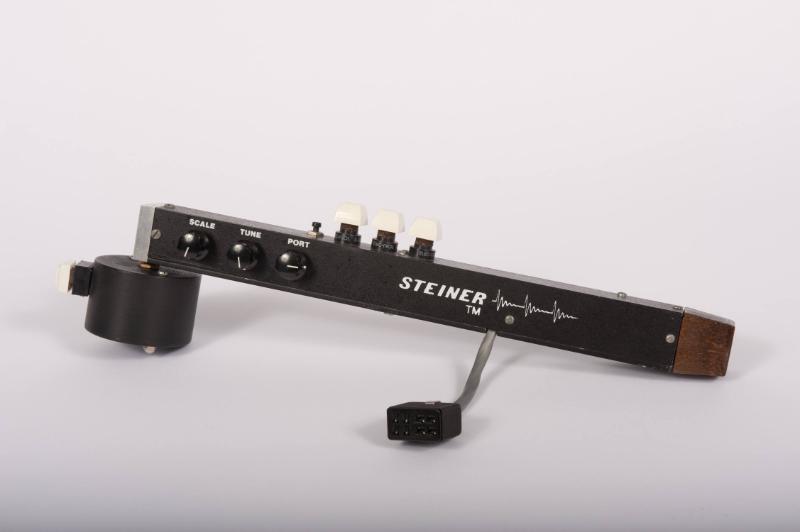
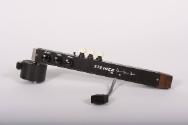
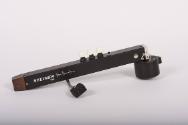
Steiner EVI
Not available for use in Recording Studios
Not currently on exhibit
Not currently on exhibit
Artifact TypeSynthesizer, Controller
Manufacturer
Nyle Steiner
Datec. 1975
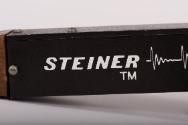
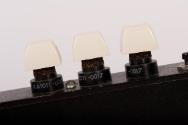
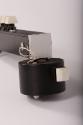
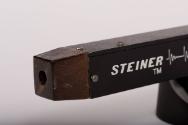
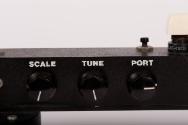
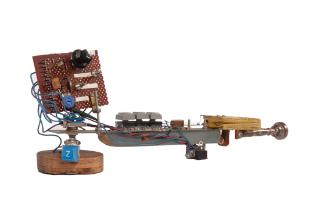
Operation/FunctionThis particular artifact is an early production model of the EVI, or Electronic Valve Instrument. It contains a wooden mouthpiece with a basic sensor for generating an initial voltage, and an attached metal bar that makes up the body of the instrument. The body features three spring switches, constructed of metal and plastic, and a rotating wooden cylinder at the end opposite the mouthpiece. Early production models such as this employ a black metal exterior with white switches and three potentiometers, labeled ‘scale’, ‘tune’, and ‘port’. A cinch cable is used to connect the controller to its synthesizer module.Cultural SignificanceThe EVI, being among the first alternate controllers designed specifically for non-keyboard players, was extremely innovative and useful at the time of its production. Through his use of the EVI in his work on film soundtracks, Nyle Steiner demonstrated the range and flexibility of the device. With the use of an accompanying synthesizer to generate sound, the EVI could be used to create a multitude of sounds that cannot be produced by the acoustic trumpet; for instance, a player could play the controller as they would a trumpet, but could produce string or flute tones, as well as a range of timbres completely foreign to the acoustic lexicon. Also, in creating an interface that is more intuitive to non-keyboard players, Steiner helped expand the demographic of synthesizer users, showing non-keyboard players that these instruments, which were almost always accompanied by a piano-style keyboard, were in fact accessible. The EVI also paved the way for the development of other alternate controllers, which also in turn helped to further expand the sonic and gestural capabilities of the synthesizer. The EVI is particularly significant in that it is effectively one of the first and only controllers designed specifically for brass instrument players.Technological SignificanceThe Electronic Valve Instrument was among one of the first alternate controllers produced specifically for use with analog modular synthesizers, and it remains one of only a few that were designed for players of brass instruments. The first commercially minded synthesizers emerged into the market in the late 1960s, with analog modular systems remaining popular until well into the late 1970s. The EVI was intended for use with such instruments, and came equipped with a dedicated module that could be connected to the instrument, enabling the controller to operate as an interface. Although a number of synthesizer designers have experimented over the years with alternate methods of interacting with their instruments, the keyboard interface has remained the dominant tool, having first emerged in early electronic instruments such as the Ondes Martenot and Ondioline, and being retained throughout the progression of early electric organs and sampling instruments on account of its relatively intuitive and “fool proof” nature. The advent of the alternate controller is one of the most important in the development of synthesizer technology in that it helped to expand both the range of the instrument, allowing players to articulate sounds in ways that are not afforded by the physical limitations of the keyboard, and the demographic of users, giving access to those who are trained in non-keyboard instruments. The EVI in particular enabled players of brass instruments to perform with instruments they may not have been otherwise comfortable playing, and offered greater expressivity in terms of its pressure sensitive mouthpiece and voltage-controlled vibrato and portamento mechanisms. The latter effect was especially significant when one considers that the keyboards of most early modular synthesizers were quite basic; they did not allow the player to vary the tone with finger pressure or articulation, and were similar to piano keyboards in that their octaves were divided evenly into only twelve tones, generally not enabling the player to access a greater number of frequencies at one time.
The EVI was the brainchild of designer Nyle Steiner, a classically trained trumpet player who sought to produce an electronic controller that he could use to operate a synthesizer. His initial designs of 1964 were in fact in the form of a stand-alone electronic instrument that consisted in a trumpet-style interface with three levers, replacing the three valves of the trumpet, to push down on vibrating strings or wires, causing them to shorten and thereby alter their sounding length. Additional pitches were to be accessed by honing in on the overtones produced, similar to the way in which a trumpet player can produce harmonics by varying the length of the instrument’s tube, however Steiner abandoned this project before any prototyping began. His next project came to be known as the Electronic Valve Instrument, and consisted in a trumpet-style device that translating pitch and air pressure information into control voltages that could be used to affect the sound generation of an analog modular synthesizer. The EVI remains one of the most revered alternate controllers, and in addition to the EWI, or Electronic Wind Instrument, which Steiner designed in the mid 1980s for use by woodwind players, was effectively among the first of its kind. The EVI required interfacing with synthesizers via a dedicated module, however the synthesizers Steiner designed, such as the Synthacon, allowed for direct connection to both the EVI and the EWI. The earliest EVI models and prototype were quite basic, capable of producing only a single control voltage and gate output that was triggered by a sensor in the mouthpiece. The later models that were produced towards the end of the 1970s employed a more sophisticated air pressure control, allowing the player to vary the envelope and volume of the sound with the articulation of their breath, and incorporated controls for vibrato, portamento, and pitch bend, as well. These innovations were made possible by Steiner’s proportional breath transducer, which he designed as an improvement upon the simple on/off gate that accompanied earlier models, as well as a series of sensors to capture vibrato and portamento information, including a “bitten” sensor for the latter, which was located in the mouthpiece, and a vibrato switch operated by the player’s right hand thumb. Control voltages were also output through the device’s three spring switches and rotational cylinder, which determine the pitches and their respective octave or register. Although the EVI could interface with virtually any analog system capable of handling control-voltage inputs, many of the professional models were accompanied by a small analog synthesizer designed by Steiner. Later models that were manufactured by the Italian electronics company, Crumar, were constructed as stand-alone devices, incorporating both the controller and synthesizer unit into a small case. By the end of the 1970s, a number of other synthesizer and electronic instrument manufacturers had developed interfaces that would make it easier for the EVI to be used in conjunction with them; one among these instruments was the Mellotron. After several attempts to cease production, the EVI was discontinued altogether in 1990, but was brought back into production in 1998 with the first MIDI compatible units that were significantly more flexible than earlier iterations could have been. The arrival of MIDI (Musical Instrument Digital Interface) in 1982 revolutionized the digital synthesizer industry, resulting in much of the preceding analog technologies either becoming obsolete or undergoing the necessary modifications to survive in an increasingly MIDI-focused industry. The EVI was in fact modified for use with MIDI while still under the manufacturing control of Crumar in the early 1980s, and incorporated a revision of a MIDI adapter module that had been originally designed by J. L. Cooper Electronics for the Computone Lyricon woodwind controller. For whatever reason, Crumar did not bring these modifications into production.
In addition to the EVI, Nyle Steiner is lauded for his numerous other innovations in the synthesizer manufacturing industry. His instruments and designs are regarded as being highly unique and intuitive. Other Steiner creations include the Electronic Wind Instrument, or EWI, which was the most commercially successful of the Steiner controllers. The EWI was designed with similar circuitry to the EVI, however its interface was modeled after that of woodwind instruments and borrowed a similar Boehm fingering system to that used in the clarinet and soprano saxophone. Much like the EVI, the EWI does not produce sound on its own and requires interfacing with a synthesizer. Also similar to the EVI, the EWI contains pressure sensors at the mouthpiece for affecting volume, and a bite sensor for altering vibrato. The EWI remained in production well after the EVI had ceased, and a number of the EWIs that were produced by Akai throughout the 1990s offered an EVI-style fingering setting, allowing brass players to also employ the EWI. An interesting distinction between the EVI and EWI is that the keys of the EWI do not move, but rather sense the position of the fingers and obtain an electrical current via conductivity. What later came to be known as the Microcon was initially developed as the synthesizer accompaniment to professional EVI and EWI units. Physically, it is quite a compact instrument, but contains a number of features, including a voltage-controlled oscillator with fine tuning and three different waveforms, a low-frequency oscillator, a voltage-controlled filter with a potentiometer for resonance, an envelope generator, and a voltage-controlled amplifier that is capable of enabling the oscillator to imitate the texture of two oscillators beating against one another.
The Synthacon, which was produced by Steiner-Parker between 1975 and 1979, is arguably Steiner’s most reputable synthesizer creation. Similar to the revered Minimoog, the Synthacon is a monophonic instrument with three voltage-controlled oscillators, a low frequency oscillator, a voltage-controlled filter, a noise source, and a voltage-controlled amplifier. The Synthacon employs a built-in keyboard interface, but can be easily connected to either the EVI or the EWI. The Synthacon is characterized as having a warm tone, comparable to that of competing instruments of the time such as the Minimoog and ARP Odyssey, however it employs certain unique features and parameter controls that give it a distinct quality. The instrument’s filter, which is well known for its flexibility, is particularly unique, and is capable of producing brilliant resonant effects without having to compromise amplitude. The interface layout of the instrument is also unusual in that it places the oscillators on the player’s right hand side, forcing them to construct a signal path that moves from right to left; the majority of monophonic synthesizers feature the opposite layout, with oscillators placed on the left and the signal path moving in a more intuitive left to right orientation. A later version of the Synthacon, referred to as the Synthacon II was developed with a duophonic keyboard. The SynthaSystem, also developed in the early and mid 1970s, was effectively Steiner-Parker’s analog modular system and employed a very similar circuitry to the Synthacon. Other Steiner-Parker innovations included the Multiphonic Keyboard, which was among the first arpeggiating keyboards, and the Selective Inverter, a programmable motion generator.
The Computone Lyricon, which was effectively the first fully dedicated woodwind-style controller, is another notable alternate controller. A number of other manufacturers sought to remedy the limitations of the keyboard interface by producing various other controllers or modifications. Among the most common on both earlier and later synthesizers was the ribbon controller, which gave the player greater flexibility in producing portamento, vibrato, and subtle microtonal articulations. As seen in many of the early modular systems from Moog, the ribbon controller was placed directly above the keyboard, spanning nearly its entire compass. Another manufacturer who stands out in particular as one of the most important contributors to alternate control is the California-based designer Donald Buchla. Buchla essentially pioneered the notion of gestural control with his pressure-sensitive touch plates, which existed as a dedicated module that could be used to interface with his 100 and 200 series analog modular systems, and his 300 series digital-analog modular system. These touch plates were divided into a number of flat “keys” that were individually tunable and offered a far more expressive tone than the traditional keyboards of the time. Buchla also designed several stand-alone instruments and controllers throughout the 1970s, 1980s, and 1990s, including the Lightning, an instrument that is activated by two hand-held wands and a spatial mapping system, the Thunder, a controller that borrows a similar technology to the touch plates but arranges the keys in a manner more reflective of the natural lateral curvature of the hand, the Marimba Lumina, an instrument that employs a similar interface to that of tuned percussion instruments, and the Wind, which was an uncompleted woodwind controller. A number of other manufacturers stepped beyond the notion of the alternate controller for keyboard-based synthesizers and began manufacturing synthesizers that were for explicit use with non-keyboard instruments. Both the Buchla Lightning and Marimba Lumina are examples of this, as well as instruments such as the EMS Synthi Hi-fli, a guitar synthesizer designed by the British manufacturer of the revered VCS3 and Synthi 100 synthesizers, meant to cater specifically to the idiom of the guitar. EMS also produced a device called the Pitch to Voltage converter, which essentially translates incoming frequencies from an acoustic source into voltages that can be used to control a synthesizer. Earlier iterations of alternate controllers also include the Theremin, which employs two antennae that the player manipulates without touching, and the Ondes Martenot, which employs a ring controller capable of producing sophisticated and subtle articulations in vibrato and volume. Several other manufacturers followed in the footsteps of Nyle Steiner to produce a series of brass and woodwind controllers, including Casio and Yamaha, both of whom were very successful in their ventures throughout the 1980s and 1990s.Users/PerformersThe controller’s manufacturer, Nyle Steiner, is often regarded as the foremost proponent of the EVI. Being a trumpet player himself, Steiner employed the controller in his film work and helped establish its continued presence in the Los Angeles studio scene throughout the 1970s. Although not in as widespread usage as the EWI, the EVI was also used in the mid and late 1970s by colleges and universities, and in associated private studios such as the Columbia-Princeton Electronic Music Center, as well as by popular musicians of the era, such as Earth, Wind, and Fire, who were the recipients of one of the first EVI systems every produced.Collection
Object number2002.05.58
Nyle Steiner
1972
Not available for use in Recording Studios
On View: On exhibit
isVirtual:

Hammond Organ Company
1957
Not available for use in Recording Studios
On View: Not currently on exhibit
isVirtual:

Optigan Corporation (of Mattel) / Opsonar (of Miner Industries)
c. 1973
Available for use in Recording Studios
On View: Not currently on exhibit
isVirtual:

Moog Music, Inc.
1973
Available for use in Recording Studios
On View: Not currently on exhibit
isVirtual:
R.A. Moog, Inc.
1970
Available for use in Recording Studios
On View: Not currently on exhibit
isVirtual:

Vox Sound, Ltd.
c. 1967
Not available for use in Recording Studios
On View: Not currently on exhibit
isVirtual:
Raymond Scott Enterprises/Manhattan Research
1957
Not available for use in Recording Studios
On View: Not currently on exhibit
isVirtual:
Mellotron (Mellotronics Manufacturing)
1973
Not available for use in Recording Studios
On View: Not currently on exhibit
isVirtual:

Streetly Electronics/ Mellotronics/ Mellotron
1971
Not available for use in Recording Studios
On View: On exhibit
isVirtual:
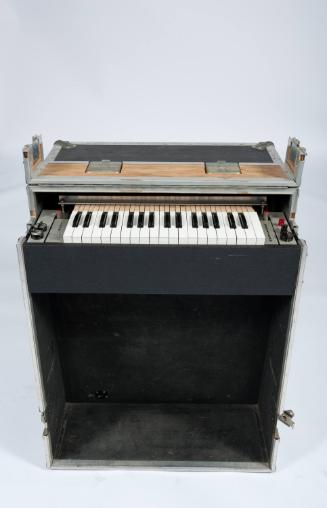
Novatron
c. 1981
Available for use in Recording Studios
On View: Not currently on exhibit
isVirtual:
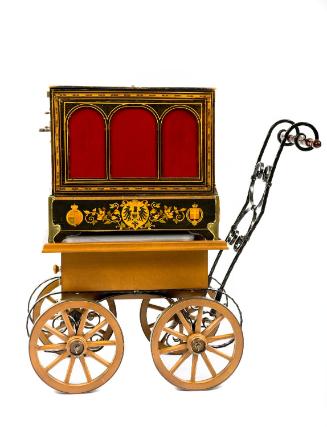
Bacigalupo-Söhne, Orgelfabrik
c. 1880
Not available for use in Recording Studios
On View: Not currently on exhibit
isVirtual:

Frank Morse Robb
1937
Not available for use in Recording Studios
On View: On exhibit
isVirtual: