EN / FR
Skip to main content

Hammond Novachord

Available for use in Recording Studios
Not currently on exhibit
Artifact TypeSynthesizer
Manufacturer LocationUSA, North America
Date1939
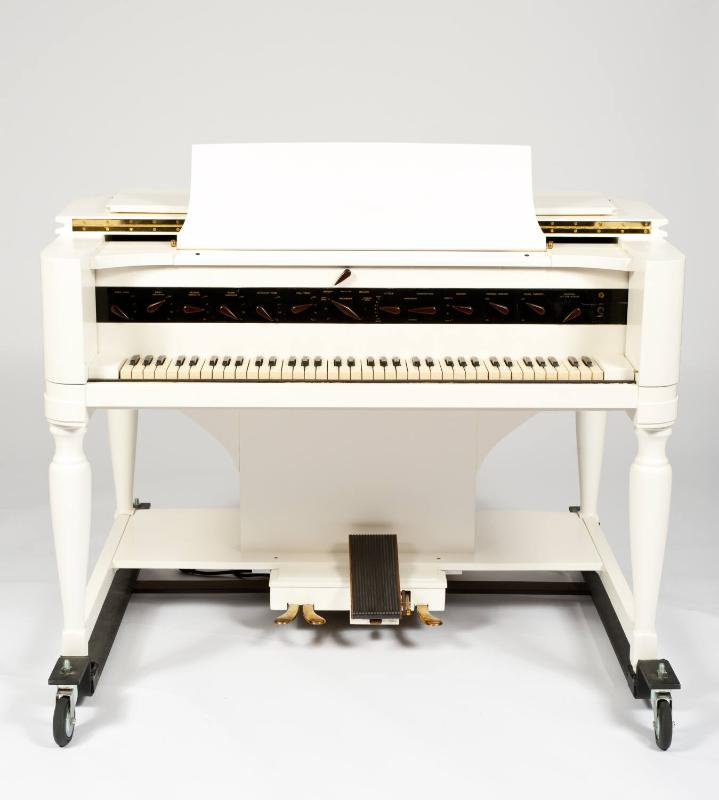
Decades ahead of its time, the Novachord is considered the very first analog, fully polyphonic synthesizer. It was designed in 1938 by Americans Laurens Hammond, John Hanert, and C.N. Williams. While it was briefly used for film soundtracks—most notably in Gone With the Wind—the Novachord’s complexity limited its appeal. Nevertheless, it became one of the world’s most sought-after electronic instruments. The instrument was a favourite of legendary musician/producer Brian Eno during his visit to NMC for a residency in 2011.  
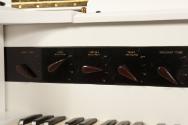
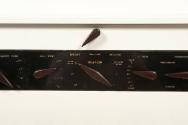
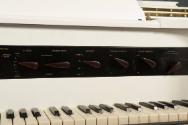
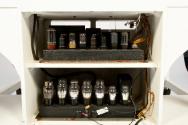
Operation/FunctionHistorically, the Novachord contains approximately 163 vacuum tubes and over 1000 capacitors. In 2011, this particular artifact underwent an extensive restoration to remove nearly 45 pounds of material from its internal structure, and most of these parts were replaced with modern components. Its compass spans six octaves, or 72 notes, and it is capable of full polyphony across the keyboard. It employs divide-down oscillator technology to enable its polyphonic capacity, and features a six-channel vibrato unit as well as a three-stage resonant band-pass filter. There are twelve vacuum tube oscillators and five octave dividers. Its synthesis method is subtractive analog. There are 14 rotary switches on the instrument’s front panel, allowing the user to control timbre, volume, resonance, balance between bass and treble, vibrato amount, and brightness, a set of three foot pedals at the bottom of the instrument, which enable the user to control sustain and volume, and a swell/expression pedal. The first six controls at the left of the front panel are the tone controls, consisting of ‘Deep Tone’, a low-pass filter; ‘First Resonator’, ‘Second Resonator’, and ‘Third Resonator’, which emphasize particular frequency bands; ‘Brilliant Tone’, a high-pass filter; and ‘Full Tone’, which allows all frequencies. The tone controls act on all notes of the instrument. The ‘Balancer’ control attenuates the volume of the lower half of the keyboard, allowing the treble frequencies to sound louder. The ‘Bright-Mellow’ control alters the harmonic content of the tone. The ‘Combination’ control acts almost as a preset, and the remaining controls affect the volume and vibrato. Wattage is 440.Cultural SignificanceAlthough the Novachord failed as a commercial venture, it remains one of the most fascinating items in the history of electronic music in that it was, technologically and aesthetically, decades ahead of its time. Unfortunately, many users were put off by its complexity, and it did not receive the kind of attention that such innovations warranted until much later. Its widest popular reach came with its use in film soundtracks of the era, and still today it is a highly sought after instrument for its unique and unearthly sound quality. With the introduction of the tone wheel generator in 1935, the Hammond Organ Company also left an incomparable influence on the development of electric organs. Their instruments were stable and, for the most part, accessible to the commercial market.Technological SignificanceThe Novachord is an early electronic instrument that emerged from what was a particularly innovative era in instrument design. The first electronic instruments, including devices such as the Theremin, Ondes Martenot, Telharmonium, and Trautonium, were designed in part as a response to the growing dissatisfaction with the limitations of acoustic instrumentation, felt rather strongly by some composers throughout the musical avant-garde of the 1920s and 1930s. They were designed expressly to provide a way forward both in tonal characteristics and in gestural control. The Theremin, invented by Russian physicist Lev Termin in 1919, employed the heterodyning principle in order to produce a single, continuously variable electronic tone. The interface of the Theremin, which allows players to interact with the instrument without physically touching any of its components, remains one of the most innovative designs in the history of electronic musical instruments. The Ondes Martenot, developed in 1928 by French cellist Maurice Martenot, employs a unique ring controller interface, as well as an array of modifired speakers that diffuse the output signal in ways that were highly experimental for the time, altering its harmonic content in the process. The Trautonium, invented in 1929 by German designer Friedrich Trautwein and German composer Oskar Sala, employed a similar gliding fingerboard instead of a traditional keyboard, with later versions incorporating filters and an envelope generator. Other prototypes for photoelectric tone production had been explored beginning as early as 1916. Although Laurens Hammond is credited with developing the first commercial electromechanical organ, dubbed the model A, in 1935, the general concept for his tone wheel design was predated nearly three decades by Thaddeus Cahill’s Telharmonium, which employed enormous rotating electromagnets as tone generators. That being said, Hammond’s tone wheel mechanism remains the most influential design in the development of electric organs, and became the standard for instruments that followed throughout the 1940s, 1950s, and 1960s. Unlike Hammond’s first tone wheel electric organs, the Novachord was significant in that it was, by and large, fully electronic, producing its sound via a series of vacuum tubes. Although, as aforementioned, it was not the first instrument to produce sound in such a manner, it stands as one of the most historically significant items in that it was the first fully electronic instrument to offer complete polyphony across its six-octave keyboard; the Theremin, Ondes Martenot, and Trautonium were all monophonic, meaning that only a single tone could be produced at any time. Polyphony was not necessarily a new concept, either: several other instruments were also developed in the late 1930s, such as Harald Bode’s Warbo Formant Organ of 1937, which employed a primitive voice allocation architecture. Polyphony in the Novachord, however, was achieved through the use of divide-down oscillator technology. Implementation of such an advanced technology in the 1930s is quite remarkable, considering that the first analog synthesizers that emerged in the 1960s were monophonic, and remained so for nearly a decade. It wasn’t until the advent of the microprocessor in the mid 1970s that polyphony became a common feature of modern synthesizers. Even then, however, most instruments could only produce eight- to ten-voice polyphony; the ability to produce something in the range of the Novachord’s 72-note polyphony would not appear until well into the 1980s. Divide-down oscillator technology was later used in many of the electric organs of the 1960s, which are usually referred to as combo organs, but was not typically incorporated into synthesizers until much later. There were a few exceptions, of course, most notably the Polymoog polyphonic synthesizer, which was released in 1975 and lauded for its organ-like quality. The Novachord was also the first electronic instrument to employ subtractive synthesis, with most electronic organs of the time adhering to the practice of additive synthesis; the majority of integrated analog synthesizers also employed subtractive synthesis, with many of the same circuit and control elements found in the Novachord. The Novachord also featured an array of complex tone controls uncommon for early electronic instruments, such as a filter and envelope generator. The instrument is still today revered for its unique tonal characteristics, and for its ability to produce a wide range of distinct sounds. As such, the Novachord is often considered to be the very first analog, fully polyphonic synthesizer, released decades before the devices that helped shape modern music surfaced. It should also be noted that the Novachord was not Hammond’s only tube-based instrument: in the 1940s the company developed the Solovox tone cabinet and keyboard, which featured a significantly simpler design. The Hammond Organ Company stands as one of the most technologically influential with respect to the development of electronic instruments. Hammond’s groundbreaking design of an instrument that cleverly combines rotating tone wheel generation, a synchronous motor, a keyboard, and an amplified speaker in 1934 paved the way for most other electro-mechanical organs that followed in subsequent decades. By the 1970s, there were in excess of thirty electric organ manufacturers, all taking their cue from Hammond’s basic approach. The most famed Hammond instrument, the B-3, is perhaps the most iconic popular musical instrument and, after the piano, it is also the second-most recorded keyboard instrument. In addition to the tone wheel generator, Laurens Hammond also invented a number of other innovative devices, such as the first 3-D glasses, a silent spring-driven clock, and one of the first reverb units to employ the torsion of a coiled spring. Both vacuum tubes and tone wheels were rendered obsolete in the early 1960s with the advent of solid-state devices such as the transistor. Solid-state technology was far smaller, lighter, more reliable, more durable, and less expensive than vacuum tube technology.Users/PerformersThere are no overt primary users of this instrument, however it can be heard in performance by Arthur Young on Vera Lynn’s hit, “We’ll Meet Again” (1939), and on Brother Bones’ 1949 recording of the 1925 standard “Sweet Georgia Brown”. Most famously, the Novachord provides the entr’acte music for the Hollywood classic Gone With the Wind of 1939. The Novachord was featured regularly in many Hollywood and television classics of the era, including The Maltese Falcon (1941), The Twilight Zone (1959 – 1964), and House of Frankenstein (1944). American film composer and Academy Award-winner Jerry Goldsmith (1929 – 2004), whose credits include Planet of the Apes (1968), Logan’s Run (1976), The Omen (1976), Poltergeist (1982), Alien (1979), and First Blood (1982), was a fervent champion of the Novachord’s unique sonic palette..
Object number2002.05.19
Photo credit: Don Kennedy
Hammond Organ Company
1957
Not available for use in Recording Studios
On View: Not currently on exhibit
isVirtual:
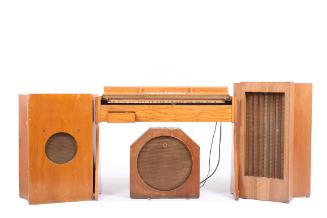
Photo credit: Don Kennedy
Maurice Louis Eugène Martenot
1975
Available for use in Recording Studios
On View: Not currently on exhibit
isVirtual:
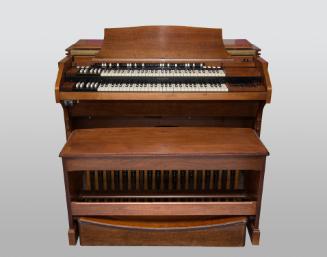
Photo credit: Don Kennedy
Hammond Organ Co.
1959
Not available for use in Recording Studios
On View: Not currently on exhibit
isVirtual:
Photo credit: Don Kennedy
The Story & Clark Piano & Organ Company
1941
Not available for use in Recording Studios
On View: Not currently on exhibit
isVirtual:
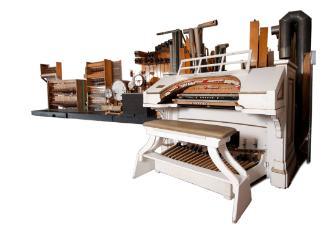
Photo credit: Don Kennedy
Kimball Piano and Organ Company
1924
Not available for use in Recording Studios
On View: On exhibit
isVirtual:
Photo credit: Don Kennedy
Moog Music, Inc.
1973
Available for use in Recording Studios
On View: Not currently on exhibit
isVirtual:
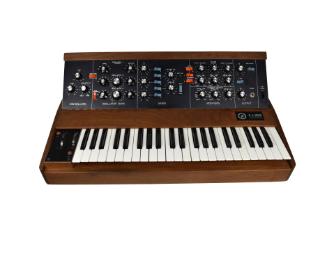
Photo credit: Meghan MacKrous, courtesy of the National Music Centre
R.A. Moog, Inc.
1970
Available for use in Recording Studios
On View: Not currently on exhibit
isVirtual:
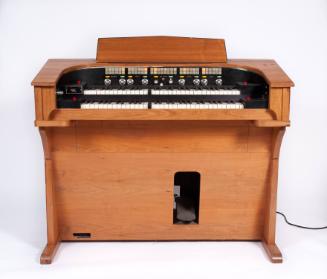
Photo credit: Don Kennedy
Chamberlin Instruments Company, Inc.
1970
Not available for use in Recording Studios
On View: On exhibit
isVirtual:
Photo credit: Don Kennedy
Hohner Musikinstrumente GmbH & Co. KG
c. 1966
Available for use in Recording Studios
On View: Not currently on exhibit
isVirtual:
Photo credit: Don Kennedy
Everett Piano Company
1935
Not available for use in Recording Studios
On View: Not currently on exhibit
isVirtual:
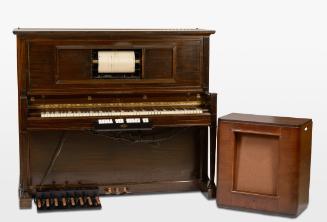
Photo credit: Don Kennedy
Willis & Company Ltd.
1924
Not available for use in Recording Studios
On View: Not currently on exhibit
isVirtual:
Bösendorfer Klavierfabrik GmbH
1855
Not available for use in Recording Studios
On View: Not currently on exhibit
isVirtual:
Back