


EN / FR
Skip to main content

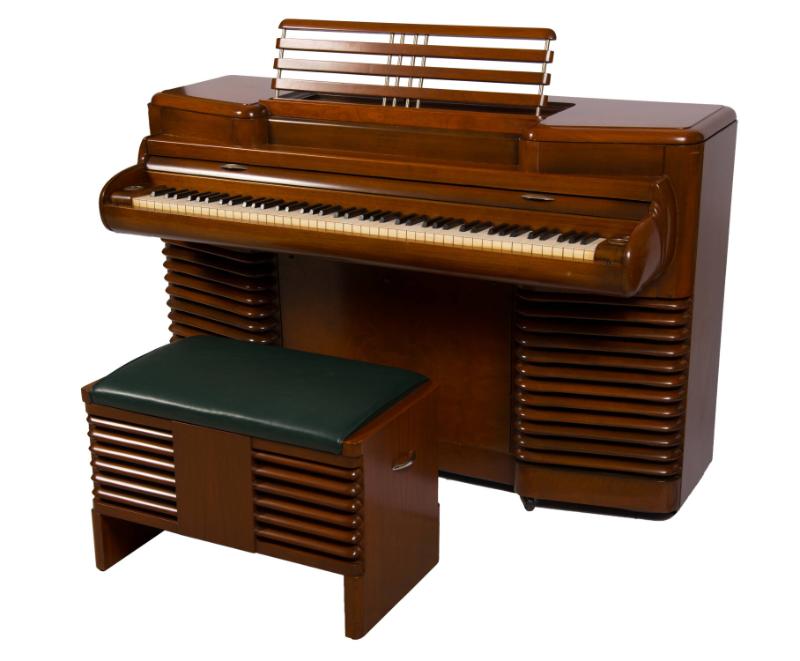
Story & Clark Storytone

Not available for use in Recording Studios
Not currently on exhibit
Artifact TypePiano, Electromechanical
Manufacturer LocationUSA
Date1941
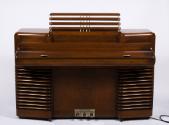
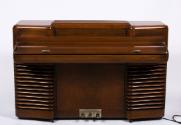
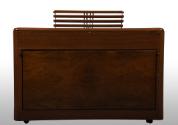
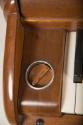
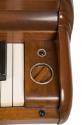
The Storytone was the first commercial electric piano, making its public debut at the 1939 World’s Fair in New York. Featuring an Art Deco style characteristic of the era, the instrument simulated the design of an acoustic piano but replaced the soundboard with a series of magnetic pick-ups, along with a vacuum tube-based amplifier. Unlike later electric pianos like the Wurlitzer 200, the Storytone didn’t quite capture the imagination of popular musicians—only 500 were produced and the instrument is now extremely rare.
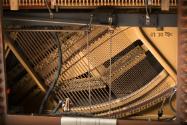
Operation/FunctionThe Storytone contains a three-step amplification system, consisting in a series of magnetic pickups, a vacuum tube-based power amplifier, and a loudspeaker configuration. Sound generating components consist in a series of piano strings and associated hammer mechanism. Voltage rating ranges between 105 and 125 volts, with 220 watts power consumption, 9/9 ohms input impedance, and 15.8 watts power output.Cultural SignificanceAlthough the Storytone, with its distinctive Art Deco exterior, stands as essentially the first commercial electric piano, it is neither as widely revered nor as successful as later instantiations of the 1960s, including the Wurlitzer 200 and Fender Rhodes Mk I, which were ubiquitous in pop music of the era. Still to this day, however, the Storytone is regarded as being a highly unique and scarce instrument and, along with items such as the Hammond Novachord and Hohner Multimonica, is recognized as a fundamental stepping-stone in the course of electronic instrument design.Technological SignificanceWhen solid body electric guitars such as the Fender Telecaster and Gibson Les Paul emerged in the early 1950s, they revolutionized use of the instrument in popular music. Although iconic electric pianos such as the Wurlitzer 200 and Fender Rhodes Mk I, which were produced in the late 1960s and early 1970s, were not quite as transformative, they certainly solidified a position as one of the most widely used keyboard instruments in popular music. The first electric pianos, however, including the Storytone, were designed decades earlier in the 1920s, with one of the earliest examples emerging from the Berlin-based C. Bechstein piano manufacturers. Their Neo-Bechstein grand piano, which was developed in the late 1920s and produced into the early 1930s, removed the instrument’s soundboard and implemented a series of magnetic coils, essentially an early version of the pickup. Interestingly, the instrument also featured a built-in radio receiver and an external loudspeaker cabinet with an integrated record player; as such, the unit was meant to appeal to the commercial market as a sort of all-in-one home entertainment product. In the 1930s, inventor Benjamin Meissner developed an amplified vertical piano, patenting the pickup mechanism that was later used in most of the electric pianos of the 1960s and 1970s. The Storytone emerged in 1939 and stands as the first commercial electric piano, made visually distinct with its era-appropriate Art Deco exterior design. The most technologically innovative feature of later electric pianos such as the Wurlitzer 200 and Fender Rhodes Mk I is with respect to their use of variously fashioned metal bars instead of the strings that characterize a conventional piano. Of course, the primary distinction between all electric pianos and their acoustic predecessors is that the former employ built-in electric amplification. As with most electromechanical instruments, this is achieved through the use of a set of pickups, which are types of transducers similar to microphones. A pickup consists in a permanent magnet (a single magnet that achieves the same effect of two polarized magnets) that maintains a constant electromagnetic field, and a coil of copper wire that is wrapped around the magnet. The tone-generating component of the electric musical instrument is placed near the magnet. When the tone generator vibrates, a disturbance is created in the electromagnetic field, which in turn induces a voltage in the coil. This electrical signal is then sent to an amplification system, generally consisting in a preamplifier, amplifier, and loudspeaker. Most modern pickups come in the form of the humbucker pickup, which employs two coils in inverse phase so as to reduce the amount of extraneous noise or AC hum included in the signal. The first dedicated pickup was designed by Hawaiian steel-guitar player, George Beauchamp, in collaboration with Adolph Rickenbacker in the early 1930s. The use of pickups rendered any need for a hollow wooden soundboard or resonating structure obsolete in associated instruments, as reflected in the design of the solid-body electric guitar. Of course, the use of pickups also meant that the conventional tone of the acoustic instruments to which they were applied, such as guitars, pianos, and harpsichords, could be modified through the use of external effects pedals and amplification systems. Other string-based electric pianos include the Yamaha CP-70, which employs a basic piano frame to maintain string tension, and the Hohner Clavinet, which features a more streamlined design and foregoes the piano frame altogether. Instruments such as the Hohner Pianet and Baldwin electric harpsichord are often referred to as electric pianos, however, strictly speaking, they ought not be classified with such instruments as they employ a plucked mechanism, similar to that of the harpsichord, rather than the striking mechanism that defines the piano. The Storytone is considered to be an early, vacuum tube-based electronic instrument that emerged from what was a particularly innovative era in instrument design. The first electronic instruments, including devices such as the Theremin, Ondes Martenot, Telharmonium, and Trautonium, were designed in part as a response to the growing dissatisfaction with the limitations of acoustic instrumentation, felt rather strongly by some composers throughout the musical avant-garde of the 1920s and 1930s. With the exception of their use in some guitar amplifiers, vacuum tubes were rendered obsolete in the early 1960s with the advent of solid-state devices such as the transistor. Solid-state technology was far smaller, lighter, more reliable, more durable, and less expensive than vacuum tube technology.Users/PerformersPerhaps the most notable usage of the Storytone occurred at the 1939 World’s Fair in New York, in which it made its debut alongside the Hammond Novachord, also of 1939.
Object number2009.01.01
Photo credit: Don Kennedy
Hammond Organ Company
1957
Not available for use in Recording Studios
On View: Not currently on exhibit
isVirtual:
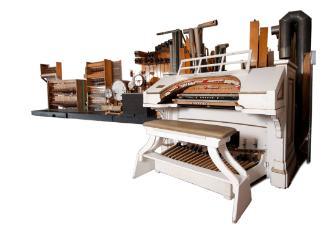
Photo credit: Don Kennedy
Kimball Piano and Organ Company
1924
Not available for use in Recording Studios
On View: On exhibit
isVirtual:
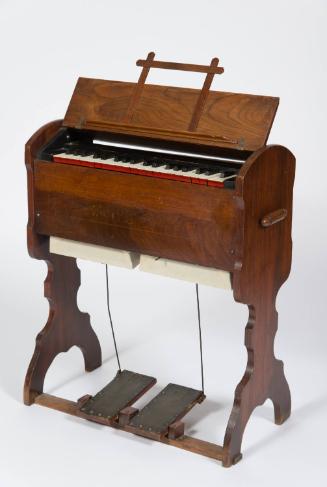
Photo credit: Don Kennedy
Mason & Hamlin Organ & Piano Company
1890
Not available for use in Recording Studios
On View: On exhibit
isVirtual:
Photo credit: Don Kennedy
Baldwin Piano and Organ Company
1966
Available for use in Recording Studios
On View: Not currently on exhibit
isVirtual:
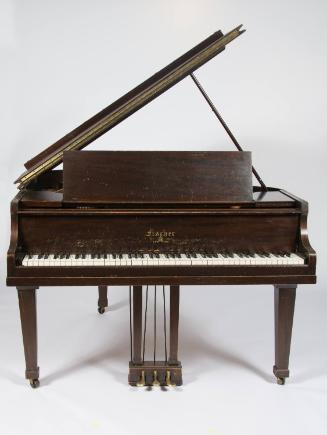
Photo credit: Don Kennedy
J. & C. Fischer Piano Company
1922
Not available for use in Recording Studios
On View: Not currently on exhibit
isVirtual:
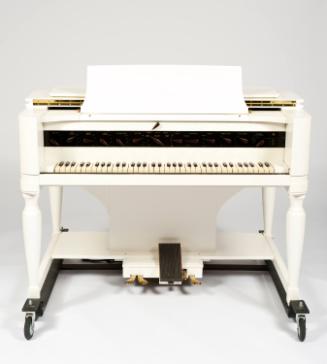
Photo credit: Don Kennedy
Hammond Organ Company
1939
Available for use in Recording Studios
On View: Not currently on exhibit
isVirtual:
Photo credit: Don Kennedy
Optigan Corporation (of Mattel) / Opsonar (of Miner Industries)
c. 1973
Available for use in Recording Studios
On View: Not currently on exhibit
isVirtual:
Photo credit: Don Kennedy
Everett Piano Company
1935
Not available for use in Recording Studios
On View: Not currently on exhibit
isVirtual:
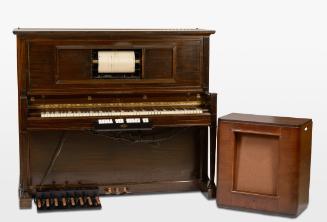
Photo credit: Don Kennedy
Willis & Company Ltd.
1924
Not available for use in Recording Studios
On View: Not currently on exhibit
isVirtual:
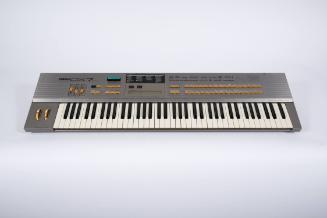
Photo credit: Don Kennedy
Yamaha Corporation/Nippon Gakki Company Limited
1987
Not available for use in Recording Studios
On View: On exhibit
isVirtual:
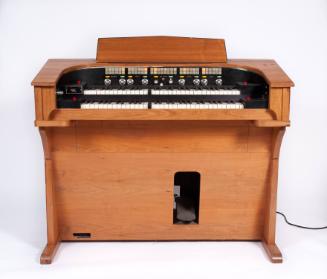
Photo credit: Don Kennedy
Chamberlin Instruments Company, Inc.
1970
Not available for use in Recording Studios
On View: On exhibit
isVirtual:
Back