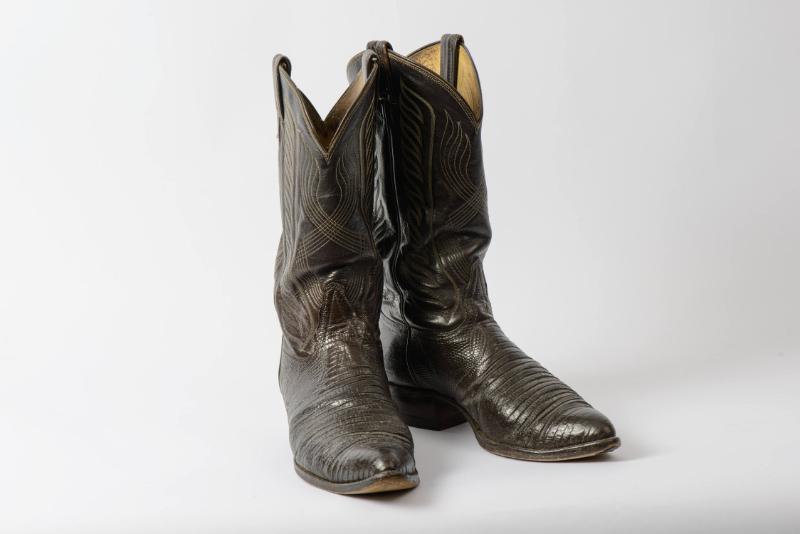
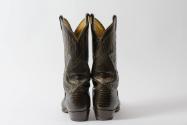
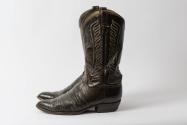
Wilf Carter Boots
Not currently on exhibit
Not currently on exhibit
Artifact TypeBoots, Cowboy
Manufacturer
Tony R. Lama
Date20th Century
Cultural SignificanceAlthough there are a number of musical styles that can be said to correspond with a particular fashion aesthetic, perhaps none is more iconic than that of the Country and Western genres. Throughout the 1950s, 1960s, 1970s, and 1980s, numerous stars of the country western scene, such as Roy Rogers and Gene Autry, looked to niche tailors to produce customized suits that would set them apart and establish a certain stage presence. The suits were often brightly coloured and elaborately adorned with tassels, sequins, imitation jewels and rhinestones, and intricate embroidery. They also typically consisted of a complete ensemble that included corresponding boots and hat. Arguably the most notable of such tailors was the Ukrainian immigrant Nuta Kotlyarenko (1902 – 1984) who became better known as Nudie Cohn of Hollywood, California. Nudie produced some of the most expensive custom garments, catering both to country superstars as well as high-profile performers in other popular genres, including Elton John, the Rolling Stones, and Elvis Presley. Other well-known tailors included Rodeo Ben, Turk of Van Nuys, California, Manuel of Nashville, Tennessee, and Rockmount Ranch Wear of Denver, Colorado.Users/PerformersWilf Carter (18 December 1904 – 5 December 1996) was born in Port Hilford, Nova Scotia to a poor family of nine children. He spent his early youth working to support his family on a farm in Annapolis Valley. At age 12, Carter began working for a travelling show and it was a fateful encounter with a yodeler that inspired him to learn about country music. Following a brief stint in Massachusetts, Carter relocated to Alberta to continue developing his farm hand. Shortly after settling, he began singing at local dances, usually yodeling either unaccompanied or with Autoharp, and auditioned for a position on the radio in 1925. In 1929 Carter moved to Calgary, Alberta, where he competed in the local rodeo of the time. In 1930, he was hired by local radio station, CFCN, known then as the “voice of the prairies”, which lead to a similar job offer from the Canadian Broadcasting Corporation (CBC) and a contract to work as a songwriter with a Toronto-based publisher. Carter’s next job, as an entertainer on summer packing trips with the Canadian Pacific Railway would prove to be particularly fruitful for his singing career. It was during a trip with trail riders in 1933 that Carter was offered the opportunity to sing on the maiden voyage of the SS Empress of Britain. While making his way east to board the ship, Carter was invited to audition for RCA in Montréal, which lead to his first record, a 78 single of his original song, “My Swiss Moonlight Lullaby.”
Shortly thereafter Carter settled in New York City, broadcasting via CBS radio to a highly receptive American population. It was during this time that Carter became known as “Montana Slim”; it is not clear whether he chose this name himself, however it was the moniker by which he was best known in the United States. Offers to broadcast his own show, The Wilf Carter Show, came from both NBC and CBS. Carter’s time in the U.S. proved lucrative, and in 1937 he purchased a ranch in Alberta, settling there while continuing to work sporadically for the CBC, NBC, and CBS over the following three years. After suffering a car accident in 1940, Carter suspended his career for much of the 1940s, only returning in 1947 to record another album with RCA Victor. In 1949 he sold his ranch and relocated his family to New Jersey to re-establish his broadcasting position with CBS. It was in this year that Carter made his first and only appearance at the Grand Ole Opry. In 1952, he relocated his family yet again, this time to Orlando, Florida. He continued to tour throughout the 1950s, including a cross-Canada tour that stopped at Toronto’s Canadian National Exhibition, and released recordings with Deca between 1954 and 1957. Carter began to enter retirement in the 1960s, but continued to record an album every year with RCA well into the 1980s. Carter passed away in 1996 in Scottsdale, Arizona, two months after receiving a diagnosis of stomach cancer.
Carter is recognized for his unique yodeling method, which was characterized by an echo or “three-in-one” style. Although he enjoyed a great deal of success in the United States between the 1930s and 1950s, his legacy remains stronger today in his native Canada. Carter is a pioneer in the yodeling style that was later incorporated into country music by singers such as Jimmie Rodgers, and, despite his deep interest in the American West, is recognized for his focus on the Canadian Rockies in his songwriting. Among his most well known songs are “There’s a Bluebird on my Windowsill” (1949) and “When it’s Springtime in the Rockies”. Carter was inducted into the Nashville Songwriters Hall of Fame in 1971, the Canadian Music Hall of Fame in 1984, and the Canadian Country Music Hall of Fame in 1984.Object numberCCMHF.2009.01.497.1-2



Hammond Organ Company
1957
Not available for use in Recording Studios
On View: Not currently on exhibit
isVirtual:
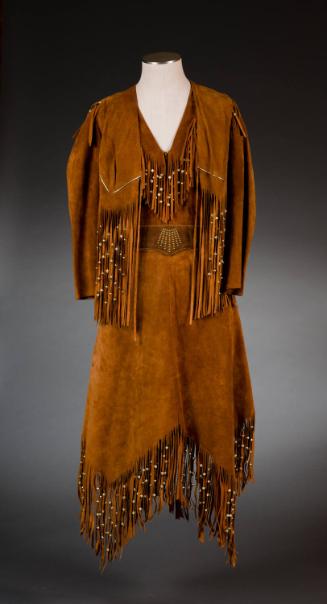
c. 1970
Not available for use in Recording Studios
On View: On exhibit
isVirtual:

The Story & Clark Piano & Organ Company
1941
Not available for use in Recording Studios
On View: Not currently on exhibit
isVirtual:

Optigan Corporation (of Mattel) / Opsonar (of Miner Industries)
c. 1973
Available for use in Recording Studios
On View: Not currently on exhibit
isVirtual:
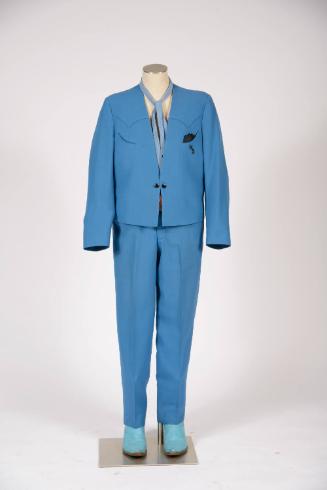
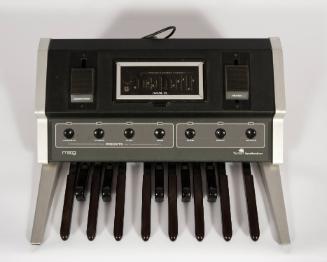
Moog Music, Inc.
c. 1978
Not available for use in Recording Studios
On View: On exhibit
isVirtual:
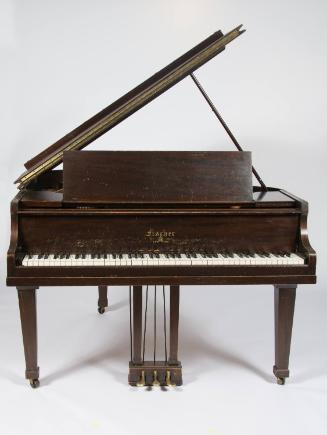
J. & C. Fischer Piano Company
1922
Not available for use in Recording Studios
On View: Not currently on exhibit
isVirtual:
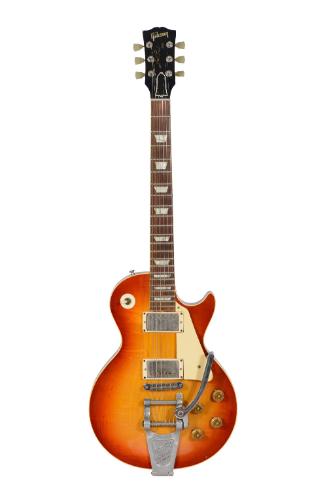
Gibson Guitar Corporation
1959
Not available for use in Recording Studios
On View: Not currently on exhibit
isVirtual: