
EN / FR
Skip to main content

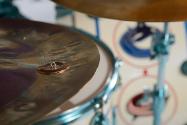
Neil Peart "Hockey Night in Canada" Drum Kit

Not available for use in Recording Studios
On exhibit
On exhibit
Artifact TypeDrum Kit
Manufacturer LocationSanta Monica, California, USA
Date2009

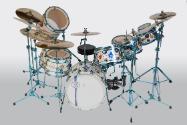
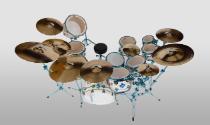
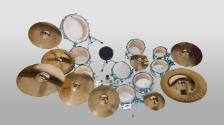
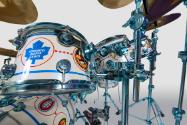
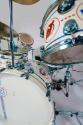
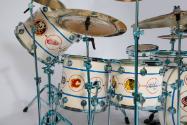
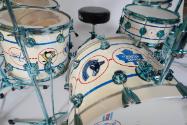
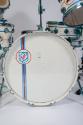
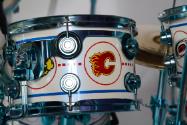
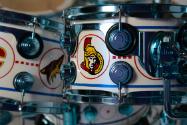
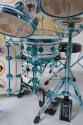
Custom-built for Neil Peart of the band Rush, this iconic drum kit was used during Peart’s percussion-heavy rendition of the “Hockey Night in Canada” theme song, seen in the opening sequence of the hockey telecasts on TSN. Inspired by Canada’s national pastime, the kit incorporated centre ice, the face off circles, and all 30 NHL logos into its graphics—complete with icy-blue metal hardware. On display at the Hockey Hall of Fame in Toronto since 2010, the drum kit recently accompanied Rush on all Canadian dates of their 40th Anniversary tour.


On loan from Rush


All cymbals have been signed by Neil Peart using a gold Sharpie.

Operation/FunctionThis kit contains four hanging toms (varying sizes), four floor toms (varying sizes), one snare drum, one kick drum, one ride cymbal, four crash cymbals (varying sizes), one Chinese cymbal, one Diamond Back Chinese cymbal, one hi-hat, one splash cymbal, one double kick pedal, and an accompanying drum throne. The kit’s cymbals all derive from Sabian’s Paragon line. Its exterior design was customized to incorporate the logos of all 30 NHL hockey teams.Cultural SignificanceAlong with the electric guitar, the drum kit is perhaps most widely recognized as a staple component of the rock ensemble. It also remains equally prominent in most jazz traditions, the genre within which its popular use was first established in the 1930s. Its importance as the rhythmic foundation of musical composition was so apparent, in fact, that an entirely new generation of electronic musical instruments – the drum machine – was developed in response. The emergence of the electronic drum machine was quite disconcerting to most live percussionists of the 1940s and 1950s, who feared being replaced by a machine. However, the various iterations of the drum machine, whether synthesized or sample-based, have developed with such unique idiosyncrasies that they stand as distinct instruments, capable of producing tones that most acoustic kits are not, and incapable of performing many functions that are inherent only in the presence of a live musician. The performance practice associated with the acoustic drum kit has been drastically altered throughout the decades since its earliest inception in popular music, with kit orientation expanding to incorporate more uncommon percussion instruments, such as the gong and conga drums, in order to respond to changing aesthetics. On account of its ability to continually customize its orientation, the drum kit is perhaps among the most flexible of all acoustic instruments.Technological SignificanceBoth cymbals and drums have been in use for several centuries as the core rhythmic accompaniment in many Western and non-Western traditions. The cymbal is often considered to be the earliest idiophone instrument, achieving especially notable prominence in the Ottoman Empire during the early nineteenth century. The snare drum, which is arguably the most vital component of the standard kit, emerged as a variant of the tabor, which was commonly used in Western Europe and North Africa. The concept of the drum kit, which combines different drums and cymbals together as a single unit, formed in the mid nineteenth century as a way to overcome logistical issues faced by orchestras and military marching bands, which often employed a dedicated musician to play a single instrument within the entire percussion section. The pedal presented itself as a means of controlling cymbals via the foot while controlling a series of two drums, usually a bass drum and a snare drum, with the hands. Throughout the late 1800s and into the 1930s, this configuration was referred to as a ‘trap set’. An accompanying performance practice emerged, which entailed accenting beats given to the bass drum and syncopated beats given to the snare. Ludwig & Ludwig Co., which would become one of the most prominent manufacturer of drum kits in the late twentieth century, patented the first bass drum pedal system in 1909. This innovation shifted control of the bass drum from the hand to the player’s other foot, opening up possibilities for additional hand-operated drums to extend the ‘kit’. The wire brush, which produces a comparatively soft sound to the wooden stick, was incorporated into common practice in 1912 in response to drum kits overpowering other acoustic instruments at a time before amplification was possible. The snare drum is often considered to be the most important component to the kit’s sound, with each unit varying slightly in sound based on the specifications of the user. Often, the snare employs a thinner head than the toms, as well as a shell made of a different material, such as wood. Perhaps its most unique feature, however, is the series of metal wires it incorporates into its bottom support structure, which vibrate when the head is struck, adding in a richer, more harmonic tone. Cymbals also vary greatly in tone, which is affected by their shape, size, and material.Users/PerformersRush was formed in Toronto, Ontario in August 1968 by founding members Geddy Lee (bass, keyboard, vocals) and Alex Lifeson (guitar, vocals), who were joined in 1974 by Neil Peart (percussion, lyricist), who is widely regarded as one of the greatest drummers of the twentieth century. Their self-titled debut album of 1974 and follow up, Fly by Night of 1975, were met with critical acclaim, establishing the group’s penchant for virtuosity, instrumental complexity, and conceptual lyricism. Later albums such as A Farewell to Kings and Hemispheres of 1977 and 1978, respectively, helped solidify the group as one of the leading proponents of the progressive rock genre. This era also saw an increase in Lee’s use of synthesizers such as the Moog Taurus I, Minimoog, and Oberheim OB-X. Lifeson and Peart also expanded their instrument catalogues, with Peart’s drum kit rounding out at approximately thirty pieces. Their mainstream success continued into the 1980s with a more commercial approach yielding hits such as “The Spirit of Radio” and “Freewill”; the group’s most iconic song, “Tom Sawyer”, was released on Moving Pictures of 1981. 1982’s Signals saw a return to synthesizer use and extended compositional influences, with hits such as “Subdivisions” and “New World Man”. Following a brief hiatus at the turn of the century, Rush continues to release new albums and tour, with their alleged final world tour wrapping up in 2015. Among their many awards and accolades are several Juno awards and inductions into the Canadian Music Hall of Fame (1994) and Rock and Roll Hall of Fame (2013).
Object numberL.2015.02.1-2
Photo credit: Don Kennedy
Obelisk
Unknown
Available for use in Recording Studios
On View: Not currently on exhibit
isVirtual:
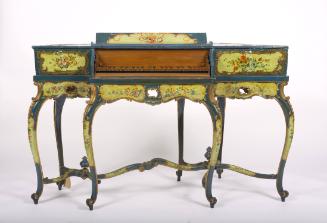
Photo credit: Don Kennedy
Francesco Bonafinis
c. 1560
Not available for use in Recording Studios
On View: On exhibit
isVirtual:
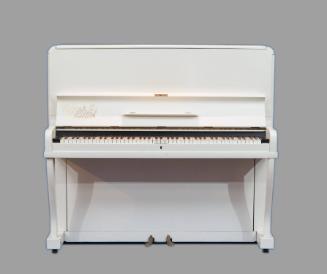
Photo credit: Don Kennedy
A. Day
c. 1910
Not available for use in Recording Studios
On View: On exhibit
isVirtual:
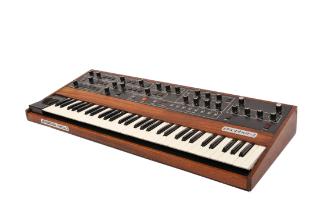
Photo credit: Don Kennedy
Sequential Circuits Inc.
c. 1978
Available for use in Recording Studios
On View: Not currently on exhibit
isVirtual:
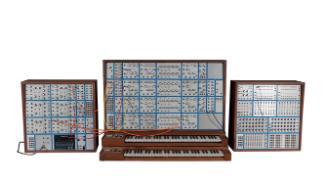
Photo credit: Don Kennedy
E-mu Systems, Inc.
About 1973
Available for use in Recording Studios
On View: Not currently on exhibit
isVirtual:
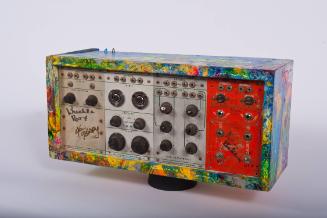
Photo credit: Don Kennedy
Donald Buchla
c. 1966
Not available for use in Recording Studios
On View: On exhibit
isVirtual:
Bösendorfer Klavierfabrik GmbH
1855
Not available for use in Recording Studios
On View: Not currently on exhibit
isVirtual:
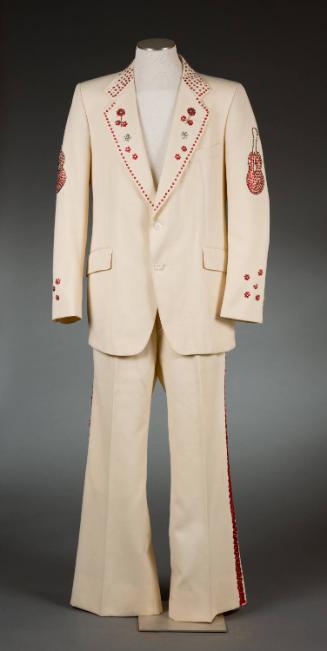
Photo credit: Don Kennedy
On View: Not currently on exhibit
isVirtual:
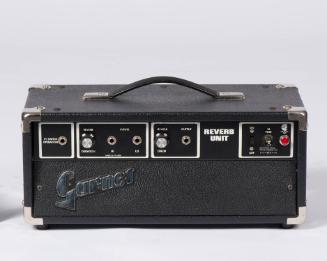
Photo credit: Don Kennedy
Garnet "Gar" Gillies
Available for use in Recording Studios
On View: Not currently on exhibit
isVirtual:
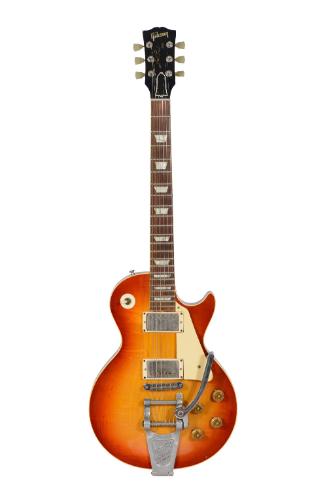
Photo credit: Don Kennedy
Gibson Guitar Corporation
1959
Not available for use in Recording Studios
On View: Not currently on exhibit
isVirtual:
Photo credit: Don Kennedy
Eric Herz
1976
Not available for use in Recording Studios
On View: Not currently on exhibit
isVirtual:
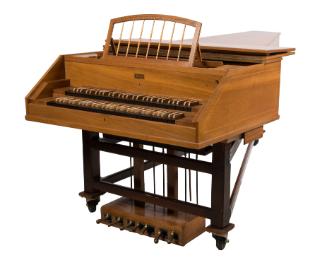
Photo credit: Don Kennedy
Kurt Wittmayer
1954
Not available for use in Recording Studios
On View: Not currently on exhibit
isVirtual:
Back