

EN / FR
Skip to main content

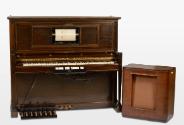
Willis Player Piano

Not available for use in Recording Studios
Not currently on exhibit
Artifact TypePiano, Vertical
Manufacturer Willis & Company Ltd. 1884 - 1979
Date1924
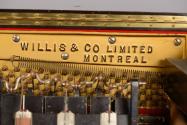
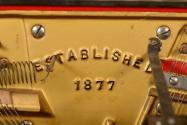
Inscription reads: ‘Willis & Co. Ltd. Montreal, Established 1877.’
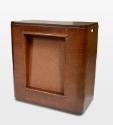
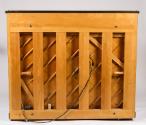
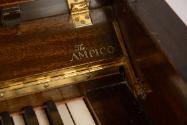
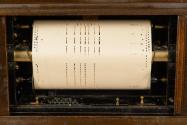
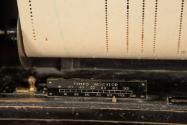
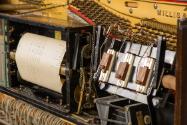
Operation/FunctionThis piano has a full compass of AAA-c5 (88 notes, 7.25 octaves), with keys made of pine wood; accidentals are ebonized and naturals are finished with ivory. The exterior of the instrument is made of mahogany wood with a dark stained varnish and two square-tapered spade foot legs. The instrument also features three pedals: volume reduction (L), bass sustain (M), and sustain (R). It employs a single escapement check action, compressed felt hammers, an Ampico pneumatic player action, and 68 under dampers with front trail action controls. The strings are overstrung. The top panel of the instrument’s front implements sliding doors to give access to the player action’s tracker bar and related mechanisms. A Lowrey Orgatron, which was added in around 1941, is attached to the front of the instrument, incorporating both a short set of stops in front of the keyboard and a set of bass pedals.Cultural SignificanceThe advent of the square piano in the late eighteenth century and the vertical piano in the mid nineteenth century marked an important shift in more generalized usage of the piano. These instruments were designed for the domestic market of the rising middle class, and were produced with the intention of being smaller and less expensive than their grand counterparts. Thanks to the square, and later the vertical design, the piano established itself as a more commonplace instrument that was accessible to a larger demographic of both professional and non-professional musicians. The player piano holds a particularly significant place in the proliferation of musical technology to the greater population, as well. Although it was by no means the first device to employ such automated technologies, the player piano stands as one of the most commercially successful and accessible mechanical instruments, and was designed so as to allow those who were not professionally trained in the performance of the piano to engage in some form of musical entertainment. Not only were those who may not have had the means to access professional training able to “perform” with these instruments, but also those who may not have had the means or interest to experience formalized musical performances were now being exposed to popular forms while running their day-to-day errands. Devices such as the player piano, barrel organ, music box, and phonograph eschewed in an era that saw increasing value placed on more informal methods of musical entertainment, including those that could be used in a number of uncommon public venues, and signaled a way of experiencing music that diverged from the exclusively orchestral contexts of concert hall settings. Although more informal methods of interacting with music were less common throughout the nineteenth century, historical traditions that preceded the emergence of the concert hall advocated a similar concept that stressed the incorporation of music into everyday life. Today, the idea that music making is meant for only the formally or professionally trained is rather antiquated, with many technologies existing that offer greater flexibility for those wishing to engage in listening to or creating music for pure enjoyment or curiosity.Technological SignificanceVertical pianos have remained popular since their inception in the late nineteenth century, however the piano itself can be seen as a development of earlier chordophones such as the hammered dulcimer, which employed hand-held hammers to strike a series of horizontal strings, and the clavichord, a Renaissance instrument that appropriated the dulcimer’s design for use with a keyboard. The grand piano was designed in 1700 by the Italian harpsichord builder Bartolomeo Cristofori (1655 – 1731), who modified the clavichord’s action so as to allow the instrument’s hammers to return to their resting position immediately after striking the string. The clavichord, which employs a series of metal tangents connected as levers to the keys, did not incorporate such a mechanism and, as a result, its tone is often quite muted on account of the tangents remaining in contact with the strings for too long. Cristofori’s piano was able to produce a larger sound akin to that of the harpsichord, but in employing a struck rather than plucked action, was also capable of producing expressive variations in its articulation, tone, and dynamics. With the rise of the Industrial Revolution in the early and mid nineteenth century, the piano underwent a series of significant design and construction developments, including improvements in string material, the incorporation of the cast iron frame, the inclusion of pedals, the extension of the keyboard compass, cross-stringing of bass strings, and, most importantly, the incorporation of a more flexible double-escapement action. These changes were subsumed by companies such as Broadwood and Sons of England, Sebastian Érard and Pleyel of France, and Steinway and Sons, Alpheus Babcock, and Chickering and Sons of the United States. Earlier instruments, typically dating from the eighteenth century and employing Cristofori’s more simplistic single-escapement action, are generally referred to as fortepianos, while modern instruments of the nineteenth and twentieth centuries are simply referred to as pianos. Beginning in the late eighteenth century, two alternate designs emerged as variations of the harpsichord-shaped case characteristic of early fortepianos: the square piano and the vertical piano. The development of the square piano is often attributed to several builders, including Gottfried Silbermann (German, 1683 – 1753), who is also credited with the introduction of the damper pedal, and Johannes Zumpe (German, 1726 – 1790), who spent the majority of his career in England and is often closely associated with the country’s building tradition. Square pianos, which featured a horizontal cross-stringing design, were used extensively throughout the late eighteenth and early nineteenth centuries, and were lauded for their being relatively inexpensive, smaller than their fortepiano counterparts, and generally more accessible to the burgeoning middle class. As a result of the compromised design, however, the instrument’s tone suffered considerably. Moreover, attempts to overcome the poor tone quality of the square piano resulted in gradual increases in the instrument’s size, making them correspondingly less practical. The vertical piano emerged in the early 1800s, and by the end of the century, had far surpassed the square piano in popularity and usage. Vertical pianos are so-called because both the frame and strings are positioned vertically; although the vertical stringing of these instruments – with the strings and soundboard placed behind and perpendicular to the keys and the tuning pins placed at the bottom of the instrument – still resulted in a poorer tone quality than that of the contemporaneous fortepiano and grand pianos, the vertical piano was regarded as being structurally superior to the square. By the early twentieth century, the square piano had fallen into relative disuse. Vertical pianos, which were manufactured in large numbers throughout the United States and Western Europe, continued to enjoy numerous improvements and experiments in their design throughout the nineteenth and very early twentieth centuries, which saw the creation of the cabinet vertical between 1805 and 1840, characterized by its extensive height and straight stringing, and the cottage vertical from around 1815 until the early twentieth century, characterized by its shorter height, as well as the oblique vertical in the 1820s, which incorporated diagonal stringing throughout as opposed to the straight or cross (combination of straight and diagonal) stringing seen on the majority of all other vertical pianos of the time, and the spinet vertical from the 1930s, which employed an unusually low hammer position with drop action to maintain a reasonable keyboard height. For a short period of time towards the end of the nineteenth century, workshops specializing in the production of cheaper, less complex, and smaller pianos became exceedingly active in England in what has been referred to as a “cottage industry”; indeed, this certainly helped promote the prevalence of the piano in domestic life as was experienced in the early twentieth century, catering to the burgeoning middle class. It is interesting to note that while the materials required for the sound-producing mechanisms of both vertical and grand pianos were relatively cheap to manufacture or purchase, outer materials, such as hardwood veneers, exotic veneers, and intricate carvings, were also unusually inexpensive at the time. Although nearly every piano of the late nineteenth century, regardless of quality, was produced with the sorts of ornate designs typical of the Victorian era from which they emerged, their outer splendor had disappeared by the early twentieth century to suit a changing aesthetic that favoured simple and clean design. The music box stands as one of the first fully mechanical musical instruments, and is also one of the first to be capable of automation, predating both the player piano and the phonograph, and influencing the development of similar mechanical instruments such as the barrel organ. That being said, more primitive versions of mechanical musical instruments have been in existence since approximately the ninth century, while devices employing some sort of automatic mechanism, not necessarily for musical purposes, can be said to date back to Greece in approximately the fifth century BCE. The earliest musical examples emerged in the Middle East and, later, in Western Europe, and consisted of a mechanism that employs the rotation of a barrel outfitted with a series of pins; this design largely remained standard until the advent of the disc-playing music box in the nineteenth century. The primary predecessor to the music box is often considered to be the carillon; though an instrument that employs a struck instead of plucked action, the carillon was one of the first musical instruments to employ the occasional use of an automatic mechanism that would ring the bells of the instrument based on a musical program. Throughout the fifteenth century, the carillon continued to be developed into much smaller forms, and eventually found equal usage in both outdoor and indoor settings. The development of mechanical musical devices continued to grow throughout the sixteenth and seventeenth centuries in Europe, and throughout the seventeenth, eighteenth, and early nineteenth centuries, cylindrical mechanisms similar to those found in music boxes were incorporated into large clocks, often employing the same system of gears, and consisted of an assortment of percussive instruments, including drums and, more commonly, bells, instead of metal tines. The use of a steel comb edged with metal tines instead of bells as the sound producing material is believed to have originated in Geneva, Switzerland in 1796, attributed to the Swiss watchmaker Antoine Favre, with the first fully developed music boxes appearing in around 1811. The first disc-playing music boxes emerged in Germany in around 1870, and by 1895 they had eclipsed the cylinder music boxes in popularity. The player pianos that succeeded music boxes employed a similar method of programming musical information into the machine: in player pianos, the pitch and duration of notes is transcribed as perforations onto a paper roll. Although these paper rolls may look similar to the perforated metal discs of music boxes, the player piano still functions as a piano, employing a striking mechanism to activate vibrations in strings instead of the plucked action found in music boxes. The player piano was even more flexible than the disc-playing music box, and it was standard for paper rolls to contain a number of different musical pieces that could be selected by moving through the scroll. Player pianos could also be operated as a “regular” piano, and thus served a dual function in the household, both for those who could play the instrument and those who could not. One advantage player pianos had over the cylinder music boxes and barrel organs of the time is that, while the pins of the cylinders had to be inserted manually, the perforations in paper rolls could be produced by a machine, making the latter format far easier to manufacture and reproduce. The first prototype of the player piano mechanism emerged during the summer of 1895 and is credited to the American instrument builder Edwin Votey of Detroit, Michigan. This prototype closely resembled the Voresetzer or push-up design, with a wooden cabinet that sat in front of an ordinary piano, with felt-covered fingers aligned directly above the keyboard. Votey’s design employed suction in order to power its action, which has since remained the standard in the construction of subsequent player piano mechanisms. Aeolian acquired the rights to Votey’s design and marketed their first instruments starting in 1897 under the Pianola trademark. Push-up player pianos were often regarded as being cumbersome and inconvenient to move and operate. As an alternative, the first built-in player mechanism was introduced in an instrument referred to as the ‘Apollo’, the creation of American piano builder Melville Clark in the early years of the twentieth century. This design soon eclipsed usage of the external, or push-up player mechanism. The earliest player pianos were not capable of activating the full 88-note range of the modern piano, typically only spanning between 58 and 65 notes; as such, many manufacturers produced a series of modified paper rolls with adapted scores. It was not until 1908 that the 88-note roll was standardized. The so-called ‘reproducing’ piano emerged in 1904 from the German firm of Edwin Welte, which came to be known as the Welte-Mignon. Reproducing pianos were viewed as a significant improvement upon the standard player piano in that they were capable of imitating many of the expressive articulations, dynamics, and even pedaling of a live, or human, performance. In 1914, Aeolian introduced the Duo-Art reproducing piano, which employed rolls featuring transcriptions of performances by well-known performers and composers.Users/PerformersAlthough there are numerous professional performers and recording artists who are associated with various manufacturers of grand pianos, it is far less common for a musician to be affiliated with the commercial use of a vertical piano. As with most automated entertainment devices, the player piano was designed specifically for use by those who were not trained in piano performance. In the early decades of the twentieth century, the player piano allowed users to experience “recorded”, so to speak, music in their homes as a form of entertainment. Prior to the introduction of radio in the 1920s, player pianos were often used in the home alongside phonographs and both disc- and cylinder-playing music boxes.
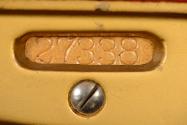
Object number2000.04.01
Photo credit: Don Kennedy
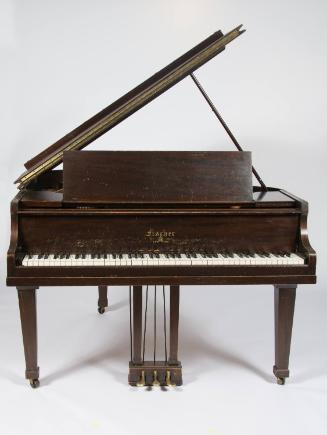
J. & C. Fischer Piano Company
1922
Not available for use in Recording Studios
On View: Not currently on exhibit
isVirtual:
Bösendorfer Klavierfabrik GmbH
1855
Not available for use in Recording Studios
On View: Not currently on exhibit
isVirtual:
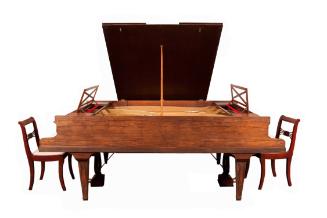
Photo credit: Don Kennedy
Pleyel et Cie
1913
Not available for use in Recording Studios
On View: Not currently on exhibit
isVirtual:
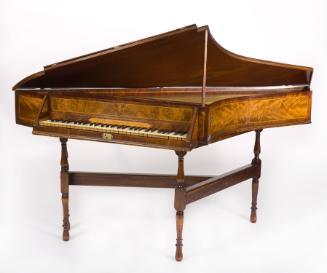
Photo credit: Don Kennedy
Neil Stewart
1777
Not available for use in Recording Studios
On View: Not currently on exhibit
isVirtual:
Photo credit: Don Kennedy
Vox Sound, Ltd.
c. 1967
Not available for use in Recording Studios
On View: Not currently on exhibit
isVirtual:
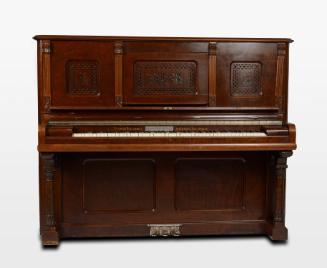
Photo credit: Don Kennedy
Heintzman & Co.
1908
Not available for use in Recording Studios
On View: On exhibit
isVirtual:
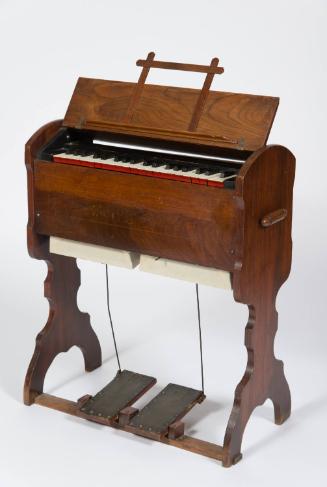
Photo credit: Don Kennedy
Mason & Hamlin Organ & Piano Company
1890
Not available for use in Recording Studios
On View: On exhibit
isVirtual:
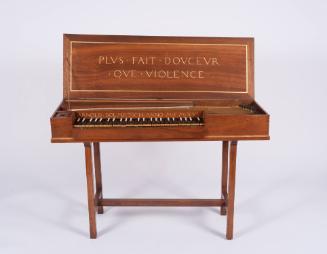
Photo credit: Don Kennedy
Arnold Dolmetsch
1926
Not available for use in Recording Studios
On View: On exhibit
isVirtual:
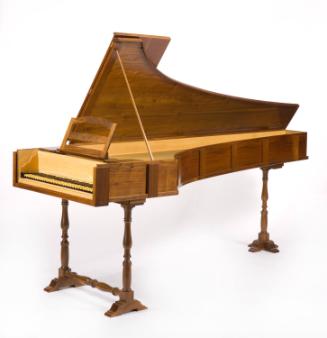
Photo credit: Don Kennedy
David Sutherland
2000
Available for use in Recording Studios
On View: Not currently on exhibit
isVirtual:
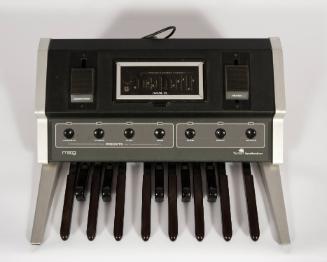
Photo credit: Don Kennedy
Moog Music, Inc.
c. 1978
Not available for use in Recording Studios
On View: On exhibit
isVirtual:
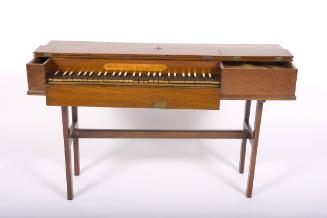
Photo credit: Don Kennedy
Johannes Zumpe
1766
Not available for use in Recording Studios
On View: On exhibit
isVirtual:
Photo credit: Don Kennedy
Bösendorfer Klavierfabrik GmbH
1938
Not available for use in Recording Studios
On View: Not currently on exhibit
isVirtual:
Back