EN / FR
Skip to main content

Röllig Orphica

Not available for use in Recording Studios
Not currently on exhibit
Artifact TypeOrphica
Manufacturer Carl (Karl) Leopold Röllig 1754 - 1804
Manufacturer LocationAustria, Europe
Datec. 1800
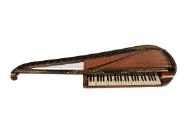
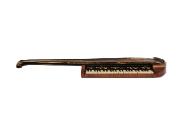
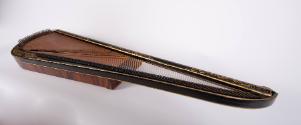
Essentially the first portable piano, the Orphica is an extremely rare instrument—with only 30 units still in existence today. Invented by German-born instrument builder Carl Leopold Röllig, the Orphica was designed to be lightweight and mobile.  Made without legs, the instrument was typically played on a tabletop, or carried around by a neck strap—much like a keytar from the 1980s. The Orphica derived its name from Greek mythology—referring of course to Orpheus, the musician who entranced all who heard his lyre.
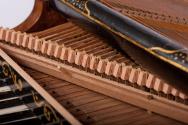
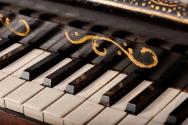
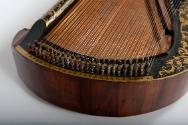
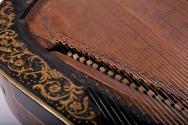
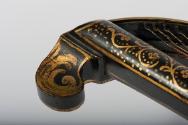
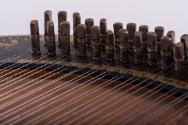
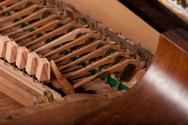
Operation/FunctionThe Orphica is constructed of a mahogany case (sound box) and soundboard, and employs a metal (iron) frame that is lacquered in black with gold guilt foliage. The hammers of the instrument are constructed of wood and are covered in leather. Traditionally, the Orphica would also feature a damper mechanism, however that feature is missing from this particular artifact. A series of strings, likely of either steel or gut, extend laterally across the instrument, with the end at the player’s right connected to the frame via tuning pins, and the other end connected by hitch pins to the soundboard via the bridge and then again the frame. A three-octave keyboard with a compass of approximately F to f’’’ protrudes from the case, oriented perpendicularly to the strings, while the frame continues to extend beyond the case. The curvature of the frame is shaped similarly to a harp, with the longest strings sitting on the end nearest the player. The natural keys are constructed of wood with ivory coverings, and the accidental keys are constructed of hard ebony.Cultural SignificanceThe cultural significance of the Orphica lies primarily in its being the first portable piano. Today, portability is a widespread luxury, with mobile devices even providing users an accessible interface with which to perform and compose. Although the Orphica was not the first portable stringed instrument, it was effectively the first portable stringed instrument to employ a keyboard mechanism. With the increasing patronage and the occurrence of acoustically sophisticated performance venues during the Baroque era, music began to shift more towards a private context. The portability and accessibility of instruments such as the Orphica, as well as instrument’s such as the virginal, barrel organ, Autoharp, and harmonium, helped expand usage to amateur musicians, and can be seen as representative of a larger movement during the Baroque and Classical eras that sought to move music back into the domain of the public sphere, as it had been during the Renaissance and medieval periods. Manufacture of the Orphica was restricted to Vienna, and the instrument’s usage occurred nearly exclusively in this city. In addition to Röllig’s technical contributions to instrument building, he is also credited with producing several compositions for the glass harmonica, as well as a number of written documents on the theory and practice of instrument building. Röllig’s attempts to remedy the design of the glass harmonica by incorporating a keyboard stemmed from the notion that long-term usage of the instrument was believed to have negative effects on the player’s nervous system.Technological SignificanceAlthough only existing for a brief period of time and not experiencing any sort of resurgence in later years, the Orphica remains an historically significant instrument in being recognized as the first fully portable piano. The Orphica employs a modified Viennese piano action – which consists of hammers that strike away from the player as opposed to striking towards them as in the modern piano – that did not enable it to produce the same sound quality as the pianos of the time, but was suitable for use in a compact enclosure. Although other portable stringed instruments, such as the violin, for instance, certainly existed at the time, the Orphica was unique both in being portable and in incorporating the keyboard interface. The majority of keyboard instruments prior, such as the harpsichord, fortepiano, and organ, were generally much larger and not capable of being moved unless of necessity. Smaller keyboard instruments such as the clavichord, virginal, and harmonium were designed with portability in mind, however they were still limited in that they required being stationary in order to be played, typically being placed on a table if not equipped with their own legs. Moreover, the reed organ requires the player to pump the bellows, usually with their feet, while they play. Like smaller stringed instruments such as the virginal and clavichord, however, the Orphica typically featured only one string per key as opposed to the two or three strings per key employed on larger instruments such as the fortepiano and harpsichord. In addition to being portable, the Orphica may also be played while standing or walking by way of a leather strap that the player wears over his or her neck. The accordion is another portable keyboard instrument that can also be played while in movement, however, unlike the accordion, which calls for a player trained and skilled in its unique performance technique, the Orphica was meant to appeal to amateur players with its straight forward keyboard interface. Among the instrument’s other innovations include the incorporation of an iron frame in the late eighteenth century, used to stabilize its stringing and reinforce the strength of its soundboard; the larger iron frames currently found in modern pianos did not become a standardized part of the instrument’s design until the mid nineteenth century. As such, the Orphica was one of the first instruments to employ an iron frame for such purposes. Naturally, the modifications that the instrument undertook in order to accommodate a smaller size were not without their drawbacks. With the action being much more primitive than on the fortepianos of the time, the instrument was not capable of producing the same quality of sound, or the same depth of expression in the keyboard. In order to allow for a larger compass, the keys of the Orphica were considerably shortened in their width, making the performance of highly technical passages unfeasible. As such, their use was limited to more simplistic or informal forms of music. While some instruments were equipped with a sustain mechanism, this feature was not standardized or even featured among all units. The tone of the Orphica is similar to that of the fortepiano, giving slightly more emphasis on the mid-range register. Its original stringing called for a tuning of A=402 Hz. Although the Orphica was invented and patented by Carl Röllig in 1795, he was not the instrument’s primary manufacturer. Following obtaining a patent for the instrument and producing a series of units himself, Röllig formed a business partnership with the Viennese piano builder Joseph Dohnal (1759 – 1829) to overtake exclusive manufacture of the instrument. From the end of the eighteenth century until the end of the instrument’s production in the early nineteenth century, Dohnal was the sole producer of the Orphica. As a result of its exclusive manufacture in Vienna, the Orphica’s usage was limited primarily to this city, with some finding their way to other nations by way of Viennese connections. Dohnal’s Orphicas did, on the whole, resemble the designs Röllig had specified in the pamphlet he produced in 1795 to accompany the instrument, titled Orphica: Ein Musikalisches Instrument (Orphica: A Musical Instrument). While Röllig’s instruments typically employed double stringing (two strings per key), it was Dohnal who pioneered the use of only one string per key in the instrument. The instrument’s also varied in terms of their compass and range, with Dohnal’s instruments favouring a much higher range than Röllig’s, which typically only reached as high as one octave above middle C, however it is believed that these modifications to the original design were approved by Röllig. Dohnal’s instruments are likely to have only been in production until around 1810, however with Röllig’s patent expiring shortly thereafter, unauthorized reproductions continued to be produced until around 1830. The Orphica was designed to employ a modified piano action, however in its early design Röllig also experimented with a version that employed a harpsichord action. There are no surviving examples of this version of the instrument. The single-escapement action employed in this instrument was first developed by Bartolomeo Cristofori in the late seventeenth century and was featured in the first pianos, also designed by Cristofori in 1700. The single-escapement action was a significant improvement upon the clavichord, which was incapable of projecting its sound on account of its tangents remaining in contact with the strings for too long a period of time. Cristofori developed a mechanism that employs gravity: when a key is depressed, the hammer is moved upwards to strike the string and then return to rest from its own weight, regardless of whether the key has been released. Following Cristofori’s death in 1731, several variations of the mechanism emerged within the designs of various piano builders. In around 1770, the German builder Johann Andreas Stein developed what became known as the “Viennese” action, which employs a single-escapement mechanism, but reverses the hammers such that they strike away from, as opposed to toward, the player. This orientation, which was employed in a more simplistic manner by Röllig in the Orphica, remained in use in Viennese pianos until the end of the nineteenth century. The single-escapement action itself also declined in usage throughout the nineteenth century with the advent of the double-escapement action and its more sophisticated repetition lever, which allowed players to execute faster movements in the keyboard. In addition to his work on the Orphica, Röllig also sought to improve the design of the glass harmonica, of which he was a distinguished performer and composer. Among his contributions to the instrument are the introduction of higher quality glasses sourced from the glassworks of Bohemia and Hungary, developing a chromatic notation system in 1785, which consisted of painting gold rims around those glasses representative of the accidentals (sharps and flats), and, in 1784, attempting to produce a version of the instrument that could be controlled with a keyboard.Users/PerformersDue to its more relaxed and informal usage, there is little documented information about particular performers of the Orphica. That being said, a small number of composers who were active during the instrument’s period of manufacture produced works specifically for the instrument. The most well known of these composers was the German Classical composer, Ludwig van Beethoven (1770 – 1827). Beethoven composed his Zwei Stücke für Klavier WoO 51 (Two Pieces for Keyboard, in C major and F major), WoO 51 with the Orphica in mind, even explicitly calling for its usage in the score. These works were composed between 1796 and 1798, during the first few years of the Orphica’s existence. Dedicated to Eleonore von Breuning, the wife of Beethoven’s friend, Franz Gerhard Wegeler, these pieces have often been referred to as Beethoven’s “light” or “easy” piano sonatas. Beethoven spent the majority of his career in Vienna, the same city in which the Orphica was exclusively manufactured. Breuning resided in Bonn, Germany at the time of the publication of this music, however it is likely that she was able to access the instrument while visiting either Wegeler or one of her two brothers, who all lived for a time in Vienna. There is also some speculation that Breuning may have even received an Orphica as a gift.
Object number2002.25.01
Photo credit: Don Kennedy
Oscar Schmidt Company
Unknown
Not available for use in Recording Studios
On View: Not currently on exhibit
isVirtual:
Photo credit: Don Kennedy
Sébastien Érard
1820
Not available for use in Recording Studios
On View: On exhibit
isVirtual:
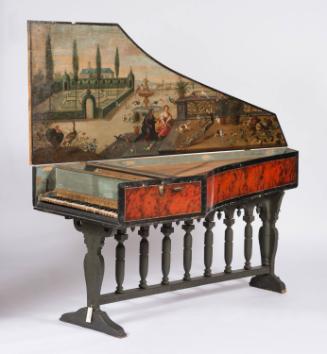
Photo credit: Don Kennedy
Joseph Johannes Couchet
1679
Not available for use in Recording Studios
On View: On exhibit
isVirtual:
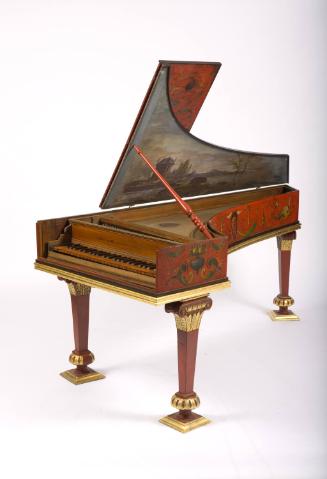
Photo credit: Don Kennedy
Vido Trasuntino
1591
Available for use in Recording Studios
On View: Not currently on exhibit
isVirtual:
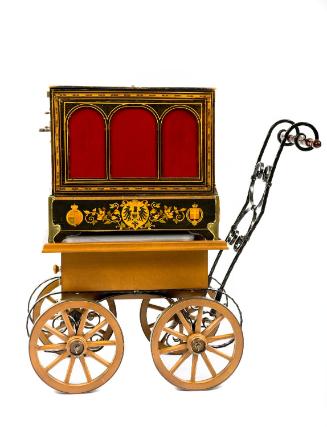
Photo credit: Don Kennedy
Bacigalupo-Söhne, Orgelfabrik
c. 1880
Not available for use in Recording Studios
On View: Not currently on exhibit
isVirtual:
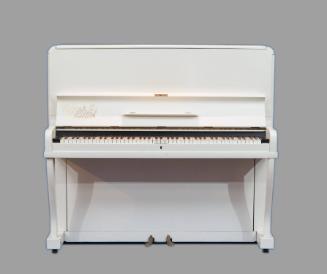
Photo credit: Don Kennedy
A. Day
c. 1910
Not available for use in Recording Studios
On View: On exhibit
isVirtual:
Photo credit: Don Kennedy
Baldwin Piano and Organ Company
1966
Available for use in Recording Studios
On View: Not currently on exhibit
isVirtual:
Bösendorfer Klavierfabrik GmbH
1855
Not available for use in Recording Studios
On View: Not currently on exhibit
isVirtual:
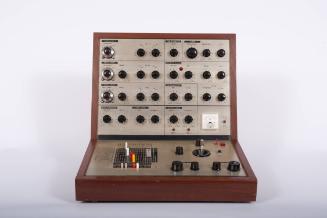
Photo credit: Don Kennedy
Electronic Music Studios (London) Limited
1969
Not available for use in Recording Studios
On View: Not currently on exhibit
isVirtual:
Photo credit: Don Kennedy
Everett Piano Company
1935
Not available for use in Recording Studios
On View: Not currently on exhibit
isVirtual:
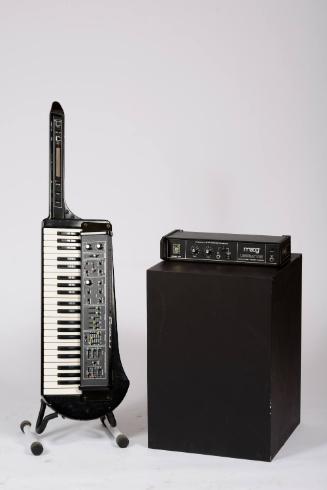
Photo credit: Don Kennedy
Moog Music, Inc.
1980
Not available for use in Recording Studios
On View: On exhibit
isVirtual:
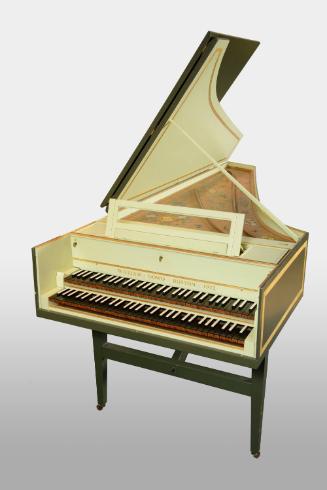
Photo credit: Don Kennedy
William Richmond Dowd
1972
Available for use in Recording Studios
On View: Not currently on exhibit
isVirtual:
Back