EN / FR
Skip to main content

Robb Wave Organ

Not available for use in Recording Studios
On exhibit
On exhibit
Artifact TypeOrgan, Electromechanical
Manufacturer Frank Morse Robb inventor | 1902 - 1992
Manufacturer LocationOntario, Canada, North America
Date1937
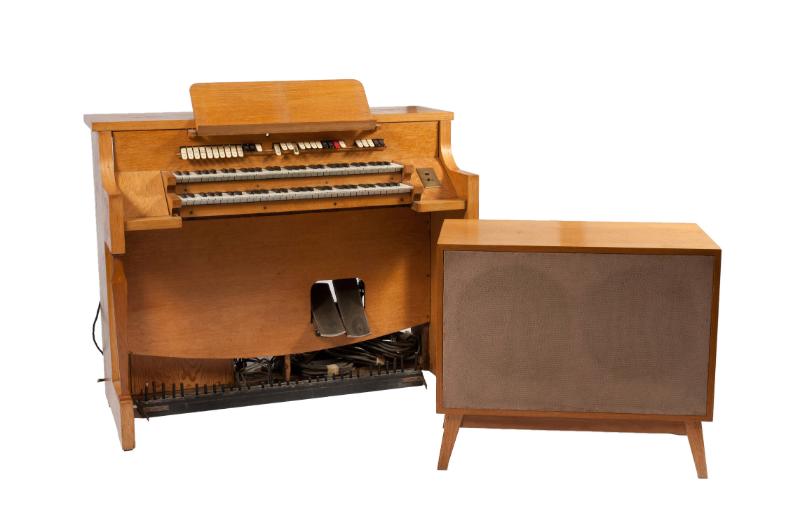
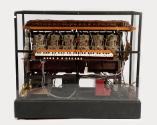
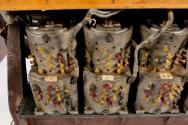
Designed by Canadian inventor, designer and business executive Frank Morse Robb (1902 – 1992), the Robb Wave electromechanical organ was one of the first instruments to produce sound via electronic means—and the first electric organ to be manufactured and sold commercially. His invention received critical praise throughout the 1930s but the economic pressures of the Great Depression forced Robb to cease production in 1938. With only 16 units ever made – the instrument seen here is reported to be the only complete model in existence.
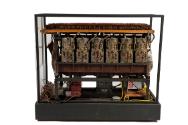
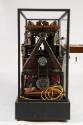
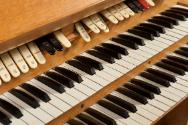
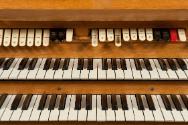
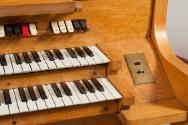
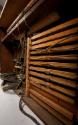
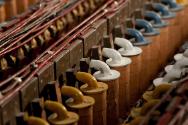
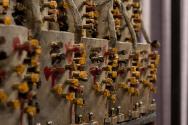
Operation/FunctionThis artifact consists of a console from which the instrument is played, and a separate tone generator unit responsible for all production of sound. The latter unit contains twelve cylindrical shafts derived from two six-cylinder car engines, each representative of a pitch within the chromatic twelve-note octave. The shafts are mounted with a stack of thick iron discs, which have been edged to approximate waveform analogs of various acoustic pipe organ timbres. A series of coils and magnets (approximately 120 in total) sit directly above the cylinders. Specific pitches are controlled via a five-octave, single-manual keyboard housed in the console. Although this particular artifact is not fully functional, it would have at one time been capable of producing a number of different tones or timbres. The tone generator unit of this particular artifact is separated from its console so as to demonstrate the mechanism, however the tone generator unit does not need to sit inside the console, and may be kept separated from it up to a distance of 100 feet. The loudspeakers accompanying the instrument can be placed behind grills or contained within external tone chests. The speakers are conical with a 12” diameter and 6” depth. The amplifiers are contained within the tone generator unit, and additional speakers and amplifiers may be added as desired.Cultural SignificanceDespite the Robb Wave organ’s lack of commercial success, the instrument was initially very well received, garnering interest from a number of well-known Canadian musicians of the time. In particular, Robb’s design was praised for its realistic and high-quality tone, especially in comparison to earlier examples of similar instruments. After a demonstration at the Toronto Daily Star’s CFCA studio in 1927, Boris Hambourg, a Russian cellist who eventually settled in Toronto and became a naturalized Canadian in 1910, attempted to further Robb’s commercial horizons by connecting him to the General Electric Company in Schenectady, New York. Unfortunately, no agreement came of this, however Robb’s instrument continued to gather critical acclaim throughout subsequent demonstrations that took place at Eaton’s department stores in Toronto and Montréal throughout the early and mid 1930s. The Robb Wave organ also received a modest amount of publicity: on 5 November 1927, the Toronto Star carried the headline, “Young Canadian invents pipe-less ethereal organ”; and, on 10 November 1927, the Globe and Mail declared, “Belleville genius may make history with Wave Organ”. As a result of economic pressures associated with the Great Depression and the Second World War, Robb’s instruments declined in commercial interest and eventually fell into obscurity at the end of the 1930s with the advent of more accessible and refined instruments introduced to the market by American designer Laurens Hammond. Nonetheless, Robb’s design is regarded as highly innovative and pivotal in the popular acceptance and commercial success of electric organs.Technological SignificanceThe Robb Wave electro-mechanical organ was a pioneering technological innovation in a number of ways: it was among the first in a generation of instruments to produce sound via electronic means, and was also the first to diffuse its sound entirely via electronic means, through a series of primitive pick ups, a vacuum tube-amp, and loudspeakers. The notion of electronic sound production was certainly not new at the time, and several other iterations of the electric organ existed at the time. Notable among these was Thaddeus Cahill’s Telharmonium, an electro-mechanical organ developed in 1897, which also employed a process of additive synthesis via tone wheels that generated electrical signals. Cahill’s Telharmonium predated the age of vacuum tubes, however, and relied on a method of connecting telephone wires to homemade cones in order to carry and amplify the electrical signals. The Telharmonium also suffered from very unreasonable size and weight issues, rendering any notion of commercial success more or less negligible. Because of its revolutionary and comparatively streamlined design, Robb’s instrument, more than any other electric organ of the time, helped pave the way for the more successful instruments that emerged in the mid 1930s. In a way, Robb’s tone wheel design also represents an early (and successful) form of sampling in that the shapes of the wheels are modeled after acoustically occurring sounds. Unlike the acoustic pipe organs many electronic organs came to replace, the Robb Wave organ does not have tuning problems, is not affected by changes in temperature, is much smaller, does not require complicated building retrofitting for installation, and is much easier to service. Similar to an acoustic pipe organ, however, is the way in which the instrument is played as well as the shape (short attack and release) and timbre of the tones. A vacuum tube is a device that directs the flow of electric current through a vacuum within a sealed container. They were used as a fundamental component of electronic technology throughout the first half of the twentieth century, until they were replaced by solid-state transistors and related devices in the 1950s and 1960s. The first instantiation of vacuum tube technology was invented by American engineer Lee De Forest (1873 – 1961) in 1906, and came in the form of what was referred to as the “grid” Audion.Users/PerformersDocumented usage by the aforementioned Warner Norman, Frank Morse Robb, Frederick Silvester.
Object number1999.02.01.1-5
Photo credit: Don Kennedy
The Wurlitzer Company
c. 1970
Available for use in Recording Studios
On View: Not currently on exhibit
isVirtual:
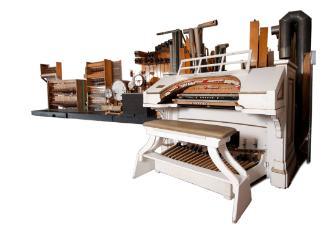
Photo credit: Don Kennedy
Kimball Piano and Organ Company
1924
Not available for use in Recording Studios
On View: On exhibit
isVirtual:
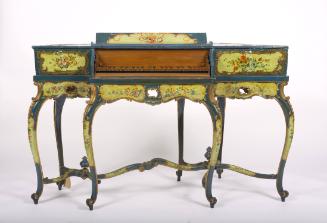
Photo credit: Don Kennedy
Francesco Bonafinis
c. 1560
Not available for use in Recording Studios
On View: On exhibit
isVirtual:
Photo credit: Don Kennedy
Radio-Victor Corporation of America (RCA)
1929
Not available for use in Recording Studios
On View: On exhibit
isVirtual:
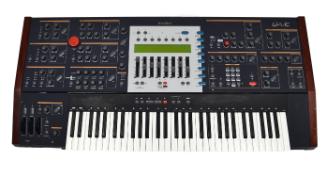
Photo credit: Meghan MacKrous, courtesy of the National Music Centre
Waldorf Electronics GmbH
1993
Available for use in Recording Studios
On View: Not currently on exhibit
isVirtual:
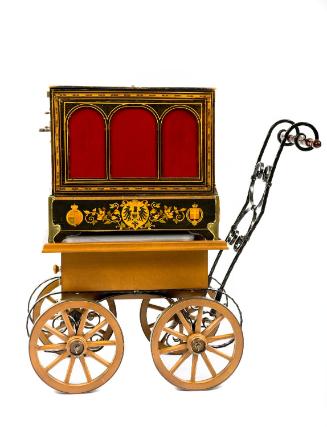
Photo credit: Don Kennedy
Bacigalupo-Söhne, Orgelfabrik
c. 1880
Not available for use in Recording Studios
On View: Not currently on exhibit
isVirtual:
Photo credit: Don Kennedy
Ken Freeman
c. 1975
Available for use in Recording Studios
On View: Not currently on exhibit
isVirtual:
Photo credit: Meghan MacKrous, courtesy of the National Music Centre
Bode Sound Company
1977
Available for use in Recording Studios
On View: Not currently on exhibit
isVirtual:
Photo credit: Don Kennedy
Drum Workshop, Inc.
2009
Not available for use in Recording Studios
On View: On exhibit
isVirtual:
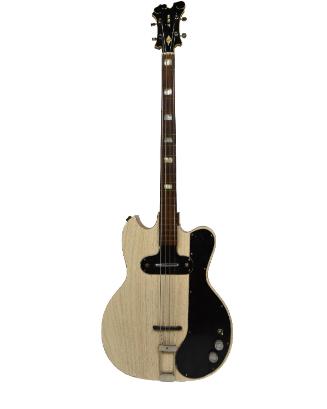
Photo credit: Meghan MacKrous, courtesy of the National Music Centre
Frank Gay
1957
Not available for use in Recording Studios
On View: Not currently on exhibit
isVirtual:
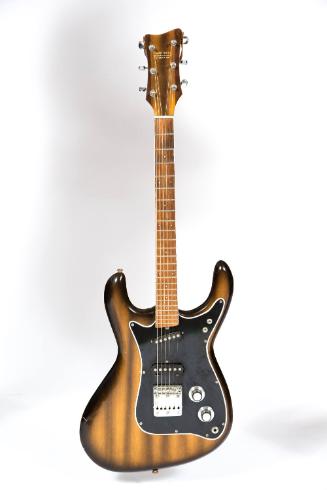
Photo credit: Don Kennedy
Frank Gay
20th Century
Not available for use in Recording Studios
On View: On exhibit
isVirtual:
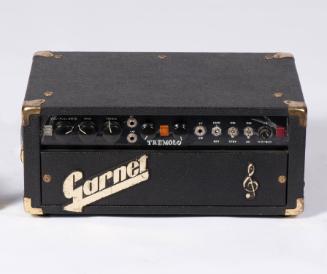
Photo credit: Don Kennedy
Garnet "Gar" Gillies
Available for use in Recording Studios
On View: Not currently on exhibit
isVirtual:
Back