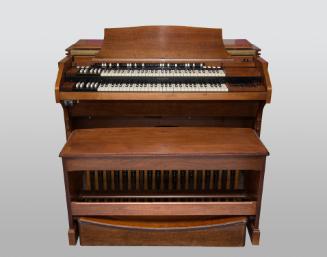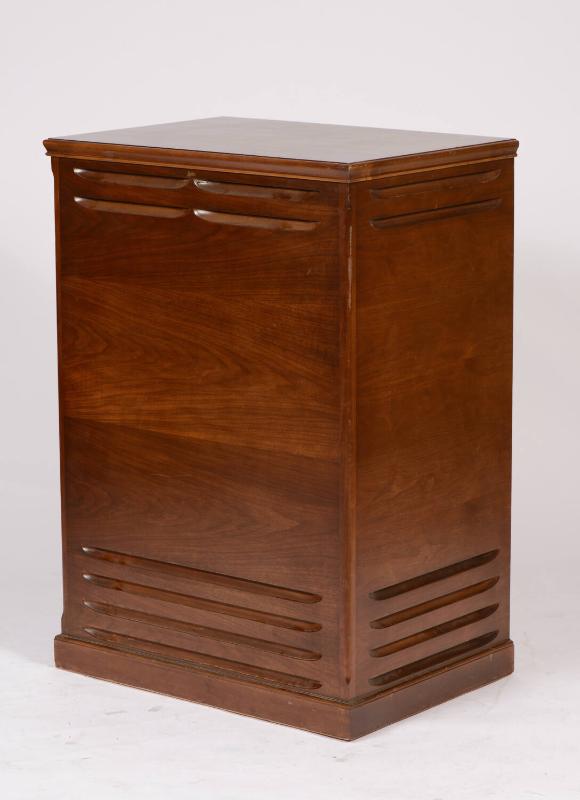
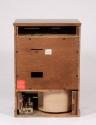
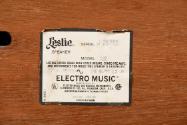
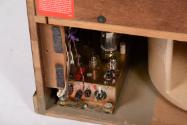
Leslie 122
Available for use in Recording Studios
Not currently on exhibit
Not currently on exhibit
Artifact TypeSpeaker/Amplifier, Tone Cabinet
Manufacturer
Electro Music / Donald Leslie
Datec.1972
Operation/FunctionSpeaker cabinet contains a built-in 40-watt monophonic vacuum tube power amplifier, and an 800 Hz, 16-Ω passive crossover. Signals are directed to a dual-speed 15” woofer with associated rotating drum and motor, and a dual-speed compression/treble driver with associated rotating horns and motor.Cultural SignificanceAlong with the Hammond B-3, the instrument with which the Leslie speaker was most frequently accompanying, the distinctive qualities of both units have left a major impact on the sounds that defined the numerous musical genres they were a part of, including rock, progressive rock, blues, soul, jazz, and funk. Just as with the B-3, the Leslie speaker, and especially the model 122, has enjoyed continued usage since its inception in the early 1940s. With its unique vibrato effect, the Leslie speaker has also been extensively used as a non-organ loudspeaker accompaniment since the 1960s, providing a tone that, when paired with instruments such as the electric guitar or voice, had never been heard before. The standardized ‘412’ and ‘stack’ loudspeaker configurations were both pioneered by Marshall (founded 1960 in London, UK) in the 1960s, initially consisting of an amp head resting on an 8x12 (eight 12” drivers within a single cabinet). This was later split for logistical reasons, resulting in the 4x12 design (four 12” drivers within a single cabinet), which is often simply referred to as a 412.Technological SignificanceThe Leslie tone cabinet is one of, if not the most unique loudspeaker systems designed during the twentieth century. It makes use of the Doppler effect ¬– a psychoacoustic phenomenon that results in perceived pitch variation between a moving sound and stationary observer – with the implementation of two rotating speaker horns. As the horns continuously spin, regular modulations in pitch occur, simulating a natural vibrato. In relation to acoustic pipe organs, this type of vibrato is referred to as a tremulant. This highly unique feature, which could be varied according to two different speeds, was groundbreaking. For organists, it allowed them to produce an even more convincing organ tone that projected far beyond what was previously possible in more confined spaces. For other instrumentalists, however, the Leslie speaker offered a new and unusual tone that gave familiar timbres such as the voice and guitar a new life. Initially, the Leslie speaker was designed as a way of emulating the constantly shifting spectral characteristics inherent in most acoustic pipe organs. The model 122 was among the most stable of the Leslie speakers, featuring a balanced signal that eliminated much of the hum produced with use of standard A/C mains. The use of a passive crossover in the model 122, which serves to split the incoming signal into various frequency bands and direct higher frequencies to the treble horns and lower frequencies to the woofer, allowed for a much cleaner sound than was present in earlier systems. Each Leslie speaker employed a slightly different exterior; just as with acoustic instruments, the materials and construction of each speaker imparts an effect on the overall sound. Variations in wood used for the cabinet can affect the tone of the output signal, in addition to the thickness of the wood, which can affect a signal’s resonance. Loudspeakers are, of course, an essential component in the amplification system. Depending on the function of the speaker, some, such as those used with stereo equipment, are designed to be as faithful as possible to the input sound, while others, such as the Leslie, serve the purpose of modifying the output sound. Many loudspeaker units of the 1960s and 1970s incorporated various effects such as reverb and distortion, giving the musician another tool with which to specialize their sound. Unlike the majority of electronics, a good number of amplifiers and preamplifiers did not make the switch from earlier vacuum tube, or valve as they were commonly called, technology to solid-state transistorized technology. Vacuum tubes were the primary electronic components used throughout the first half of the twentieth century and were largely replaced in most electronic devices throughout the late 1950s and early 1960s by solid-state technology and, later, by transistorized and digital integrated circuits. With respect to amplifiers, vacuum tubes offer a high tolerance to distortion or overdrive, which serves to give the output sound characteristic warmth that is often desired among musicians. As such, many prefer to use vintage tube-based amplifiers and speakers over more modern transistorized units. The vibrato effect of the Leslie has been simulated numerous times, with the most notable hardware emulation arriving in the form of the Univox Uni-Vibe phase shifting pedal of the 1960s. The earliest loudspeakers were developed during the telephone era of the late nineteenth century, but were made far more feasible with the introduction of the vacuum tube in the early twentieth century. The dynamic speaker is the most common type used in amplification systems, designed in 1925 by Edward Kellogg and Chester Rice.Users/PerformersThere are literally countless examples of the Hammond B-3 in recorded and live music, spanning from the mid 1950s until the present, with usage permeating numerous genres, including rock, pop, soul, funk, jazz, blues, folk, reggae, and prog, in addition to various commercial uses. In virtually every case, the organ is accompanied by a Leslie tone cabinet, most frequently the model 122. Among the most recognizable albums and compositions to feature the B-3 and Leslie 122 in combination include: Santana’s “Black Magic Woman/Gypsy Queen” from Abraxas of 1970; The Beatles’ “Let it Be” from Let It Be of 1970, performed by Billy Preston; Bob Dylan’s “Like a Rolling Stone” from Highway 61 Revisited of 1965; The Zombies’ “Time of the Season” from Odessey and Oracle of 1968; Steppenwolf’s “Born to be Wild” from Steppenwolf of 1968; Steve Miller Band’s “Fly Like an Eagle” from Fly Like an Eagle of 1976; Deep Purple’s “Hush” from Shades of Deep Purple of 1968, performed by Jon Lord; and, The Spencer Davis Group’s “Gimme Some Lovin’” from Autumn ‘66 of 1966. The various models of Leslie speaker have also been used with other Hammond organs, including the C-3 and M series. Among the more notable tracks to have included these combinations are: Booker T and the MGs’ “Green Onions” from Green Onions of 1962, performed on a Hammond M-3; Yes’ “Roundabout” from Fragile of 1971, performed on a Hammond C-3 by Rick Wakeman; Deep Purple’s “Highway Star” from Machine Head of 1972, performed on a Hammond C-3 by Jon Lord; Procol Harum’s “Whiter Shade of Pale” and “Conquistador” from Procol Harum of 1967, performed on a Hammond M-102 by Matthew Fisher; and, Emerson, Lake & Palmer’s “Knife Edge” from Emerson, Lake & Palmer of 1970, performed on a Hammond C-3 by Keith Emerson. In addition to its use with the Hammond electromechanical organs, the Leslie speaker, and especially the model 122, has been used to lend its characteristic vibrato effect to various vocal and guitar tracks, primarily in studio recordings but also in live performances. Perhaps the most iconic usage of the Leslie speaker paired with a guitar is in the The Beatles’ “Lucy in the Sky with Diamonds” from Sgt. Pepper’s Lonely Hearts Club Band of 1967.Object number2002.06.02
Kustom
1969
Available for use in Recording Studios
On View: Not currently on exhibit
isVirtual:
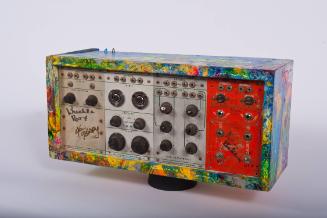
Donald Buchla
c. 1966
Not available for use in Recording Studios
On View: On exhibit
isVirtual:
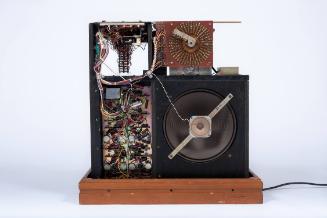
The Wurlitzer Company
c. 1959
Not available for use in Recording Studios
On View: On exhibit
isVirtual:

Radio-Victor Corporation of America (RCA)
1929
Not available for use in Recording Studios
On View: On exhibit
isVirtual:

CBS Musical Instruments
1966
Available for use in Recording Studios
On View: Not currently on exhibit
isVirtual:
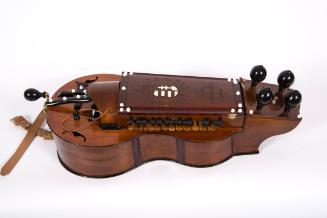
1999
Not available for use in Recording Studios
On View: Not currently on exhibit
isVirtual:
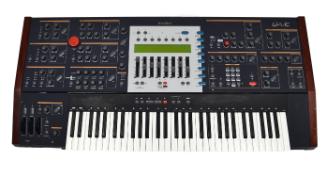
Waldorf Electronics GmbH
1993
Available for use in Recording Studios
On View: Not currently on exhibit
isVirtual:

Ovation Guitar Company
20th Century
Not available for use in Recording Studios
On View: Not currently on exhibit
isVirtual:

Ken Freeman
c. 1975
Available for use in Recording Studios
On View: Not currently on exhibit
isVirtual:
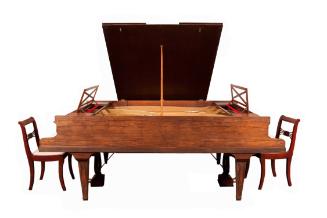
Pleyel et Cie
1913
Not available for use in Recording Studios
On View: Not currently on exhibit
isVirtual:
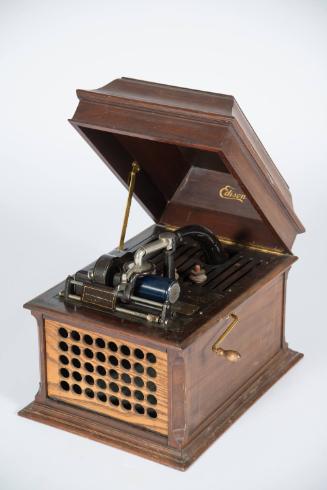
Thomas Alva Edison
1904
Not available for use in Recording Studios
On View: On exhibit
isVirtual:
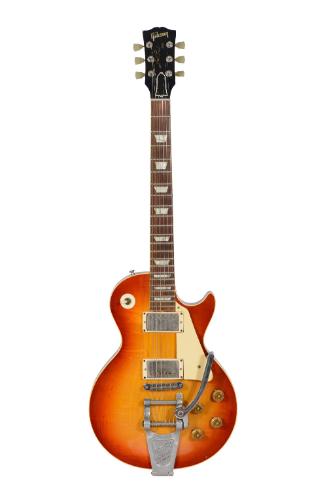
Gibson Guitar Corporation
1959
Not available for use in Recording Studios
On View: Not currently on exhibit
isVirtual:
Used with/Used with