EN / FR
Skip to main content

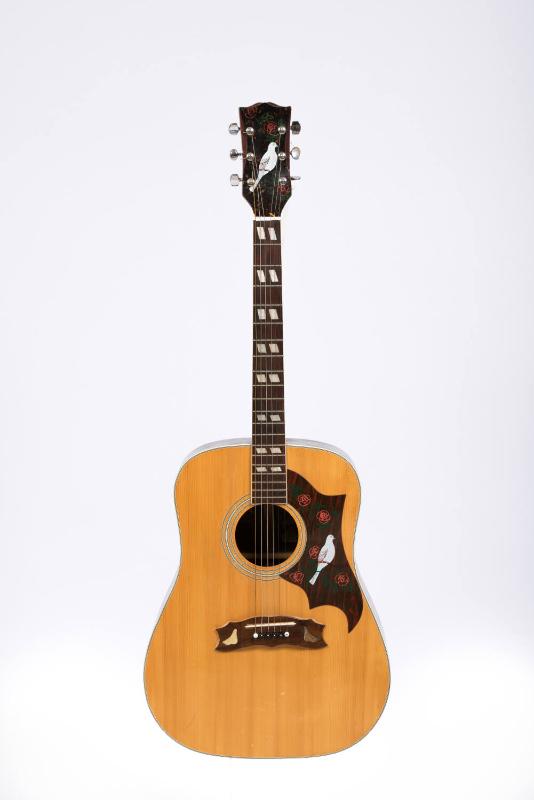
Terri Clark Guitar

Not currently on exhibit
Artifact TypeGuitar, Acoustic
Datec. 1980
 
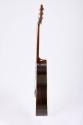
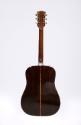
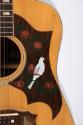
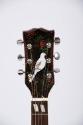
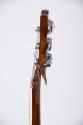
The acoustic guitar seen here is the childhood instrument of Canadian country singer, Terri Clark. Born in Montréal and raised in Medicine Hat, Clark got this guitar for Christmas when she was about 10 years old. She used it as her main songwriting instrument for years, until her baby brother accidentally tripped on it and snapped the guitar’s headstock. Years after moving to Nashville and becoming a country superstar, Clark still returns to her home province to tour and perform in festivals like the Big Valley Jamboree in Camrose, Alberta. 
 
On loan from Terri Clark
Operation/FunctionThis particular artifact is an example of a steel-string, flat-top acoustic guitar. It consists of a hollow wooden body, which is itself comprised of a soundboard, box, and sound hole for amplification, as well as six steel strings and accompanying machine heads and metal fingerboard. This instrument employs standard tuning, with open string pitches beginning at the bottom with the highest pitch, the E a major third above middle C, and moving downwards in pitch by a fourth to B, downwards by a major third to G, downwards by a fourth to D, downwards by a fourth to A, and downwards by a fourth to E, spanning two octaves in total. The instrument is referred to as being ‘standard-handed’, meaning it is to be strummed with the right hand while the left hand controls the frets.Cultural SignificanceThe cultural significance of both the acoustic and electric guitar cannot be overstated. Gibson remains at the forefront of guitar manufacture as one of the leading companies. Although the acoustic guitar is perhaps not used quite as commonly as the electric guitar, both have remained throughout the course of the twentieth century one of, if not the most, exploited instruments in popular music. The steel-stringed flat-top has served as the most popular form of acoustic guitar, with its usage spanning a multitude of genres.Technological SignificanceBoth acoustic and electric guitars have undergone a number of technological advances that have improved their tone and construction quality, however it is the mere advent of the latter that has had the most lasting technological impact. Les Paul (1915 – 2009) helped pioneer both the design and popularity of the electric guitar, and is considered one of the founders of solid-body technology, having produced a prototype called “The Log” in 1940. Additionally, Paul also conducted a number of experiments in guitar design and recording technology, essentially establishing the revolutionary practices of multi-track recording and overdubbing, as well as delay and phasing effects. Fender was the first company to produce a commercial solid-body electric guitar in 1950 with the release of the Telecaster, and Gibson responded in 1952 with the Les Paul, named in recognition of the fact that Paul helped design the instrument with Gibson’s president of the time, Ted McCarty. Gibson also produced the first commercial humbucker pickup, designed in 1955 and patented in 1959, which eliminated the hum of single-coil pickups without compromising the tone quality. Although the acoustic guitar is not recognized as having made as significant a contribution in instrument technology, it has seen many important changes throughout its history. The instrument finds it origins in the lute, which featured a varying number of gut strings and was most popular throughout the Renaissance, and the Baroque guitar, which featured five sets or courses of gut strings and eclipsed the popularity of the lute in the early eighteenth century. The majority of usage of such instruments took place in Europe, however a number of variants of these instruments, such as the Middle Eastern oud, were equally as prevalent. The modern guitar shares the same basic construction approach as its predecessors, consisting of a curved wooden sound box and soundboard, designed to optimize amplification and tone quality, as well as a neck and fretboard across which a series of tuned strings are strung. Although performance techniques and tuning systems have been considerably adapted over the years, the same basic approach of plucking or strumming with one hand and coordinating frets with the other has also been maintained. The modern acoustic guitar was pioneered by the American C.F. Martin & Company, which was founded in 1833 by the German craftsman Christian Frederick Martin. Martin established the body shape and size still used in modern acoustic guitars, which employed a larger lower bout, smaller upper bout, and deeper box than its Classical predecessors so as to produce a louder volume and accentuate bass frequencies. Martin’s design was known as the “dreadnought”, and quickly became the most common body style on account of its ability to project the guitar above other instruments in an ensemble. Martin was also pivotal in introducing steel strings to replace the nylon strings used in Classical guitars. Steel strings significantly altered the structural requirements of the instrument and, along with Martin’s inclusion of a series of bracing pieces in the box and the truss rod in the headstock, further enhanced the tone quality and volume.Users/PerformersTerri Clark was born Terry Sauson on 5 August 1968 in Montréal, Quebec, settling soon after with her family in Medicine Hat, Alberta. Her first exposure as a performer came at the famed Tootsie’s Orchid Lounge in Nashville, located one block from the city’s Ryman Auditorium, which led to a record deal with Mercury Records in 1995. Her following two albums, Just the Same of 1996 and How I Feel of 1998 were each certified Platinum in both Canada and the United States. Throughout the course of her career, Clark has released ten studio albums containing more than twenty singles, with six reaching number one on the charts; several of her albums have reached Gold, Platinum, Double Platinum, and Triple Platinum status. In 2004, Clark became the first Canadian female artist to be inducted into the Grand Ole Opry; she remains the only individual to hold this honour. She has been awarded the Canadian Country Music Association’s Entertainer of the Year award eight separate times, as well as their Female Vocalist of the Year award five times. She currently co-hosts America’s Morning Show with Blair Garner.
Object numberT.2009.09.492
Photo credit: Don Kennedy
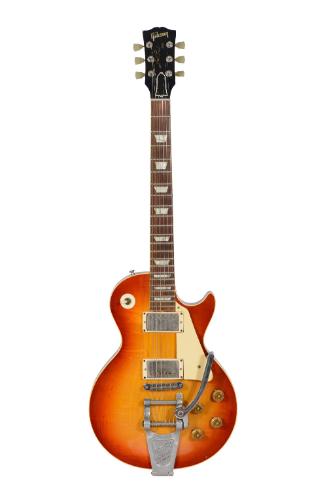
Gibson Guitar Corporation
1959
Not available for use in Recording Studios
On View: Not currently on exhibit
isVirtual:
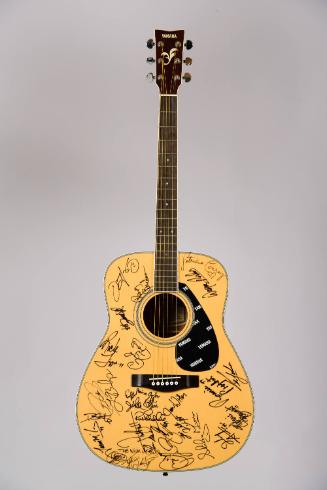
Photo credit: Don Kennedy
Yamaha Corporation/Nippon Gakki Company Limited
20th Century
Not available for use in Recording Studios
On View: Not currently on exhibit
isVirtual:
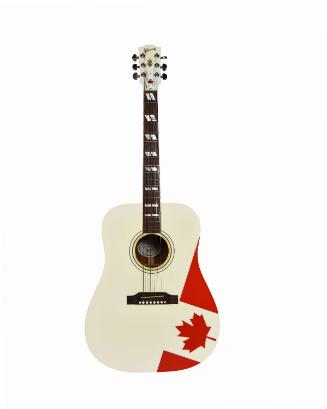
Photo credit: Meghan MacKrous, courtesy of the National Music Centre
Gibson Guitar Corporation
2014
Not available for use in Recording Studios
On View: On exhibit
isVirtual:

Photo credit: Don Kennedy
Jim Henson’s Creature Shop
2011
On View:
isVirtual:
Photo credit: Don Kennedy
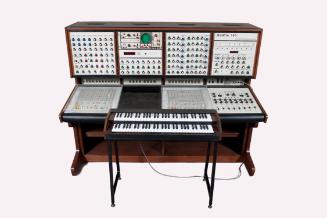
Electronic Music Studios (London) Limited
1972
Available for use in Recording Studios
On View: Not currently on exhibit
isVirtual:
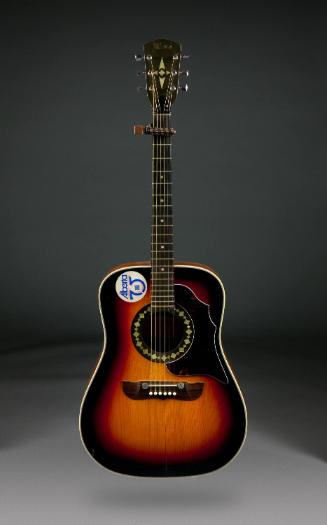
Photo credit: Don Kennedy
Framus (Franconian Musical Instruments Manufacture)
20th Century
Not available for use in Recording Studios
On View: Not currently on exhibit
isVirtual:
Photo credit: Don Kennedy
Ovation Guitar Company
20th Century
Not available for use in Recording Studios
On View: Not currently on exhibit
isVirtual:
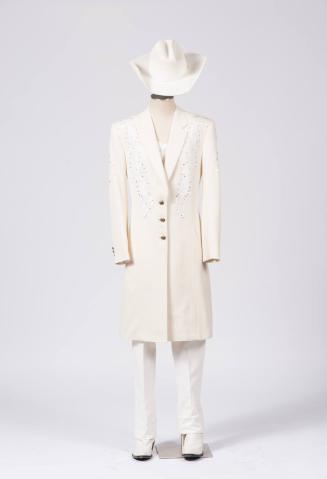
Photo credit: Don Kennedy
Manuel Cuevas
1998
On View: Not currently on exhibit
isVirtual:
Photo by Don Kennedy
CBS Masterworks
20th Century
Not available for use in Recording Studios
On View: Not currently on exhibit
isVirtual:
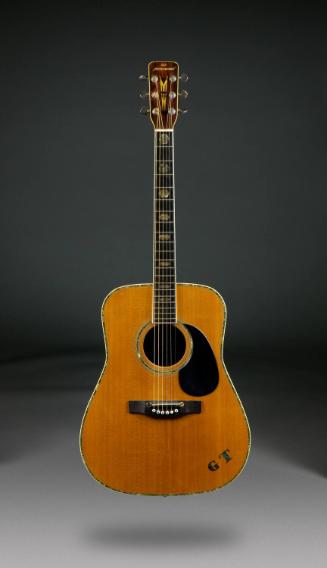
Photo credit: Don Kennedy
Gibson Guitar Corporation
Not available for use in Recording Studios
On View: Not currently on exhibit
isVirtual:
Photo credit: Don Kennedy
The Story & Clark Piano & Organ Company
1941
Not available for use in Recording Studios
On View: Not currently on exhibit
isVirtual:
Back