
EN / FR
Skip to main content

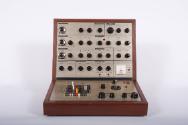
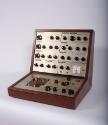
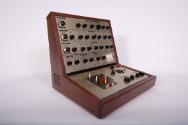
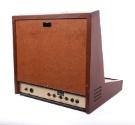
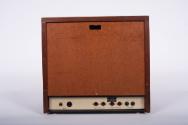
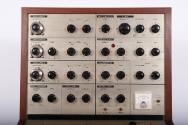
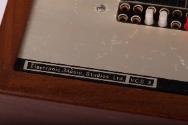
EMS VCS3 Production Prototype

Not available for use in Recording Studios
Not currently on exhibit
Artifact TypeSynthesizer
Manufacturer LocationUnited Kingdom, Europe
Date1969
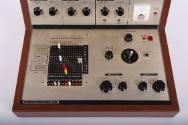
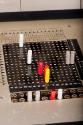
In the 1970s, European rock rippled with the sounds of the VCS3. The first portable and semi-integrated synthesizer, it predated the more commercially successful and well-known Minimoog by a year. Instead of using the physical cables employed by most other manufacturers, the VCS3 uses a unique circular patching matrix with corresponding resistor pins. Led Zeppelin, The Who and Pink Floyd are among a long list of progressive artists who put it to work.
Operation/FunctionThis particular artifact is an analog, semi-modular synthesizer that contains three voltage-controlled oscillators (two in the normal audio range, one as a low frequency oscillator), an 18 dB/octave combination low-pass and band-pass filter, one voltage-controlled amplifier with trapezoidal envelope generator, an external CV/gate input, a noise generator, a ring modulator, a built-in spring reverb, amplifiers with stereo speakers and twin stereo outputs. This particular artifact has been modified so as to function under standard 110 V/60 Hz North American A/C power.Cultural SignificanceModular synthesis has left an indelible mark on the way in which current trends in synthesizer design are informed. In the 1960s, these instruments offered a way forward for composers and musicians who felt stifled by the rigour of early electronic music techniques, such as those practiced in Germany and France throughout the 1950s. They promised new timbres and uninhibited methods of control and ultimately set into motion the foundations of synthesis practices that would follow throughout the 1970s and 1980s. In 1969, the VCS3 effectively pioneered the first instantiation of what would become the fully integrated, compact analog synthesizer in the early 1970s. This approach, which was made more famous by instruments such as the Minimoog and ARP 2600 of 1970 and 1971, respectively, was not only technologically revolutionary, but had the added benefit of helping the synthesizer become more accessible to the public sphere in that they were more intuitive to program, far more portable, and significantly less expensive than their modular predecessors. As such, the synthesizer was no longer reserved for high-end music professionals and technicians with access to the most state-of-the-art studios of the day. Perhaps the most long-lasting impact of compact, integrated synthesizers, however, was that they allowed the synthesizer to be more easily used in live contexts, as opposed to the studios and institutions where the larger modular systems were rather permanently installed. Still today, the synthesizer is one of the most commonly used instruments in live performance. While Moog and ARP largely dominated the American market throughout the 1970s, the VCS3 and its successor, the Synthi AKS of 1972, were used extensively throughout Europe, and especially in their home turf of the United Kingdom. They were particularly popular among the earliest progressive rock bands emerging out of England in the late 1960s and early 1970s, including groups such as Pink Floyd, King Crimson, and The Moody Blues. Their use was made more iconic by musicians such as Brian Eno in his contributions to the early recordings and performances of the art rock group, Roxy Music. Although the VCS3 was not as widely regarded as the Minimoog, which effectively set the standard for nearly every synthesizer that followed, it remains one of the most sought after pieces of vintage equipment.Technological SignificanceThe synthesizer is arguably one of, if not the most technologically significant contributions to the course of electronic music. Although earlier electronic instruments such as the Theremin and Ondes Martenot offered new and unique ways of articulating sound, their sonic template was, for the most part, quite limited, capable of producing only a few distinct timbres. The modern synthesizer, on the other hand, was viewed as an integrated electronic orchestra, as it were, allowing the user to sculpt a wide and varied array of tones and gestures. What’s more, it allowed the user to modify their sounds in real time, seemingly without the sorts of physical limitations imposed on acoustic instruments. Of course, each instrument did come with its own characteristic tonal qualities and control limitations, however the wealth of opportunity inherent in the ability to manipulate and define nearly every parameter of sound structure solidified the synthesizer’s place as one of the most powerful musical innovations of the twentieth century. The concept of modular design was initially quite desirable to professional and studio musicians in that it allowed one to more or less completely customize their instrument and modify its functions as desired. The modular nature of early synthesizers also meant that an array of patches, or defined sounds that could be altered in real time, were possible, offering the musician a high degree of flexibility and the opportunity to develop their own performance technique and signature tone. Analog modular synthesis was quite prevalent as a music-making practice in academic institutions and private studios throughout the late 1960s and into the early 1980s, both in Europe and throughout North America. Electronic instruments of this era were entirely transistor-based, with solid-state devices such as the transistor representing the next generation in technology following the vacuum tube, which was used extensively throughout the first half of the twentieth century. Solid-state technology was far smaller, lighter, more reliable, more durable, and less expensive than vacuum tube technology. This technology developed even further in around 1970 into the form of integrated circuits (ICs), which house the many discrete components of transistor-based circuits within a single silicon chip, as they are often called. Integrated circuits were significantly smaller and less expensive to manufacture than the circuits from which they derived. Although not all analog synthesizers designed in the very early 1970s employed integrated circuitry, their use was mostly standardized by the late 1970s with the inclusion of the first affordable eight-bit microprocessors, such as the Zilog Z80, that emerged mid-decade. As a result, integrated circuits adapted to incorporate more sophisticated digital components. Although modular-type systems are still in production today ¬– the Buchla 200e, for instance, is based on the modular design of the Buchla 200 analog system – the advent of affordable microprocessor chips in the mid 1970s and the rise of programmable polyphonic instruments in the late 1970s resulted in the relative obsolescence of the discrete transistor-based systems of the early 1970s. The earliest dedicated studios that arose in the 1950s and 1960s consisted of discrete components such as sine, sawtooth, and square wave generators, filters, noise generators, mixers, and units for reverberation and ring modulation. The music making practice of the time was cumbersome, requiring the composer to record audio components onto magnetic tape, which would then undergo a series of splicing and manipulations. The modular systems of the late 1960s and 1970s were differentiated from their “primitive” counterparts in that they could be made to interact with one another under the governance of voltage control. The concept of voltage control, which was implemented into early electronic instruments such as Hugh Le Caine’s Electronic Sackbut, is based on the principle by which the function of electrical components relates to voltage, or the flow of electrical current. The most unique aspect of the concept of voltage control, which modular synthesizers took full advantage of, suggests that a voltage produced by one component or module can be used to control some function of another module via connection by patch cords or related means. These techniques enabled a very rich and highly interactive approach to the idiom of electronic music composition. The term ‘modular’ simply implies that various dedicated modules for sound production, manipulation, and amplification are integrated within a single cabinet, so as to operate as one system. The modular systems of the 1960s and 1970s were more compact than earlier synthesizers such as the RCA Mark II of the Columbia-Princeton Electronic Music Center, however their overwhelming size and hefty price tag often meant that they were accessible, for the most part, only to professionals, with a number of systems having initially been installed in recording studios and educational institutions. In response to this, most of the major companies of the era also released smaller, more portable systems (both modular and non-modular) throughout the 1970s that were also suitable for live performance, such as the Minimoog, ARP 2600 and Odyssey, and the Buchla Music Easel. Although most of these instruments borrowed elements from their modular ancestors, they were not in themselves modular by nature, but rather featured set configurations that were usually internally affixed. With the advent of integrated circuits, synthesizers increasingly began to adopt the smaller, more compact aesthetic exhibited in the performance-oriented instruments of the early 1970s, especially that of the revered Minimoog. The once popular modular approach gave way to more streamlined designs that, while still offering users the ability to control numerous aspects of the instrument’s tone and gesture, limited the way in which the instrument could be operated. Although the modular synthesizer was highly regarded for its flexibility, it was also criticized for being largely unintuitive and cumbersome in its patching schemes; the smaller, sophisticated digital-analog hybrids of the late 1970s, such as the Sequential Circuits Prophet 5, though still not relatively inexpensive, responded more readily to the technological demands of an increasingly burgeoning consumer market. The EMS VCS3 was a highly unique contribution to the development of synthesizer design in that it served to bridge the gap between the larger modular systems of the late 1960s with the first fully integrated performance-oriented systems of the early 1970s, such as the Minimoog and ARP 2600. Having predated the release of the Minimoog by a year, the VCS3 was effectively the first portable, integrated/modular hybrid synthesizer to emerge on the market. Unlike its modular predecessors, the various component modules – oscillators, filter, ring modulator, noise generator, etc. – contained within the VCS3 were subsumed under a single front panel, not separated. As such, the user was not able to customize their instrument, swapping out modules for others as conventionally done in modular synthesis. Much like the Minimoog, the functions of the VCS3 were pre-determined by the manufacturer and greatly limited in their number, allowing the instrument as a whole to be much smaller and far more portable than its modular counterparts. Unlike the Minimoog, however, in which the various component functions are hard-wired internally, eliminating the need for the user to manually direct electrical signals, the components of the VCS3 are not affixed to one another electrically and still require patching in order to operate. In this way, the VCS3 could be viewed as being far more flexible than the Minimoog, still allowing the user to determine the instrument’s overall signal paths. Despite having chronologically followed in the VCS3’s footsteps, the Minimoog is widely regarded to be the first and most influential portable, truly integrated synthesizer, primarily on account of the fact that it did away with unintuitive patching schemes and incorporated a keyboard directly into its enclosure, whereas the VCS3 required connection via a cable to an external keyboard. Moreover, the signal path and specifications of the Minimoog, which consisted in three voltage-controlled oscillators directed to a 24 dB/octave voltage-controlled filter and then to a voltage-controlled amplifier with standard ADSR envelope shape largely became the industry standard from 1970 onward, forming the basis of nearly every synthesizer that has followed. In this regard, the VCS3 was more akin to its modular predecessors in that its signal paths could be specified and altered by the user via patching. This hybrid approach was also reflected in several later instruments such as the semi-modular ARP 2600 of 1971. The ARP 2600 consisted in several of the more popular modules of the 2500 series that were affixed internally, however these connections could also be bypassed by the insertion of patch cables. The VCS3 also implemented various built-in components featured more regularly in modular synthesizers than later integrated systems, such as a ring modulator and spring reverb. The VCS3, along with most EMS products that incorporate a similar interface, remains among the most innovative synthesizer in its approach to patching, pioneering a unique circular patch bay that required the insertion of small pins to complete a circuit, rather than bulky and messy patch cables. The only comparable system was employed by ARP Instruments, Inc. in the ARP 2500 of 1970, which featured a matrix system of sliding switches, aligned horizontally to make electrical connections. Although this design also kept instrument interaction more streamlined and clean, ARP’s design was highly susceptible to cross-talk, or bleeding between independent signal paths, and, thus, was only incorporated into a single product, with the ARP 2600 returning to the use of external cables. EMS’s matrix was also far more flexible than that of Moog, ARP, and Buchla: since each component, such as an oscillator, commands a single row of sixteen pin holes, it, in effect, becomes equipped with sixteen different output “jacks”, so to speak, that can be routed to the input of any other component. This was largely unheard of, with most Moog and Buchla modules containing only one or two output jacks per module component. The parameter design of the VCS3’s components was also relatively flexible, combining the approaches of the major competing manufacturers with the use of separate waveform shapes in the oscillators in addition to single sweep potentiometers for tuning and wave shaping, and individual attenuators for every input. The VCS3’s filter was also unique with its trapezoidal shape, allowing it to function both as a low-pass and band-pass filter. Units constructed prior to 1974 employed an 18 dB/octave filter, while later units incorporated the largely standardized 24 dB/octave shape. Although its patching method was highly unique, it was often criticized for being unintuitive, making the instrument somewhat difficult to program even for professional users. Perhaps the most problematic aspect of EMS’s patch pin approach, however, was that the resistor pins – and, in particular, the most commonly used white pins – came with relatively substantial variable tolerance allowances, often affecting the overall sound. This was not generally a problem with conventional patching cables, as the impedance inherent in most was too small to affect the instrument’s circuits. Moreover, the patching matrix was not buffered, so to speak, meaning that as subsequent pins are inserted, they will affect the behaviour of others. The instrument’s oscillators were also notoriously unstable, even at a time when the majority of analog oscillators were prone to significant amounts of drift or detuning. To help overcome this, the instrument’s designer, David Cockerell, incorporated an extra oscillator into the accompanying DK1 mechanical keyboard, improving the device’s ability to calibrate and scale correctly. Although the VCS3 did not have as far-reaching an effect as the Minimoog, its pioneering compact design proved successful and, as a result, EMS produced numerous offshoots of the instrument throughout the 1970s, though, not all of which were made commercially available. The most notable of these are the Synthi 100 of 1971, which incorporated three VCS3s as well as additional features such as a 256-step sequencer, the Synthi A and AKS of 1971 and 1972, which were more portable and stable revisions of the VCS3, the Synthi P (Professional), Synthi E (Educational), and VCS3 Mk II of the mid 1970s, the latter of which incorporated a unique “Prestopatch” semi-programmable feature. Although not necessarily among the most well known of the major synthesizer manufacturers, Electronic Music Studios (London) was certainly among the most sophisticated, ambitious, innovative, and pioneering. It is widely regarded that Peter Zinovieff’s MUSYS system, which was designed collaboratively by David Cockerell and Peter Grogono in the late 1960s, incorporating two DEC PDP8 minicomputers, was the first instance in which a computer was installed in a private home. Of course, by modern standards, these computers were incredibly primitive, containing at most just 12 kB of RAM. In the 1960s, however, consumer access to this kind of digital technology was unheard of, with most computers of the time existing only in universities or government facilities, and certainly not being employed for the sake of musical exploration. This, combined with the fact that MUSYS was programmed via a video monitor rather than punch card was truly astonishing. Despite being literally decades ahead of their time, EMS was unable to adapt and refine most of their innovative ideas into successful commercial ventures, succumbing to the fate of most of the major analog manufacturers in the 1980s and 1990s.Users/PerformersIn both his work with Roxy Music in the early 1970s as well as in his solo and collaborative work from the mid and late 1970s, Brian Eno is perhaps the most iconic user of instruments such as the VCS3 and Synthi AKS. As a hugely successful composer, musician, and producer, there is perhaps no other figure who has had as influential an impact on the course of electronic and ambient music throughout the late twentieth century. Eno was born 15 May 1948 in Woodbridge, Suffolk, England, and honed his aesthetic interests between 1966 and 1969 as a visual art student at the Winchester School of Art, where he also developed tangential interests in emerging experimental music practices involving the use of tape machines, pioneered by minimalist composers such as Terry Riley. After a chance encounter with saxophonist Andy Mackay in London in 1971, he joined the art rock band Roxy Music, led by Bryan Ferry, performing primarily on the VCS3. He departed from the group in 1973 following the release of For Your Pleasure that same year, citing irreconcilable differences with Ferry, and embarked on a more experimental solo career. His first two albums, the rock-oriented Here Come the Warm Jets and Taking Tiger Mountain (By Strategy), both of 1974, were met with critical acclaim despite their overtly experimental approach, which involved production and composition techniques that were highly unorthodox for the time. Here Come the Warm Jets enlisted a number of disparate guest musicians who performed often in response to Eno’s dancing and various physical gestures; these recordings were then heavily processed and layered by Eno, some to the point of being unrecognizable from their original source. Although perhaps more streamlined in its recording process, Taking Tiger Mountain (By Strategy) implemented a unique compositional strategy developed by Eno and artist Peter Schmidt, which consisted in a deck of cards, referred to as ‘Oblique Strategies’, each offering vague or indirect suggestions to guide the artist in developing a new idea. At the same time, Eno released the first of several collaborative works with King Crimson’s Robert Fripp: (No Pussyfooting), released in 1973 to a somewhat frosty reception, was a highly experimental record that merged Fripp’s guitar playing with Eno’s minimalist-inspired tape loop manipulations and overdubbing, resulting in a process that is now famously known as “Frippertronics”. Eno’s subsequent three solo albums, Another Green World and Discreet Music, both of 1975, and Before and After Science of 1977, saw the foundations of the ambient technique that would later be solidified in the seminal Ambient 1: Music for Airports of 1978. A series of collaborative projects followed in the late 1970s and early 1980s with musicians such as Talking Heads’ David Byrne, Daniel Lanois, and Cluster’s Dieter Moebius and Hans-Joachim Roedelius. With the success of his first solo albums so heavily dependent on his unique approach toward the recording studio as a supplemental musical instrument, Eno quickly became in high demand as a record producer. In this role, he led the creation of some of the most iconic and genre-defining sounds in both popular and experimental music of the 1970s and 1980s. His most notable producer credits include David Bowie’s Berlin-era albums of Low (1977), “Heroes” (1977), and Lodger (1979), as well as U2’s massively successful The Unforgettable Fire (1984), The Joshua Tree (1987), and Achtung Baby (1991), which were co-produced with Daniel Lanois. In addition to being perhaps the most popular, commercially successful, and accessible of the British progressive rock bands, Pink Floyd were also among the most rampant users of EMS equipment throughout the 1970s, frequently exposing the masses to instruments such as the VCS3, Synthi AKS, and Synthi Hi-Fli. Pink Floyd was formed in 1965 by vocalist and guitarist Syd Barrett (born 6 January 1946 in Cambridge, England; died 2006), percussionist Nick Mason (born 27 January 1944 in Birmingham, England), keyboardist Richard Wright (born 28 July 1943 in Middlesex, England; died 2008), and bass guitarist Roger Waters (born 6 September 1943 in Surrey, England), the latter three having met while studying architecture at London Polytechnic in the early 1960s. Following the release of the group’s debut album, The Piper at the Gates of Dawn, in 1967, Dave Gilmour (born 6 March 1946 in Cambridge, England), a friend of Barrett’s, joined as lead guitarist. As a quintet, the group released 1968’s psychedelia-infused A Saucerful of Secrets, which featured the first of what would grow to become numerous album covers done by Hipgnosis, a London-based conceptual art collective that produced many iconic covers throughout the 1970s and 1980s for groups such as Led Zeppelin, Yes, T.Rex, Hawkwind, Al Stewart, Wings, Black Sabbath, Bad Company, and Genesis. In 1968, Barrett made the decision to leave the group on account of his declining mental health, releasing two solo albums – The Madcap Laughs and Barrett, both of 1970 – before retreating into relative seclusion until his death in 2006. With Barrett’s departure, Roger Waters assumed the role of the group’s primary vocalist, lyricist, and songwriter, sharing occasional songwriting and vocalist duties with Dave Gilmour. The group’s early era – consisting in the albums Ummagumma of 1969, Atom Heart Mother of 1970, Meddle of 1971, and Obscured by Clouds of 1972 – was largely rock-oriented with mostly standard instrumentation for the time, though also incorporating elements of folk music, improvisation, and, in the case of Atom Heart Mother’s opening suite, a chorus and chamber orchestra. The group’s subsequent, more progressive rock-oriented phase from 1973 through to 1979 subsumed their most critically acclaimed work and was heavily marked by the incorporation of popular synthesizers such as the Synthi AKS and Minimoog, as well as highly conceptual themes and imagery. Requisite albums of this era include The Dark Side of the Moon of 1973, Wish You Were Here of 1975, Animals of 1977, and The Wall of 1979. Roger Waters departed the group in 1985; following a brief stint without Richard Wright in the early 1980s, the remaining trio recorded two final albums in the late 1980s. Tangerine Dream was formed in 1967 by musician Edgar Froese (born 6 June 1944 in Tilsit, former East Prussia; died 2015), with its core lineup of 1971 through to 1977 also including Peter Baumann (born 29 January 1953 in Berlin, Germany) and Christopher Franke (born 6 April 1953 in Berlin, Germany). Prior to Baumann’s introduction in 1971, the group also included musicians Klaus Schulze (born 4 August 1947 in Berlin, Germany; founding member of the group Ash Ra Tempel) and Conrad Schnitzler (born 17 March 1937 in Düsseldorf, Germany; died 2011; founding member of the group Kluster and co-founder of the famed Zodiak Free Arts Lab in West Berlin). The group’s first successful albums, Atem of 1973 and Phaedra of 1974, with the latter published under the Virgin Records label, were released to critical acclaim. These albums were preceded by the lesser known Electronic Meditation of 1970, Alpha Centauri of 1971, and Zeit of 1972. Several other successful albums followed, including Rubycon and Ricochet of 1975, Stratosfear of 1976, Encore of 1977, and the soundtrack to the 1977 film Sorcerer. Following Baumann’s departure in 1977, Tangerine Dream continued to record and tour extensively, releasing the albums Cyclone in 1978, Force Majeure in 1979, and the soundtrack to Michael Mann’s film Thief in 1981. Tangerine Dream in particular were known for their willingness to pioneer the use of emerging electronic technologies, such as the analog synthesizer, sequencers, tape loops, and the digital synthesizer. In 1975, the group performed an historic concert at Coventry Cathedral in England’s West Midlands, with each member wielding many of the iconic electronic instruments of the era, including several Moog modular systems, EMS Synthis, and Mellotrons. Their unique combination of electronic and experimental aesthetics with ambient sensibilities helped define one aspect of what came to be known as the “krautrock” genre, which consisted in contemporaneous groups such as Can, Faust, Harmonia, Neu!, Kraftwerk, Amon Düüll II, and Popol Vuh, in addition to Cluster and Ash Ra Tempel. The krautrock genre – which grew to incorporate elements of rock, psychedelic, early techno, and free jazz – had a massive influence outside Germany, inspiring parallel aesthetics in electronic dance music, progressive rock, experimental music, new age music, and noise.
Object number2002.05.15
Photo credit: Don Kennedy
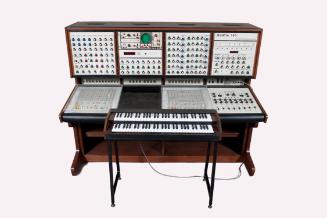
Electronic Music Studios (London) Limited
1972
Available for use in Recording Studios
On View: Not currently on exhibit
isVirtual:
Photo credit: Don Kennedy
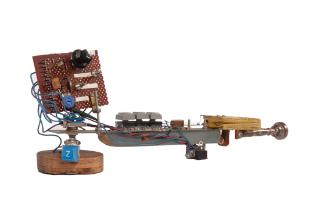
The Wurlitzer Company
c. 1959
Not available for use in Recording Studios
On View: On exhibit
isVirtual:
Photo Credit: Don Kennedy
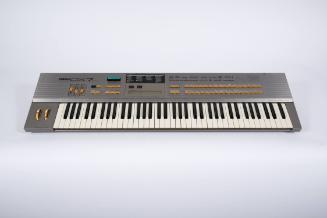
1984
Available for use in Recording Studios
On View: Not currently on exhibit
isVirtual:
Photo credit: Don Kennedy
Elizabeth Wyn Wood
2003
On View: Not currently on exhibit
isVirtual:
Photo credit: Don Kennedy
1971
Not available for use in Recording Studios
On View: On exhibit
isVirtual:

Photo credit: Don Kennedy
Drum Workshop, Inc.
2009
Not available for use in Recording Studios
On View: On exhibit
isVirtual:
Photo credit: Don Kennedy
Nyle Steiner
1972
Not available for use in Recording Studios
On View: On exhibit
isVirtual:
Photo credit: Don Kennedy
Yamaha Corporation/Nippon Gakki Company Limited
1987
Not available for use in Recording Studios
On View: On exhibit
isVirtual:
Photo credit: Don Kennedy
Everett Piano Company
1935
Not available for use in Recording Studios
On View: Not currently on exhibit
isVirtual:
Back