EN / FR
Skip to main content

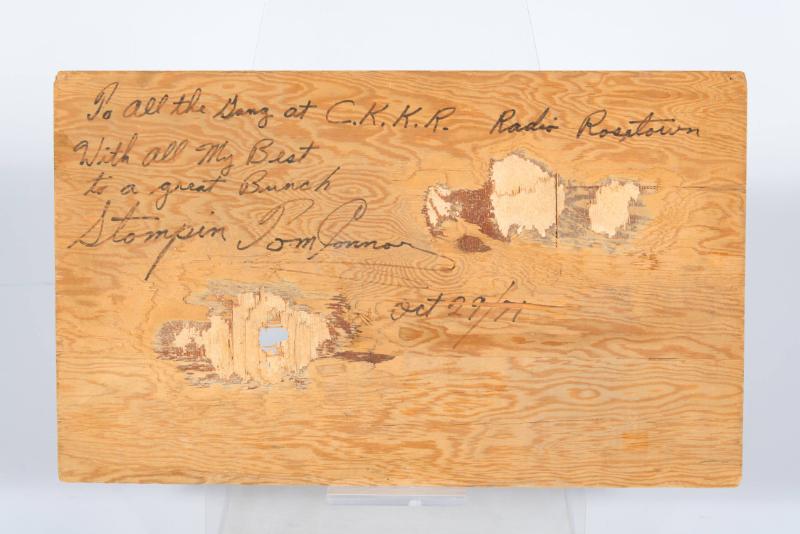
Stompin’ Tom Connors Stompin’ Board

Not available for use in Recording Studios
On exhibit
On exhibit
Artifact TypeBoard, Plywood
Date1971

Few stage props in Canadian music are as iconic as Stompin’ Tom Connors’ “stompin’ board.” The revered country-folk superstar kept his rhythm by stomping his left foot into this humble piece of plywood—the board was designed to prevent damage to the stage floor from his boot heel. While Connors used countless boards over the years, this one was autographed for the staff at CKKR in Rosetown, Saskatchewan (now CJYM).

Signed by Stompin’ Tom Connors: "To all the Gang at C.K.K.R. Radio Rosetown / With all My Best / to a great Bunch / Stompin Tom Connors / Oct 29/71."

Operation/FunctionThis particular artifact is a piece of plywood board.Cultural SignificanceConnors’ so-called “stompin’” boards are, along with the black Stetson he wore throughout his career, something of trademark objects. They serve to represent the unique stage presence of the artist, who was one of the most revered and prolific country musicians in Canada. There is perhaps no other Canadian musician who has dedicated his or her career to the intense patriotism exhibited by Connors. His song “The Hockey Song” has been featured with the NHL since 1992.Users/PerformersStompin’ Tom Connors was born Charles Thomas Connors on 9 February 1936 in Saint John, New Brunswick. Connors’ childhood was riddled with misfortune and poverty. His family moved extensively, with numerous father figures entering his life for only brief periods of time. He spent several years in an orphanage, worked as a farm labourer, and was even incarcerated alongside his convicted mother. By his teenage years, he had been placed by the child welfare system into an adopted home in Prince Edward Island. Music entered his life around this time, however, with his first song completed at age 11 and his first guitar acquired at age 15. At 15, he left his adopted family and spent the next thirteen years effectively hitch hiking around the country, drifting between jobs and writing songs. While at the Maple Leaf Hotel in Timmins, Ontario, Connors began performing his songs to a public audience, initially as a way to make up payment for a beer. This continued for the next 14 months and led to a weekly performance slot on CKGB radio in Timmins, as well as eight 45 recordings with Quality Records in Toronto. Throughout this time, he developed something of a trademark: in order to keep time in the loud bars in which he was accustomed to performing, Connors would vigorously stomp the heel of his left boot on the stage floor. On 1 July 1967, he was introduced as “Stompin’” Tom Connors, and continued to use the nickname thereafter. Following complaints from venue owners about damage to their stage floors, he began carrying with him a plywood board. In 1969, Connors relocated to Toronto, Ontario, where he began recording his most well known works with Dominion Records. Throughout the mid 1970s, Connors hosted a series on CBC Television called Stompin’ Tom’s Canada, in which he related stories with people from across the country. His song, “The Consumer”, was also featured as the theme song for the CBC’s Marketplace. Connors’ began to withdraw from the musical community in the late 1970s and turned increasingly more political and fervent in his views toward supporting Canadian content. His approach was viewed as something of a novelty act, and, as a result, his popularity shifted from commercial radio to country programs and university stations. During this decade, he settled on his farm in Ballinafad, near Erin, Ontario. Between the mid 1970s and 1980s he established three recording labels, including Assisting Canadian Talent (ACT) and Boot Records, which released an array of musical styles, including those with which Connors himself was not familiar, simply because support for such genres did not already exist. Connors has been regarded as one of the most overtly patriotic and nationalistic musicians in Canada, and exhibited a unique style that combined political themes, history, story telling, and local lore, demonstrating his extensive travels. In addition to his trademark stomping boards, Connors also donned a black Stetson, which has become synonymous with his image. In 1978, he returned the six Juno awards he had been the recipient of, citing a protest position against the nomination of Canadian artists who live and work in the United States for being given similar honours. His music is little known outside Canada, perhaps with the exception of “The Hockey Song”, which was first used in 1992 during an Ottawa Senators game, and has since come to define the NHL. Connors returned to the studio in 1986 with a fiddle-based album. Throughout his career he produced in excess of 500 songs. Awards and recognitions include an honorary Doctor of Laws degree from St. Thomas University in 1993, an honorary LL.D. from the University of Toronto in 2000, an honorary Litt.D. from the University of Prince Edward Island in 2002, Lifetime Achievement Awards from the Governor General, East Coast Music Awards, SOCAN, and Toronto Musician’s Union. In 1996, he was made an Officer of the Order of Canada, and in 2009 his image was featured on a series of Canada Post stamps. In 1993, he was awarded induction into the Canadian Country Music Hall of Fame but declined the honour. Following a life of heavy drinking and smoking, Connors passed away on 6 March 2013 in Ballinafad, Ontario of kidney failure. Among his well known recordings are On Tragedy Trail of 1968, My Stompin’ Grounds of 1971, Bud the Spud and Other Favourites of 1969, The Unpopular Stompin’ Tom Connors of 1976, Fiddle and Song of 1988, Stompin’ Tom and the Hockey Song of 1972, Believe in Your Country of 1992, Dr. Sompin’ Tom Eh? Of 1993, Long Gone to the Yukon of 1995, An Ode for the Road of 2002, and The Ballad of Stompin’ Tom of 2008.
Object numberT.2016.16.01
Photo credit: Don Kennedy
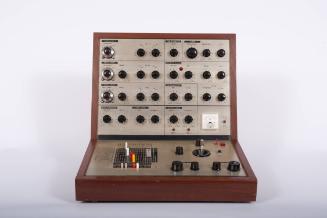
Electronic Music Studios (London) Limited
1969
Not available for use in Recording Studios
On View: Not currently on exhibit
isVirtual:
Tom Cochrane Harmonica
1990
Not available for use in Recording Studios
On View: On exhibit
isVirtual:
Photo credit: Don Kennedy
The Wurlitzer Company
c. 1959
Not available for use in Recording Studios
On View: On exhibit
isVirtual:
Photo credit: Don Kennedy
Elizabeth Wyn Wood
2003
On View: Not currently on exhibit
isVirtual:
Photo credit: Don Kennedy
Joseph Johannes Couchet
1679
Not available for use in Recording Studios
On View: On exhibit
isVirtual:
Photo credit: Don Kennedy
Buchla & Associates
c. 1968
Available for use in Recording Studios
On View: Not currently on exhibit
isVirtual:
Photo credit: Don Kennedy
The Aeolian Company, Ltd.
c. 1910
Not available for use in Recording Studios
On View: Not currently on exhibit
isVirtual:
Photo credit: Don Kennedy
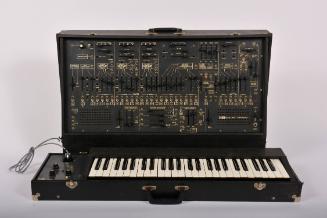
ARP Instruments, Inc.
1976
Available for use in Recording Studios
On View: Not currently on exhibit
isVirtual:
Photo credit: Don Kennedy
ARP Instruments, Inc.
c. 1972
Not available for use in Recording Studios
On View: On exhibit
isVirtual:
Photo credit: Don Kennedy
Baldwin Piano and Organ Company
1966
Available for use in Recording Studios
On View: Not currently on exhibit
isVirtual:
Photo credit: Don Kennedy
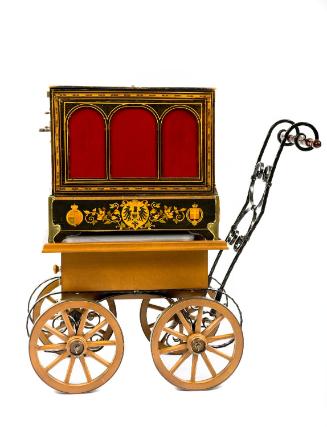
Bacigalupo-Söhne, Orgelfabrik
c. 1880
Not available for use in Recording Studios
On View: Not currently on exhibit
isVirtual:
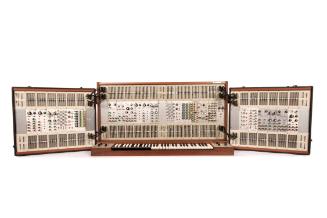
Photo credit: Don Kennedy
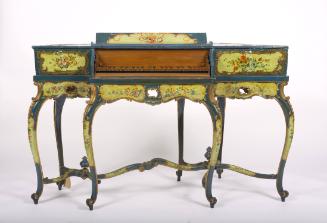
Francesco Bonafinis
c. 1560
Not available for use in Recording Studios
On View: On exhibit
isVirtual:
Back