EN / FR
Skip to main content

Elton John Songwriting Piano

Not available for use in Recording Studios
On exhibit
On exhibit
Artifact TypePiano, Vertical
Manufacturer A. Day
Manufacturer LocationUnited Kingdom
Datec. 1910

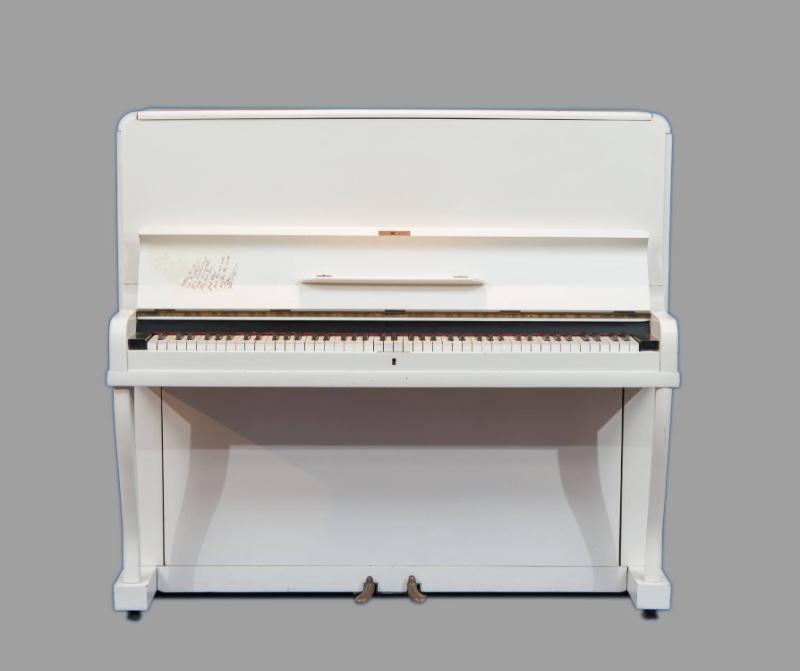
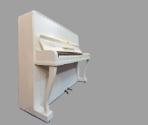
English pop star Elton John acquired this vertical piano at some point in the early 1960s—using it exclusively as his songwriting instrument until 1972. Colloquially referred to as a birdcage piano, this style was especially popular with players lacking the means or space for a Steinway or Mason and Hamlin model. Working with lyricist Bernie Taupin, John used it to compose his first five albums, which include the hits “Your Song” and “Tiny Dancer.”

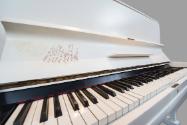
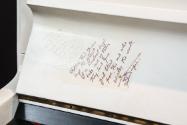
The fallboard of the piano was signed by John and Taupin in 1972, with John’s inscription reading: “to Bryan and Nanette, Sarah and Emma with Love Elton John May 31, 1971 original piano, lots of success with it,” and Taupin’s inscription reading: “Within this piano lays the ghost of a hundred songs, take care of them, they love you.  God Bless from the one who writes the words, Bernie Taupin.”

In 1991, John revisited the piano, and gave another inscription on the face of the piano, which reads: “May 1991 – 19 years later – 3 children – 1 hysterectomy – 25 lawsuits – 1 Marriage – 751 cats and countless boyfriends is free – Send you both my Love, Elton John.”


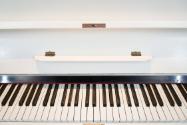
Operation/FunctionThis artifact is a vertical piano that employs a birdcage action. The exterior of the piano is constructed of wood and is painted white. Interior components consist of wooden and compressed felt hammers, steel strings, iron frame, and wooden soundboard and bridge. Keys are covered in plastic coverings, with the instrument featuring an 85-note compass.Cultural SignificanceElton John remains one of the most prolific and successful musicians of the modern era. Having sold over 300 million records and produced over fifty number one singles throughout the past fifty years, his music has penetrated a generation and is surpassed in recognition only by Elvis Presley and The Beatles. His 1997 arrangement of “Candle in the Wind”, which he produced for the late Princess Diana, remains to this day the best selling single of all time. Although John’s songwriting piano is an instrument of relatively poor technical quality, and was never featured on any professional recordings, it stands as the tool with which he composed some of his most well known songs, such as “Your Song” and “Tiny Dancer”. It symbolizes what was arguably the most important phase in John’s early career and remained in his possession while he rose to prominence in the American music industry throughout the early 1970s. This particular artifact also symbolizes a more significant trend in popular music, which saw an increasing focus on the incorporation of the piano into recordings and performance. Of course, the piano was well used throughout the 1950s and early 1960s by musicians such as Jerry Lee Lewis and Little Richard, however its presence and the manner in which it was used seemed to shift throughout the 1960s and 1970s, taking on a more prominent and even sometimes solo role in popular music. The advent of the square piano in the late eighteenth century and the vertical piano in the mid nineteenth century also marked an important shift in more generalized usage of the piano. These instruments were designed for the domestic market of the rising middle class, and were produced with the intention of being smaller and less expensive than their grand counterparts. Thanks to the square, and later the vertical design, the piano established itself as a more commonplace instrument that was accessible to a larger demographic of both professional and non-professional musicians.Technological SignificanceAlthough vertical pianos have remained popular since their inception in the late nineteenth century, the birdcage vertical piano is regarded as having one of the most flawed and undesirable designs. The piano itself can be seen as a development of earlier chordophones such as the hammered dulcimer, which employed hand-held hammers to strike a series of horizontal strings, and the clavichord, a Renaissance instrument that appropriated the dulcimer’s design for use with a keyboard. The grand piano was designed in 1700 by the Italian harpsichord builder Bartolomeo Cristofori (1655 – 1731), who modified the clavichord’s action so as to allow the instrument’s hammers to return to their resting position immediately after striking the string. The clavichord, which employs a series of metal tangents connected as levers to the keys, did not incorporate such a mechanism and, as a result, its tone is often quite muted on account of the tangents remaining in contact with the strings for too long. Cristofori’s piano was able to produce a larger sound akin to that of the harpsichord, but in employing a struck rather than plucked action, was also capable of producing expressive variations in its articulation, tone, and dynamics. With the rise of the Industrial Revolution in the early and mid nineteenth century, the piano underwent a series of significant design and construction developments, including improvements in string material, the incorporation of the cast iron frame, the inclusion of pedals, the extension of the keyboard compass, cross-stringing of bass strings, and, most importantly, the incorporation of a more flexible double-escapement action. These changes were subsumed by companies such as Broadwood and Sons of England, Sebastian Érard and Pleyel of France, and Steinway and Sons, Alpheus Babcock, and Chickering and Sons of the United States. Earlier instruments, typically dating from the eighteenth century and employing Cristofori’s more simplistic single-escapement action, are generally referred to as fortepianos, while modern instruments of the nineteenth and twentieth centuries are simply referred to as pianos. Beginning in the late eighteenth century, two alternate designs emerged as variations of the harpsichord-shaped case characteristic of early fortepianos: the square piano and the vertical piano. The development of the square piano is often attributed to several builders, including Gottfried Silbermann (German, 1683 – 1753), who is also credited with the introduction of the damper pedal, and Johannes Zumpe (German, 1726 – 1790), who spent the majority of his career in England and is often closely associated with the country’s building tradition. Square pianos, which featured a horizontal cross-stringing design, were used extensively throughout the late eighteenth and early nineteenth centuries, and were lauded for their being relatively inexpensive, smaller than their fortepiano counterparts, and generally more accessible to the burgeoning middle class. As a result of the compromised design, however, the instrument’s tone suffered considerably. Moreover, attempts to overcome the poor tone quality of the square piano resulted in gradual increases in the instrument’s size, making them correspondingly less practical. The vertical piano emerged in the early 1800s, and by the end of the century, had far surpassed the square piano in popularity and usage. Vertical pianos are so-called because both the frame and strings are positioned vertically; although the vertical stringing of these instruments – with the strings and soundboard placed behind and perpendicular to the keys and the tuning pins placed at the bottom of the instrument – still resulted in a poorer tone quality than that of the contemporaneous fortepiano and grand pianos, the vertical piano was regarded as being structurally superior to the square. By the early twentieth century, the square piano had fallen into relative disuse. Vertical pianos, which were manufactured in large numbers throughout the United States and Western Europe, continued to enjoy numerous improvements and experiments in their design throughout the nineteenth and very early twentieth centuries, which saw the creation of the cabinet vertical between 1805 and 1840, characterized by its extensive height and straight stringing, and the cottage vertical from around 1815 until the early twentieth century, characterized by its shorter height, as well as the oblique vertical in the 1820s, which incorporated diagonal stringing throughout as opposed to the straight or cross (combination of straight and diagonal) stringing seen on the majority of all other vertical pianos of the time, and the spinet vertical from the 1930s, which employed an unusually low hammer position with drop action to maintain a reasonable keyboard height. Birdcage vertical pianos are a specific type of vertical piano typically subsumed under the category of cottage verticals, and gained an early level of popularity based on their ability to be manufactured relatively cheaply and easily. In fact, for a short period of time towards the end of the nineteenth century, workshops specializing in the production of cheaper, less complex, and smaller pianos became exceedingly active in England in what has been referred to as a “cottage industry”; indeed, this certainly helped promote the prevalence of the piano in domestic life as was experienced in the early twentieth century, catering to the burgeoning middle class. High-end instruments from prominent English builders such as Broadwood & Sons, Brinsmead, and Collard & Collard continued production concurrently, seemingly unaffected by the increase in demand for cheaper instruments. It is interesting to note that while the materials required for the sound-producing mechanisms of both vertical and grand pianos were relatively cheap to manufacture or purchase, outer materials, such as hardwood veneers, exotic veneers, and intricate carvings, were also unusually inexpensive at the time. Although nearly every piano of the late nineteenth century, regardless of quality, was produced with the sorts of ornate designs typical of the Victorian era from which they emerged, their outer splendor had disappeared by the early twentieth century to suit a changing aesthetic that favoured simple and clean design. In England, lavish design in vertical pianos generally entailed the use of burled woods and silver or brass candle sconces mounted on the front panel of the instrument. This particular piano, having been constructed in the early twentieth century, is unique in its design in that it reflects that of the early twentieth century aesthetic; the majority of English pianos of this type were constructed several decades earlier. Interestingly, throughout the 1950s in England, many pianos from the Victorian era were modernized on the exterior so as to make them appear more contemporary. Candle sconces were removed and the ornate front panels and legs characteristic of the late nineteenth century were replaced with more plain versions. Lids were often shortened, and rounded wooden corner mouldings were fitted. The Birdcage piano was, for the most part, unique to English piano building, though they were also produced in small numbers throughout Germany. They are so-called on account of their use of what was referred to as a “birdcage” or “overdamper” design, which consisted in the dampers being mounted above the hammers with wires running back down to connect the damper to the piano’s action mechanism. The majority of vertical pianos employ an underdamper design, which places the dampers underneath the hammers and closer to the action itself, thereby eliminating the need for connective wires. This design was used up until approximately the 1930s, at which point it became relatively obsolete in English manufacturing, with just a few exceptions. Birdcage pianos were exclusively straight strung, facilitating the space for the instrument’s cumbersome wires. These instruments were notoriously problematic, with restoration technicians citing difficulties in tuning on account of the overdamper rail obscuring access to some of the tuning pins, and performers citing the instrument’s inability to completely dampen the vibrations in the strings. This is typically credited to the fact that, unlike the underdamper mechanism, which is positioned very close to the action itself, the overdamper mechanism is placed farther away from where the initial vibrations on the strings emanate, and nearer a portion of the strings that experiences less movement. Additionally, many cite that the wire mechanism is also noisy when in use. The general drawback with Birdcage pianos, however, seems to derive from the fact that the materials and craftsmanship that went into the construction of these instruments was simply of poorer quality than compared to other vertical and grand pianos of the era. It should be noted that later Birdcage pianos used bridle tapes that more closely resembled the underdamper mechanism, while Birdcage pianos of the cottage industry era employed the more classic “spring and loop” mechanism characteristic of all early specimens, however the parts required to restore either version of the Birdcage piano are now quite scarce, making the instrument something of a burden to service.Users/PerformersSir Elton John was born Reginald Kenneth Dwight on 25 March 1947 in Pinner, Middlesex, England. His musical career began at the tender age of three, when he began learning to play the piano. Initially self-taught, he began lessons in 1957, the same year his parents divorced. In 1959, Dwight became the recipient of a part-time scholarship to study at the Royal Academy of Music and, over the next four years, commuted to London to partake in Saturday morning classes. Dwight began his performing career in 1962 as a weekend piano player at the Northwood Hills hotel, a venue that saw the formation of his first group, The Corvettes. In 1963, The Corvettes, which consisted of school friends Mick Inkpen, Stuart Brown, and Rex Bishop, reformed as Bluesology. In 1965, Bluesology embarked on a tour of continental Europe, and Dwight remained as their keyboard player until 1967, leaving the group to pursue solo interests. It was also in 1967 that Dwight legally changed his name to Elton John, which he had been using as a stage name with the band. Taupin, who was born on 22 May 1950 in Lincolnshire, England, came in contact with John after the two independently responded to an advertisement placed by Liberty Records in the New Musical Express. They began their collaborative relationship in the same year, which initially consisted in the pair corresponding by mail. The process would begin with Taupin first producing lyrics, then with John setting the words to music and composing the songs. They have maintained this somewhat indirect arrangement ever since, and it is reported that the two have never composed a single song while in each other’s presence. In addition to composing songs for Elton John, the pair also worked as songwriters for the DJM record label, producing songs for other artists throughout the late 1960s and early 1970s. John made his live American debut in 1970, performing with a full band at The Troubadour in Los Angeles. 1970 also saw the release of his self-titled sophomore album, which followed 1969’s Empty Sky, featuring the critically acclaimed “Your Song”. Between 1970 and 1976, John released fourteen studio albums under the direction of producer Gus Dudgeon, including Tumbleweed Connection (1970), Madman Across the Water (1971), Honky Chateau (1972), and Goodbye Yellow Brick Road (1973), the latter of which maintained its spot at the top of the Billboard Top 100 chart for two consecutive months. In 1973, John formed the Rocket Record Company and ceased his connection with DJM. Taupin and John continue to maintain their working relationship to the present day. In the 1980s and 1990s, John took on a number of ancillary projects. In 1992, he founded the Elton John AIDS Foundation, and has been an open advocate of gay rights since publicly announcing his sexual orientation in 1987. Another of his most notable collaborations occurred between 1993 and 1994, when he joined Tim Rice on producing the musical score to Disney’s The Lion King (1994). This collaboration earned John his first and only Academy Award. In 1997, John and Taupin rearranged “Candle in the Wind”, which had originally appeared on Goodbye Yellow Brick Road in 1973, as a tribute to the late Diana, Princess of Wales. This arrangement remains the best selling single of all time, with over 33 million copies sold worldwide. In 1998, John was knighted by Queen Elizabeth II after having been named a Commander of the Order of the British Empire two years prior and, between 2004 and 2009, undertook a performing residency at Caesar’s Palace in Las Vegas, which he has since reprised. In addition to his Academy Award, John has also been the recipient of numerous other awards, including induction into the Songwriters hall of Fame in 1992 and the Rock and Roll Hall of Fame in 1994, a Tony Award in 2000, the Grammy Legend Award in 2001, the Kennedy Center Honor in 2004, the Billboard Magazine Legend of Live Award in 2006, the Rockefeller Foundation Lifetime Achievement Award in 2013, twelve Ivor Novello Awards, six Grammy Awards, five Brit Awards, a Golden Globe Award, a Disney Legend Award, and an honorary doctorate from the Royal Academy of Music. He remains one of the most prolific and successful musicians of the era, having sold in excess of 300 million records, obtained fifty-six top 40 singles, and produced 35 gold and 25 platinum albums. His achievements in the American music industry are succeeded only by Elvis Presley and The Beatles. In addition to working with Elton John, Bernie Taupin has also co-written music for Rod Stewart, Alice Cooper, and Brian Wilson, and produced the lyrics for Jefferson Starship’s “We Built This City”.
Object number2004.02.01
Bösendorfer Klavierfabrik GmbH
1855
Not available for use in Recording Studios
On View: Not currently on exhibit
isVirtual:
Photo credit: Don Kennedy
Oscar Schmidt Company
Unknown
Not available for use in Recording Studios
On View: Not currently on exhibit
isVirtual:
Photo credit: Don Kennedy
Venczel József Schunda
c. 1905
Not available for use in Recording Studios
On View: Not currently on exhibit
isVirtual:
Photo credit: Don Kennedy
Joseph Johannes Couchet
1679
Not available for use in Recording Studios
On View: On exhibit
isVirtual:
Photo credit: Don Kennedy
Drum Workshop, Inc.
2009
Not available for use in Recording Studios
On View: On exhibit
isVirtual:
Photo credit: Don Kennedy
Carl (Karl) Leopold Röllig
c. 1800
Not available for use in Recording Studios
On View: Not currently on exhibit
isVirtual:
Photo credit: Don Kennedy
Pleyel et Cie
1913
Not available for use in Recording Studios
On View: Not currently on exhibit
isVirtual:
Photo credit: Don Kennedy
Francesco Bonafinis
c. 1560
Not available for use in Recording Studios
On View: On exhibit
isVirtual:
Photo credit: Don Kennedy
Vido Trasuntino
1591
Available for use in Recording Studios
On View: Not currently on exhibit
isVirtual:
Photo credit: Don Kennedy
Sébastien Érard
1820
Not available for use in Recording Studios
On View: On exhibit
isVirtual:
Photo credit: Don Kennedy
Hohner Musikinstrumente GmbH & Co. KG
c. 1966
Available for use in Recording Studios
On View: Not currently on exhibit
isVirtual:
Photo credit: Don Kennedy
Johannes Zumpe
1766
Not available for use in Recording Studios
On View: On exhibit
isVirtual:
Back