EN / FR
Skip to main content

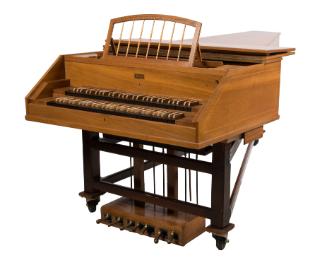
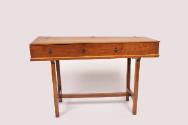
Dolmetsch Clavichord

Not available for use in Recording Studios
On exhibit
On exhibit
Artifact TypeClavichord
Manufacturer Arnold Dolmetsch 1858 - 1940
Manufacturer LocationUnited Kingdom
Date1926

Considered an early ancestor of the piano, the clavichord began to fall out of favour around 1700—after the emergence of the more mechanically efficient piano. The Clavichord seen here, however, was manufactured much later by the French-English instrument builder Arnold Dolmetsch. Dolmetsch was one of the key figures in the 20th-century revival of early music and a pioneer in reconstructing instruments using historical designs. He was also single-handedly responsible for making the recorder—an instrument little used after the renaissance era—the entry level learning tool for amateurs.

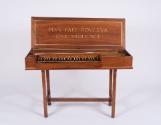
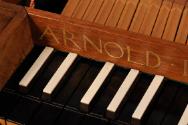
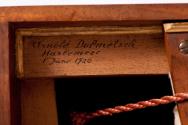
Batten inscription reads: ‘Arnold Dolmetsch Anno M CM XXIX’ after the maker. 

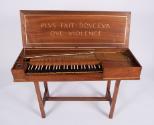
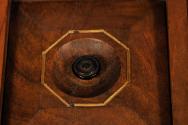
Interior lid inscription reads: ‘PLVS FAIT DOVCEVR QVE VIOLENCE,', or “kindness does more than violence”.

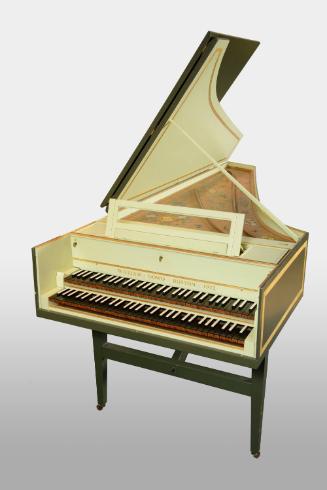
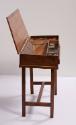
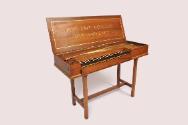
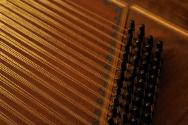
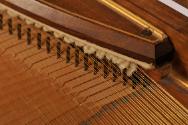
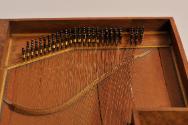
Operation/FunctionThis particular artifact is an unfretted clavichord that features a walnut case with four octaves of reverse-coloured keys and bichord stringing.Cultural SignificanceAlthough interest in early music is widespread today, this was not always the case. In fact, early music traditions had nearly been forgotten throughout the nineteenth century. Many orchestral instruments, including the piano, saw their greatest period of development and modernization during this time thanks to the Industrial Revolution and earlier instruments from previous centuries such as the harpsichord and clavichord had fallen into relative obscurity. The early twentieth century saw resurgent interest in early musical instruments as a reaction to the dominance of the piano in the nineteenth century. Perhaps no one has had more of a pioneering influence on the revival of early music than Arnold Dolmetsch. Dolmetsch pioneered the popular authenticist movement that supported a return to the creation of historically accurate instruments, basing design principles and materials of construction on those historical models and writings still in existence. His efforts, in effect, inspired numerous generations of builders dedicated to a similar methodology. The early music revival did not wane throughout the late twentieth century, either, nor did it remain limited to the classical sphere, as is evident in much of the Baroque-inspired rock music of the 1960s and in the production of instruments such as the electric clavichord, or Clavinet, and the electric harpsichord. Although Dolmetsch was not the first to reconsider a scholarly interest in early music – Cambridge University was, for example, a hive of activity in the study of virginal music and madrigals during the 1870s – he was the first to pioneer the industry of early musical instrument building. He was also recognized as a strong proponent of education in relation to early music, both in the context of construction and historical performance.Technological SignificanceThe clavichord was a significant contribution to the development of stringed keyboard instruments, slightly predating the harpsichord. It first emerged during the late Middle Ages as a keyed variant on instruments such as the dulcimer, and continued in popular use throughout the Renaissance and Baroque eras. Although its innovative percussive mechanism allowed for dynamic variations that were not readily available in contemporaneous keyboard instruments such as the harpsichord and portative organ, the simplicity of its hammer design meant that the instrument could not produce substantial volume levels. When the piano emerged from Italian instrument builder Bartolomeo Cristofori in 1700, it brought with it a more sophisticated clavichord mechanism that enabled the instrument to project its tone. Perhaps Cristofori’s most significant and defining contribution was his single-escapement action. The single-escapement action essentially modified the striking mechanism of the clavichord so as to allow the instrument’s hammers to return to their resting position immediately after striking the string. As a result, the string is able to resonate freely and produce a tone that is substantial in volume. Moreover, Cristofori’s design was oriented such that the hammer itself did not lift to the height of the string, which would result in a dampening of the sound; rather, the momentum induced by the wippen pushes the hammer upward from its maximum height to simply impact the string then fall downward naturally. Cristofori’s piano was, as a result, able to produce a larger sound akin to that of the harpsichord, however, in employing a struck rather than plucked action, it was also capable of producing expressive and nuanced variations in its articulation, tone, and dynamics. Cristofori also replaced the blunt edge of the clavichord’s metal tangents with a circular coil of paper covered in leather, which was the precursor to the compressed felt pad found on modern pianos. This padding made the hammer’s impact with the string softer, thereby emphasizing the resonance of lower harmonics in the strings vibrations and resulting in a richer tone. The advent of electric amplification via pickups in the 1930s signaled a new approach to instrument design, calling into reconsideration the need for structures that were required to support fully acoustic amplification. Many instruments, including the guitar, piano, and harpsichord, were re-conceptualized according to this new model, resulting in an array of electric instruments that each offers a unique tone, function, and identity. The Clavinet, which was first introduced in 1964, can be seen as an extension of these early efforts in relation to the clavichord. Although the Clavinet is effectively a modernized variant of the clavichord, the two exhibit some fundamental differences. Perhaps the main difference between the clavichord and Clavinet is that the tangents of the former strike upward toward the strings, which sit above the hammer, while the tangents of the latter strike downward onto the strings, which sit below the keys. While the tangents of the clavichord are simply constructed of metal, the tangents of the Clavinet also feature a hard rubber tip, giving the user greater control over tone, dynamics, and articulation. The Clavinet was certainly an improvement upon the clavichord, thanks in no small part to the inclusion of pickups that allowed the instrument to be used in more varying contexts.Users/PerformersMost composers of early keyboard music did not specify a particular instrument for which the music was optimal, except occasionally in the case of organs. As such, written keyboard music could be performed on virtually any keyboard instrument of the time, with the player making practical decisions about how to execute the piece based on the features offered by the instrument in use. The majority of these early instruments had a similar keyboard compass range that was capable of accommodating much of the standard keyboard music of the time. Typically, the clavichord was used exclusively in the private sphere for composing and practicing, rather than for performing, on account of its characteristically soft tone. As such, works would often be composed with the clavichord and composed with the harpsichord or virginal. There is a great deal of information regarding composers of early keyboard music, with the most well known group of composers belonging to the virginal school, which was based in England in the late Renaissance and included the famed composer William Byrd (about 1540 – 1623). Other composers of early keyboard music who lived on the European continent include François Couperin (France, 1668 – 1733), Jean-Philippe Rameau (France, 1683 – 1764), Domenico Scarlatti (born in Italy, lived in Spain, 1685 – 1757), Girolamo Frescobaldi (Italy, 1583 – 1643), Giovanni Picchi (Italy, 1571 – 1643), Samuel Scheidt (Germany, 1587 – 1684), Jan Pieterszoon Sweelinck (The Netherlands, 1562 – 1621) and, of course, Johann Sebastian Bach (Germany, 1685 – 1750). The English virginal school produced a number of “virginal books”, as they were called, which were simply collections of the popular keyboard music of the time, and were not necessarily intended for the virginal, a variant of the harpsichord. These included The Mulliner Book, The Dublin Virginal Manuscript, Elizabeth Roger’s Virginal Book, The Fitzwilliam Virginal Book, My Ladye Nevells Booke, Clement Matchett’s Virginal Book, Parthenia, Priscilla Bunbury’s Virginal Book, Will Forster’s Virginal Book, and Anne Cromwell’s Virginal Book. The most famous of these is The Fitzwilliam Virginal Book, which served as the seminal source of keyboard music throughout the late Renaissance and early Baroque eras. Its name is derived from the Viscount Fitzwilliam, who bequeathed the manuscript to Cambridge University in 1816; the book is still housed within Cambridge’s Fitzwilliam Museum collection. As was the case with most collections of musical scores at the time, The Fitzwilliam Virginal Book is not attributed to any particular author, and contains in excess of 300 works from composers such as William Byrd, Peter Philips, Giles Farnaby, John Bull, and Jan Sweelinck. Parthenia, which was printed in 1612, was essentially the first published collection of music in England; prior to this, most collections of musical scores were simply manuscripts that circulated directly between performers.
Object number2008.04.01
Photo credit: Don Kennedy
Sébastien Érard
1820
Not available for use in Recording Studios
On View: On exhibit
isVirtual:
Photo credit: Don Kennedy
William Richmond Dowd
1972
Available for use in Recording Studios
On View: Not currently on exhibit
isVirtual:
Photo credit: Don Kennedy
Heintzman & Co.
1908
Not available for use in Recording Studios
On View: On exhibit
isVirtual:
Photo credit: Don Kennedy
J. & C. Fischer Piano Company
1922
Not available for use in Recording Studios
On View: Not currently on exhibit
isVirtual:
Photo credit: Don Kennedy
Kimball Piano and Organ Company
1924
Not available for use in Recording Studios
On View: On exhibit
isVirtual:
Photo credit: Don Kennedy
Johannes Zumpe
1766
Not available for use in Recording Studios
On View: On exhibit
isVirtual:
Photo credit: Don Kennedy
Kurt Wittmayer
1954
Not available for use in Recording Studios
On View: Not currently on exhibit
isVirtual:
Tom Cochrane Harmonica
1990
Not available for use in Recording Studios
On View: On exhibit
isVirtual:
Photo credit: Don Kennedy
Radio-Victor Corporation of America (RCA)
1929
Not available for use in Recording Studios
On View: On exhibit
isVirtual:
Photo credit: Don Kennedy
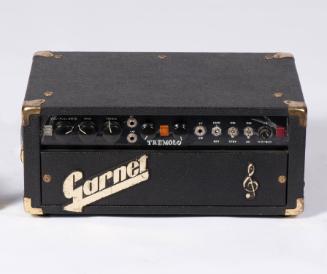
Garnet "Gar" Gillies
Available for use in Recording Studios
On View: Not currently on exhibit
isVirtual:
Photo credit: Don Kennedy
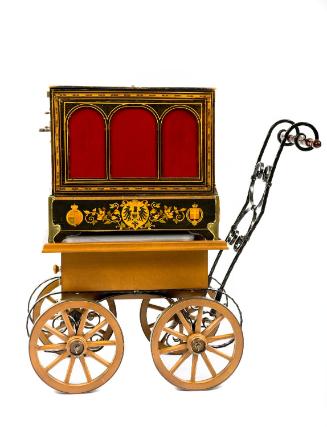
Bacigalupo-Söhne, Orgelfabrik
c. 1880
Not available for use in Recording Studios
On View: Not currently on exhibit
isVirtual:
Photo credit: Don Kennedy
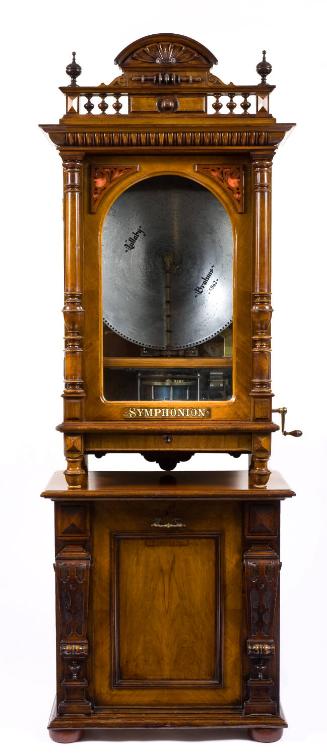
Symphonion Company
c. 1890
Not available for use in Recording Studios
On View: On exhibit
isVirtual:
Back