EN / FR
Skip to main content

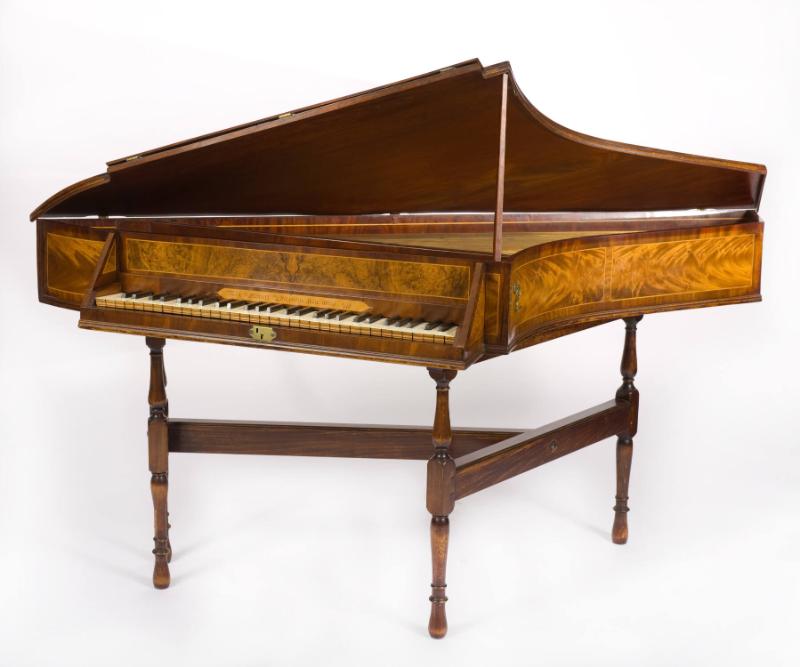
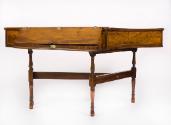
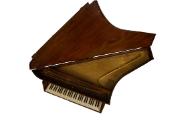
Stewart Spinet

Not available for use in Recording Studios
Not currently on exhibit
Artifact TypeSpinet
Manufacturer Neil Stewart Scottish, 1759 - 1805
Date1777

This particular instrument was built to the design specifications of Edinburgh-based builder, James Logan.

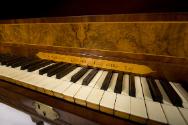
Inscription on nameboard: 'Neil Stewart Edinburgh fecit anno 1777'.

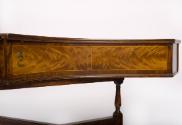
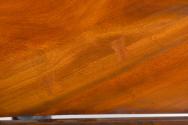
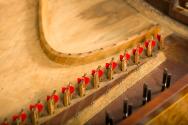
Operation/FunctionThe wooden exterior of this instrument features burled walnut panels, and the keyboard spans a compass of five octaves (F-F) with an additional lowest note, likely a short octave C pitch. The keys of the keyboard are wooden, with ivory tops on the naturals and ebonized accidentals. The interior components – jacks, strings, and associated parts – are made typically for the era in wood and metal, with closed top jacks kept together by a metal staple.Cultural SignificanceAlthough the harpsichord is historically recognized as the most well known of the plucked string keyboard instruments, the spinet held a similar reputation to the vertical piano in its being a smaller and more practical alternative to the larger and more complex grand piano. More precisely, the spinet is historically related to the virginal in much the same way that the vertical piano is to the square piano; both served as compact alternatives to the standard design, with the former design succeeding the latter with a slightly more sophisticated structure. In comparison to other larger keyboard instruments of the era, such as the organ, the spinet and virginal were also the preferred instruments for many on account of their relative portability and compact size. Unlike the clavichord, another instrument recognized for its smaller size, the spinet was capable of projecting its tone to a far more substantial level. On account of their size, spinets were also easier to manufacture and therefore less expensive. The harpsichord remained popular in the context of chamber and orchestral performance, as it was loud enough to hold its place among a group of instruments.Technological SignificanceAlthough succumbing to the piano late in the eighteenth century, instruments belonging to the harpsichord family are still today regarded as tonally and structurally intriguing on account of their unique plucking mechanism. The harpsichord, in its ability to alter its tone, split its voicing over the two manuals of double-manual instruments, and maintain a relatively loud volume, remained the dominant keyboard instrument of the Baroque era. When the piano emerged in 1700, however, it brought with it a more refined clavichord mechanism that enabled the instrument to project its tone. Unlike members of the harpsichord family, the clavichord employs a striking mechanism that attaches small pieces of metal called tangents to the back end of the keys: when a key is depressed, the back end is lifted and the tangent hits the string, causing it to vibrate. Since there is no other mechanism separating the key from the tangent, however, the difficulty with the clavichord lies in the fact that the tangent remains in contact with the string for as long as the player holds down the key. As a result, the tangent dampens the vibrations in the strings, preventing them from projecting. That being said, since the touch of the key is directly correspondent with the movement of the tangent, it is possible for the player of the clavichord to produce tones that vary in dynamic expression; by hitting the key with minimal force, a quieter sound is produced, and by hitting the key with a greater force, louder tones are achieved. Thus, although the clavichord was more expressive than the harpsichord, its tone was, overall, too quiet in comparison and the instrument was largely rendered inappropriate for public performance. The inventor of the piano, Italian builder Bartolomeo Cristofori, is crediting with the design of the single escapement action, which improved upon the key lever system of the clavichord by physically detaching the key from the tangent, or hammer as they are called in pianos. When a key is depressed on Cristofori’s piano, the hammer is similarly pushed upward to strike the string, but then falls back to its resting position immediately afterward under its own weight, regardless of whether the key remains held down. Cristofori’s piano was also capable of producing the same types of expressive and dynamic variations as the clavichord. For the most part, the harpsichord was not capable of varying its dynamics – an unfortunate feature that is attributed to the plucking mechanism. A number of innovations were introduced into the instrument to attempt to overcome this difficulty, including: incorporating coupling mechanisms into double-manual instruments, which would enable the player to split the manuals into 8’ and 4’ sections, thereby producing tones of slightly varying amplitude as well as frequency; replacing the quill or bone plectra with ones made of leather – a practice first established by the French builder Pascal Taskin in 1768, which produced a slightly softer tone; introducing materials such as silk and silver into the instrument’s steel and brass strings, again, so as to produce somewhat softer tones; and, retrofitting the lid of the instrument with moveable slats that would allow the player to make active changes to the projected amplitude. In the end, these innovations proved ineffectual, and the hammering system of the piano, capable of natural subtleties and variations that are a direct result of the player’s touch, emerged as the more sophisticated mechanism at the end of the eighteenth century. The organ, though also considered an early keyboard instrument, is often placed into its own category of instruments, and has been continuously refined over the centuries to allow the player a great many number of variations in tone, timbre, and amplitude. The harpsichord family also suffered further practical issues, one of which stems from the manner in which the jacks mute the strings after the key is released. When the key is released, the jack falls back into its resting position and a piece of felt placed at the top of the jack serves to dampen the vibrations of the strings. Unless a key is held down for a sufficient amount of time, which is not generally feasible in common performance practice, the jack mutes the string somewhat prematurely, resulting in a tone that feels roughly cut. On account of its size and complexity, the harpsichord was usually considered the central figure of the harpsichord family. The spinet, which emerged slightly later than the virginal and harpsichord, is generally recognized as a smaller, more compacted version of the harpsichord; in this sense, it is not unlike the square or vertical piano in its relation to the larger and more complex grand piano. The spinet is closely related to the virginal, as well, with both implementing a truncated design that, as a necessity, resulted in a shift in the placement of the strings in relation to the keys; whereas the strings on the virginal run nearly perpendicular to the keys, those of the spinet run at a 30-degree diagonal. As such, the spinet is often considered as lying somewhere in between the harpsichord and the virginal. In addition to alterations in their shape, the virginal, spinet, and harpsichord are further differentiated in the grouping of their strings: the harpsichord often features various sets of strings of different lengths, while the spinet features two strings placed in close proximity, and the virginal only features a single string per key. The orientation of the jacks within the spinet is also unique, with a pair of independent jacks placed within the space in between sets of strings. This is done because, being strung at an angle, the strings are too close together for an individual jack to fit in the space in between. Thus, by placing two strings closer together, a large space is made in between each pair, and the two jacks may be placed side by side, facing opposite directions. The spinet is regarded as having a feel more akin to the harpsichord, however due to the orthogonal stringing, the spinet loses much of its bass tones. Another variation of the harpsichord came in the form of the clavicytherium, which, not unlike the vertical piano, orients its strings and soundboard vertically instead of laterally. As in the vertical piano, the clavicytherium was designed so as to provide a space-saving alternative. Since both instruments are unable to incorporate gravity into their action, their mechanism tends to be more complex than that of their laterally oriented counterparts. Yet another variation came in the form of the archicembalo, which was first constructed in the sixteenth century with a unique keyboard design that was capable of accommodating different tuning systems. A very small number of pedal harpsichords were also built prior to the eighteenth century, and included another set of strings underneath the primary disposition that were controlled with the player’s feet via a series of pedals. No known examples of this instrument currently exist. An instrument known as the tangent piano also emerged briefly, incorporated the shape of the harpsichord with the mechanism of the clavichord. This instrument was not produced in large numbers, and was also eclipsed by the piano, which substantially modified the clavichord mechanism. In the late nineteenth century, a number of piano builders, most notably the French firms of Érard and Pleyel began reproducing harpsichords, incorporated techniques and materials borrowed from piano building. These instruments came to be known as “revival” harpsichords and, along with the historically informed instruments that arose in the mid twentieth century, which based their designs on historical models and documents, were in popular use throughout the twentieth century. Some modern harpsichords are built with a transposition mechanism that allowed the player to shift the keyboard so as to alter the A pitch (i.e. 440 Hz versus 415 Hz, etc.). Both the harpsichord and the spinet find their origins in the psaltery, a medieval plucked stringed instrument that was modified at some point during the mid fifteenth century to incorporate a keyboard for controlling the plucking action. The foremost producers of harpsichords, virginals, and spinets during the late Renaissance and Baroque periods were based primarily in the regions of Italy, England, France, Germany, and Flanders, an area that encompasses modern day Belgium and The Netherlands. The spinet and the virginal are understood to have first appeared in Italy in the early sixteenth century, followed by the first Flemish spinets and virginals. The virginal did not emerge in England until the early seventeenth century, pioneered by the English builder Gabriel Townsend. The famed Ruckers family are historically recognized as one of the most esteemed manufacturers of harpsichords, and were based in Antwerp, which stood as the centre of harpsichord production during the sixteenth and seventeenth centuries. Their instruments are unique in their designs, and are lauded for their innovative construction and high standard of quality. The Flemish harpsichords served as the model for most other builders throughout Europe, however each country introduced its own variations. For instance, Italian harpsichords were unique in their use of cypress wood for the case, soundboard, and bridge, and did not typically feature two manuals. German builders extended the instrument’s disposition to include a 16’ and 2’ set of strings. Other notable harpsichords builders include Pascal Taskin (1723 – 1793) of France, Jacob Kirkman (1710 – 1792) of England, and Vido Trasuntino (1522 – 1606) of Italy. This particular spinet features closed top jacks, which was an innovative feature that employed metal staples to connect the two outermost components of the jack; this offered a secure prevention of forward travel of the jack’s tongue, which affects the former’s ability to return to its starting position without plucking the string again on the way down.Users/PerformersEspecially throughout England, the term ‘virginal’ was often used to describe an array of stringed keyboard instruments that were not in fact virginals, such as harpsichords, spinets, and even clavichords. As such, the spinet did not, generally speaking, have its own repertoire distinct from that of the harpsichord, as both instruments had a similar range that was capable of accommodating much of the standard keyboard music of the time. In fact, most composers of early keyboard music did not specify a particular instrument for which the music was optimal, except, perhaps, occasionally in the case of organs. As such, written keyboard music could be performed on virtually any keyboard instrument of the time, with the player making practical decisions about how to execute the piece based on the features offered by the instrument in use. Although a number of harpsichord and spinet players would have existed at the time, there is very little documented information about particular players. There is, however, a great deal of information regarding composers of early keyboard music, with the most well known group of composers belonging to the virginal school, which was based in England in the late Renaissance and included the famed composer William Byrd (about 1540 – 1623). Other composers of early keyboard music who lived on the European continent include François Couperin (France, 1668 – 1733), Jean-Philippe Rameau (France, 1683 – 1764), Domenico Scarlatti (born in Italy, lived in Spain, 1685 – 1757), Girolamo Frescobaldi (Italy, 1583 – 1643), Giovanni Picchi (Italy, 1571 – 1643), Samuel Scheidt (Germany, 1587 – 1684), Jan Pieterszoon Sweelinck (The Netherlands, 1562 – 1621) and, of course, Johann Sebastian Bach (Germany, 1685 – 1750). The English virginal school produced a number of “virginal books”, as they were called, which were simply collections of the popular keyboard music of the time, and were not necessarily intended for the virginal. These included The Mulliner Book, The Dublin Virginal Manuscript, Elizabeth Roger’s Virginal Book, The Fitzwilliam Virginal Book, My Ladye Nevells Booke, Clement Matchett’s Virginal Book, Parthenia, Priscilla Bunbury’s Virginal Book, Will Forster’s Virginal Book, and Anne Cromwell’s Virginal Book. The most famous of these is The Fitzwilliam Virginal Book, which served as the seminal source of keyboard music throughout the late Renaissance and early Baroque eras. Its name is derived from the Viscount Fitzwilliam, who bequeathed the manuscript to Cambridge University in 1816; the book is still housed within Cambridge’s Fitzwilliam Museum collection. As was the case with most collections of musical scores at the time, The Fitzwilliam Virginal Book is not attributed to any particular author, and contains in excess of 300 works from composers such as William Byrd, Peter Philips, Giles Farnaby, John Bull, and Jan Sweelinck. Parthenia, which was printed in 1612, was essentially the first published collection of music in England; prior to this, most collections of musical scores were simply manuscripts that circulated directly between performers.
Object number2007.04.02
Bösendorfer Klavierfabrik GmbH
1855
Not available for use in Recording Studios
On View: Not currently on exhibit
isVirtual:
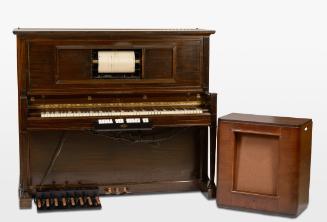
Photo credit: Don Kennedy
Willis & Company Ltd.
1924
Not available for use in Recording Studios
On View: Not currently on exhibit
isVirtual:
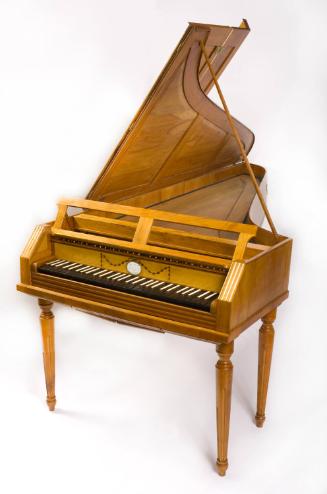
Photo credit: Don Kennedy
Louis Dulcken II
1791
Available for use in Recording Studios
On View: Not currently on exhibit
isVirtual:
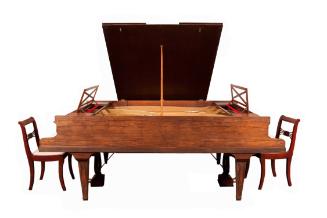
Photo credit: Don Kennedy
Pleyel et Cie
1913
Not available for use in Recording Studios
On View: Not currently on exhibit
isVirtual:
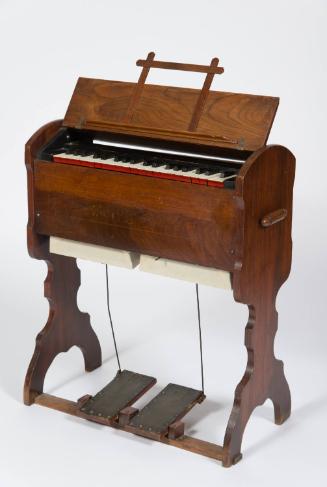
Photo credit: Don Kennedy
Mason & Hamlin Organ & Piano Company
1890
Not available for use in Recording Studios
On View: On exhibit
isVirtual:
Photo credit: Don Kennedy
The Wurlitzer Company
c. 1970
Available for use in Recording Studios
On View: Not currently on exhibit
isVirtual:
Photo credit: Don Kennedy
Optigan Corporation (of Mattel) / Opsonar (of Miner Industries)
c. 1973
Available for use in Recording Studios
On View: Not currently on exhibit
isVirtual:
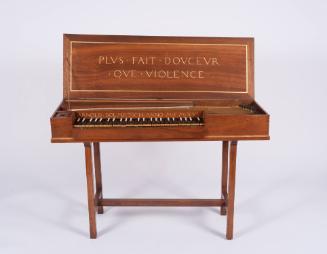
Photo credit: Don Kennedy
Arnold Dolmetsch
1926
Not available for use in Recording Studios
On View: On exhibit
isVirtual:
Photo credit: Don Kennedy
Baldwin Piano and Organ Company
1966
Available for use in Recording Studios
On View: Not currently on exhibit
isVirtual:
Photo credit: Don Kennedy
Vox Sound, Ltd.
c. 1967
Not available for use in Recording Studios
On View: Not currently on exhibit
isVirtual:
Photo credit: Don Kennedy
Elettronica Musicale Europea (EME) / Vox
c. 1968
Available for use in Recording Studios
On View: Not currently on exhibit
isVirtual:
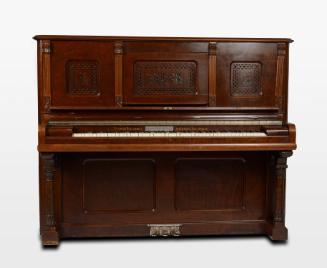
Photo credit: Don Kennedy
Heintzman & Co.
1908
Not available for use in Recording Studios
On View: On exhibit
isVirtual:
Back