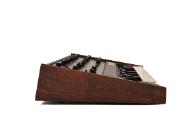
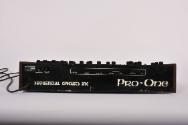
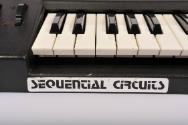
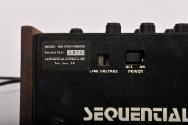
Sequential Circuits Pro One
Available for use in Recording Studios
Not currently on exhibit
Not currently on exhibit
Artifact TypeSynthesizer
Manufacturer
Sequential Circuits Inc.
Datec. 1981
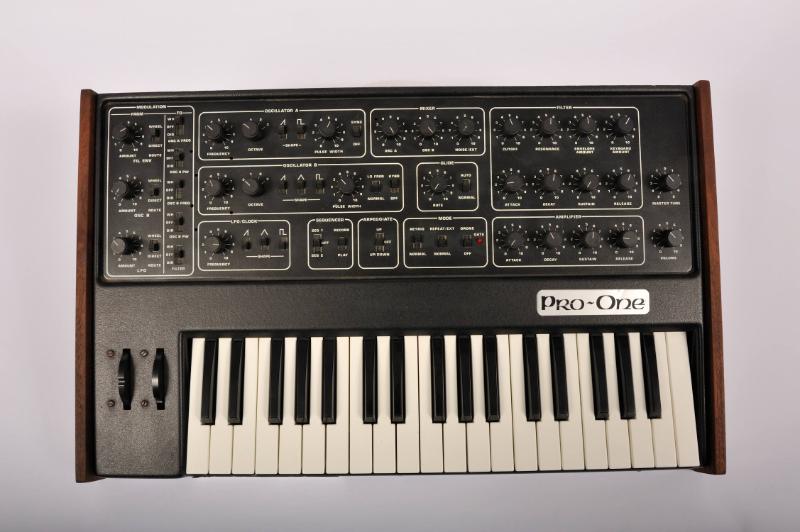
Operation/FunctionThe Sequential Circuits Pro One is a monophonic synthesizer across its 37-note keyboard, employing wholly analog circuitry. It contains two VCOs (voltage-controlled oscillators), labeled A and B, with two accompanying knobs for octave and fine-tune frequency selection, a knob for pulse width variation, switches for pulse, sawtooth, and triangle (oscillator B only) selection, and keyboard sync, as well as an LFO (low frequency oscillator). There are two onboard envelopes, including one dedicated to the VCA (voltage-controlled amplifier) and another dedicated to the VCF (voltage-controlled filter), each with attack, decay, sustain, and release. The filter is a four-pole low-pass and contains controls for cutoff, resonance, envelope amount, and keyboard amount. Similar to the Prophet 5, its polyphonic predecessor, the Pro One includes a modulation section that allows signals from the filter envelope, oscillators, or LFO to manipulate other signals from the oscillators and filter. Additional features include an analog sequencer with 40 note capacity and arpeggiator, a note hold or drone function, glide, two control wheels for pitch bend and modulation, a mixer, and noise that can be bypassed with an external input. Master tune and volume knobs are also included. The VCOs in this instrument employ CEM (Curtis Electromusic) 3340 integrated circuits, or chips, and the filter employs CEM 3320 chips. It also incorporates a basic CPU for digital scanning of the instrument keyboard in conjunction with the sequencer function.Cultural SignificanceEarly analog synthesizers such as the Pro One have left an indelible mark on the way in which current trends in synthesizer design are informed. In the 1970s and early 1980s, these instruments offered a way forward for composers and musicians who felt stifled by the rigour of early electronic music techniques, such as those practiced in Germany and France throughout the 1950s. They promised new timbres and uninhibited methods of control and ultimately set into motion the foundations of synthesis practices that would follow into the modern era. The Pro One stands as among one of Sequential Circuits’ most commercially successful instruments, primarily on account of its comparatively affordable price tag.Technological SignificanceThe synthesizer is arguably one of, if not the most technologically significant contributions to the course of electronic music. Although earlier electronic instruments such as the Theremin and Ondes Martenot offered new and unique ways of articulating sound, their sonic template was, for the most part, quite limited, capable of producing only a few distinct timbres. The modern synthesizer, on the other hand, was viewed as an integrated electronic orchestra, as it were, allowing the user to sculpt a wide and varied array of tones and gestures. What’s more, it allowed the user to modify their sounds in real time, seemingly without the sorts of physical limitations imposed on acoustic instruments. Of course, each instrument did come with its own characteristic tonal qualities and control limitations, however the wealth of opportunity inherent in the ability to manipulate and define nearly every parameter of sound structure solidified the synthesizer’s place as one of the most powerful musical innovations of the twentieth century. The concept of modular design was initially quite desirable to professional and studio musicians in that it allowed one to more or less completely customize their instrument and modify its functions as desired. The modular nature of early synthesizers also meant that an array of patches, or defined sounds that could be altered in real time, were possible, offering the musician a high degree of flexibility and the opportunity to develop their own performance technique and signature tone. Analog modular synthesis was quite prevalent as a music-making practice in academic institutions and private studios throughout the late 1960s and into the early 1980s, both in Europe and throughout North America. Electronic instruments of this era were entirely transistor-based, with solid-state devices such as the transistor representing the next generation in technology following the vacuum tube, which was used extensively throughout the first half of the twentieth century. Solid-state technology was far smaller, lighter, more reliable, more durable, and less expensive than vacuum tube technology. This technology developed even further in around 1970 into the form of integrated circuits (ICs), which house the many discrete components of transistor-based circuits within a single silicon chip, as they are often called. Integrated circuits were significantly smaller and less expensive to manufacture than the circuits from which they derived. Although not all analog synthesizers designed in the very early 1970s employed integrated circuitry, their use was mostly standardized by the late 1970s with the inclusion of the first affordable eight-bit microprocessors, such as the Zilog Z80, that emerged mid-decade. As a result, integrated circuits adapted to incorporate more sophisticated digital components.
Although modular-type systems are still in production today ¬– the Buchla 200e, for instance, is based on the modular design of the Buchla 200 analog system – the advent of affordable microprocessor chips in the mid 1970s and the rise of programmable polyphonic instruments in the late 1970s resulted in the relative obsolescence of the discrete transistor-based systems of the early 1970s. The earliest dedicated studios that arose in the 1950s and 1960s consisted of discrete components such as sine, sawtooth, and square wave generators, filters, noise generators, mixers, and units for reverberation and ring modulation. The music making practice of the time was cumbersome, requiring the composer to record audio components onto magnetic tape, which would then undergo a series of splicing and manipulations. The modular systems of the late 1960s and 1970s were differentiated from their “primitive” counterparts in that they could be made to interact with one another under the governance of voltage control. The concept of voltage control, which was implemented into early electronic instruments such as Hugh Le Caine’s Electronic Sackbut, is based on the principle by which the function of electrical components relates to voltage, or the flow of electrical current. The most unique aspect of the concept of voltage control, which modular synthesizers took full advantage of, suggests that a voltage produced by one component or module can be used to control some function of another module via connection by patch cords or related means. These techniques enabled a very rich and highly interactive approach to the idiom of electronic music composition. The term ‘modular’ simply implies that various dedicated modules for sound production, manipulation, and amplification are integrated within a single cabinet, so as to operate as one system. The modular systems of the 1960s and 1970s were more compact than earlier synthesizers such as the RCA Mark II of the Columbia-Princeton Electronic Music Center, however their overwhelming size and hefty price tag often meant that they were accessible, for the most part, only to professionals, with a number of systems having initially been installed in recording studios and educational institutions. In response to this, most of the major companies of the era also released smaller, more portable systems (both modular and non-modular) throughout the 1970s that were also suitable for live performance, such as the Minimoog, EMS VCS3, ARP 2600 and Odyssey, and the Buchla Music Easel. Although most of these instruments borrowed elements from their modular ancestors, they were not in themselves modular by nature, but rather featured set configurations that were usually internally affixed. With the advent of integrated circuits, synthesizers increasingly began to adopt the smaller, more compact aesthetic exhibited in the performance-oriented instruments of the early 1970s, especially that of the revered Minimoog. The once popular modular approach gave way to more streamlined designs that, while still offering users the ability to control numerous aspects of the instrument’s tone and gesture, limited the way in which the instrument could be operated. Although the modular synthesizer was highly regarded for its flexibility, it was also criticized for being largely unintuitive and cumbersome in its patching schemes.
The Pro One was something of an anomaly when it was first introduced in 1981; by the late 1970s, more sophisticated polyphonic, programmable, digital-analog hybrids, such as the Sequential Circuits Prophet 5, had become the next generation of synthesizer, following the monophonic, fully analog, integrated instruments of the early 1970s. Although the Pro One does not incorporate the same degree of computer control as instruments such as the Prophet 5, it offers a level of flexibility that was not possible on monophonic synthesizers of the early 1970s on account of the inclusion of a basic computer that digitally scans the instrument’s keyboard in conjunction with the functions of the sequencer. The Pro One is often regarded as the more commercial alternative to the Prophet 5, and stood as the first synthesizer to sell for under 1000 USD at the time of its release. Internally, it employs many of the same analog components as the Prophet 5, essentially containing only one of the latter’s five voice cards as well as its unique modulation function. It also employs the second generation of integrated circuits, CEM (Curtis Electromusic) chips, which were lauded for being more stable than their SSM (Solid State Music) predecessors, if perhaps lacking some of the richness of the latter. Sequential Circuits was one of the most successful and innovative synthesizer designers, implementing many new technologies that were highly influential. In addition to the Pro One and Prophet 5, the latter being the first fully programmable, polyphonic, digital-analog hybrid synthesizer, Sequential also produced the Prophet 10, which was a combination of two Prophet 5s, the Prophet 600, which was essentially a Prophet 5 with built-in MIDI, the Prophet VS, which employs a highly sophisticated vector synthesis function, and the recent Dave Smith Instruments Prophet 6, which is a fully analog homage to the Prophet 5. Sequential was also innovative in developing the Studio 440 drum machine, which preceded the release of the hugely popular Akai MPC, designed by fellow Bay Area designer, Roger Linn of Linn Electronics. Despite the success of the Prophet 5, it could be argued that Sequential Circuits founder, Dave Smith’s, most significant technological contribution came with the development of MIDI in 1982. Smith, along with representatives from Roland, Korg, and Oberheim, theorized the concept and implemented the first successful interfacing between two instruments of different manufacturers at the NAMM trade show in 1983. For his part, Smith is also credited with coining the term MIDI, or Musical Instrument Digital Interface. Somewhat unbelievably, MIDI is still operating at version 1.0, standing the test of time against an influx of technologies that are constantly evolving and fading.Users/PerformersNotable groups to have used this instrument throughout the 1980s and 1990s include Depeche Mode, New Order, Prince, Soft Cell, and Vince Clarke. More recently, the Toronto-based rock quartet Metric feature this instrument both on recordings and in live performances.Collection
Object number2005.02.07
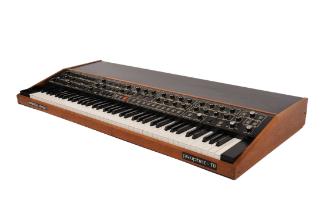
Sequential Circuits Inc.
1983
Available for use in Recording Studios
On View: Not currently on exhibit
isVirtual:
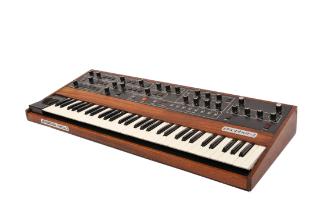
Sequential Circuits Inc.
c. 1978
Available for use in Recording Studios
On View: Not currently on exhibit
isVirtual:
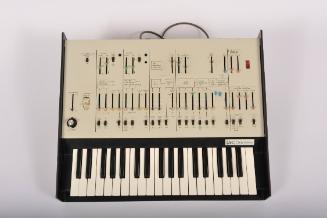
ARP Instruments, Inc.
1972
Available for use in Recording Studios
On View: Not currently on exhibit
isVirtual:

Moog Music, Inc.
1976
Available for use in Recording Studios
On View: Not currently on exhibit
isVirtual:

1969
Available for use in Recording Studios
On View: On exhibit
isVirtual:

Venczel József Schunda
c. 1905
Not available for use in Recording Studios
On View: Not currently on exhibit
isVirtual:
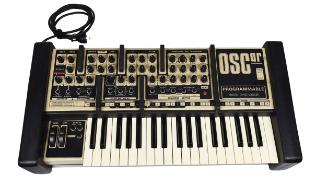
Oxford Synthesizer Company
c. 1984
Available for use in Recording Studios
On View: Not currently on exhibit
isVirtual:

Kurzweil Music Systems
1985
Available for use in Recording Studios
On View: Not currently on exhibit
isVirtual:
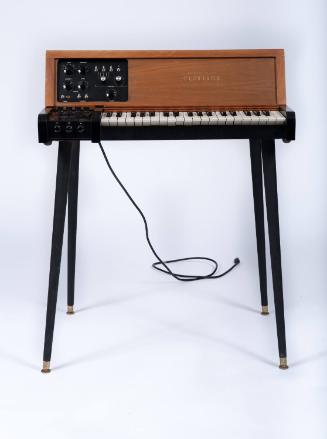
Raymond Scott Enterprises/Manhattan Research
1957
Not available for use in Recording Studios
On View: Not currently on exhibit
isVirtual:

Hammond Organ Company
1957
Not available for use in Recording Studios
On View: Not currently on exhibit
isVirtual:
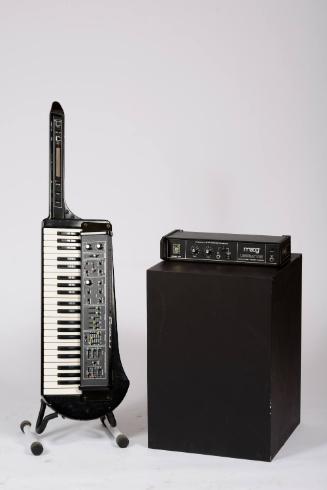
Moog Music, Inc.
1980
Not available for use in Recording Studios
On View: On exhibit
isVirtual:

CBS Musical Instruments
1966
Available for use in Recording Studios
On View: Not currently on exhibit
isVirtual: