


EN / FR
Skip to main content

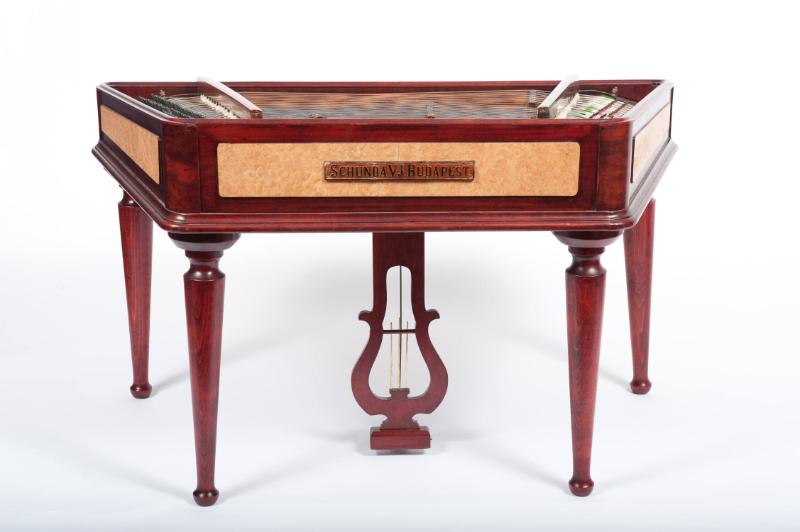
Schunda Cimbalom

Not available for use in Recording Studios
Not currently on exhibit
Artifact TypeCimbalom
Manufacturer Venczel József Schunda 1845 - 1923
Manufacturer LocationHungary
Datec. 1905

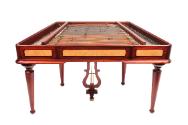
The most widely used instrument in its native Hungary, the concert cimbalom was a redesign of earlier folk instruments like the hammered dulcimer. Unlike its smaller cousin however, the concert cimbalom is much larger and heavier—allowing for greater volume and a much richer, more nuanced tone. The Budapest-based instrument builder Venczel József Schunda (1845 – 1923) is credited with designing and manufacturing the first concert cimbalom between 1870 and 1874. Composers such as Igor Stravinsky and Béla Bartók incorporated this instrument into their compositions in innovative ways.


Acquired with support from Mary Maxim

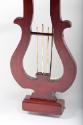
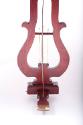
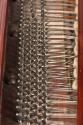
Operation/FunctionThis instrument is constructed of wooden soundboard, box, and legs, and metal strings and pedal. The string compass spans a range of C to e’’’, or just over four octaves, with strings fashioned from steel and copper alloys. In total, the instrument features approximately 125 strings, with most pitches consisting of 3, 4, or 5 strings per pitch, all tuned in unison. The instrument employs five separate bridges placed at various points along the soundboard, with the strings attached at the end of the bridge to a series of metal tuning pegs, similar to those used in pianos. The instrument also features a lyre-shaped attachment containing one sustaining pedal that, when depressed, lifts a set of two felt dampening bars from the strings so as to allow the strings’ vibrations to resonate. The soundboard features four round, rosette sound holes. The hammers used to play the instrument are constructed of wood, with wool string wrapped around one end to provide padding.Cultural SignificanceThe primitive instruments from which the concert cimbalom originated date back in usage in Hungary to approximately sometime between the fifth and eighth centuries, having migrated to Europe by a wave of Asiatic nomads from modern day China, Mongolia, and India. Variations of the instrument have remained a staple in the folk music of several European nations, including Germany, Italy, Poland, France, England, and the Czech Republic since the sixteenth century. In the seventeenth and eighteenth centuries, the instrument began to gain popularity throughout the Ottoman Empire (modern day Turkey) and Persia (modern day Iran), where the Middle Eastern variant, known as the santur, was developed. The advent of the concert cimbalom in the late nineteenth century remained centralized in Austria-Hungary and Germany, with usage primarily in Romani or gypsy folk music, but with increasing popularity at the beginning of the twentieth century spread to subsume a wider demographic that included nearby Eastern European countries such as Romania, Slovakia, Moravia, and the Ukraine. Thanks to Schunda’s more structurally durable design, the instrument began to feature more prominently as an orchestral instrument in the Classical and avant-garde music of the late nineteenth and early twentieth centuries as well, as in Franz Liszt’s Ungarischer Sturmmarsch of 1876 and Igor Stravinsky’s Renard ballet of 1915 and Les Noces of 1917, and in music by the famed Hungarian composers Zoltán Kodály in his Háry János suite of 1926 and Béla Bártok in his Rhapsody No. 1 for violin and orchestra of 1928. In contemporary repertoire, French composer Pierre Boulez, English composer Peter Maxwell Davies, Hungarian composer György Kurtág, American minimalist composer John Adams, and Dutch minimalist composer Louis Andriessen have also experimented with the instrument in innovative ways. Additionally, in the late nineteenth century, courses focused specifically on the performance techniques of the cimbalom began to surface in a number of institutions, including the Budapest Academy of Music. In the eighteenth and nineteenth centuries, the cimbalom was regarded as an equal among popular stringed instruments such as the harpsichord, piano, and clavichord, with its usage proliferating throughout Central and Western European. And, even while the piano continued to gain significant notoriety in Western and Central Europe throughout the nineteenth and twentieth centuries, the cimbalom remained the most important instrument in the musical traditions of both rural- and city-dwelling Eastern Europeans. The instrument remains the most widely used musical instrument in Hungary, officially being nationalized as the country’s signature instrument in 1890, and is usually featured more frequently than the piano in traditional and contemporary classical and folk music of the area.Technological SignificanceThe instrument known as the Hungarian concert cimbalom refers to the modern cimbalom design that was first developed and implemented by Hungarian piano builder, Venczel Jozséf Schunda between 1870 and 1874. Schunda based his design on the earlier folk cimbalom and hammered dulcimer models that were used at the time, but varied his instrument considerably both in design and construction to produce an instrument of professional standards. Schunda’s cimbalom was markedly much larger than its predecessors, and was therefore not recognized for portability as earlier versions of the instrument had been. In addition to featuring larger dimensions, the concert cimbalom was innovative in that it also employs heavier structural components such as a larger soundboard and box, an increased number of strings, and a sustain pedal. As a result, the concert cimbalom is capable of producing a much louder, richer, and more nuanced tone than its earlier counterparts. Additionally, the beaters that accompany the concert cimbalom are often much longer than those used with dulcimers, and feature a padded end, usually made of cotton or wool, to further alter the tone. On account of these features, the concert cimbalom has often been regarded as bearing greater similarity to early versions of the piano than to the dulcimers and cimbaloms that preceded it. The instrument has been lauded for its construction and quality of tone, which have rendered it the first dulcimer-like instrument suitable for use in a concert hall and among larger ensembles. The intricacies of its stringing mechanism and beater design have given way to a multitude of new and increasingly more complex performance techniques that were not only impractical on earlier dulcimers, but also impossible to achieve in pianos. Concert cimbaloms were also significant in terms of their ability to remain in tune for much longer than their predecessors. The earliest instantiations of the instrument originated in the Middle East and Eastern Asia, and typically consisted of a wooden sound box with strings made of gut or metal strung across, activated by striking with metal or wood. The instrument is known to have migrated to Europe at some point between the fifth and eighth centuries by a wave of Asiatic nomads from modern day China, Mongolia, and India. Many other cultures have constructed a similar instrument, including the santur, which is commonly used in Greece, Turkey, and Iran, the hackbrett in Germany, the salterio in Italy, the plucked zither in Austria, and the hammered dulcimer in North America. The concert cimbalom remains the largest and most structurally complex of all variants. Instrument builders producing concert cimbaloms today have continued to develop and improve upon Schunda’s design, including expanding the compass of the instrument to reach five full octaves. Some models also incorporate a lighter frame that is designed so as to produce a similar tone quality and feel while allowing the instrument to reclaim some of the portability its ancestors were historically associated with.Users/PerformersPrimary usage of this instrument is among folk musicians, particularly those whose musical styles are associated with the musical practices and traditions of Eastern and Central European. The majority of usage of the concert cimbalom initially took place in Hungary, however a number of contemporary performers have since developed a career focused on the instrument and hail from around the world, including Americans Laurence Kaptain (born 1952) and Michael Masley (born 1952), and Romanians Toni Iordach (1942 – 1988) and Joseph Moskowitz (1879 – 1954).
Object number2006.09.01
Photo credit: Don Kennedy
Bacigalupo-Söhne, Orgelfabrik
c. 1880
Not available for use in Recording Studios
On View: Not currently on exhibit
isVirtual:
Photo credit: Don Kennedy
Sébastien Érard
1820
Not available for use in Recording Studios
On View: On exhibit
isVirtual:
Bösendorfer Klavierfabrik GmbH
1855
Not available for use in Recording Studios
On View: Not currently on exhibit
isVirtual:
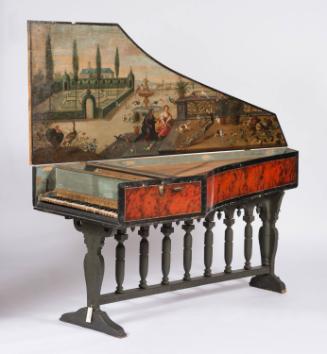
Photo credit: Don Kennedy
Joseph Johannes Couchet
1679
Not available for use in Recording Studios
On View: On exhibit
isVirtual:
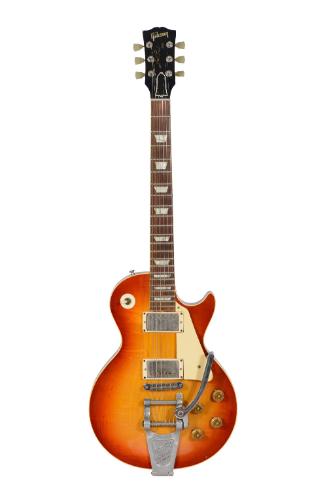
Photo credit: Don Kennedy
Gibson Guitar Corporation
1959
Not available for use in Recording Studios
On View: Not currently on exhibit
isVirtual:
Photo credit: Don Kennedy
Kazuo Yairi for CBS Masterworks
20th Century
Available for use in Recording Studios
On View: Not currently on exhibit
isVirtual:
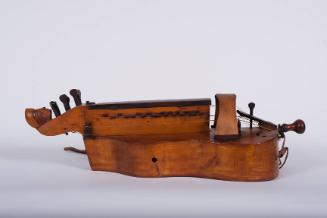
Photo credit: Don Kennedy
c. 1800
Not available for use in Recording Studios
On View: Not currently on exhibit
isVirtual:
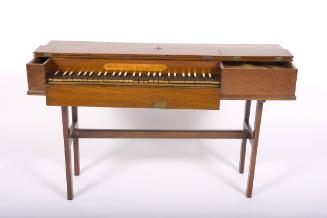
Photo credit: Don Kennedy
Johannes Zumpe
1766
Not available for use in Recording Studios
On View: On exhibit
isVirtual:
Photo credit: Don Kennedy
Joleph Rlok
1886
Not available for use in Recording Studios
On View: On exhibit
isVirtual:
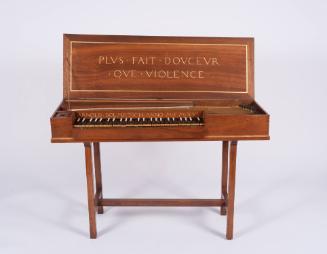
Photo credit: Don Kennedy
Arnold Dolmetsch
1926
Not available for use in Recording Studios
On View: On exhibit
isVirtual:
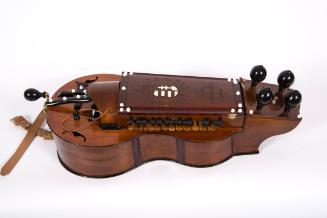
Photo credit: Don Kennedy
1999
Not available for use in Recording Studios
On View: Not currently on exhibit
isVirtual:
Photo credit: Don Kennedy
Oscar Schmidt Company
Unknown
Not available for use in Recording Studios
On View: Not currently on exhibit
isVirtual:
Back