
EN / FR
Skip to main content

McLeyvier Amadeus

Not available for use in Recording Studios
On exhibit
On exhibit
Artifact TypeSynthesizer, Computer Music System
Manufacturer David McLey inventor | 1947 - 2010
Manufacturer LocationOntario, Canada, North America
Bibliography
Date1981
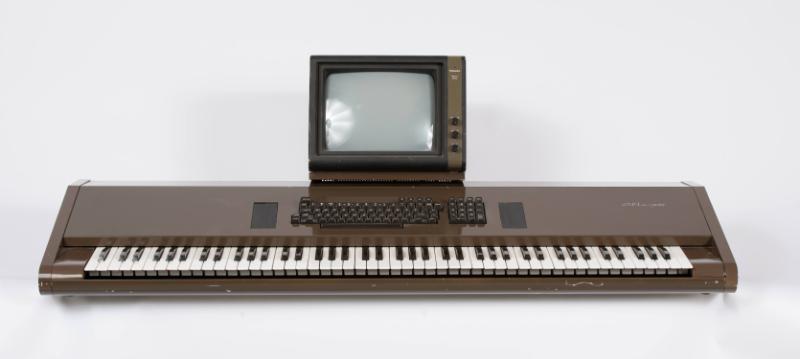
This artifact helped pave the way for the evolution of computerized music in contemporary culture. Often referred to as the McLeyvier, this is a computer-controlled analog synthesizer designed for composing, sequencing, performing, editing and notating music. Though somewhat revolutionary at the time, its development coincided with the rise of digital synthesis—a factor that made this analog machine fade into obscurity. Its inventor, David McLey (1948 – 2010), was an American-born musician and instrument designer who spent the latter part of his life in Toronto.
Operation/FunctionThis instrument consists of four suitcase-sized units: a computer with a DEC LSI 11/23 processor, a hard drive with an additional 256k RAM for update storage, a disk drive, sixteen voice cards, and a mixing card; a synthesizer; a velocity-sensitive musical keyboard offering 88 notes; and, a computer keyboard coupled with a video monitor called a CRT – essentially, a modified DEC VT100. Users had the option to customize the musical keyboard with wooden and ivory keys instead of the standard plastic keys, in addition to incorporating a thumbwheel. As a replacement to the more traditional usage of knobs, jacks, patch cords, buttons, and switches, the McLeyvier delegates control of sound parameters and configuration of the synthesizer system to the computer. A series of small lights on the exterior of the instrument signals normal function and operation to the user. Notable features include 128-voice polyphony, disk space for storing up to six hours of sound, SMPTE time synchronization, and a notational score display that offers both editing and printing capabilities. Although the computer’s “native” language is English, it could actually be programmed in any language, including Braille, so as to be more accessible to a wider demographic. A variety of synthesis techniques were made available in the synthesizer, with editing commands such as ‘invert’, ‘ostinato’, and ‘transpose’. Unlike most computer music systems that arose in the early 1980s, the McLeyvier employs analog components in customized voice cards, each including two oscillators, two variable filters (high-, low-, and band-pass), a noise generator, a series of external inputs, an amplifier capable of both linear and exponential control, two envelope generators, and a variety of signal processing effects. Parameters are controlled via a series of approximately fifty digital-to-analog converters per voice card, and are visually accessible through the computer’s video monitor.Cultural SignificanceThe McLeyvier instruments are recognized as one of the first all-in-one computer-controlled composition and performance systems. Although only a select few composers throughout its brief time on the market accessed it intimately, its initial marketing success helped it gain prominence in the realm of computer music instruments. Although the widespread acceptance of the computer as both an extremely useful compositional tool and instrument is the norm in today’s world, the root of this ever-developing interest in computer music can be traced back to multi-dimensional systems such as the McLeyvier. McLey had the ability to foresee the computer’s potential, and had hoped that his instrument would not only interest electronic musicians, but that it would also be flexible and accessible enough to appeal to non-musicians.Technological SignificanceThe McLeyvier system was intended to be a sort of all-in-one composing, recording, and performing instrument. The integration, simplicity, and expanse of its musical operating system and programming language made it extremely user-friendly and highly adaptable to the needs and desires of each particular user. A series of several hundred basic commands were available to the user in order to execute any number of manipulations or edits at any point while composing. It was also known for its ability to be completely reconfigurable, containing an initialization program that could be run every time the program was booted, which enabled the user to customize nearly every aspect of its operation. Although it was for these reasons unique in its operation, the McLeyvier emerged from within a group of instruments referred to as CMIs, or computer musical instruments. The most successful of this species of electronic instrument were the Fairlight CMI and the Synclavier, though similar systems developed by Crumar, E-mu, and Syntauri also faired well in the market. The Fairlight CMI, developed by an Australian company and introduced into the market in 1979, also featured a dedicated computer for sound control, as well as disk drives, a touch-sensitive keyboard, sequencer, and an analog-to-digital converter that could be used for processing external signals. The California-based E-mu company released in 1981 the first in their line of early digital samplers, the Emulator. Although not as sophisticated as other computer music systems, the Emulator contained a number of useful features, including eight-voice polyphony and real-time looping. In the early 1980s, Crumar developed a system based on a design from Bell Labs, which incorporated floppy disc drives, a Z80 microprocessor, a computer, and a keyboard controller. Essentially, this unit was the precursor the Synergy, which was released in 1982. The Synclavier II was released in 1983 and featured a more streamlined design than the Fairlight CMI, operating more as a musical instrument than a computer while also offering 16-track digital recording and high quality digital sampling. The Syntauri Corporation’s alphaSyntauri was designed as a less expensive and more accessible computer music system, featuring a 48k Apple II computer and interface hardware. Unlike these systems, however, which were digital in both their control and sound production, the McLeyvier systems employed analog components for generating and manipulating signals. The McLeyvier was also unparalleled in its ability to comprehend different languages, including Braille. In an interview McLey gave for People magazine in 1982, he compared the impact of his instrument to that of Johann Gutenberg’s printing press, hoping it would similarly revolutionize and refine the compositional process. Interestingly, McLey has stated that his decision to use analog components was not based on any perceived difference in sound quality, but simply because analog sound generation, given its prevalence at the time, was more straight forward than digital means. Composer Laurie Spiegel, who later took over software development for the instrument, has suggested that the McLeyvier’s timing – that is, its use of analog components at a time when digital synthesis was gaining momentum and dominance in the electronic musical instrument market – was an important factor in its demise. When Spiegel took over McLey’s position in 1982, her goal was to create new software that could function with a proposed digital version of the instrument. This project to digitize the McLeyvier was never fully realized, however, as Hazelcom Industries, the company responsible for its production and marketing, lost interest and ceased operations in 1983. In an interview with Pitchfork magazine in 2012, Spiegel suggested that the McLeyvier was a victim of a certain type of obsolescence that arises not because the instrument reached and outgrew its aesthetic potential and possibilities, but rather because it is unfeasible or impractical to maintain: in modern times of rapid technological development, often the difficulty with ill-timed instruments such as the McLeyvier is simply attributed to the fact that a certain electronic component is no longer being manufactured or is too scarce. Today, the functions offered by the McLeyvier system are commonplace: Sibelius and Finale are popular software programs used for real time composing and editing, also featuring MIDI samples to enable the composer to hear as they compose; DAWs such as ProTools and Logic Pro offer extremely refined recording, editing, composing, sequencing, and film-synchronization options and are accessible both to amateur users as well as studio professionals; and, a number of virtual software synthesizers and integrative programming environments such as Max/MSP and SuperCollider are also known for their flexibility and range in both composing and performing.Users/PerformersStevie Wonder (born 1950, Detroit, Michigan, USA), an award-winning performer, songwriter, and recording artist who is recognized for his keen interest in and experimentation with a variety of electronic instruments and new technologies. Laurie Spiegel (born 1945, Chicago, Illinois, USA), a composer and pioneer in the development and composition of early computer music. Spiegel began working at Bell Laboratories (Murray Hill, New Jersey, USA) in 1973, and has spent the majority of her life living and working in the New York area, interacting at various times with notable electronic musicians such as Suzanne Ciani, Pauline Oliveros, Morton Subotnick, Philip Glass, and Éliane Radigue. Spiegel began her career in electronic music at Subotnick’s Bleeker Street studio, where she encountered the Buchla 100 modular system he had used to produce 1967’s Silver Apples of the Moon, which was essentially the first commercially-released recording of pure electronic music. In addition to her work for Bell Labs, Spiegel contributed to the development of a prototype Apple II 48k computer in the late 1970s, and also helped produce the Syntauri Corporation’s alphaSyntauri synthesizer, another computer music system that was intended to be professional yet affordable. She also worked as a consultant for Eventide, and taught occasionally at New York University throughout the 1970s. In 1982, Spiegel relocated to Toronto to take over production of the McLeyvier systems and to help further develop and refine its programming language. After work on the McLeyvier project ceased in 1983, however, Spiegel turned her attention toward newer musical programming environments, completing the GROOVE (Generating Realtime Operations On Voltage-controlled Equipment) computer music system, a sophisticated digital-analog hybrid project that began in the 1960s and was developed in collaboration with computer music pioneer Max Mathews, and Music Mouse – An Intelligent Instrument for the MacIntosh, which was intended for use in less expensive desktop computers.
Object number2000.05.27
Photo credit: Don Kennedy
David Sutherland
2000
Available for use in Recording Studios
On View: Not currently on exhibit
isVirtual:
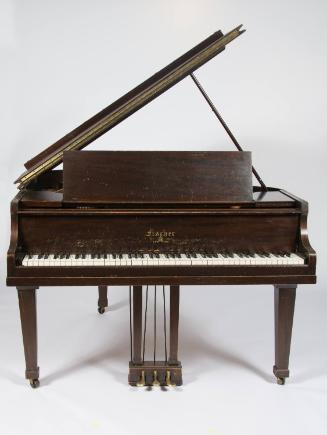
Photo credit: Don Kennedy
J. & C. Fischer Piano Company
1922
Not available for use in Recording Studios
On View: Not currently on exhibit
isVirtual:
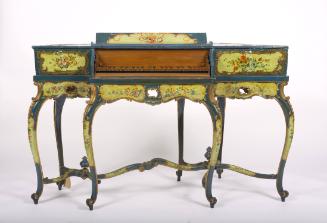
Photo credit: Don Kennedy
Francesco Bonafinis
c. 1560
Not available for use in Recording Studios
On View: On exhibit
isVirtual:
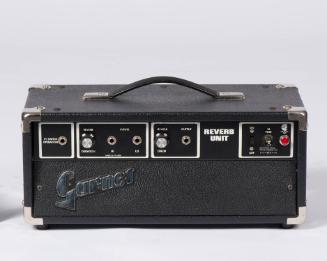
Photo credit: Don Kennedy
Garnet "Gar" Gillies
Available for use in Recording Studios
On View: Not currently on exhibit
isVirtual:
Photo credit: Don Kennedy
Venczel József Schunda
c. 1905
Not available for use in Recording Studios
On View: Not currently on exhibit
isVirtual:
Photo credit: Don Kennedy
Buchla & Associates
c. 1990
Not available for use in Recording Studios
On View: Not currently on exhibit
isVirtual:
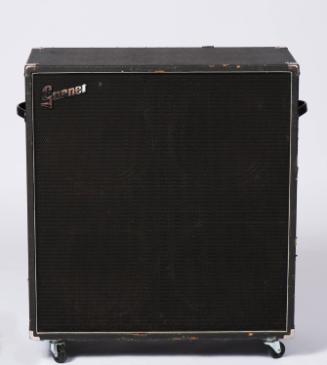
Photo credit: Don Kennedy
Garnet "Gar" Gillies
1965 through 1980
Not available for use in Recording Studios
On View: On exhibit
isVirtual:
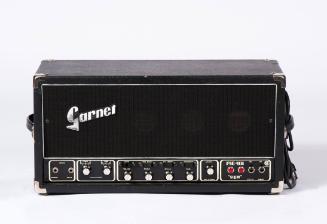
Photo credit: Don Kennedy
Garnet "Gar" Gillies
Available for use in Recording Studios
On View: Not currently on exhibit
isVirtual:
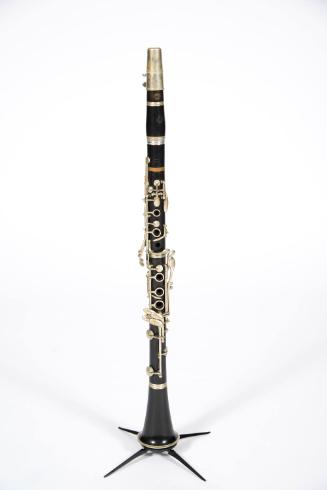
Photo credit: Don Kennedy
Henri Selmer Paris
c. 1930
Not available for use in Recording Studios
On View: On exhibit
isVirtual:
Photo credit: Don Kennedy
Drum Workshop, Inc.
2009
Not available for use in Recording Studios
On View: On exhibit
isVirtual:

Photo credit: Don Kennedy
Gerri Schneider
20th Century
On View:
isVirtual:
Photo credit: Don Kennedy
Ovation Guitar Company
20th Century
Not available for use in Recording Studios
On View: On exhibit
isVirtual:
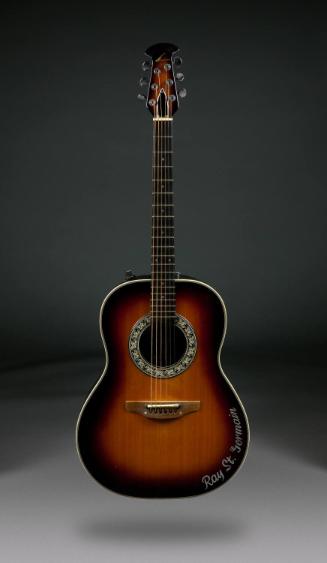
Back