
EN / FR
Skip to main content

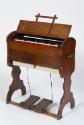
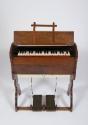
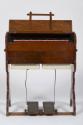
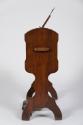
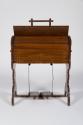
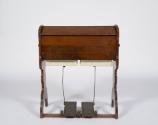
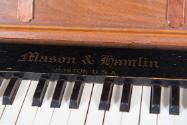
Mason & Hamlin Harmonium

Not available for use in Recording Studios
On exhibit
On exhibit
Artifact TypeOrgan, Reed
Manufacturer LocationUSA, North America
Date1890
The portable, compact harmonium—a type of reed organ—was popular with travelling priests and missionaries in the late 19th and early 20th centuries. Like pipe organs, harmoniums make music with bellows, a reservoir and valves connected to a keyboard, but they use much smaller metal reeds instead of pipes. The maker of this one, Mason & Hamlin, is one of America’s oldest instrument manufacturers. The company established itself in 1854 and developed a longstanding reputation for quality that began with the first type of instrument it focused on: the harmonium.
Operation/FunctionThis particular artifact consists of a walnut (wooden) case, with a varnish finish, leather and wood bellows, natural keys constructed of celluloid, accidental keys constructed of ebony, and leather and metal reeds. The keyboard has a compass of F-f’’’, spanning three octaves. The bellows are connected to two pedals, which are constructed of wood, rubber, and metal.Cultural SignificanceMason & Hamlin instruments have remained among the most well known and well respected, both in piano and in organ manufacturing, since the company’s inception in 1854. The company is particularly revered for its commitment to maintaining very high quality standards. Their instruments have been used by a number of professional musicians, including Russian pianist and composer Sergei Rachmaninoff and French pianist and composer Maurice Ravel, both of whom were especially supportive of the company throughout the piano’s golden age at the turn of the last century. The company has been particularly associated with the development of the piano building practice in the United States, and their instruments have often been cited as epitomizing what can be referred to as the “American sound”. Many famed composers and performers also endorsed the company’s organs, including the French-Hungarian composer Franz Liszt, who offered his name to the company’s patented sustain mechanism for organs. Mason & Hamlin was also one of the most innovative manufacturers of harmoniums and pianos throughout the late nineteenth and early twentieth centuries, not only helping to popularize the instruments, but also helping to significantly improve their designs and mechanisms. Between 1850 and 1920, several million harmoniums were manufactured in the United States alone. The harmonium is typically most esteemed for its portable nature, having been favoured by musicians who require an instrument that is small and durable, either to be placed in a small venue or to be moved across long distances. Throughout the First and Second World Wars, the harmonium served as the instrument of choice for travelling priests, chaplains, and missionaries who were impressed with the instrument’s ability to travel well and maintain its tuning stability. It was during missionary trips in the mid nineteenth century that the harmonium appeared in India, where it gathered significant popularity. Since that time, the hand-pumped harmonium, which was originally developed in France, has remained a staple instrument in the vocal traditions of North India, and in nearby central Asian countries. The instrument saw a series of further developments and modifications in India over the decades that followed its first appearance, including the addition of drone stops to supplement structural and formal practices, and mechanisms that allow for the alteration of scales. Given the instrument’s European origins, however, it was briefly banned on Indian radio stations between 1940 and 1971 following India’s struggle for independence from Britain, with a ban on the broadcast of harmonium solos still existing today. That being said, the hand-pumped harmonium is still used very extensively in group contexts, and is a often used as a training instrument in helping singers develop the direction of the raga.Technological SignificanceAlong with producing some of the most immaculate and high quality organs and pianos, Mason & Hamlin is also internationally recognized as one of the foremost innovators in both organ and piano design. Mason & Hamlin’s original designs for the organ-harmonium were developed by Emmons Hamlin, who had worked as a technician with George A. Prince and Company prior to establishing his company with Henry Mason in 1854. Prince’s company was regarded as one of the most well-respected and prolific manufacturers of small reed organs and melodeons, and was one of the first companies to begin producing organs that employ suction, as opposed to the traditional pressure, bellows. The suctions bellows was an improvement upon the earlier pressure bellows in that wind movement was more isolate, honing in on the fundamental frequency of the vibrating reed. Pressure bellows, though capable of producing generally greater volumes than suctions bellows, tended to over exert the reed, causing it produce a series of extraneous harmonic and inharmonic overtones. While working for Prince’s company, Hamlin developed a method for voicing the reed and manipulating its tonal quality by altering their shape and orientation within the wind chest. Mason & Hamlin’s earliest harmoniums employed Hamlin’s approach to reed design and placed the bellows of the instrument directly beneath the reeds and in a vertical arrangement; this design became known as the American-style reed organ and remained the standard model for all harmoniums employing suction bellows throughout the nineteenth and twentieth centuries. Throughout the remainder of their organ production, which ceased in 1927, Mason & Hamlin also produced a series of larger reed organs, including cabinet organs that featured stops, multiple keyboards, and couplers. Just as they had with their earliest organs, Mason & Hamlin continued to develop their reputation upon constructing instruments that featured extremely high quality craftsmanship and materials. The harmonium was hailed as a significant improvement upon the smaller reed organs that had preceded it, and was especially praised for its portable nature and structural durability. Although harmoniums are typically less complex than larger reed organs and only provide the singular tone that corresponds with the instrument’s one set of free reeds, they flourished throughout the late nineteenth and early twentieth centuries as items that could be used in smaller venues, such as small churches and private residences, and still garner a commanding presence with their rich tones. Harmoniums in particular were also popular among travelling musicians, such as chaplains and missionaries, who required a self-contained and durable instrument that was easy to operate. One of the many innovations in the design of the harmonium included those that could be folded unto themselves and carried around from a handle as a sort of suitcase. The harmonium is classified as a type of reed organ, a category of instruments that range in size but all operate under the common mechanism of vibrating free reeds, typically constructed of metal. The reed organ itself can be said to have originated in Asia several centuries before the beginning of the Common Era. Early experimentations in wind-powered reed instruments began to appear in the factories of many European organs builders in the early eighteenth century, and the material was esteemed for its low cost, its ability to remain in tune, and its relatively small size. The first recognized free reed instrument appeared in Europe in 1780, and was constructed by the Danish physiology professor, Christian Kratzenstein (1723 – 1795). By the early nineteenth century, many builders in both Europe and the United States had begun constructing small organs that replaced pipes with a set of free reeds, while still maintaining the organ’s characteristic feature of incorporating pumped bellows. On account of their virtuous features of portability and ease of operation, reed organs became increasingly popular throughout the century, especially in institutions such as churches and in less affluent or underdeveloped rural areas. Although all instruments that operate under these principles are generally referred to as reed organs, specific names have been given to different instruments to signal distinctions in construction approach or in manufacturer geography. The harmonium was first associated with the French organ builder, Alexandre-François Debain, who patented a compacted version of a reed organ that he termed a ‘harmonium’ in August of 1840, which was itself based on much earlier reed organ designs from the late eighteenth century. Debain’s instrument employed a pressure bellows system and free reeds. Similar instruments surfaced in the United States shortly thereafter, and were often called the “American Organ”, or the “American Pump Organ”. The American version of the instrument was developed from the melodeon, a reed organ that was also characterized as being small and housed in a table-like case. The melodeon appeared after the first European reed organs but was unlike those instruments in that it employed a suction mechanism to draw air across its reeds and back into itself, rather than a pressure mechanism to push air forcefully outwards of the instrument. Thus, one major distinction between the harmoniums that were manufactured in Europe and those that were manufactured in the United States throughout the middle of the nineteenth century was the bellows system employed in the respective instruments. The pressure bellows system was most commonly used in European instruments, while the suction bellows mechanism – which had been initially developed for the melodeon by a colleague of Debain’s and transplanted with him to the United States, then later developed by Buffalo, New York residents Jeremiah Carhart and Elias Parkman Needham – was employed almost exclusively by American manufacturers. Pressure bellows expel air directly into the reed organ’s wind chest and, although this allows instruments employing this mechanism to produce louder and slightly richer tones, the mechanism was considered faltered in that the outward push of air caused the reeds to over excite and produce too many extraneous harmonic and inharmonic overtones beyond the fundamental. The suction bellows, though not capable of producing the same volume levels as the pressure bellows, was considered a more refined mechanism in that the amount of air being directed to the reeds is controlled by a vacuum mechanism built into the wind chest. As such, the number of extraneous frequencies produced by the reeds is limited, allowing the fundamental tone to emerge as predominant. Although the pressure bellows system was employed throughout Europe, its main users were based in France. The suction bellows mechanism was used primarily throughout the United States, but also gained popularity in Europe, and particularly in Germany. The suction bellows mechanism was patented by Carhart and Needham in 1846, and was first employed in the instruments of George A. Prince, for whom Carhart, Needham, and Hamlin initially worked. Mason & Hamlin, who began using only suction bellows in their instruments from 1860, helped standardize the mechanism’s usage throughout the United States. Other popular iterations of the reed organ came in the form of the cabinet reed organ, which was essentially a larger and more complex successor to the harmonium that typically featured the automatic swell mechanism that was patented by George Wood in 1862, and the regal organ, which was a small predecessor to the harmonium, popular throughout the Renaissance, that featured brass reeds housed within a set of resonators and two separate sets of bellows. Although manufacture of North American and European reed organs continued into the mid twentieth century, their usage was eclipsed by the advent of electronic organs in the 1930s and 1940s. The hand-pumped harmonium, which is widely used throughout India is still manufactured and used in large numbers and has not been affected by the demise of its foot-pumped counterpart. The hand-pumped harmonium originally developed in France, and found its way to India through missionary trips in the mid nineteenth century. The instrument quickly garnered popularity there, and has since undergone several important modifications by Indian manufacturers and designers, including the addition of a series of drone stops. The Dwarkin and Sons company of Calcutta was particularly influential in developing the shape of the modern hand-pumped harmonium, which is meant to be played while seated on the floor, with one hand pumping the bellows and the other performing melodic passages on the keyboard. This design mimics the way in which much of the traditional vocal music of India is structured, focusing on melodic more than harmonic movement. The harmonium still presents some technical challenges for this type of music, however, in that notes cannot slide between one another, which makes it difficult for the instrument to imitate the subtle inflections vocalists very commonly perform, and that the instrument is not able to be retuned during performances, which makes it difficult for the instrument to express changes in intonation that occur between different sections of the raga. Harmonium player Vidyadhar Oke, who is trained as a medical doctor, recently developed a microtonal hand-pumped harmonium that is capable of producing twenty-two tones within the octave. The first and fifth notes of the octave are fixed, however the remaining ten keys in the octave are each accompanied by a stop that, when pulled out, produces a higher tone. This design has allowed the harmonium to be more flexible when used to accompany traditional ragas. Although Mason & Hamlin was reputed as one of the foremost manufacturers of reed organs, and particularly harmoniums, throughout the late nineteenth and early twentieth centuries, it was with respect to piano manufacture that they achieved their greatest success and praise. Under the direction of designer Richard Gertz, Mason & Hamlin pioneered the innovation of several key components of the modern piano, all of which heavily contributed the instruments’ high quality construction and tone. The screw stringer mechanism was patented in the earliest Mason & Hamlin vertical pianos, and consisted of an arrangement that allowed string tension to be maintained while tuning, serving as an improvement upon older devices of tuning pins. Gertz also patented the Mason & Hamlin Crown Retention System, referred to simply as the tension resonator, while with Mason & Hamlin, which consists of a system of steel rods that are fastened under moderate tension along the perimeter of the underside of the piano frame so as to prevent the soundboard from warping, flattening, or changing shape and losing its optimal tone over time. As such, the intended shape of the piano rim and what is referred to as the “crown” of the soundboard is preserved. Retaining these shapes not only affects the quality of the tone produced, but also the force with which the instrument can acoustically resonate and project its tones. Gertz’s tension resonator mechanism was first introduced into Mason & Hamlin pianos in 1900, and is still a standard device employed in all of their pianos today. On account of Gertz’s prior work with Steinway & Sons, the tone and construction of early Mason & Hamlin pianos have often been compared to those of their New York competitors. Those who prefer Mason & Hamlin pianos, however, generally cite them as being more durable and refined in construction. Regardless, Mason & Hamlin pianos are known for producing a range of expressive tones, including powerful bass tones, and clear mid-range and treble tones that ring out thanks to the instruments’ characteristically long sustain. Today, the current owners of Mason & Hamlin have improved upon the original designs by strengthening the action and increasing the size of the soundboard.Users/PerformersA number of composers of the classical era have produced works specifically for the foot-pumped harmonium since the late nineteenth century, including the Austrian composer Anton Bruckner, who composed an arrangement of his Symphony No. 7 for the famed Austrian serialist composer Arnold Schoenberg featuring a chamber ensemble of two violins, viola, cello, bass, clarinet, French horn, piano, and harmonium. The piece was to be performed for the Viennese Society for Private Musical Performances, but the Society ceased operations before the piece could be premiered; it would be another 60 years before the arrangement was ever performed. Compositions for the harmonium have also been produced by the Austrian serialist composer Alban Berg in his Altenberg Lieder (1907), Czech composer Anton Dvorak his is Five Bagatelles (1878), German avant-garde composer Paul Hindemith in his Hin und zurück (1927), French-Hungarian Romantic composer Franz Liszt in his Dante Symphony (approximately 1857), and Arnold Schoenberg in his Herzgewächse (1911). Schoenberg also produced a chamber arrangement of French impressionist composer Claude Debussy’s Prélude à l’après-midi d’un faune that features a harmonium. In relation to more recent popular and experimental usage, the harmonium has been featured in the music of groups such as the Kronos Quartet, The Beatles, Nico (in the solo music she produced following her involvement with the Velvet Underground), King Crimson, Pink Floyd, Radiohead, Sigur Rós, Tom Waits, and Sharon Van Etten.
Object number1997.01.63
Bösendorfer Klavierfabrik GmbH
1855
Not available for use in Recording Studios
On View: Not currently on exhibit
isVirtual:
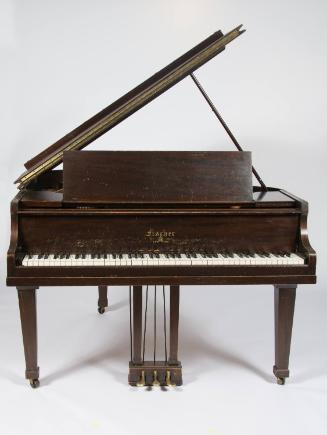
Photo credit: Don Kennedy
J. & C. Fischer Piano Company
1922
Not available for use in Recording Studios
On View: Not currently on exhibit
isVirtual:
Photo credit: Don Kennedy
Baldwin Piano and Organ Company
1966
Available for use in Recording Studios
On View: Not currently on exhibit
isVirtual:
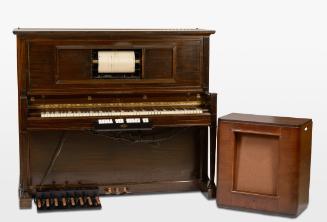
Photo credit: Don Kennedy
Willis & Company Ltd.
1924
Not available for use in Recording Studios
On View: Not currently on exhibit
isVirtual:
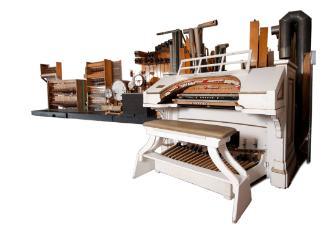
Photo credit: Don Kennedy
Kimball Piano and Organ Company
1924
Not available for use in Recording Studios
On View: On exhibit
isVirtual:
Photo credit: Don Kennedy
The Wurlitzer Company
c. 1970
Available for use in Recording Studios
On View: Not currently on exhibit
isVirtual:
Photo credit: Don Kennedy
The Story & Clark Piano & Organ Company
1941
Not available for use in Recording Studios
On View: Not currently on exhibit
isVirtual:
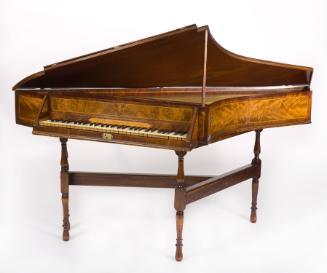
Photo credit: Don Kennedy
Neil Stewart
1777
Not available for use in Recording Studios
On View: Not currently on exhibit
isVirtual:
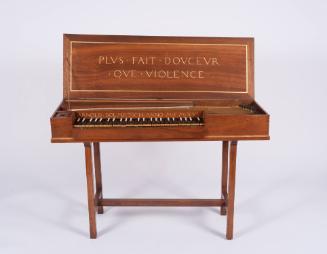
Photo credit: Don Kennedy
Arnold Dolmetsch
1926
Not available for use in Recording Studios
On View: On exhibit
isVirtual:
Photo credit: Don Kennedy
Everett Piano Company
1935
Not available for use in Recording Studios
On View: Not currently on exhibit
isVirtual:
Photo credit: Don Kennedy
Hammond Organ Company
1957
Not available for use in Recording Studios
On View: Not currently on exhibit
isVirtual:
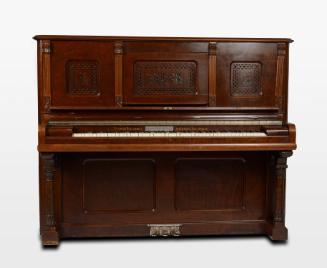
Photo credit: Don Kennedy
Heintzman & Co.
1908
Not available for use in Recording Studios
On View: On exhibit
isVirtual:
Back