EN / FR
Skip to main content

Kimball Theatre Organ

Not available for use in Recording Studios
On exhibit
On exhibit
Artifact TypeOrgan, Theatre
Manufacturer LocationUSA, North America
Date1924

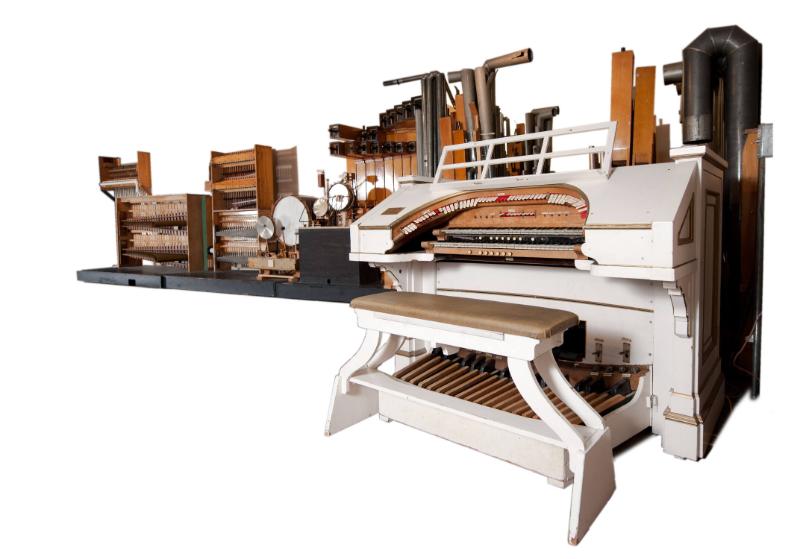
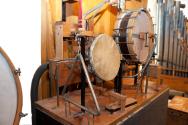
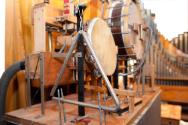
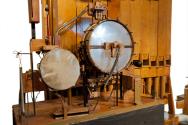
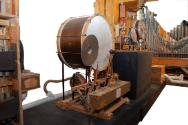
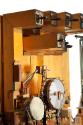
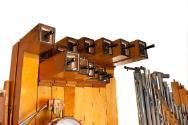
In the golden age of silent film, movies were anything but silent. Sound effects and soul-stirring musical scores were often produced live through the use of a theatre organ. These huge, multi-part instruments were a crucial part of the cinematic experience in the 1920s and early 1930s, enabling films to set a mood and tell a stronger story without words. This particular one was built by the Kimball Piano and Organ Company, one of the 20th century’s most respected manufacturers of pianos and organs—both theatre and pipe. The instrument contains many technological innovations, including an electro-pneumatic relay that allows parts of the instrument to be placed in different locations.


Donated by Carol Otto

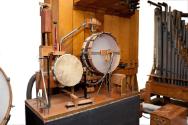
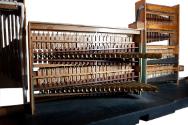
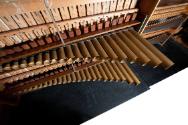
Operation/FunctionThis particular organ is identified as an orchestral unit 2/6, meaning that it has 2 manuals and 6 ranks. The entire artifact consists of a number of components that are all connected to function as a singular instrument. The main control component of the instrument is the console, which features built in pedals and sound effect buttons, two manuals, a series of stop switches, and several preset switches. Generally speaking, the instruments that make up the organ consist of a pipe organ, featuring both metal and wooden pipes, with a reservoir or wind chamber, a series of percussion instruments including snare drum, tambourine, castanets, cymbals, and bass drum, a 3 octave glockenspiel, a 3 octave xylophone, a four octave marimba, and 20 tubular bells, or chimes. The instrument also features several preset switches for triggering specific stop registrations. The instrument is powered via an electric blower, and the individual instruments and organ’s reservoir are connected by a series of plastic pipes. The organ reservoir is constructed of wood and leather, with the majority of materials in the instrument also consisting of wood, metal, and plastic. The instrument is classified as a 2/6, meaning it contains 2 manuals and 6 ranks (diapason, flute, tibia, violin, trumpet, and Vox humana). The two manuals of the instrument are split between accompaniment and solo, and specific registrations available are: accompaniment (bourdon 16’, diapason 8’, violin 8’, flute 8’, tibia clausa 8’, octave 4’, violin 4’, Wald flute 4’, tibia 4’, nazard 2 2/3’, piccolo 2’, trumpet 8’, Vox humana 8’, Vox humana 4’, chimes, harp [marimba single strike], glockenspiel, xylophone, snare drum, snare drum tap, tom tom, tambourine, castanet, Chinese block tap, second touch: diapason 8’ trumpet 8’ glockenspiel, snare drum roll, triangle, Chinese block roll), solo (bourdon 16’, contre viole 16’, diapason 8’, violin 8’, claribel flute 8’, tibia clausa 8’, violin 4’, Wald flute 4’, tibia 4’, nazard 2 2/3’, piccolo 2’, tierce 1 3/5’, trumpet 8’, tibia 16’, Vox humana 8’, Vox humana 4’, orchestral oboe [violin 8’ + nazard], marimba 8’, marimba 4’, glockenspiel, orchestral bells rolled-strike, xylophone), pedals (acoustic bass 32’, contra bass 16’, flute claribel 8’, violin 8’, violin 4’, trumpet 8’, bass drum, cymbal, snare drum roll, 2/4 drum, second touch: chimes, bass drum, tympani, cymbal, triangle, toe studs, chimes soft, chimes sustained, grand crash, sforzando, triangle, bass drum & cymbal, 2 bird calls). Accessories include six thumb pistons per manual and three thumb pistons per pedal, with manual adjustment of the pistons via a switchboard in the console, tibia vibrato, main vibrato, Vox humana vibrato, 2 expression pedals, and general crescendo. The instrument also features 61 manual notes, and a 32-note pedal board.Cultural SignificanceTheatre organs held significant prominence during the silent film era and, although they are still used today as novelty units from an earlier era, they enjoyed their greatest success throughout the 1920s and 1930s during the “golden age” of silent film. The advent of the theatre organ signaled a new conceptual era for sound in film, and essentially represented the first fully surround sound theatre system. Their presence became a crucial aspect of the film’s ability to tell a story and set a mood, and today they are revered for their superior showmanship quality. Although they were perhaps most popular in the United States, theatre organs were used worldwide and enjoyed great success throughout continental Europe, the United Kingdom, and the British Commonwealth, including Canada and Australia. When the first “talkie” feature films arose following the release of The Jazz Singer in 1927, and the first projectors capable of handling sound appeared in 1929, the popularity and perceived need for theatre organs began to decline. Although silent films had ceased production early into the 1930s, theatre organs remained in a number of theatres for several years thereafter, though often in a neglected state of disrepair. Between 1915 and 1933, there were in excess of 7,000 theatre organs installed throughout the United States, but by the end of the 1930s, only a few hundred units remained in their original locations, with most having been dismantled and sold to various public venues and private residences. The Wurlitzer company stood as the most successful and well-respected producer of theatre organs, with the Wurlitzer name becoming nearly synonymous as a brand name with the instrument. Coming at a time when the movie theatre was hailed as the “cathedral of the motion picture”, theatre organs were also regarded for their opulent and often gaudy designs – most featured brightly colored stops and consoles, the latter of which often contained gold or ivory trim and built-in lighting systems – and were made to match the intricate and ornate Art Deco theatres they were initially installed in. As is still the case today, movies presentations of the time often included a series of shorts or previews that preceded the feature. Although theatre organs were initially intended to ameliorate the costly and logistical burden of hiring a full orchestra, they were in themselves considered luxurious items, and were typically only found in larger theatres. In the 1950s, following the general disintegration of the theatre organ industry, the instrument enjoyed a resurgence in popularity thanks to the recordings that several professional theatre organists released on long playing records. Additionally, the culture of theatre organ performance found its post-war niche in the American Theatre Organ Society, an organization that formed in the 1950s to help preserve and disseminate the instruments and their associated music. Although this increase in popularity, which continued throughout the decades that followed, resulted in many theatres seeking to restore their instruments, financial difficulties and the advent of urban decay meant that many theatres themselves were falling into decrepit states, with cities unable to provide the monetary support required to justify their necessity. Although some were restored, many historic theatres were demolished during this time, with the instruments again moving into other venues or private residences. That being said, a number of organs were moved to larger public venues such as civic auditoriums and sports arenas, which were able to restore the instruments and put them into use. The Kimball company remained throughout most of the twentieth century as one of the most prolific and well-respected manufacturers of pianos and organs in the world. They specialized in smaller, vertical pianos that were widely distributed throughout the United States, appealing in particular to members of the middle class. Kimball pianos were distinguished from other manufacturers by their highly stylized cabinets – a feature that seemed for whatever reason to contribute to their popularity in the Midwest. Their pianos are regarded for their high construction and craftsmanship standards, and are still found to be in use in large numbers throughout the United States.Technological SignificanceThe British-American builder Robert Hope-Jones (1859 – 1914) is generally regarded as the inventor of the theatre organ, primarily on account of his development of the electro-pneumatic relay, though he also contributed many other design features and components to the instrument. The electro-pneumatic relay, which is recognized as the defining mechanical characteristic between traditional pipe organs and theatre organs, revolutionized the design of organs in that it allowed various components of the instrument to be set at different locations, virtually at any distance, while still remaining electrically connected. In traditional pipe organs, all components must be physically connected in order to function, and often required large amounts of installation space as a result. The electro-pneumatic relay is a mechanism that receives electrical signals from the console of the organ and relays them to the various instruments via electric cables. This was particularly useful for theatre organs in consideration of the fact that although the instruments were not meant to be seen and were usually placed behind the walls of the theatre, it was imperative that the console be placed in front of the screen so as to allow the player to monitor the film while performing – such a design method was not possible in the construction of pipe organs. Although not all of the innovations that appeared in Hope-Jones’ earliest instruments were of his design, he is also regarded as being the first to successfully combine all of the appropriate elements. Hope-Jones’ instrument was referred to as a “unit orchestra”, and was initially marketed by the Rudolph Wurlitzer Company of New York – the company that would later become the largest manufacturer of theatre organs – first as the “Wurlitzer Hope-Jones Unit Orchestra”, then later simply as the “theatre organ”. Hope-Jones later licensed his name and patents to Wurlitzer, with their specific units being referred to as the “Mighty Wurlitzer”. The first iterations of theatre organs were much smaller and more basic than their commercial counterparts. They were essentially modified vertical pianos that included a few ranks of pipes and some sound effects, and were often self-contained within a single cabinet that was to be placed in the orchestra pit. Although initially intended for the theatre, many early builders also sought to target the domestic market and thus these organs often incorporated a player piano mechanism to substitute the player pianos that were extremely popular around the turn of the century. In the early days of cinema, films were accompanied either by large orchestras or pianists, depending on the size and budget of the theatre. The realized potential of the organ as an instrument that can not only imitate orchestral sounds, but also include instruments other than the organ itself thanks to the creation of the electro-pneumatic relay, garnered increasing interest among traditional pipe organ builders, primarily in the United States. With the increasing popularity of silent film into the early twentieth century, theatre organ manufacturers began to produce larger and more complex systems that could be easily handled by the theatres they were now being installed in. The “modern” theatre organ, as it was produced primarily throughout the 1910s and 1920s, remains today as an astounding example of an amalgamation of different instruments, and is lauded for its unique ability to allow the player to control every sound-producing component from a self-contained console that contains only a few manuals and a series of stops. As with traditional pipe organs, a few main challenges associated with the theatre organ are that they require a complex installation process and must remain under the supervision of a qualified technician in order to keep in good condition. The basic elements of the theatre organ that separate it technologically from the traditional pipe organ include: the electro-pneumatic relay mechanism, which uses low-voltage electricity to transmit signals from the action of the keyboard to the pipes and instruments via a series of cables, valves, and pistons; the principle of unification, which extends pipe ranks simply by adding more pipes above and below the highest and lowest pitches of an already existing rank, allowing for a fewer overall number of ranks that can be accessed at various locations throughout the instrument’s numerous manuals – in a church organ, a singular rank is typically only accessible from one manual unless a coupler is employed; the horseshoe console, which allowed performers easier access to the theatre organ’s many stops, which often number far greater than those of a traditional pipe organ; the use of stop tabs instead of stop drawbars for ease of access; the addition of numerous non-organ instruments, consisting primarily of chromatically-tuned percussion instruments such as xylophone, glockenspiel, marimba, and tubular bells and chimes – which were introduced by Hope-Jones – and non-chromatic percussion instruments such as drums, cymbals, woodblocks, sleigh bells and castanets – which were introduced by Wurlitzer – as well as several sound effects such as whistles, sirens, horns, and birdcalls; the inclusion of shutters or shades on the walls covering the instruments, which are operated by the player via a foot pedal and can be used to either increase or decrease amplitude, effectively varying the dynamic range of the overall sound; the increased use of more refined tremulants, which are devices that shake the wind source so as to produce a vibrato effect; an overall higher wind pressure that Hope-Jones believed would offer a more accurate imitation of orchestral instruments on account of more harmonic overtones being produced; and, the inclusion of newly-designed or modified pipes and stops that were meant to produce a variety of new timbral characteristics not previously heard on traditional pipe organs. Two of the most unique stops featured on the theatre organ are the Diaphone and redefined Tibia Clausa. Many builders of traditional church organs also began incorporating some of these elements into their designs, including unification and the electro-pneumatic mechanism; Kimball incorporated the electro-pneumatic mechanism into a number of their pipe organs. Thanks to the electro-pneumatic relay system, the theatre organ essentially became the first iteration of a truly surround sound entertainment system. In addition to the actual sound sources being hidden from view, they could also be placed at various locations throughout the theatre, and a system that imitated the natural placement of sounds – for instance, larger organ pipes toward the back of the theatre, birdcalls situated above the audience, etc. – could be designed to give a more immersive experience. The Kimball Organ Company was recognized for its development of a portable pipe organ that replaced the longest pipes of the instruments with several ranks of free reeds. Among the company’s technological achievements was the reconstruction of the pipe organ at the Mormon Tabernacle Church in Salt Lake City, Utah. The theatre organ was succeeded in popularity by the electro-mechanical organ, with the earliest instantiations having been produced by Canadian inventor Frank Morse Robb in the 1920s and the first successful commercial versions having been developed by American inventor Laurens Hammond in the 1940s and 1950s. These organs did not require pipes or reeds, and produced tones through a series of edged metal tone wheels and electromagnets. Hammond organs also incorporated a series of drawbars, which effectively act as stops, allowing the instrument to alter its timbre. Unlike the drawbars and tabs of traditional pipe and theatre organs, however, which produced individual timbres at various ranks, the drawbars of the Hammond organ correspond to individual overtones in the harmonic series: by adding drawbars, one is performing an act of additive synthesis and increasing the spectral complexity of the overall timbre.Users/PerformersOne of the most well known theatre organists was the American musician Jesse Crawford (1895 – 1962, born in Woodland, California), who was known throughout the golden age of the instrument as the “poet of the organ,” having developed and mastered a number of registration techniques that are now standardized in the instrument’s performance practice. Crawford also stands as the first theatre organist to sell over one million recordings, and was employed at both the Paramount Theatre in New York and the Chicago Theatre in Chicago. Other well-known American theatre organists included Dick Leibert (dates of birth and death unknown), who served for many years as the principal organist at New York’s Radio City Music Hall, which housed the largest theatre organ ever built by the famed Wurlitzer company, Richard Purvis (1913 – 1994, born in San Francisco, California), who worked for many years as the principal organist at San Francisco’s Grace Cathedral, Ann Leaf (dates of birth and death unknown), who was the chief organist at a number of theatres throughout the Los Angeles area, and Al Melgard (dates of birth and death unknown), an organist who, despite having lost his left index finger as a child, controlled the legendary six-manual Barton theatre organ at Chicago Stadium for several decades. George Wright (1920 – 1998, born in Orland, California), another American theatre organist, was considered one of the foremost and most prolific recording artists of the instrument. The British theatre organist Reginald Dixon (1904 – 1985, born in Sheffield, England) remained the most well known player throughout both the United Kingdom and the rest of the British Empire, and has been regarded as having recorded and sold more than any other performer of the instrument in its history. In addition to those who dedicated their careers to the performance of the theatre organ, there were also a number of performers who transitioned from theatre organ playing – which often required players to be quick on their feet and adaptable to improvisation – into the world of composition. British-American musician Oliver Wallace (1887 – 1963, born in London, England and became a US citizen in 1914), for instance, who is often considered to be the first professional theatre organist in the United States, found employment with Walt Disney after the decline of the silent movie era and composed the score to a number of animated features including, most notably, Dumbo (1941), for which he received an Academy Award. Wallace also contributed to the scores for Cinderella (1950), Alice in Wonderland (1951), Peter Pan (1953), and Lady and the Tramp (1955).
Object number1999.01.01.1-15
Photo credit: Don Kennedy
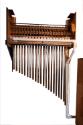
Frank Morse Robb
1937
Not available for use in Recording Studios
On View: On exhibit
isVirtual:
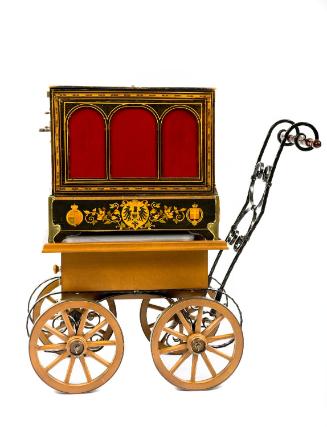
Photo credit: Don Kennedy
Bacigalupo-Söhne, Orgelfabrik
c. 1880
Not available for use in Recording Studios
On View: Not currently on exhibit
isVirtual:
Bösendorfer Klavierfabrik GmbH
1855
Not available for use in Recording Studios
On View: Not currently on exhibit
isVirtual:
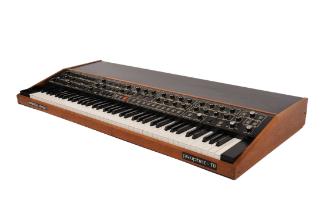
Photo credit: Don Kennedy
Sequential Circuits Inc.
1983
Available for use in Recording Studios
On View: Not currently on exhibit
isVirtual:
Photo credit: Don Kennedy
CBS Musical Instruments
1966
Available for use in Recording Studios
On View: Not currently on exhibit
isVirtual:
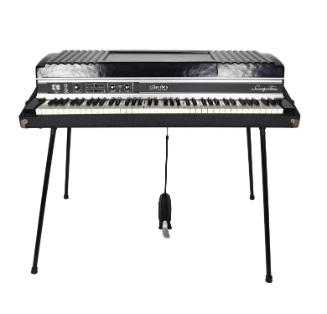
Photo credit: Meghan MacKrous, courtesy of the National Music Centre
CBS Musical Instruments
c. 1980
Available for use in Recording Studios
On View: Not currently on exhibit
isVirtual:
Photo credit: Don Kennedy
The Wurlitzer Company
c. 1970
Available for use in Recording Studios
On View: Not currently on exhibit
isVirtual:
Photo credit: Don Kennedy
Vido Trasuntino
1591
Available for use in Recording Studios
On View: Not currently on exhibit
isVirtual:
Photo credit: Don Kennedy
Drum Workshop, Inc.
2009
Not available for use in Recording Studios
On View: On exhibit
isVirtual:
Photo credit: Don Kennedy
Hohner Musikinstrumente GmbH & Co. KG
c. 1967
Available for use in Recording Studios
On View: Not currently on exhibit
isVirtual:
Photo credit: Don Kennedy
Garnet "Gar" Gillies
Available for use in Recording Studios
On View: Not currently on exhibit
isVirtual:
Photo credit: Don Kennedy
Hammond Organ Company
1957
Not available for use in Recording Studios
On View: Not currently on exhibit
isVirtual:
Back