EN / FR
Skip to main content

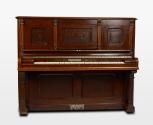
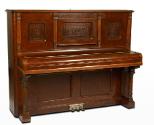
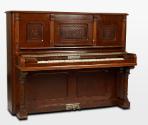
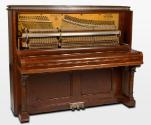
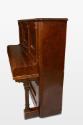
Heintzman Transposing Piano

Not available for use in Recording Studios
On exhibit
On exhibit
Artifact TypePiano, Vertical
Manufacturer Heintzman & Co. piano makers, entrepreneurs | incorporated 1866
Manufacturer LocationOntario, Canada
Date1908

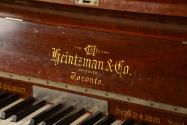
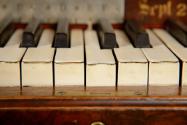
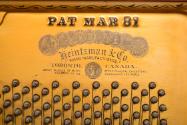
For songwriters in the early 20th century, transposing pianos took the trickiness out of playing in a variety of keys. Instead of having to figure out a different hand position—something that would require some level of formal musical training—a player could simply slide a lever and physically shift the keyboard to play songs in a different key. This particular transposing piano was designed, patented and built by Toronto-based Heintzman & Co., considered for over 100 years to be one of the finest piano manufacturers in the world.


Donated by Shirley Campbell (née Graham) in the name of her mother, Esther “Essie” Graham

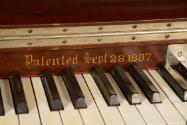
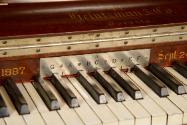
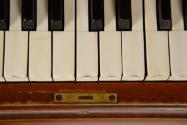
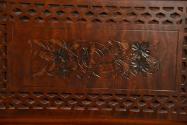
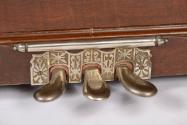
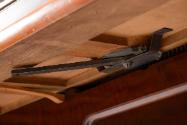
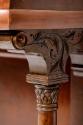
Operation/FunctionInternal components include an iron frame, brass and copper strings, and original tuning pins. The piano features three pedals: sustain pedal (far right), una corda (far left), and a centre pedal that activates the transposing mechanism; in non-transposing vertical pianos, this pedal, if included, would control the sostenuto action. To accommodate the transposing mechanism, this particular piano contains ten extra keys – five on either end, totaling 98 keys in the instrument – and a sliding pulley-lever with a handle for adjusting the keyboard. Keys G through F inclusive are available to the player; transpositions cannot be made to G-flat. 52-inch cabinet height.Cultural SignificanceAlthough transposing pianos were not commonplace instruments within the professional performance and academic realms, they were widely used throughout the first five or six decades of the twentieth century by songwriters who lacked the formal musical training to play in a multitude of different keys, and by the music publishers that employed their services. They were also useful for accomplished players who required transposing to different keys at short notice, such as vocal accompanists, but who found it difficult to do so without substantial practice. Today, transposition is a relatively standard feature on most digital pianos and samplers, and it is the widespread usage of the earlier acoustic versions in popular and commercial music that helped pave the way for the technology’s acceptance. At the turn of the century, prior to the proliferation of radio technology, the piano became the primary form of social and domestic entertainment, however it was primarily vertical non-transposing and player pianos that were heavily exploited in this market. Heintzman’s cultural importance, not just within Canada but also internationally, is just as marked as its technological contributions. Under the guidance of Theodor Heintzman, Heintzman & Co. established a high standard of quality in their instrument building approach right from the company’s inception, and largely maintained its reputation as a world-renowned manufacturer of high-end instruments for over one hundred years ¬– even throughout the pressures of a booming and competitive piano market that demanded greater quantity and cheaper prices in the early twentieth century – until its decline began in the 1970s. Heintzman pianos were used by numerous performers, organizations, and concert halls, both within Canada and abroad thanks to the clever marketing and salesmanship of Theodor’s business-savvy son, George. In fact, George was able to orchestrate the exhibition of approximately thirty Heintzman & Co. pianos at London’s Colonial and Indian Exhibition in 1886, with all thirty selling within the United Kingdom. In addition to the company’s vertical and grand pianos being hailed for their brilliant sound quality, they were also recognized for their attention to detail in construction ¬– especially in relation to the craftsmanship of the cabinetry – and with respect to the instruments being sturdy and durable. It is alleged that prior to the First World War, the Heintzman brand was better known throughout the British Empire than the two Prime Ministers of the era, Sir Wilfred Laurier and Sir Robert Laird Borden. The Heintzman name has been honoured in Toronto through the founding of Heintzman Hall, which stands opposite Eaton’s famous department store, and through the heritage status given to the three former homes of Heintzman family members in Toronto’s Junction neighbourhood, including Theodor’s former home, referred to as “the Birches”, at 288 Annette Street, Herman’s home at 166 High Park Avenue, and George’s home at 23 Woodside Avenue. A road at the site of the former West Toronto factory, which remained the hub of Heintzman & Co.’s activity for nearly a century, was renamed Heintzman Street after West Toronto joined Toronto as The Junction neighbourhood in 1909.Technological SignificanceThe transposing piano was a particularly useful aid for those who were not formally trained in music, but required the means to notate and experiment in different keys. Similar to the way in which a capo is used on a guitar, the transposing piano allows the player to access different keys without having to adjust their playing. This is achieved via a transposing mechanism that, as in the case of Heintzman’s design, shifts the keyboard laterally, relative to the hammers and strings, which remain stationary. Thus, the same physical key on the keyboard can be used to trigger any one of the other pitches in the octave. This design, though highly innovative for its time, was fairly obscure with respect to the more common household usage of vertical non-transposing or player pianos. That being said, its niche use by both burgeoning songwriters and music publishers in the early part of the century helped pave the way for its increasing prevalence throughout the remainder of the twentieth century. Edward Riley, a New York-based flute maker, designed the first transposing piano in 1801, obtaining the first patent for the mechanism in the same year. American piano builder Jacob Doll also designed a transposing piano in 1801, which is reported to still exist. Heintzman obtained patents for their transposing mechanism in September 1887, September 1891, September 1893, and March 1896. Today, digital pianos and samplers typically come equipped with an on-board transposing function, rendering any popular or professional need for these earlier acoustic versions obsolete. Pianos were not the only keyboard that featured a transposing function: the harmonium, a type of small, foot- or hand-pumped reed organ, also occasionally included a mechanical-lever used to shift the position of the keyboard. Heintzman & Co.’s technological legacy is significant. They laid claim to a number of innovations and improvements in piano building, the most crucial of which is their modification of the agraffe bridge, a transverse metal bridge that extends across the iron frame of the piano and works to prevent unwanted movement and slipping of the strings while also allowing for greater clarity and brilliance of tone in the treble register. Theodor Heintzman obtained Canadian patents for his improved bridge in 1873, 1882, 1884, and 1896, based on the initial designs of Sébastian Érard, the acclaimed French piano builder and founder of the Érard Frères piano manufacturing company who is credited with inventing the agraffe bridge in 1809. Heintzman also designed customized iron frames to accommodate proper usage of the agraffe bridge. With respect to vertical pianos, Heintzman also was the first to incorporate the sostenuto pedal, which is still a feature commonly found only in grand pianos. Heintzman & Co. was known for its dedication to maintaining the high levels of quality and old-world craftsmanship that were initially established by Theodor Heintzman. Although the company produced both vertical and grand pianos of high quality, their earned reputation stems primarily from their grand pianos, which remained a preferred instrument among national and international performers well into the 1970s. The company has often gleaned comparisons to Steinway & Sons, one of the most well respected American piano manufacturers. The company retained its reputation as a family tradition into the 1980s as well, with successive generations learning the trade from family members and honing their craft through work with the company.Users/PerformersIrving Berlin (born 1888, near Mogilev, Russia, modern day Belarus; died 1989, New York City, New York, USA), composer, lyricist, and highly acclaimed songwriter whose work comprises a large portion of The Great American Songbook, a collection of the most revered American popular songs of the twentieth century, including Broadway tunes and film music. Berlin was born in the Russian Empire, but relocated to the United States with his family in 1893. Having withdrawn from high school in his early teens, Berlin worked as a singing waiter between 1904 and 1907, the time at which he also began teaching himself how to play the piano. Berlin was hailed for his ability to exploit the American vernacular in his simple and uncomplicated lyrics, and in his manner of speaking directly to the average American citizen. Throughout his entire career, he wrote approximately 1,500 songs, including 19 scores for Broadway and 18 scores for Hollywood films, and received eight Academy Award nominations. His songs have topped popular music charts numerous times, and have been re-recorded by a number of well-known artists. Notable songs include: “Alexander’s Ragtime Band” (1911), Berlin’s first international hit; “White Christmas” (1942), as sung by Bing Crosby and recognized as the best-selling single of all time; “There’s No Business Like Show Business” (1946), written for the musical Annie Get Your Gun; and “Easter Parade” (1933). Berlin employed the German-born Helmy Kresa for almost sixty years as his secretary and personal transcription assistant.
Object number2016.13.01
Bösendorfer Klavierfabrik GmbH
1855
Not available for use in Recording Studios
On View: Not currently on exhibit
isVirtual:
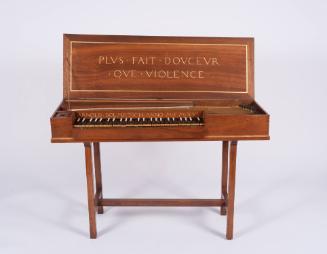
Photo credit: Don Kennedy
Arnold Dolmetsch
1926
Not available for use in Recording Studios
On View: On exhibit
isVirtual:
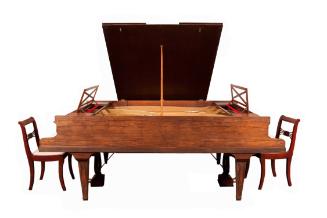
Photo credit: Don Kennedy
Pleyel et Cie
1913
Not available for use in Recording Studios
On View: Not currently on exhibit
isVirtual:
Photo credit: Don Kennedy
Sébastien Érard
1820
Not available for use in Recording Studios
On View: On exhibit
isVirtual:
Photo credit: Don Kennedy
Venczel József Schunda
c. 1905
Not available for use in Recording Studios
On View: Not currently on exhibit
isVirtual:
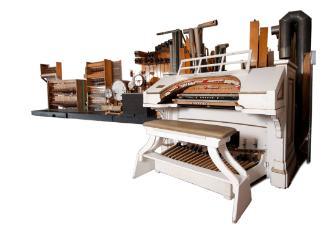
Photo credit: Don Kennedy
Kimball Piano and Organ Company
1924
Not available for use in Recording Studios
On View: On exhibit
isVirtual:
Photo credit: Don Kennedy
Buchla & Associates
c. 1990
Not available for use in Recording Studios
On View: Not currently on exhibit
isVirtual:
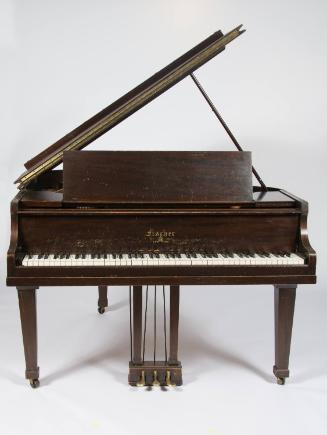
Photo credit: Don Kennedy
J. & C. Fischer Piano Company
1922
Not available for use in Recording Studios
On View: Not currently on exhibit
isVirtual:
Photo credit: Don Kennedy
Carl (Karl) Leopold Röllig
c. 1800
Not available for use in Recording Studios
On View: Not currently on exhibit
isVirtual:
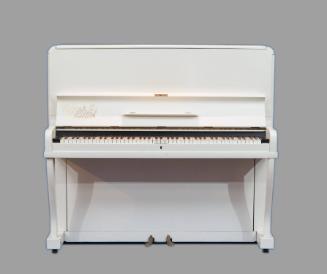
Photo credit: Don Kennedy
A. Day
c. 1910
Not available for use in Recording Studios
On View: On exhibit
isVirtual:
Photo credit: Don Kennedy
Johannes Zumpe
1766
Not available for use in Recording Studios
On View: On exhibit
isVirtual:
Photo credit: Don Kennedy
Gibson Guitar Corporation
1959
Not available for use in Recording Studios
On View: Not currently on exhibit
isVirtual:
Back