EN / FR
Skip to main content

OSCar

Available for use in Recording Studios
Not currently on exhibit
Artifact TypeSynthesizer
Manufacturer LocationOxford, England, United Kingdom
Datec. 1984

The OSCar is a hybrid analog/digital synthesizer that stands out with a number of unique technical features and design quirks. MIDI-equipped, it boasts digital - not analog - oscillators, and its 3 octave, monophonic keyboard (one key sounding at a time) can be made duophonic (two keys sounding simultaneously), altogether giving the user different control options and a wider sound palette. The OSCar also has a distinctive look, with protective black rubber control covers and end pieces. It was popular in the United Kingdom throughout the 80s and with a range of artists, such as Ultravox ("Do they know it’s Christmas"), Jean Michel Jarre, Asia, Stevie Wonder, Underworld and Keith Emerson.

Operation/FunctionThis instrument contains two digitally-controlled oscillators capable of producing sawtooth, triangle, and square/variable/modulated pulse waveforms, a dedicated low-frequency oscillator with square, triangle, and sawtooth waveforms, a sample-and-hold function, two 12 dB/octave voltage-controlled filters (low-pass, high-pass, and band-pass) that can be linked in series to produce a single 24 dB/octave filter, two independent four-pole envelopes (ADSR) for both the filter and voltage-controlled amplifier components, a built-in sequencer, and a duophonic keyboard with a three-octave (C-C) compass. This particular model is MIDI-equipped, capable of storing up to 36 programmable patches, 24 custom waveforms, and 24 sequences. The instrument is digitally controlled via a Z80 microprocessor.Cultural SignificanceIn addition to its unique technical features, the OSCar also exhibits a highly unusual industrial design with a bulky wooden base and hefty black rubber end pieces and section dividers; as such, it remains visually iconic.Technological SignificanceThe synthesizer is arguably one of, if not the most technologically significant contributions to the course of electronic music. Although earlier electronic instruments such as the Theremin, Clavivox, and Ondes Martenot offered new and unique ways of articulating sound, their sonic template was, for the most part, quite limited, capable of producing only a few distinct timbres. The modern synthesizer, on the other hand, was viewed as an integrated electronic orchestra, as it were, allowing the user to sculpt a wide and varied array of tones and gestures. What’s more, it allowed the user to modify their sounds in real time, seemingly without the sorts of physical limitations imposed on acoustic instruments. Of course, each instrument did come with its own characteristic tonal qualities and control limitations, however the wealth of opportunity inherent in the ability to manipulate and define nearly every parameter of sound structure solidified the synthesizer’s place as one of the most powerful musical innovations of the twentieth century. The concept of modular design was initially quite desirable to professional and studio musicians in that it allowed one to more or less completely customize their instrument and modify its functions as desired. Although modular-type systems are still in production today, the advent of affordable eight-bit microprocessor-based integrated circuitry in the mid 1970s and the rise of programmable polyphonic instruments in the late 1970s resulted in the relative obsolescence of the discrete transistor-based systems of the early 1970s. Synthesizers increasingly began to adopt the smaller, more compact aesthetic exhibited in these performance-oriented instruments, especially that of the revered Minimoog. The once popular modular approach gave way to more streamlined designs that, while still offering users the ability to control numerous aspects of the instrument’s tone and gesture, limited the way in which the instrument could be operated. Although the modular synthesizer was highly regarded for its flexibility, it was also criticized for being largely unintuitive and cumbersome in its patching schemes; the smaller, integrated digital-analog hybrids of the late 1970s and early 1980s, though still not relatively inexpensive, responded more readily to the technological demands of an increasingly burgeoning consumer market. In the early 1970s, integrated circuits emerged in synthesizers, housing the many discrete components of transistor-based circuits within a single silicon chip, as they are often called. Integrated circuits were significantly smaller and less expensive to manufacture than the circuits from which they derived. With the introduction of the first affordable eight-bit microprocessors in the mid 1970s, such as the Zilog Z80, integrated circuits adapted to incorporate more sophisticated digital components. The OSCar belongs to the era of synthesizers that incorporate microprocessor-based integrated circuits. In addition to being more reliable and less expensive to manufacture, the synthesizers of the microprocessor era were, to varying extents, also programmable, meaning that various parameters could be stored either within the instrument’s internal memory or onto an external device. Synthesizers that emerged from the era of digital-analog hybrids are often considered to represent the height of synthesizer design, combining analog and digital sound production with reliable and flexible digital control. Throughout the 1980s and 1990s, synthesizers continued to develop following the compact, user-friendly model established in the mid 1970s. These instruments, however, generally moved away from the hybrid internal architecture to incorporate full digital control, computer-based tone generation, and digital signal processing, such as in the iconic Yamaha DX7 of 1983. The OSCar remains something of an oddity in the world of monophonic synthesizers; released in 1983, it came onto the market at a time when the polyphonic synthesizer was dominating commercial and professional use, however its implementation of powerful and unique digital technologies, including MIDI, separated it from the fully analog systems that preceded it in the early 1970s. Functionally, the OSCar was intended to operate as a sort of programmable alternative to the Minimoog, much as the Moog Source had unsuccessfully attempted to do in 1981. The former instrument quickly became known for its unique features, however, which included independent pulse-width modulation on each of its two oscillators, allowing the user to produce rich and discordant timbres, the inclusion of both additive and subtractive synthesis via the top two octaves of the keyboard, allowing the user to program complex custom waveforms, a duophonic keyboard, a powerful sequencer that allows the user to insert space in between notes and lengthen notes, a built-in distortion effect via the master volume knob, which, when turned past the 2/3 mark overdrives the instrument’s filter, and a separation control in the cutoff parameter of the two filters, which allows the user to produce two distinct resonant frequencies simultaneously.Users/PerformersThe most notable usage of the OSCar throughout the 1980s includes Ultravox’s “Love’s Great Adventure” from 1984’s Lament, and Band Aid’s massive hit “Do They Know it’s Christmas?” of 1984, which features the instrument in the song’s bass line. Ultravox toured with an OSCar throughout much of the 1980s.
Object number2007.01.28
Photo credit: Don Kennedy
Ken Freeman
c. 1975
Available for use in Recording Studios
On View: Not currently on exhibit
isVirtual:
Photo credit: Don Kennedy
Sequential Circuits Inc.
c. 1981
Available for use in Recording Studios
On View: Not currently on exhibit
isVirtual:
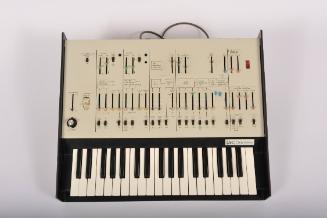
Photo credit: Don Kennedy
ARP Instruments, Inc.
1972
Available for use in Recording Studios
On View: Not currently on exhibit
isVirtual:
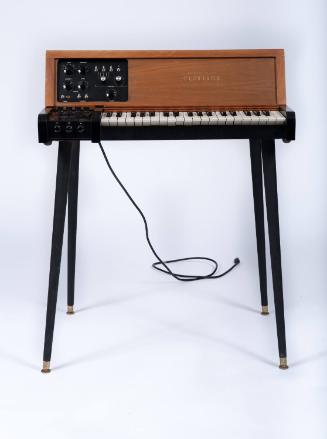
Photo credit: Don Kennedy
Raymond Scott Enterprises/Manhattan Research
1957
Not available for use in Recording Studios
On View: Not currently on exhibit
isVirtual:
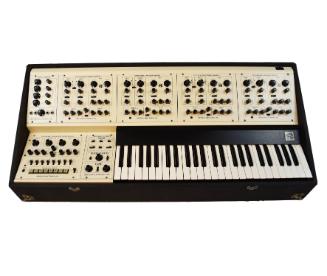
Photo credit: Meghan MacKrous, courtesy of the National Music Centre
Oberheim Electronics, Inc.
1976
Available for use in Recording Studios
On View: Not currently on exhibit
isVirtual:
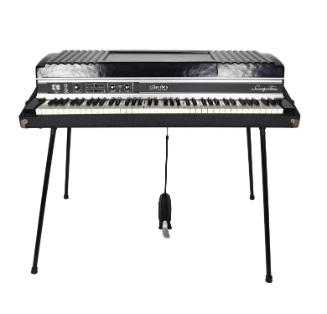
Photo credit: Meghan MacKrous, courtesy of the National Music Centre
CBS Musical Instruments
c. 1980
Available for use in Recording Studios
On View: Not currently on exhibit
isVirtual:
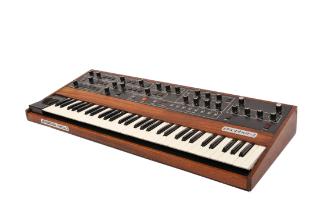
Photo credit: Don Kennedy
Sequential Circuits Inc.
c. 1978
Available for use in Recording Studios
On View: Not currently on exhibit
isVirtual:
Photo credit: Don Kennedy
Ovation Guitar Company
20th Century
Not available for use in Recording Studios
On View: Not currently on exhibit
isVirtual:
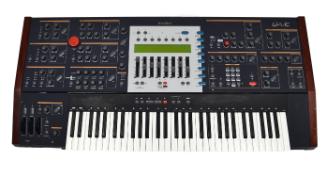
Photo credit: Meghan MacKrous, courtesy of the National Music Centre
Waldorf Electronics GmbH
1993
Available for use in Recording Studios
On View: Not currently on exhibit
isVirtual:
Photo credit: Don Kennedy
Linn Electronics, Inc.
1982
Not available for use in Recording Studios
On View: On exhibit
isVirtual:
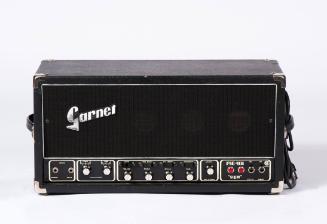
Photo credit: Don Kennedy
Garnet "Gar" Gillies
Available for use in Recording Studios
On View: Not currently on exhibit
isVirtual:
Photo credit: Don Kennedy
Linn Electronics, Inc.
c. 1982
Available for use in Recording Studios
On View: Not currently on exhibit
isVirtual:
Back