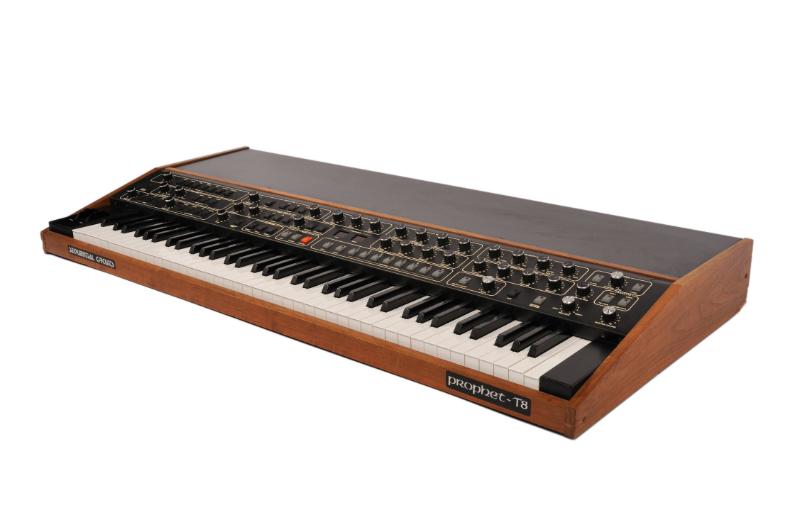
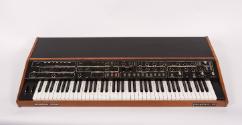
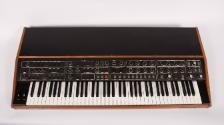
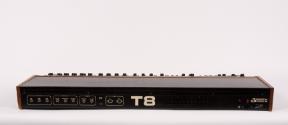
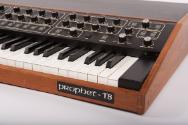
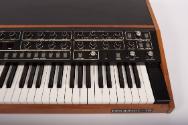
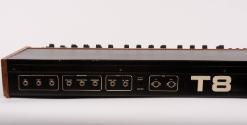
Sequential Circuits Prophet T8
Available for use in Recording Studios
Not currently on exhibit
Not currently on exhibit
Artifact TypeSynthesizer
Manufacturer
Sequential Circuits Inc.
Date1983
Operation/FunctionThe Sequential Circuits Prophet T8 is a digital-analog synthesizer that features eight-voice polyphony across its 76-note chromatic keyboard. Each of the eight voices in the single voice card contains two voltage-controlled oscillators, for a total of sixteen oscillators in the instrument. Available waveforms consist of square, triangle, and sawtooth. There is an additional LFO (low frequency oscillator) on board, which is capable of modulating the filter, or the pulse width or frequency of the oscillators. Other features include a standard voltage-controlled 24 dB/octave four pole low-pass resonant filter with dedicated ADSR envelope, a voltage-controlled amplifier with ADSR, CV/gate external control inputs, wheels for pitch bend and modulation, an onboard ‘Poly-Mod’ function that allows for extended signal modulation, a sequencer with a memory of 670 notes, and MIDI compatibility. The instrument’s keyboard is quite sophisticated, featuring weighted wooden keys with velocity sensitivity and aftertouch. The keyboard may also be arranged according to different modes, including split, layer double, and unison. Onboard programmable functions facilitate memory for 128 patches.Cultural SignificanceDespite being regarded as one of the most sophisticated synthesizers ever produced – primarily on account of its keyboard, which was well ahead of its time – the Prophet T8 did not enjoy the same massive popularity as its predecessor, the Prophet 5 of 1978. It is likely that this was due to the fact that the instrument’s keyboard spent two years in research and development; in order to recover the significant funds spent on this effort, the instrument was marketed at an exceedingly high price point that was simply unfeasible for the average user. Moreover, the delay in the design of the Prophet T8’s keyboard meant that its release coincided with the Yamaha DX7, which was far more accessible to the consumer market both in its preset-geared interface and price.Technological SignificanceThe synthesizer is arguably one of, if not the most technologically significant contributions to the course of electronic music. Although earlier electronic instruments such as the Theremin, Clavivox, and Ondes Martenot offered new and unique ways of articulating sound, their sonic template was, for the most part, quite limited, capable of producing only a few distinct timbres. The modern synthesizer, on the other hand, was viewed as an integrated electronic orchestra, as it were, allowing the user to sculpt a wide and varied array of tones and gestures. What’s more, it allowed the user to modify their sounds in real time, seemingly without the sorts of physical limitations imposed on acoustic instruments. Of course, each instrument did come with its own characteristic tonal qualities and control limitations, however the wealth of opportunity inherent in the ability to manipulate and define nearly every parameter of sound structure solidified the synthesizer’s place as one of the most powerful musical innovations of the twentieth century. The concept of modular design was initially quite desirable to professional and studio musicians in that it allowed one to more or less completely customize their instrument and modify its functions as desired. Although modular-type systems are still in production today ¬– the Buchla 200e, for instance, is based on the modular design of the Buchla 200 analog system – the advent of affordable eight-bit microprocessor-based integrated circuitry in the mid 1970s and the rise of programmable polyphonic instruments in the late 1970s resulted in the relative obsolescence of the discrete transistor-based systems of the early 1970s. Synthesizers increasingly began to adopt the smaller, more compact aesthetic exhibited in these performance-oriented instruments, especially that of the revered Minimoog. The once popular modular approach gave way to more streamlined designs that, while still offering users the ability to control numerous aspects of the instrument’s tone and gesture, limited the way in which the instrument could be operated. Although the modular synthesizer was highly regarded for its flexibility, it was also criticized for being largely unintuitive and cumbersome in its patching schemes; the smaller, integrated digital-analog hybrids of the late 1970s, such as the Prophet 5, though still not relatively inexpensive, responded more readily to the technological demands of an increasingly burgeoning consumer market. In the early 1970s, integrated circuits emerged in synthesizers, housing the many discrete components of transistor-based circuits within a single silicon chip, as they are often called. Integrated circuits were significantly smaller and less expensive to manufacture than the circuits from which they derived. With the introduction of the first affordable eight-bit microprocessors in the mid 1970s, such as the Zilog Z80, integrated circuits adapted to incorporate more sophisticated digital components. The Prophet T8 belongs to the era of synthesizers that incorporate microprocessor-based integrated circuits. In addition to being more reliable and generally less expensive to manufacture, the synthesizers of the microprocessor era were, to varying extents, also programmable, meaning that various parameters could be stored either within the instrument’s internal memory or onto an external device. Synthesizers that emerged from the era of digital-analog hybrids are often considered to represent the height of synthesizer design; combining analog sound production with reliable and flexible digital control. Throughout the 1980s and 1990s, synthesizers continued to develop following the compact, user-friendly model established in the mid 1970s. These instruments, however, generally moved away from the hybrid internal architecture to incorporate full digital control, computer-based tone generation, and digital signal processing, such as in the iconic Yamaha DX7 of 1983.
The Prophet 5, the instrument upon which the Prophet T8 is based, remains one of the most technologically groundbreaking synthesizers of all time. Released in 1978, it was the first true ‘hybrid’ instrument to incorporate a dedicated microprocessor for system control and control voltage generation while retaining analog sound generation. With regard to the synthesizer component of the Prophet T8, little was done to expand upon the range of the Prophet 5, with the exception of some extended flexibility in the programming and modulation functions, fully integrated MIDI capabilities, and the implementation of an onboard sequencer that was relatively basic even by the standards of the time. One significant drawback to the sequencer of the T8 was that it could only be programmed in real time. What the Prophet T8 lacked in extended synthesis design, however, it more than made up for in its keyboard, which remains one of the most sophisticated to be featured on an electronic musical instrument. Nearly two years were spent in research and development on the keyboard, which includes 76 weighted wooden keys. Unlike virtually all synthesizer keyboards of the time, which were made of plastic and offered little in the way of articulation, dynamic control, response, and feel, Sequential sought with the Prophet T8 to develop a keyboard that imitated many of the expressive complexities of an acoustic piano keyboard system. Namely, the Prophet T8’s keyboard boasts velocity sensitivity and aftertouch, the latter of which is a feature that triggers a new type of sound or articulation when a key is pushed slightly beyond its maximum depression point. Velocity sensitivity was achieved through the use of a then cutting-edge microprocessor-controlled system based on optical or photocell sensors. This design was later licensed to New England Digital for their Synclavier, which is widely accepted as the most elaborate synthesizer system ever produced. Sequential’s design allowed for individual or independent sensitivity, meaning that each key could be uniquely articulated and programmed. The parameters of the velocity are also adjustable, allowing the user to set the response according to their own preferences. For the time, this keyboard was highly unique and innovative, and still remains one of the most intricate ever offered. The Prophet T8 employs the same microprocessor as the Prophet 5, the Z80, as well as a second microprocessor, the newer Z8000; the former was dedicated to the keyboard, while the latter handled the remainder of the instrument’s functions. The same integrated circuits used in the oscillators and filters of the Prophet 5 were also used in the Prophet T8, however the latter instrument’s voltage-controlled amplifiers received upgraded components.
Sequential Circuits was one of the most successful and innovative synthesizer designers, implementing many new technologies that were highly influential. In addition to the Prophet 5, the first fully programmable, polyphonic, digital-analog hybrid synthesizer, and the Prophet T8, Sequential also produced the Prophet 10, which was a combination of two Prophet 5s, the Pro One, a monophonic synthesizer that was perhaps their most commercially successful product, the Prophet 600, which was essentially a Prophet 5 with built-in MIDI, the Prophet VS, which employs a highly sophisticated vector synthesis function, and the recent Dave Smith Instruments Prophet 6, which is a fully analog homage to the Prophet 5. Sequential was also innovative in developing the Studio 440 drum machine, which preceded the release of the hugely popular Akai MPC, designed by fellow Bay Area designer, Roger Linn of Linn Electronics. Despite the success of the Prophet 5, it could be argued that Sequential Circuits founder, Dave Smith’s, most significant technological contribution came with the development of MIDI in 1982. Smith, along with representatives from Roland, Korg, and Oberheim, theorized the concept and implemented the first successful interfacing between two instruments of different manufacturers at the NAMM trade show in 1983. For his part, Smith is also credited with coining the term MIDI, or Musical Instrument Digital Interface. Somewhat unbelievably, MIDI is still operating at version 1.0, standing the test of time against an influx of technologies that are constantly evolving and fading.Users/PerformersAlthough the Prophet T8 produces many of the same iconic sounds as the Prophet 5, its use was at the time and remains relatively limited; this is quite unlike the Prophet 5, which can be heard in numerous recordings and live performances throughout the late 1970s and 1980s. Among the more notable users of the Prophet T8 are Howard Jones, The Thompson Twins, Steve Levine, Swing Out Sister, and The Human League, in later recordings.Collection
Object number2002.05.55
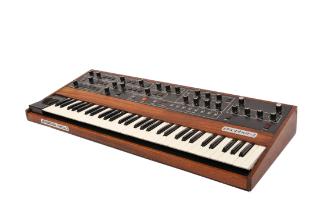
Sequential Circuits Inc.
c. 1978
Available for use in Recording Studios
On View: Not currently on exhibit
isVirtual:

Sequential Circuits Inc.
c. 1981
Available for use in Recording Studios
On View: Not currently on exhibit
isVirtual:

Linn Electronics, Inc.
1982
Not available for use in Recording Studios
On View: On exhibit
isVirtual:
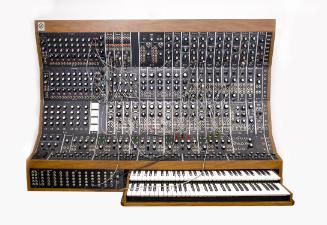
R.A. Moog Inc./ Moog Music Inc. (division of Norlin Music Instruments, Ltd.)
c. 1973
Available for use in Recording Studios
On View: Not currently on exhibit
isVirtual:

Moog Music, Inc.
1973
Available for use in Recording Studios
On View: Not currently on exhibit
isVirtual:
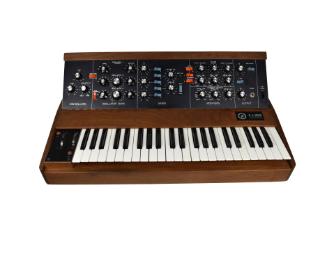
R.A. Moog, Inc.
1970
Available for use in Recording Studios
On View: Not currently on exhibit
isVirtual:
Moog Music, Inc.
1969
Not available for use in Recording Studios
On View: On exhibit
isVirtual:

Hohner Musikinstrumente GmbH & Co. KG
c. 1967
Available for use in Recording Studios
On View: Not currently on exhibit
isVirtual:
The Wurlitzer Company
c. 1959
Not available for use in Recording Studios
On View: On exhibit
isVirtual:

CBS Musical Instruments
1966
Available for use in Recording Studios
On View: Not currently on exhibit
isVirtual:
Bösendorfer Klavierfabrik GmbH
1855
Not available for use in Recording Studios
On View: Not currently on exhibit
isVirtual:

Ken Freeman
c. 1975
Available for use in Recording Studios
On View: Not currently on exhibit
isVirtual: