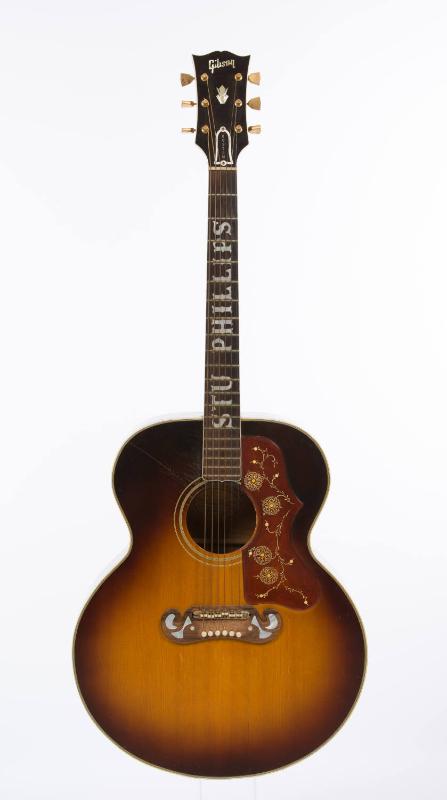
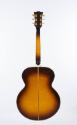
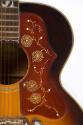
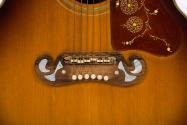
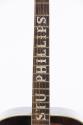
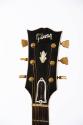

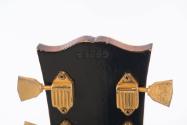
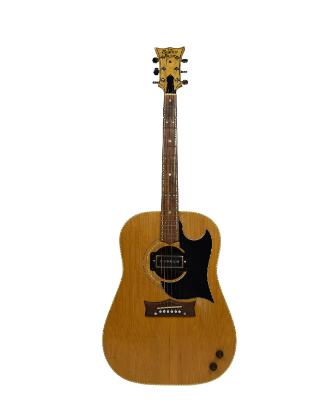
Stu Phillips Guitar
Not available for use in Recording Studios
Not currently on exhibit
Not currently on exhibit
Artifact TypeGuitar, Acoustic
Manufacturer
Gibson Guitar Corporation
Operation/FunctionThis particular artifact is an example of a steel-string, flat-top acoustic guitar. It consists of a hollow wooden body, which is itself comprised of a soundboard, box, and sound hole for amplification, as well as six steel strings and accompanying machine heads and metal fingerboard. This instrument employs standard tuning, with open string pitches beginning at the bottom with the highest pitch, the E a major third above middle C, and moving downwards in pitch by a fourth to B, downwards by a major third to G, downwards by a fourth to D, downwards by a fourth to A, and downwards by a fourth to E, spanning two octaves in total. The instrument is referred to as being ‘standard-handed’, meaning it is to be strummed with the right hand while the left hand controls the frets.Cultural SignificanceThe cultural significance of both the acoustic and electric guitar cannot be overstated. Gibson remains at the forefront of guitar manufacture as one of the leading companies. Although the acoustic guitar is perhaps not used quite as commonly as the electric guitar, both have remained throughout the course of the twentieth century one of, if not the most, exploited instruments in popular music. The steel-stringed flat-top has served as the most popular form of acoustic guitar, with its usage spanning a multitude of genres. Gibson instruments are known for their quality of tone and construction, and have been the preferred choice of artists that perform in a range of styles. A notable user of Gibson electric guitars was Led Zeppelin guitarist, Jimmy Page, with whom the company collaborated to customize a series of signature Les Paul guitars. Other well-known users of customized Les Paul guitars include Slash of Guns n’ Roses, Eric Clapton, Jeff Beck, Peter Frampton, Pete Townshend of The Who, Billy Gibbons of ZZ Top, and Marc Bolan of T. Rex, among countless other users of Gibson’s other models.Technological SignificanceBoth acoustic and electric guitars have undergone a number of technological advances that have improved their tone and construction quality, however it is the mere advent of the latter that has had the most lasting technological impact. Les Paul (1915 – 2009) helped pioneer both the design and popularity of the electric guitar, and is considered one of the founders of solid-body technology, having produced a prototype called “The Log” in 1940. Additionally, Paul also conducted a number of experiments in guitar design and recording technology, essentially establishing the revolutionary practices of multi-track recording and overdubbing, as well as delay and phasing effects. Fender was the first company to produce a commercial solid-body electric guitar in 1950 with the release of the Telecaster, and Gibson responded in 1952 with the Les Paul, named in recognition of the fact that Paul helped design the instrument with Gibson’s president of the time, Ted McCarty. Gibson also contributed several other innovations throughout its history, including the Tune-o-matic bridge, which first featured on the Les Paul and remains the standard bridge of Gibson electric guitars, as well as the first semi-hollow-body electric guitar in 1958. Gibson also produced the first commercial humbucker pickup, designed in 1955 and patented in 1959, which eliminated the hum of single-coil pickups without compromising the tone quality. In the late 1950s and early 1960s, Gibson also premiered several series of electric guitars that featured futuristic body shapes, including the Flying V, Explorer, and Firebird.
Although the acoustic guitar is not recognized as having made as significant a contribution in instrument technology, it has seen many important changes throughout its history. The instrument finds it origins in the lute, which featured a varying number of gut strings and was most popular throughout the Renaissance, and the Baroque guitar, which featured five sets or courses of gut strings and eclipsed the popularity of the lute in the early eighteenth century. The majority of usage of such instruments took place in Europe, however a number of variants of these instruments, such as the Middle Eastern oud, were equally as prevalent. The modern guitar shares the same basic construction approach as its predecessors, consisting of a curved wooden sound box and soundboard, designed to optimize amplification and tone quality, as well as a neck and fretboard across which a series of tuned strings are strung. Although performance techniques and tuning systems have been considerably adapted over the years, the same basic approach of plucking or strumming with one hand and coordinating frets with the other has also been maintained. The modern acoustic guitar was pioneered by the American C.F. Martin & Company, which was founded in 1833 by the German craftsman Christian Frederick Martin. Martin established the body shape and size still used in modern acoustic guitars, which employed a larger lower bout, smaller upper bout, and deeper box than its Classical predecessors so as to produce a louder volume and accentuate bass frequencies. Martin’s design was known as the “dreadnought”, and quickly became the most common body style on account of its ability to project the guitar above other instruments in an ensemble. Martin was also pivotal in introducing steel strings to replace the nylon strings used in Classical guitars. Steel strings significantly altered the structural requirements of the instrument and, along with Martin’s inclusion of a series of bracing pieces in the box and the truss rod in the headstock, further enhanced the tone quality and volume.Users/PerformersStu Phillips was born 19 January 1933 in St. Eustache, near Montréal, Quebec, but ventured west during his teenage years, settling in Calgary, Alberta. Phillips aspired to succeed in the music industry as a youth and began his career by performing at various social and religious functions, as well as appearing on several radio shows such as “Noon Specials” and “Saturday Night Jamborees”. In addition to appearing on local radio stations such as CJAD, CFCF, and CKVL while in Montréal, Phillips also worked as an announcer on western radio stations, including CFRN in Edmonton, CHED in Calgary, and CJIB in Vernon, British Columbia. In the late 1950s, Phillips transitioned into television, which is the format in which he received his most widespread acclaim. He served as the host of several television shows on the CHCT network in Calgary, before relocating to Winnipeg and taking over CBC’s Red River Jamboree in 1961. His success in television was, however, soon eclipsed by his work in studio recording, which focused on showcasing songs that spoke to the unique story of Canada and its citizens. He composed an impressive 150 works based on Canadian folklore and history, many of which were released on a series of albums with Banff/Rodeo Records of Halifax, Nova Scotia. His first albums were released starting in the late 1950s, including Echoes of the Canadian Foothills (1957), A Visit to Old Quebec (1957), and A Visit to British Columbia (1958), with Orval Prophet’s rendition of Phillips’ song “The Champlain & St. Lawrence Line” becoming a top 20 RPM hit in 1973. Phillips relocated to Nashville, Tennessee in 1965 to produce another series of albums with RCA Victor, including the iconic Singin’ Stu Phillips (1966), Grassroots Country (1967) and Our Last Rendezous (1968). The first album in that series, Singin’ Stu Phillips, produced some of his most recognizable hits, including “Kathy Keep Playing”, “Bracero”, “The Great El Tigre”, and his cover of Ian Tyson’s “Four Strong Winds”. Our Last Rendezvous was equally successful, producing a number of Billboard Country Chart hits, including “Juanita Jones”, “Vin Rose”, “The Note in Box Number 9”, and “The Top of the World”. In 1967, Phillips fulfilled his lifelong dream of becoming a regular member of the Grand Ole Opry in Nashville. Phillips was eventually dropped by RCA in the 1970s, however he continued to record well into the 1990s, with several of his earlier albums enjoying re-issue success. Phillips was often referred to as “the travelling balladeer”, and, occasionally, “the western gentleman”, and was inducted into the Canadian Country Music Hall of Fame in 1993.Collection
Object numberT.2016.10.01.1-2
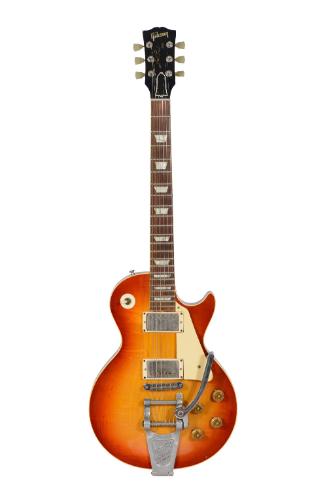
Gibson Guitar Corporation
1959
Not available for use in Recording Studios
On View: Not currently on exhibit
isVirtual:

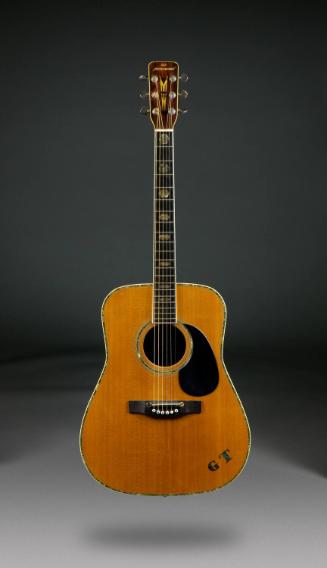
CBS Masterworks
20th Century
Not available for use in Recording Studios
On View: Not currently on exhibit
isVirtual:

Ovation Guitar Company
20th Century
Not available for use in Recording Studios
On View: Not currently on exhibit
isVirtual:

Kazuo Yairi for CBS Masterworks
20th Century
Available for use in Recording Studios
On View: Not currently on exhibit
isVirtual:
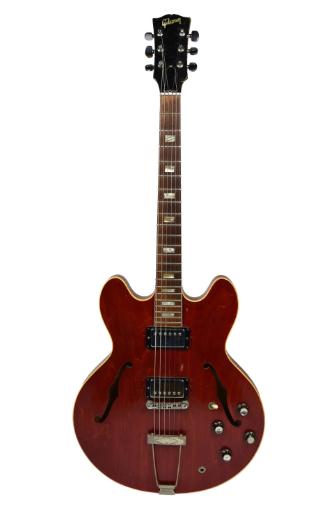
Gibson Guitar Corporation
1961
Not available for use in Recording Studios
On View: On exhibit
isVirtual:
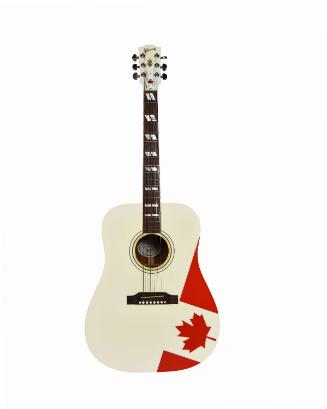
Gibson Guitar Corporation
2014
Not available for use in Recording Studios
On View: On exhibit
isVirtual:

Höfner GmbH & Co. KG
20th Century
Not available for use in Recording Studios
On View: Not currently on exhibit
isVirtual:
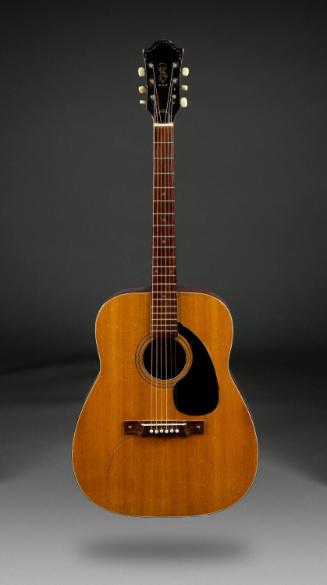
George Petralia
1969
Not available for use in Recording Studios
On View: On exhibit
isVirtual:
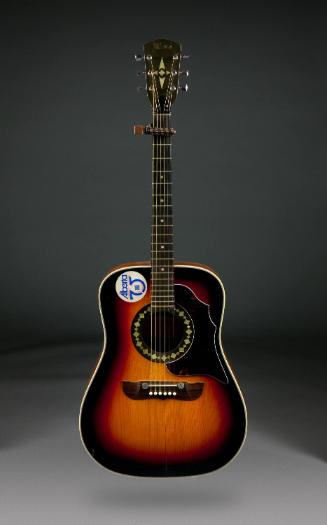
Framus (Franconian Musical Instruments Manufacture)
20th Century
Not available for use in Recording Studios
On View: Not currently on exhibit
isVirtual:
Grammer Guitar Inc (Ampeg Corporation)
1971
Available for use in Recording Studios
On View: Not currently on exhibit
isVirtual: